
What topics and trends defined most-cited Tuberculosis Research and Epidemiology research in the Class of 2026?
Tuberculosis research in the Class of 2026 is driven by multidrug resistance, non-sputum diagnostics, and Global Burden of Disease analytics. Computational modeling (molecular dynamics) and non-human primate models grew sharply, while single-cell RNA sequencing declined, highlighting a shift toward non-invasive diagnostics and structural drug discovery.
At a glance
- Field
- Tuberculosis Research and Epidemiology
- Cohort label
- Class of 2026 (2024 publications)
- Papers analyzed
- 8,168
- Papers ranked
- 20
- Top topics in ranked papers
- Multidrug-resistant tuberculosis, Drug susceptibility testing, Global Burden of Disease, Bacteriologically confirmed tuberculosis, HIV-TB coinfection
- Publication window
- Jan 1, 2024 – Dec 31, 2024
- Eligibility
- Research articles; reviews excluded
- Citation window
- 18 months post-publication
- 18m citation range
- 32–104
- Data source
- OpenAlex · Retrieved Jul 2026
- License
- CC BY 4.0
Rankings
20 papers ranked by 18-month citation count
Multidrug-resistant tuberculosis
Nature Reviews Disease Primers202410.1038/s41572-024-00504-2
Classification of early tuberculosis states to guide research for improved care and prevention: an international Delphi consensus exercise
The Lancet Respiratory Medicine202410.1016/s2213-2600(24)00028-6
Global, regional, and national burden of tuberculosis and attributable risk factors for 204 countries and territories, 1990–2021: a systematic analysis for the Global Burden of Diseases 2021 study
BMC Public Health202410.1186/s12889-024-20664-w
Global, regional, and national age-specific progress towards the 2020 milestones of the WHO End TB Strategy: a systematic analysis for the Global Burden of Disease Study 2021
The Lancet Infectious Diseases202410.1016/s1473-3099(24)00007-0
Levofloxacin for the Prevention of Multidrug-Resistant Tuberculosis in Vietnam
New England Journal of Medicine202410.1056/nejmoa2314325
Levofloxacin Preventive Treatment in Children Exposed to MDR Tuberculosis
New England Journal of Medicine202410.1056/nejmoa2314318
Tuberculosis — United States, 2023
MMWR Morbidity and Mortality Weekly Report202410.15585/mmwr.mm7312a4
Type I IFN-mediated NET release promotes Mycobacterium tuberculosis replication and is associated with granuloma caseation
Cell Host & Microbe202410.1016/j.chom.2024.11.008
Diagnostic yield as an important metric for the evaluation of novel tuberculosis tests: rationale and guidance for future research
The Lancet Global Health202410.1016/s2214-109x(24)00148-7
Treatment of Psoriasis Patients with Latent Tuberculosis Using IL-17 and IL-23 Inhibitors: A Retrospective, Multinational, Multicentre Study
American Journal of Clinical Dermatology202410.1007/s40257-024-00845-4
Global, regional and national trends in tuberculosis incidence and main risk factors: a study using data from 2000 to 2021
BMC Public Health202410.1186/s12889-023-17495-6
Tuberculosis in otherwise healthy adults with inherited TNF deficiency
Nature202410.1038/s41586-024-07866-3
Global prevalence and burden of multidrug-resistant tuberculosis from 1990 to 2019
BMC Infectious Diseases202410.1186/s12879-024-09079-5
Bedaquiline-pretomanid-moxifloxacin-pyrazinamide for drug-sensitive and drug-resistant pulmonary tuberculosis treatment: a phase 2c, open-label, multicentre, partially randomised controlled trial
The Lancet Infectious Diseases202410.1016/s1473-3099(24)00223-8
CD4+ T cells re-wire granuloma cellularity and regulatory networks to promote immunomodulation following Mtb reinfection
Immunity202410.1016/j.immuni.2024.08.002
Exposure to Mycobacterium remodels alveolar macrophages and the early innate response to Mycobacterium tuberculosis infection
PLoS Pathogens202410.1371/journal.ppat.1011871
Global, regional, and national burden of HIV-negative tuberculosis, 1990–2021: findings from the Global Burden of Disease Study 2021
Infectious Diseases of Poverty202410.1186/s40249-024-01227-y
Further analysis of tuberculosis in eight high-burden countries based on the Global Burden of Disease Study 2021 data
Infectious Diseases of Poverty202410.1186/s40249-024-01247-8
Specific CD4+ T cell phenotypes associate with bacterial control in people who ‘resist’ infection with Mycobacterium tuberculosis
Nature Immunology202410.1038/s41590-024-01897-8
Propionate prevents loss of the PDIM virulence lipid in Mycobacterium tuberculosis
Nature Microbiology202410.1038/s41564-024-01697-8
Topic trends
Dominant research themes and year-over-year shifts in Tuberculosis Research and Epidemiology
What Topics Define the Class of 2026?
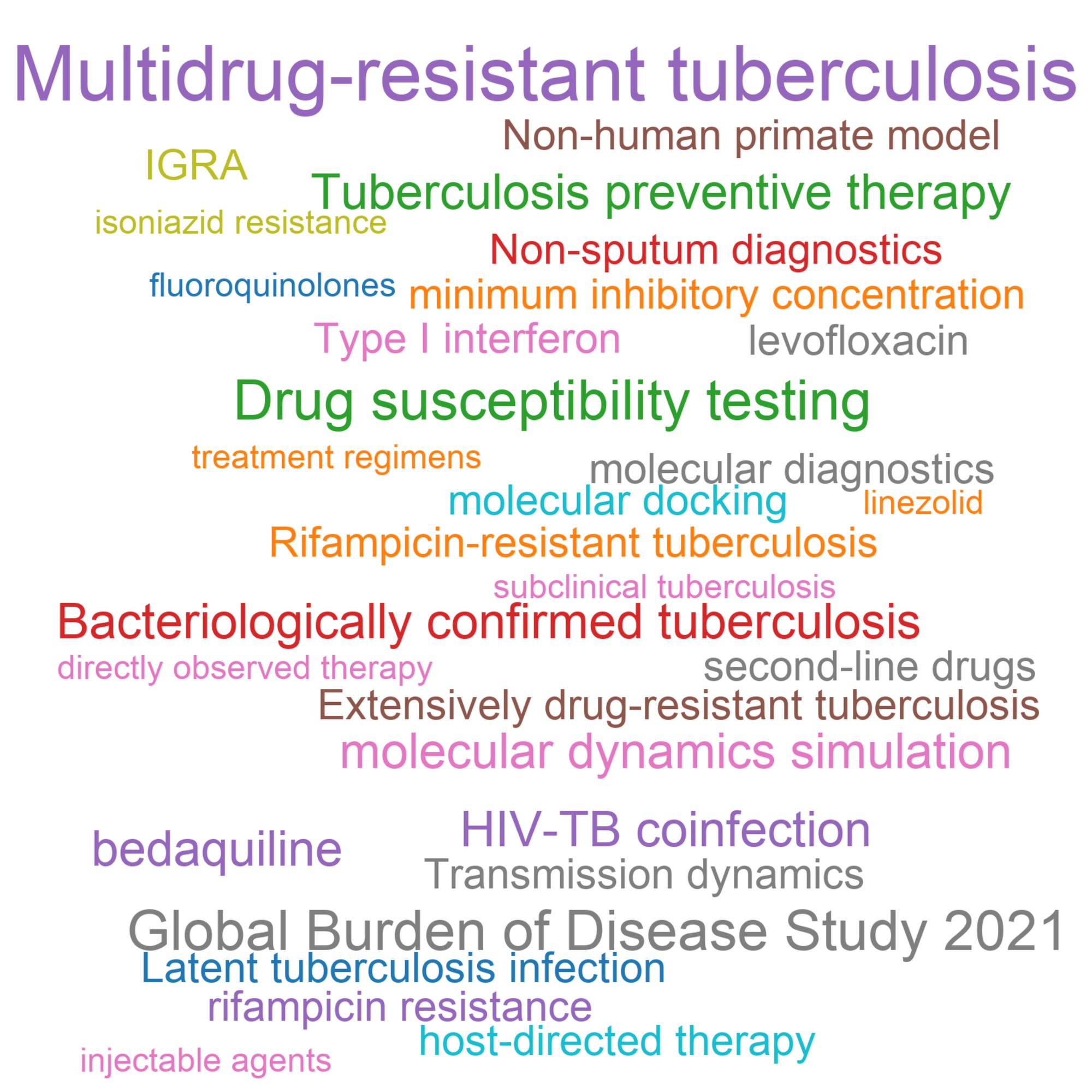
Multidrug-resistant tuberculosis (MDR-TB) stands out as the core theme defining the Class of 2026 cohort (norm_freq 0.18), closely accompanied by drug susceptibility testing (0.10) and second-line regimen evaluations including bedaquiline and levofloxacin. Global Burden of Disease Study 2021 analytics (0.10) and key epidemiological parameters—such as age-standardized incidence rates and disability-adjusted life years (DALYs)—form a major population-health cluster. Diagnostic innovation features prominently through non-sputum diagnostics (0.06), bacteriologically confirmed tuberculosis (0.08), and molecular diagnostics (0.06), emphasizing rapid diagnostic turnaround time and point-of-care feasibility. Host-pathogen interaction and computational target discovery rely on molecular dynamics simulations (0.08), molecular docking, and host-directed therapy (0.06), alongside immunologic analyses targeting CD4+ and CD8+ T-cell epitopes. Non-human primate models (0.06) provide essential translational validation for emerging vaccines and therapeutics. Together, these thematic clusters illustrate a field concentrated on combating drug-resistant strains, refining non-invasive diagnostics, and accelerating host-targeted therapeutic discovery.
How Did Topics Shift from the Class of 2025 to the Class of 2026?
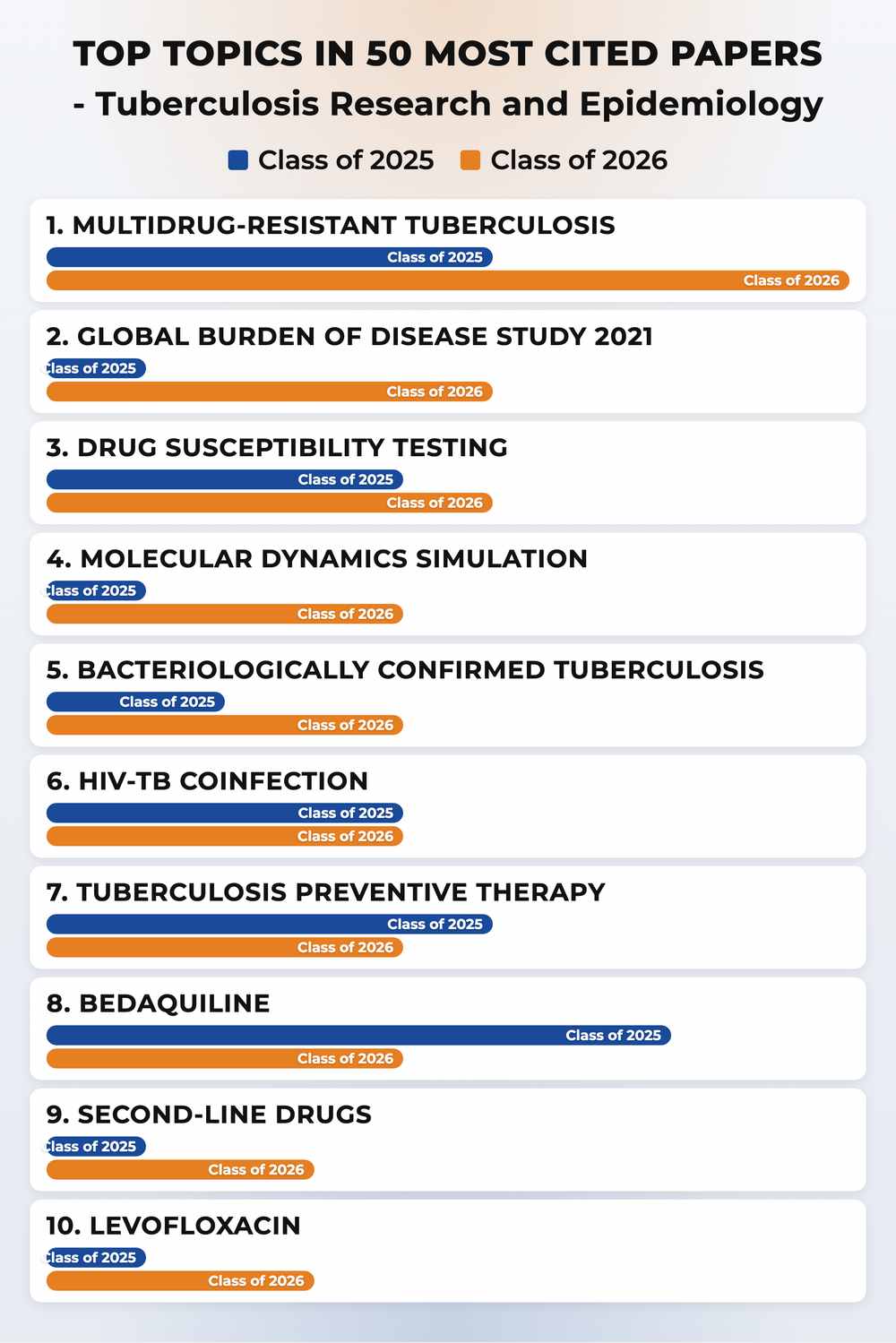
Comparing the Class of 2025 and Class of 2026 cohorts reveals a marked shift toward computational structural biology, non-sputum diagnostics, and global epidemiological modeling. Molecular dynamics simulations experienced the largest fold-change expansion, quadrupling from a normalized frequency of 0.02 in 2023 to 0.08 in 2024 (fold change 4.00). Molecular docking, molecular diagnostics, and non-human primate model studies also grew substantially, each tripling in normalized frequency (fold change 3.00). Several major topics emerged as new entrants in 2024 with zero recorded top mentions in 2023, including Global Burden of Disease Study 2021, non-sputum diagnostics, transmission dynamics, host-directed therapy, and levofloxacin. Conversely, single-cell RNA sequencing saw a notable decline (fold change 0.40), and bedaquiline mentions moderated (fold change 0.57) as attention expanded to multi-drug second-line regimens. These shifts reflect a maturing paradigm that pairs high-resolution biophysical modeling with field-deployable non-invasive diagnostics and global burden assessment.
Methodology
PRI identifies high-impact research using a transparent, topic-agnostic framework applied consistently across scientific domains. Bibliographic records are drawn from OpenAlex, including publication dates, citation relationships, and document types.
This ranking covers the Class of 2026 cohort: journal articles published in 2024. Reviews and other non-article document types are excluded to ensure comparability.
Research impact is quantified with an 18-month post-publication citation window—the number of citing works published within 18 months of each paper's publication date. This metric captures early impact while controlling for publication age.
An LLM-based relevance classifier then reviews each candidate's title and abstract to confirm substantive alignment with the target domain. Only papers classified as relevant appear in the final ranking.
Zheng Su, Tinsley Li, Thematic Shifts in Early-High-Impact Cancer Genomics and Diagnostics Research: A Bibliometric and Semantic Analysis. bioRxiv 2026.07.04.736459; doi: https://doi.org/10.64898/2026.07.04.736459
Cite this ranking
Pepkio Research Index (PRI). Topics and Trends in Most Cited Tuberculosis Research and Epidemiology Papers, Class of 2026. https://pri.pepkio.com/top-papers/tuberculosis-research-and-epidemiology/2026. Accessed 2026-10-21.

Methodology
Zheng Su, Tinsley Li, Thematic Shifts in Early-High-Impact Cancer Genomics and Diagnostics Research: A Bibliometric and Semantic Analysis. bioRxiv 2026.07.04.736459; doi: https://doi.org/10.64898/2026.07.04.736459