
What topics and trends defined most-cited Mycobacterium research and diagnosis research in the Class of 2026?
The Class of 2026 cohort shows a strong shift toward drug-resistant tuberculosis research, with Mycobacterium tuberculosis coverage expanding to 56% of top papers. Second-line drug evaluations, tongue swab testing, and machine learning emerged rapidly, while studies on non-tuberculous mycobacteria and general whole-genome sequencing moderated.
At a glance
- Field
- Mycobacterium research and diagnosis
- Cohort label
- Class of 2026 (2024 publications)
- Papers analyzed
- 5,482
- Papers ranked
- 20
- Top topics in ranked papers
- Mycobacterium tuberculosis, whole-genome sequencing, drug susceptibility testing, multidrug-resistant tuberculosis
- Publication window
- Jan 1, 2024 – Dec 31, 2024
- Eligibility
- Research articles; reviews excluded
- Citation window
- 18 months post-publication
- 18m citation range
- 22–104
- Data source
- OpenAlex · Retrieved Jul 2026
- License
- CC BY 4.0
Rankings
20 papers ranked by 18-month citation count
Multidrug-resistant tuberculosis
Nature Reviews Disease Primers202410.1038/s41572-024-00504-2
Global losses due to dairy cattle diseases: A comorbidity-adjusted economic analysis
Journal of Dairy Science202410.3168/jds.2023-24626
Nontuberculous mycobacterial pulmonary disease (NTM PD) incidence trends in the United States, 2010–2019
BMC Infectious Diseases202410.1186/s12879-024-09965-y
Mosquitoes provide a transmission route between possums and humans for Buruli ulcer in southeastern Australia
Nature Microbiology202410.1038/s41564-023-01553-1
CD4+ T cells re-wire granuloma cellularity and regulatory networks to promote immunomodulation following Mtb reinfection
Immunity202410.1016/j.immuni.2024.08.002
Specific CD4+ T cell phenotypes associate with bacterial control in people who ‘resist’ infection with Mycobacterium tuberculosis
Nature Immunology202410.1038/s41590-024-01897-8
Propionate prevents loss of the PDIM virulence lipid in Mycobacterium tuberculosis
Nature Microbiology202410.1038/s41564-024-01697-8
Newly Identified <i>Mycobacterium africanum</i> Lineage 10, Central Africa
Emerging infectious diseases202410.3201/eid3003.231466
Pathogenic role for CD101-negative neutrophils in the type I interferon-mediated immunopathogenesis of tuberculosis
Cell Reports202410.1016/j.celrep.2024.115072
A first-in-class leucyl-tRNA synthetase inhibitor, ganfeborole, for rifampicin-susceptible tuberculosis: a phase 2a open-label, randomized trial
Nature Medicine202410.1038/s41591-024-02829-7
Mycobacterium tuberculosis virulence lipid PDIM inhibits autophagy in mice
Nature Microbiology202410.1038/s41564-024-01797-5
Quantitative measurement of antibiotic resistance in Mycobacterium tuberculosis reveals genetic determinants of resistance and susceptibility in a target gene approach
Nature Communications202410.1038/s41467-023-44325-5
Multidrug-resistant tuberculosis
Clinica Chimica Acta202410.1016/j.cca.2024.119701
Identification of bacterial determinants of tuberculosis infection and treatment outcomes: a phenogenomic analysis of clinical strains
The Lancet Microbe202410.1016/s2666-5247(24)00022-3
Clinical Metagenomic Next-Generation Sequencing for Diagnosis of Central Nervous System Infections: Advances and Challenges
Molecular Diagnosis & Therapy202410.1007/s40291-024-00727-9
Metabolically active neutrophils represent a permissive niche for Mycobacterium tuberculosis
Mucosal Immunology202410.1016/j.mucimm.2024.05.007
The catalogue of Mycobacterium tuberculosis mutations associated with drug resistance to 12 drugs in China from a nationwide survey: a genomic analysis
The Lancet Microbe202410.1016/s2666-5247(24)00131-9
Compensatory evolution in NusG improves fitness of drug-resistant M. tuberculosis
Nature202410.1038/s41586-024-07206-5
Five-Year Outcomes among U.S. Bronchiectasis and NTM Research Registry Patients
American Journal of Respiratory and Critical Care Medicine202410.1164/rccm.202307-1165oc
Diagnostic accuracy of tongue swab testing on two automated tuberculosis diagnostic platforms, Cepheid Xpert MTB/RIF Ultra and Molbio Truenat MTB Ultima
Journal of Clinical Microbiology202410.1128/jcm.00019-24
Topic trends
Dominant research themes and year-over-year shifts in Mycobacterium research and diagnosis
What Topics Define the Class of 2026?
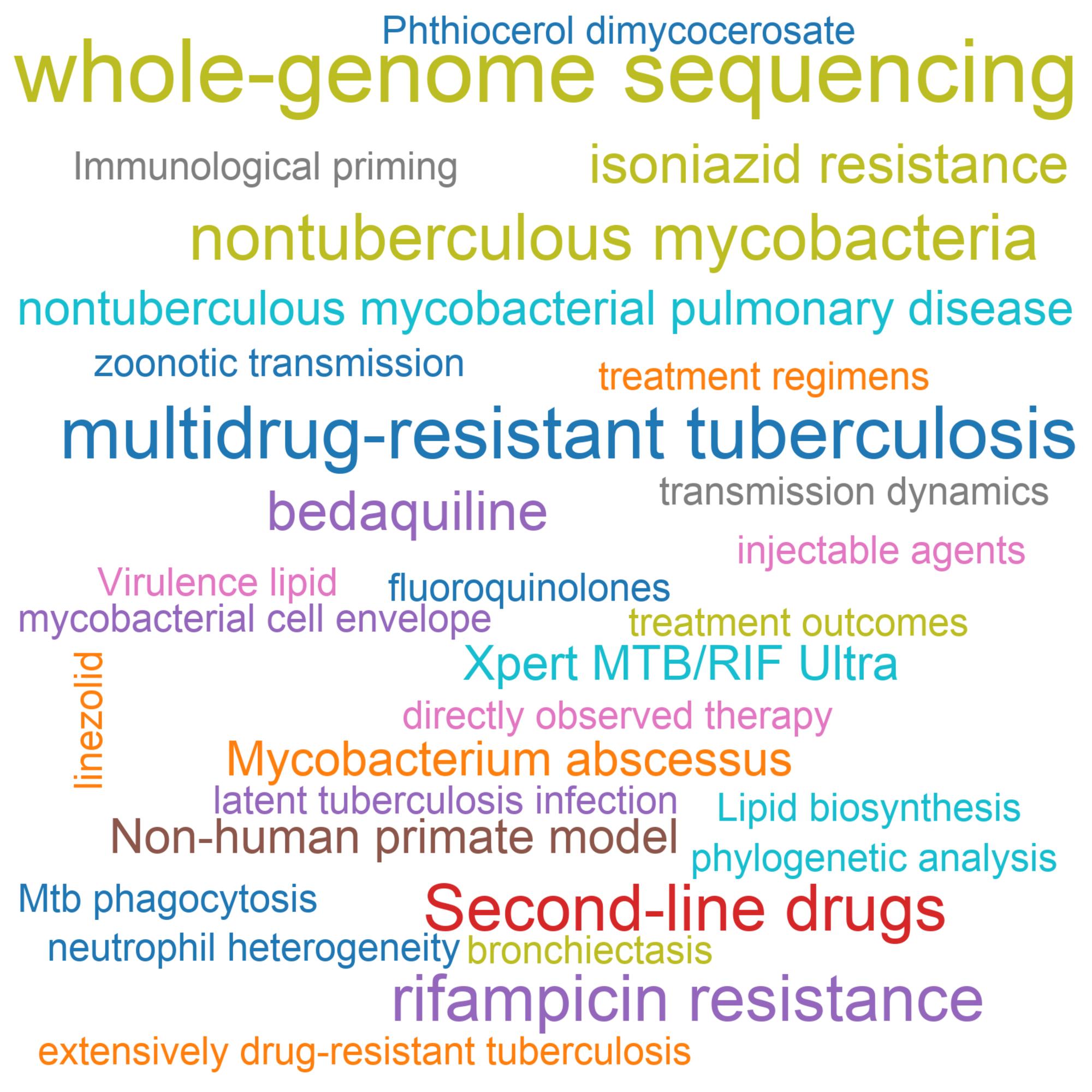
Research in the Class of 2026 cohort is overwhelmingly anchored by Mycobacterium tuberculosis, which appears in 56% of top-cited publications as studies focus on resolving drug resistance mechanisms and improving clinical diagnostics. Genomic surveillance and resistance profiling represent the central methodological pillars of the field, led by whole-genome sequencing (14%), drug susceptibility testing (12%), and targeted identification of drug resistance mutations (8%). Specifically, resistance to critical therapeutics—most notably rifampicin resistance (8%), isoniazid resistance (6%), and second-line drugs (8%) including bedaquiline (6%)—dominates translational investigation. Clinical disease management centers on multidrug-resistant tuberculosis (10%) and pulmonary tuberculosis (10%), backed by molecular diagnostic tools such as Xpert MTB/RIF Ultra (6%) and phenotypic assays quantifying minimum inhibitory concentration (6%). While nontuberculous mycobacteria (8%) and associated pulmonary disease (6%) remain notable secondary areas of focus, the core momentum of the field is overwhelmingly dedicated to combating drug-resistant tuberculosis through integrated genomic, diagnostic, and pharmacological approaches.
How Did Topics Shift from the Class of 2025 to the Class of 2026?
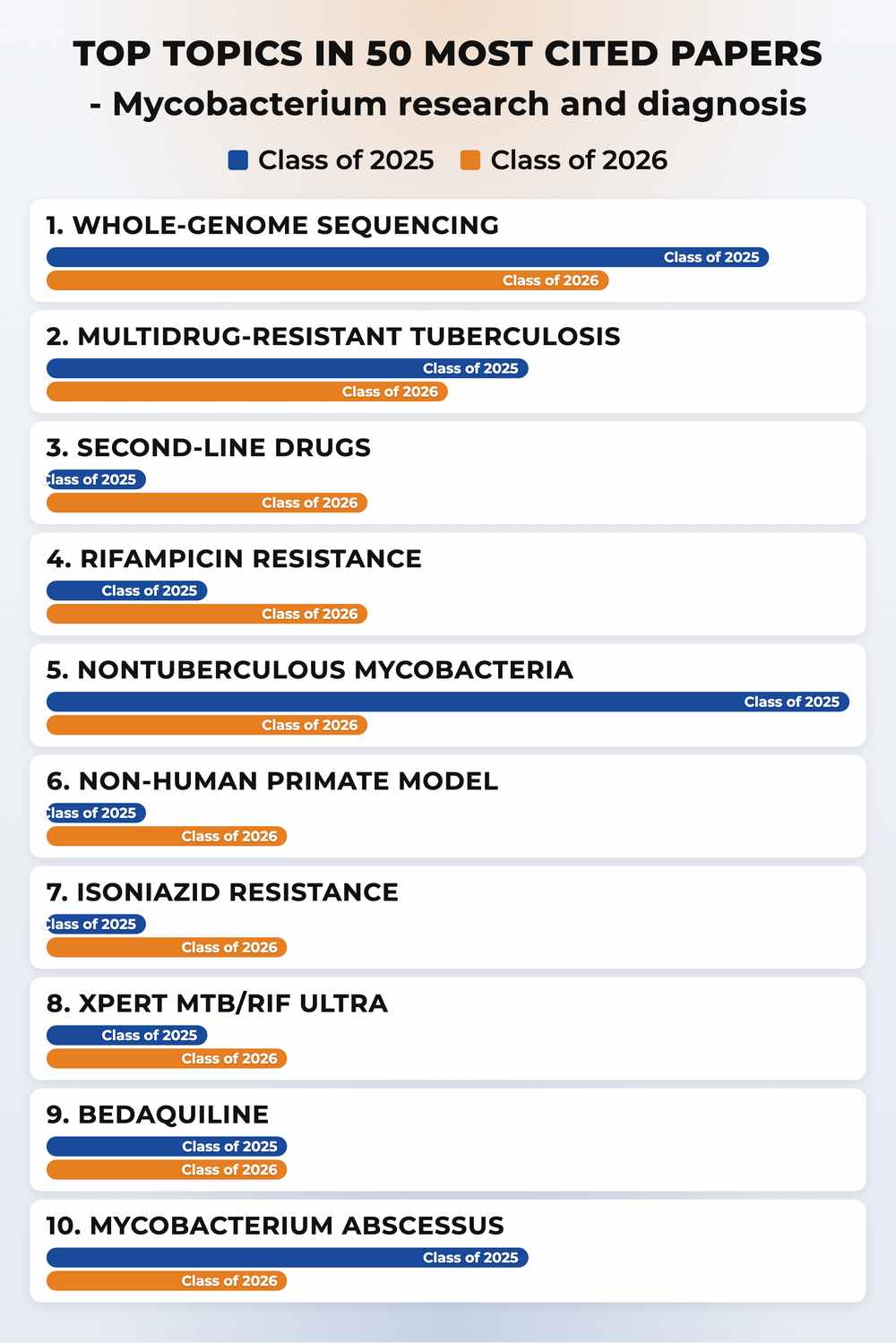
Comparison between the Class of 2025 and Class of 2026 cohorts highlights a pronounced shift toward actionable drug resistance surveillance and specialized diagnostic modalities. Investigation of Mycobacterium tuberculosis itself expanded substantially, rising from 42% to 56% of top publications. Emerging focus areas registered notable gains, with second-line drugs advancing from zero representation to 8% of top papers, alongside the rise of non-human primate models (6%), tongue swab testing (4%), and machine learning applications (4%) for diagnostic interpretation. Conversely, research on opportunistic non-tuberculous pathogens experienced a marked decline: nontuberculous mycobacteria dropped from 20% to 8%, Mycobacterium avium complex decreased from 12% to 4%, and Mycobacterium abscessus fell from 12% to 6%. Broad methodologies like whole-genome sequencing saw slight moderation (from 18% to 14%) as efforts pivoted from general sequencing toward targeted clinical application. Overall, the field transitioned away from broad non-tuberculous species surveys toward focused clinical strategies addressing complex drug-resistant tuberculosis.
Methodology
PRI identifies high-impact research using a transparent, topic-agnostic framework applied consistently across scientific domains. Bibliographic records are drawn from OpenAlex, including publication dates, citation relationships, and document types.
This ranking covers the Class of 2026 cohort: journal articles published in 2024. Reviews and other non-article document types are excluded to ensure comparability.
Research impact is quantified with an 18-month post-publication citation window—the number of citing works published within 18 months of each paper's publication date. This metric captures early impact while controlling for publication age.
An LLM-based relevance classifier then reviews each candidate's title and abstract to confirm substantive alignment with the target domain. Only papers classified as relevant appear in the final ranking.
Zheng Su, Tinsley Li, Thematic Shifts in Early-High-Impact Cancer Genomics and Diagnostics Research: A Bibliometric and Semantic Analysis. bioRxiv 2026.07.04.736459; doi: https://doi.org/10.64898/2026.07.04.736459
Cite this ranking
Pepkio Research Index (PRI). Topics and Trends in Most Cited Mycobacterium research and diagnosis Papers, Class of 2026. https://pri.pepkio.com/top-papers/mycobacterium-research-and-diagnosis/2026. Accessed 2026-10-24.

Methodology
Zheng Su, Tinsley Li, Thematic Shifts in Early-High-Impact Cancer Genomics and Diagnostics Research: A Bibliometric and Semantic Analysis. bioRxiv 2026.07.04.736459; doi: https://doi.org/10.64898/2026.07.04.736459