
What topics and trends defined most-cited RNA Interference and Gene Delivery research in the Class of 2026?
RNA interference and gene delivery research is anchored by lipid nanoparticles (50%) and ionizable lipids (22%). The Class of 2026 highlights a strong shift toward crossing the blood-brain barrier (16%), AI-assisted in silico screening (8%), and high-throughput vector discovery, while interest in general mRNA vaccines (6%) continues to decline.
At a glance
- Field
- RNA Interference and Gene Delivery
- Cohort label
- Class of 2026 (2024 publications)
- Papers analyzed
- 9,649
- Papers ranked
- 20
- Top topics in ranked papers
- Lipid nanoparticles, Ionizable lipids, mRNA delivery, Blood-brain barrier, Extracellular vesicles (EVs)
- Publication window
- Jan 1, 2024 – Dec 31, 2024
- Eligibility
- Research articles; reviews excluded
- Citation window
- 18 months post-publication
- 18m citation range
- 82–169
- Data source
- OpenAlex · Retrieved Jul 2026
- License
- CC BY 4.0
Rankings
20 papers ranked by 18-month citation count
Reformulating lipid nanoparticles for organ-targeted mRNA accumulation and translation
Nature Communications202410.1038/s41467-024-50093-7
Artificial intelligence-driven rational design of ionizable lipids for mRNA delivery
Nature Communications202410.1038/s41467-024-55072-6
Direct cytosolic delivery of siRNA via cell membrane fusion using cholesterol-enriched exosomes
Nature Nanotechnology202410.1038/s41565-024-01785-0
AGILE platform: a deep learning powered approach to accelerate LNP development for mRNA delivery
Nature Communications202410.1038/s41467-024-50619-z
Artificial intelligence-guided design of lipid nanoparticles for pulmonary gene therapy
Nature Biotechnology202410.1038/s41587-024-02490-y
Accelerating ionizable lipid discovery for mRNA delivery using machine learning and combinatorial chemistry
Nature Materials202410.1038/s41563-024-01867-3
In vivo editing of lung stem cells for durable gene correction in mice
Science202410.1126/science.adk9428
Peptide-Functionalized Lipid Nanoparticles for Targeted Systemic mRNA Delivery to the Brain
Nano Letters202410.1021/acs.nanolett.4c05186
Charge-assisted stabilization of lipid nanoparticles enables inhaled mRNA delivery for mucosal vaccination
Nature Communications202410.1038/s41467-024-53914-x
Durable and efficient gene silencing in vivo by hit-and-run epigenome editing
Nature202410.1038/s41586-024-07087-8
Enhancing in situ cancer vaccines using delivery technologies
Nature Reviews Drug Discovery202410.1038/s41573-024-00974-9
An AAV capsid reprogrammed to bind human transferrin receptor mediates brain-wide gene delivery
Science202410.1126/science.adm8386
Strategies to reduce the risks of mRNA drug and vaccine toxicity
Nature Reviews Drug Discovery202410.1038/s41573-023-00859-3
Targeting the transferrin receptor to transport antisense oligonucleotides across the mammalian blood-brain barrier
Science Translational Medicine202410.1126/scitranslmed.adi2245
RNA aggregates harness the danger response for potent cancer immunotherapy
Cell202410.1016/j.cell.2024.04.003
Peptide-functionalized, -assembled and -loaded nanoparticles in cancer therapy
Drug Discovery Today202410.1016/j.drudis.2024.103981
Amine headgroups in ionizable lipids drive immune responses to lipid nanoparticles by binding to the receptors TLR4 and CD1d
Nature Biomedical Engineering202410.1038/s41551-024-01256-w
A bioswitchable delivery system for microRNA therapeutics based on a tetrahedral DNA nanostructure
Nature Protocols202410.1038/s41596-024-01050-7
Precision drug delivery to the central nervous system using engineered nanoparticles
Nature Reviews Materials202410.1038/s41578-024-00695-w
Polymer-locking fusogenic liposomes for glioblastoma-targeted siRNA delivery and CRISPR–Cas gene editing
Nature Nanotechnology202410.1038/s41565-024-01769-0
Topic trends
Dominant research themes and year-over-year shifts in RNA Interference and Gene Delivery
What Topics Define the Class of 2026?
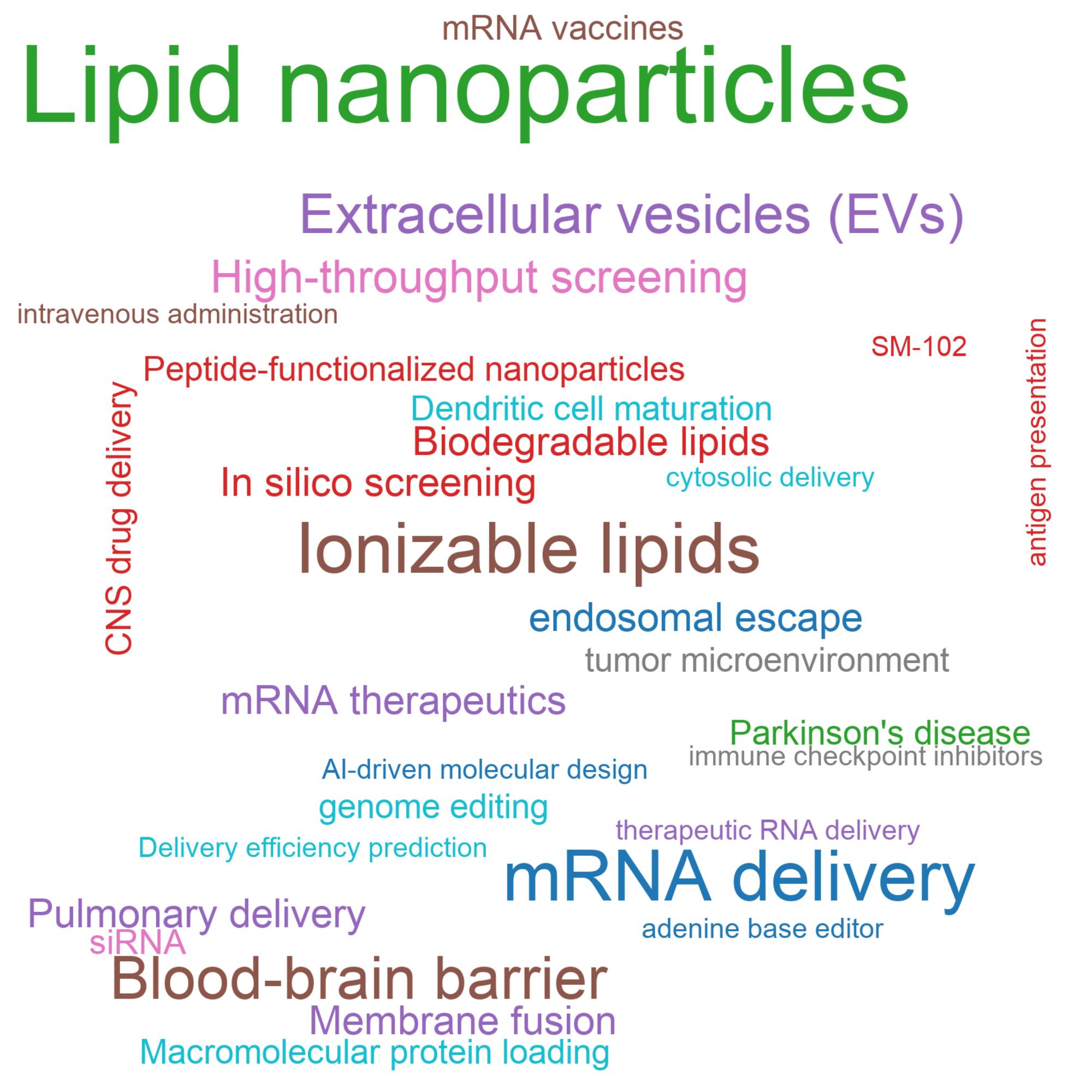
Lipid nanoparticle (LNP) formulation and optimization remain the absolute cornerstone of non-viral gene delivery research, present in 50% of the top-cited papers in the Class of 2026. Within this dominant paradigm, active investigation centres on custom lipid chemical engineering, with ionizable lipids (22%) and biodegradable lipids (8%) driving improved nucleic acid encapsulation, cellular internalization, and endosomal escape. Beyond standard systemic delivery, overcoming formidable physiological barriers has become a central focus; targeted transport across the blood-brain barrier (16%) and localized pulmonary delivery (8%) highlight the field's shift toward extrahepatic tissue targeting. In parallel, bio-inspired and biological nanocarriers, particularly extracellular vesicles (EVs, 14%), are gaining substantial traction as complementary platforms offering low immunogenicity and innate organ tropism. Finally, the methodological framework of gene delivery discovery is undergoing a modern transformation, as high-throughput screening platforms (10%) and in silico rational design (8%) replace traditional trial-and-error formulation methods to rapidly map structure-activity relationships.
How Did Topics Shift from the Class of 2025 to the Class of 2026?
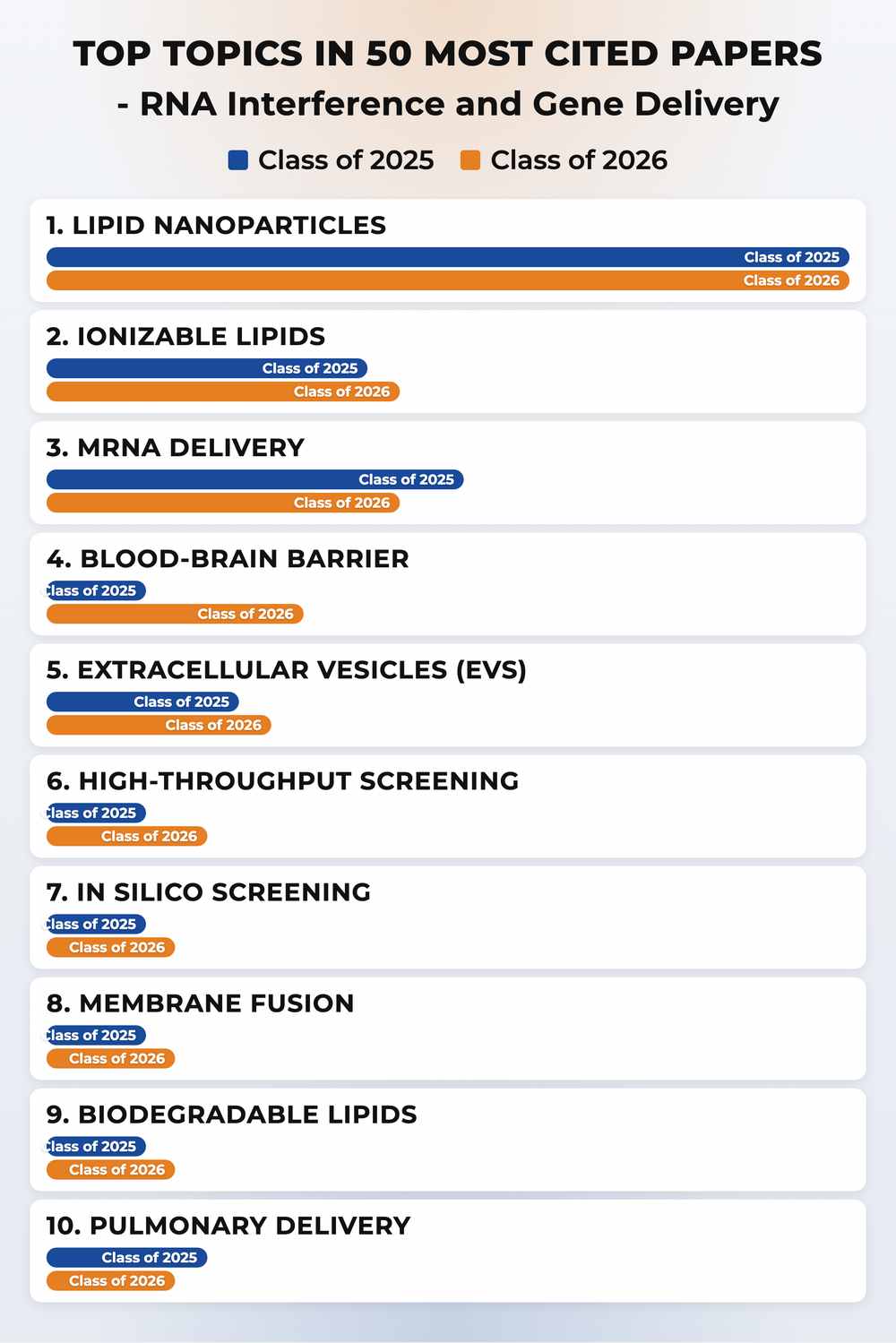
Comparing the Class of 2025 to the Class of 2026 reveals a clear strategic pivot in gene delivery research: transitioning from post-pandemic systemic mRNA vaccines toward bio-targeted extrahepatic delivery, neurological therapeutics, and AI-accelerated formulation design. The most prominent thematic acceleration occurred in central nervous system (CNS) drug delivery, where interest in crossing the blood-brain barrier surged nearly three-fold from 6% in 2023 to 16% in 2024, accompanied by new applications targeting Parkinson's disease (6%). Simultaneously, delivery vector discovery has embraced advanced predictive methodologies: in silico screening expanded from 0% to 8%, AI-driven molecular design reached 4%, and high-throughput experimental screening increased five-fold from 2% to 10%. Conversely, general interest in broad mRNA vaccines contracted by half from 12% to 6%, while generic formulation studies gave way to targeted biophysical mechanisms such as membrane fusion (rising to 8%) and biodegradable lipid design (doubling to 8%). Together, these trends illustrate how the field is rapidly evolving beyond emergency vaccine technologies toward highly engineered, organ-specific genetic medicines.
Methodology
PRI identifies high-impact research using a transparent, topic-agnostic framework applied consistently across scientific domains. Bibliographic records are drawn from OpenAlex, including publication dates, citation relationships, and document types.
This ranking covers the Class of 2026 cohort: journal articles published in 2024. Reviews and other non-article document types are excluded to ensure comparability.
Research impact is quantified with an 18-month post-publication citation window—the number of citing works published within 18 months of each paper's publication date. This metric captures early impact while controlling for publication age.
An LLM-based relevance classifier then reviews each candidate's title and abstract to confirm substantive alignment with the target domain. Only papers classified as relevant appear in the final ranking.
Zheng Su, Tinsley Li, Thematic Shifts in Early-High-Impact Cancer Genomics and Diagnostics Research: A Bibliometric and Semantic Analysis. bioRxiv 2026.07.04.736459; doi: https://doi.org/10.64898/2026.07.04.736459
Cite this ranking
Pepkio Research Index (PRI). Topics and Trends in Most Cited RNA Interference and Gene Delivery Papers, Class of 2026. https://pri.pepkio.com/top-papers/rna-interference-and-gene-delivery/2026. Accessed 2026-10-16.

Methodology
Zheng Su, Tinsley Li, Thematic Shifts in Early-High-Impact Cancer Genomics and Diagnostics Research: A Bibliometric and Semantic Analysis. bioRxiv 2026.07.04.736459; doi: https://doi.org/10.64898/2026.07.04.736459