
What topics and trends defined most-cited Physiological and biochemical adaptations research in the Class of 2026?
Research in physiological and biochemical adaptations is increasingly focused on thermal limits. The Class of 2026 highlights a sharp rise in studies on heat waves and temperature optimums, while generalized topics like osmoregulation and ecotoxicology declined, reflecting an urgent shift toward modeling extreme environmental stress.
At a glance
- Field
- Physiological and biochemical adaptations
- Cohort label
- Class of 2026 (2024 publications)
- Papers analyzed
- 3,472
- Papers ranked
- 20
- Top topics in ranked papers
- Oxidative stress, heat stress, thermal tolerance, transcriptomics
- Publication window
- Jan 1, 2024 – Dec 31, 2024
- Eligibility
- Research articles; reviews excluded
- Citation window
- 18 months post-publication
- 18m citation range
- 23–45
- Data source
- OpenAlex · Retrieved September 2026
- License
- CC BY 4.0
Rankings
20 papers ranked by 18-month citation count
A lethal mitonuclear incompatibility in complex I of natural hybrids
Nature202410.1038/s41586-023-06895-8
Metabolic loads and the costs of metazoan reproduction
Science202410.1126/science.adk6772
Effects of chronic cold stress and thermal stress on growth performance, hepatic apoptosis, oxidative stress, immune response and gut microbiota of juvenile hybrid sturgeon (Acipenser baerii ♀ × A. schrenkii ♂)
Fish & Shellfish Immunology202410.1016/j.fsi.2024.110078
Acute stress response in gill of Pacific white shrimp Litopenaeus vannamei to high alkalinity
Aquaculture202410.1016/j.aquaculture.2024.740766
Oxidative stress induced by hydrogen peroxide disrupts zebrafish visual development by altering apoptosis, antioxidant and estrogen related genes
Scientific Reports202410.1038/s41598-024-64933-5
The toxicity effects of imidacloprid and chlorpyrifos on oxidative stress and blood biochemistry in Cyprinus carpio
Comparative Biochemistry and Physiology Part C Toxicology & Pharmacology202410.1016/j.cbpc.2024.109979
Drosophila immune cells transport oxygen through PPO2 protein phase transition
Nature202410.1038/s41586-024-07583-x
Antifreeze proteins and surface-modified cellulose nanocrystals for designing anti-freezing conductive hydrogel sensors
Carbohydrate Polymers202410.1016/j.carbpol.2024.123056
Physiological and transcriptomic analysis provides new insights into osmoregulation mechanism of Ruditapes philippinarum under low and high salinity stress
The Science of The Total Environment202410.1016/j.scitotenv.2024.173215
Recent selection and introgression facilitated high-altitude adaptation in cattle
中国科学通报:英文版202410.1016/j.scib.2024.05.030
Variation in temperature of peak trait performance constrains adaptation of arthropod populations to climatic warming
Nature Ecology & Evolution202410.1038/s41559-023-02301-8
Effects of saline and alkaline stresses on the survival, growth, and physiological responses in juvenile mandarin fish (Siniperca chuatsi)
Aquaculture202410.1016/j.aquaculture.2024.741143
Effects of Temperature and Light on Microalgal Growth and Nutrient Removal in Turtle Aquaculture Wastewater
Biology202410.3390/biology13110901
Hidden impacts of ocean warming and acidification on biological responses of marine animals revealed through meta-analysis
Nature Communications202410.1038/s41467-024-47064-3
A systematic map of studies testing the relationship between temperature and animal reproduction
Ecological Solutions and Evidence202410.1002/2688-8319.12303
Lactate dehydrogenase A (LDHA)-mediated lactate generation promotes pulmonary vascular remodeling in pulmonary hypertension
Journal of Translational Medicine202410.1186/s12967-024-05543-7
Heatwave responses of Arctic phytoplankton communities are driven by combined impacts of warming and cooling
Science Advances202410.1126/sciadv.adl5904
Two-stage evolution of mammalian adipose tissue thermogenesis
Science202410.1126/science.adg1947
Comprehensive analysis of histophysiology, transcriptome and metabolome tolerance mechanisms in black porgy (Acanthopagrus schlegelii) under low temperature stress
The Science of The Total Environment202410.1016/j.scitotenv.2024.172318
Warmer environmental temperature accelerates aging in mosquitoes, decreasing longevity and worsening infection outcomes
Immunity & Ageing202410.1186/s12979-024-00465-w
Topic trends
Dominant research themes and year-over-year shifts in Physiological and biochemical adaptations
What Stressors Define the Class of 2026?
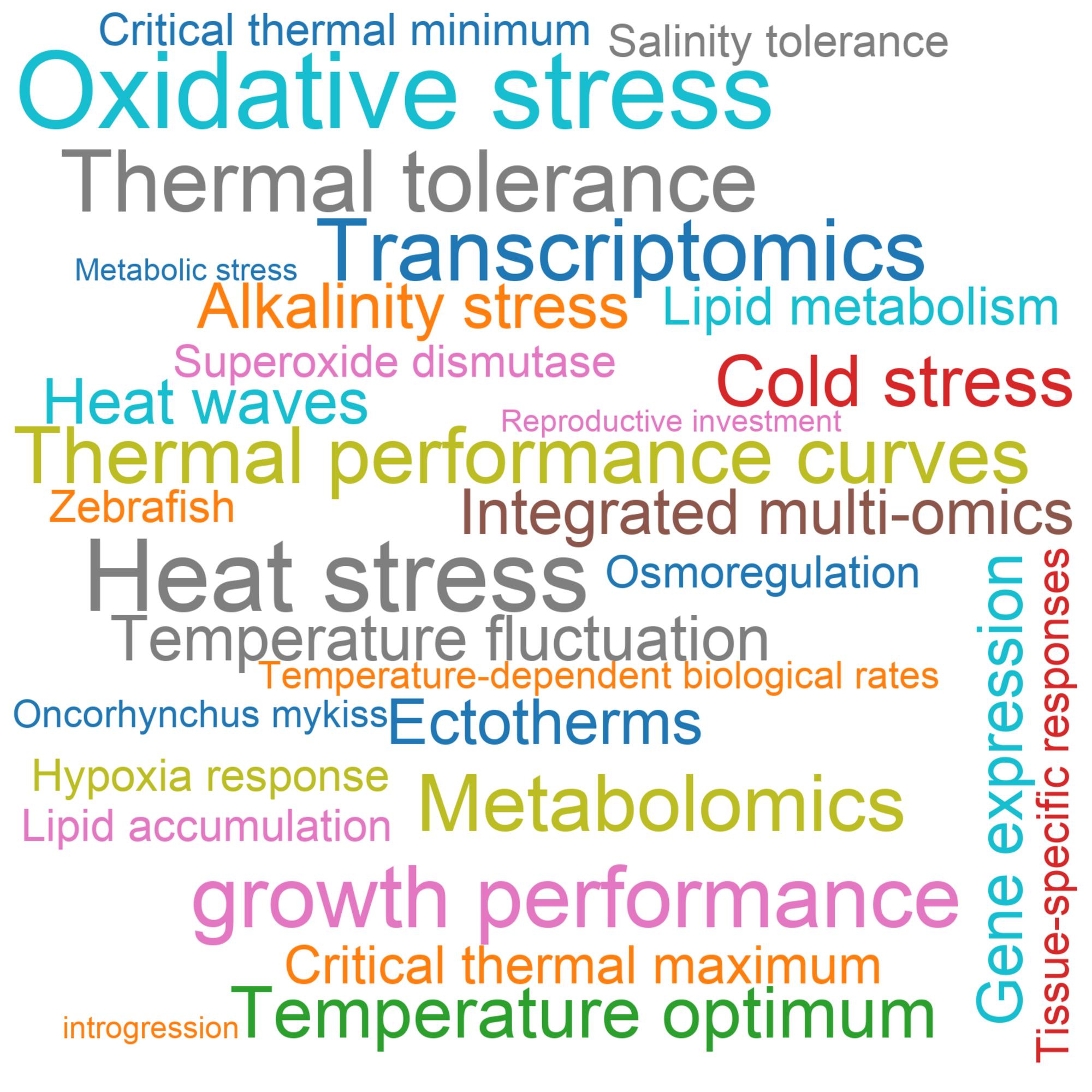
The Class of 2026 in physiological and biochemical adaptations is overwhelmingly defined by research into organismal responses to extreme temperatures and physiological distress. Oxidative stress is the most prominent topic, appearing in 20% of the top papers, closely followed by heat stress (18%) and thermal tolerance (14%). These dominant themes reflect a strong focus on how organisms cope with challenging environmental conditions. Advanced methodologies like transcriptomics and metabolomics are heavily utilized to untangle these complex adaptation mechanisms at a molecular level. Overall, the leading research emphasizes understanding biological resilience in the face of shifting thermal environments and physiological demands.
How Did Research Priorities Shift from the Class of 2025 to the Class of 2026?
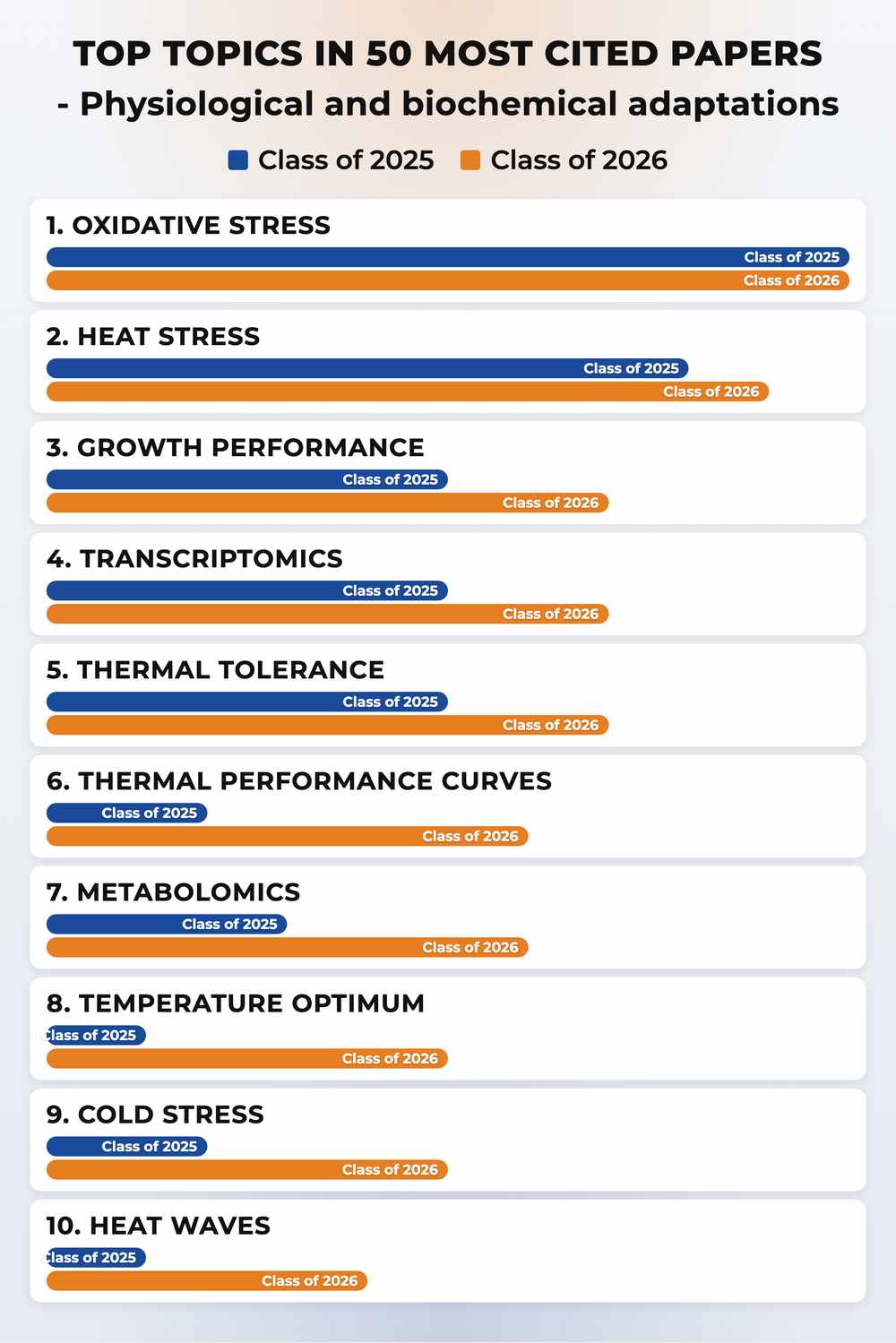
The transition to the Class of 2026 reveals a sharp pivot toward extreme climate impacts and specific thermal metrics. Concepts like temperature optimum and heat waves saw dramatic rises, surging from near invisibility in the previous year to prominent positions in the top literature. Similarly, the study of thermal performance curves saw a threefold increase, highlighting a drive to quantify precisely how organisms perform across temperature gradients. Conversely, more generalized physiological topics like osmoregulation, thermal acclimation, and ecotoxicology experienced significant declines, dropping by half compared to the previous year. This shift suggests a concentrated movement toward modeling immediate, severe climate stressors rather than broader physiological acclimation.
Methodology
PRI identifies high-impact research using a transparent, topic-agnostic framework applied consistently across scientific domains. Bibliographic records are drawn from OpenAlex, including publication dates, citation relationships, and document types.
This ranking covers the Class of 2026 cohort: journal articles published in 2024. Reviews and other non-article document types are excluded to ensure comparability.
Research impact is quantified with an 18-month post-publication citation window—the number of citing works published within 18 months of each paper's publication date. This metric captures early impact while controlling for publication age.
An LLM-based relevance classifier then reviews each candidate's title and abstract to confirm substantive alignment with the target domain. Only papers classified as relevant appear in the final ranking.
Zheng Su, Tinsley Li, Thematic Shifts in Early-High-Impact Cancer Genomics and Diagnostics Research: A Bibliometric and Semantic Analysis. bioRxiv 2026.07.04.736459; doi: https://doi.org/10.64898/2026.07.04.736459
Cite this ranking
Pepkio Research Index (PRI). Topics and Trends in Most Cited Physiological and biochemical adaptations Papers, Class of 2026. https://pri.pepkio.com/top-papers/physiological-and-biochemical-adaptations/2026. Accessed 2026-10-24.

Methodology
Zheng Su, Tinsley Li, Thematic Shifts in Early-High-Impact Cancer Genomics and Diagnostics Research: A Bibliometric and Semantic Analysis. bioRxiv 2026.07.04.736459; doi: https://doi.org/10.64898/2026.07.04.736459