
What topics and trends defined most-cited Marine Biology and Ecology Research research in the Class of 2026?
Marine biology and ecology research in the Class of 2026 is heavily anchored by ocean carbon sequestration and phytoplankton biomass dynamics. Rapidly emerging priorities show significant growth in particulate organic carbon and marine comparative genomics, while focus on marine heatwaves and broad phytoplankton community composition has experienced relative decline across top-ranked literature.
At a glance
- Field
- Marine Biology and Ecology Research
- Cohort label
- Class of 2026 (2024 publications)
- Papers analyzed
- 4,453
- Papers ranked
- 20
- Top topics in ranked papers
- Carbon sequestration, phytoplankton biomass, particulate organic carbon, eutrophication
- Publication window
- Jan 1, 2024 – Dec 31, 2024
- Eligibility
- Research articles; reviews excluded
- Citation window
- 18 months post-publication
- 18m citation range
- 23–183
- Data source
- OpenAlex · Retrieved Jul 2026
- License
- CC BY 4.0
Rankings
20 papers ranked by 18-month citation count
Harmful algal blooms in inland waters
Nature Reviews Earth & Environment202410.1038/s43017-024-00578-2
<scp>Bio‐ORACLE</scp> v3.0. Pushing marine data layers to the <scp>CMIP6</scp> Earth System Models of climate change research
Global Ecology and Biogeography202410.1111/geb.13813
Carbon export from seaweed forests to deep ocean sinks
Nature Geoscience202410.1038/s41561-024-01449-7
Evidence of dark oxygen production at the abyssal seafloor
Nature Geoscience202410.1038/s41561-024-01480-8
Chemical signaling in biofilm-mediated biofouling
Nature Chemical Biology202410.1038/s41589-024-01740-z
Frenemies on the reef? Resolving the coral–Endozoicomonas association
Trends in Microbiology202410.1016/j.tim.2023.11.006
Climate change is an important predictor of extinction risk on macroevolutionary timescales
Science202410.1126/science.adj5763
The annual update GLODAPv2.2023: the global interior ocean biogeochemical data product
Earth system science data202410.5194/essd-16-2047-2024
The marine biodiversity impact of the Late Miocene Mediterranean salinity crisis
Science202410.1126/science.adp3703
Sea level controls on Ediacaran-Cambrian animal radiations
Science Advances202410.1126/sciadv.ado6462
Projected loss of brown macroalgae and seagrasses with global environmental change
Nature Communications202410.1038/s41467-024-48273-6
Seagrass genomes reveal ancient polyploidy and adaptations to the marine environment
Nature Plants202410.1038/s41477-023-01608-5
Disentangling drivers of mudflat intertidal DOM chemodiversity using ecological models
Nature Communications202410.1038/s41467-024-50841-9
Aquatic deoxygenation as a planetary boundary and key regulator of Earth system stability
Nature Ecology & Evolution202410.1038/s41559-024-02448-y
One-third of Southern Ocean productivity is supported by dust deposition
Nature202410.1038/s41586-024-07366-4
Long-term effects of dead algal deposition on sediment surfaces: Behavior of endogenous phosphorus release in sediments
Water Research202410.1016/j.watres.2024.122742
Temperature and nutrients drive distinct successions between diatoms and dinoflagellates over the past 40 years: Implications for climate warming and eutrophication
The Science of The Total Environment202410.1016/j.scitotenv.2024.172997
Impact of anthropogenic global hypoxia on the physiological response of bivalves
The Science of The Total Environment202410.1016/j.scitotenv.2024.172056
Tracking the Changes of DOM Composition, Transformation, and Cycling Mechanism Triggered by the Priming Effect: Insights from Incubation Experiments
Environmental Science & Technology202410.1021/acs.est.4c03784
The Central Paratethys Sea—rise and demise of a Miocene European marine biodiversity hotspot
Scientific Reports202410.1038/s41598-024-67370-6
Topic trends
Dominant research themes and year-over-year shifts in Marine Biology and Ecology Research
What Topics Define the Class of 2026?
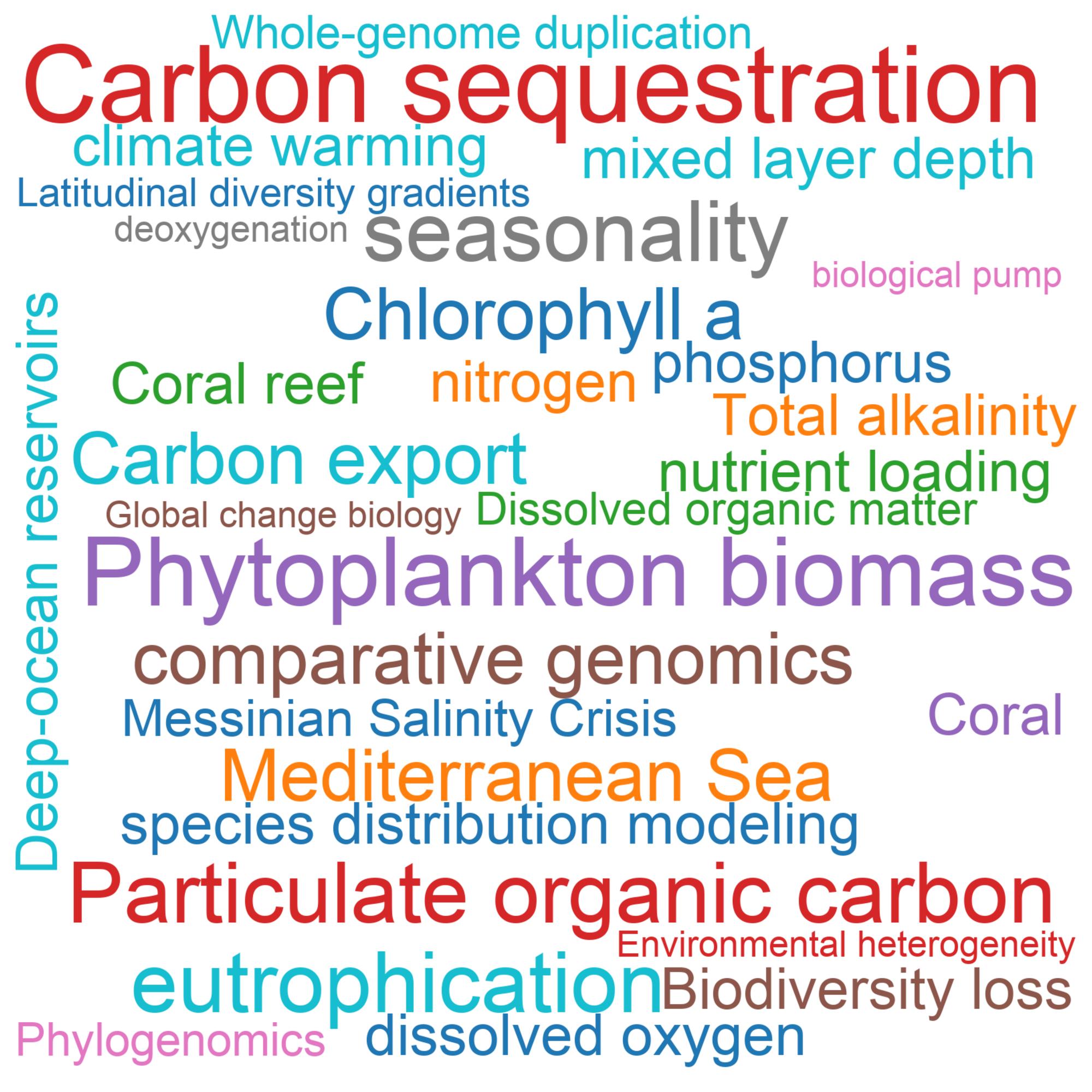
The Class of 2026 in marine biology and ecology research is prominently defined by studies on marine carbon cycling and biogeochemical ocean processes. Leading the cohort, carbon sequestration stands out as the single most frequent core concept with a 12% normalized frequency, closely accompanied by phytoplankton biomass dynamics at 10% normalized frequency. Researchers are increasingly focusing on the biological carbon pump, evaluating how primary production drives elemental flux and long-term carbon storage in ocean reservoirs. Alongside marine carbon dynamics, ecosystem health indicators such as eutrophication (8%) and seasonal biogeochemical variability (8%) represent central research focal points across high-impact literature. Additional dominant themes include particulate organic carbon export, chlorophyll a remote sensing, and regional ecological assessments centered in marine hotspots like the Mediterranean Sea. Furthermore, high-throughput technologies such as autonomous BGC-Argo float arrays and comparative marine genomics are becoming integral to baseline monitoring. Together, these topics illustrate a strong consensus around quantifying oceanic carbon budgets, predicting biological responses to global environmental change, and developing mechanistic models of marine ecosystem function.
How Did Topics Shift from the Class of 2025 to the Class of 2026?
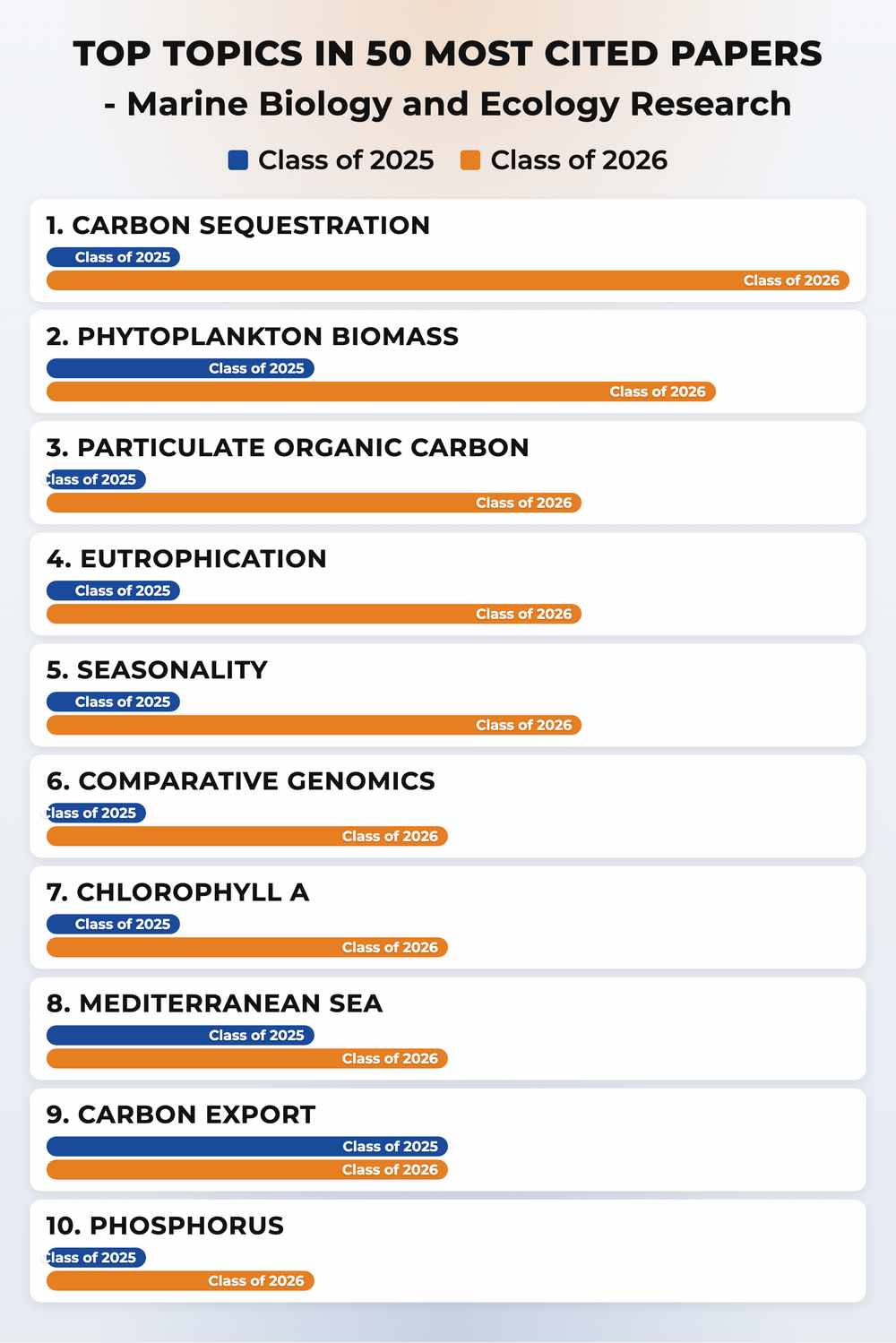
Comparing the Class of 2025 to the Class of 2026 reveals a distinct shift toward high-resolution observation and mechanistic genomic approaches in marine ecology. The most pronounced expansion occurred in particulate organic carbon tracking, which jumped from zero representation in 2023 to 8% of top papers in 2024. Similarly, comparative genomics and deep-ocean reservoir dynamics emerged as major new growth areas, reflecting an increasing emphasis on molecular-level adaptation and deep-sea biogeochemistry. Substantial gains were also observed in coral reef resilience, biodiversity loss assessments, and depth-resolved autonomous sampling using BGC-Argo platforms. Conversely, several established concepts saw a relative decline in representation: research focused on marine heatwaves dropped by 50% (from 8% in 2023 to 4% in 2024), and general studies on phytoplankton community composition declined from 6% to 4%. This shift suggests that the field is moving from broad observational studies of thermal anomalies toward granular, process-oriented investigations of organic carbon export, microbial genomic capacity, and subsurface ocean dynamics.
Methodology
PRI identifies high-impact research using a transparent, topic-agnostic framework applied consistently across scientific domains. Bibliographic records are drawn from OpenAlex, including publication dates, citation relationships, and document types.
This ranking covers the Class of 2026 cohort: journal articles published in 2024. Reviews and other non-article document types are excluded to ensure comparability.
Research impact is quantified with an 18-month post-publication citation window—the number of citing works published within 18 months of each paper's publication date. This metric captures early impact while controlling for publication age.
An LLM-based relevance classifier then reviews each candidate's title and abstract to confirm substantive alignment with the target domain. Only papers classified as relevant appear in the final ranking.
Zheng Su, Tinsley Li, Thematic Shifts in Early-High-Impact Cancer Genomics and Diagnostics Research: A Bibliometric and Semantic Analysis. bioRxiv 2026.07.04.736459; doi: https://doi.org/10.64898/2026.07.04.736459
Cite this ranking
Pepkio Research Index (PRI). Topics and Trends in Most Cited Marine Biology and Ecology Research Papers, Class of 2026. https://pri.pepkio.com/top-papers/marine-biology-and-ecology-research/2026. Accessed 2026-10-21.

Methodology
Zheng Su, Tinsley Li, Thematic Shifts in Early-High-Impact Cancer Genomics and Diagnostics Research: A Bibliometric and Semantic Analysis. bioRxiv 2026.07.04.736459; doi: https://doi.org/10.64898/2026.07.04.736459