
What topics and trends defined most-cited Marine and fisheries research research in the Class of 2026?
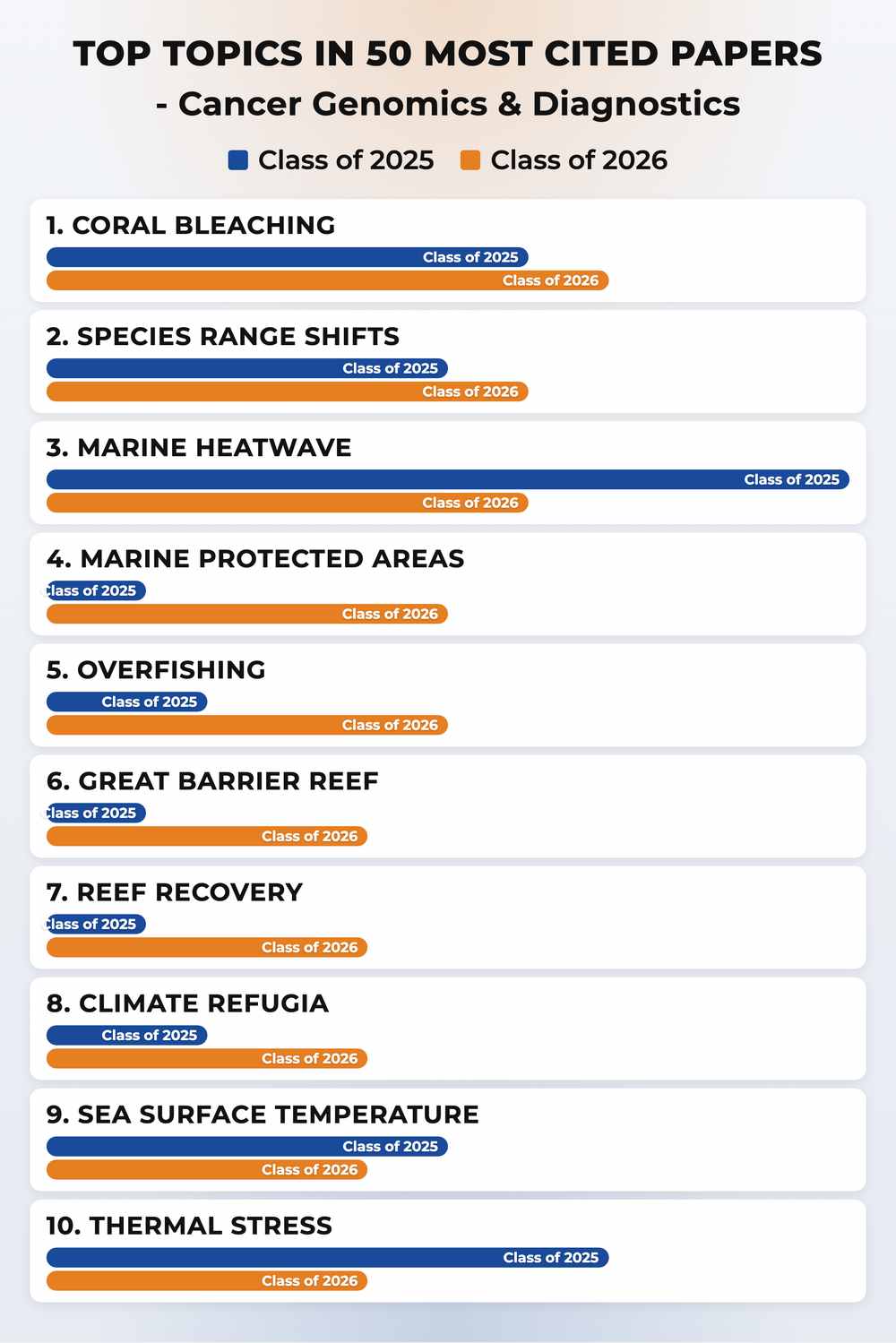
The Class of 2026 for Marine and Fisheries Research indicates a sharp rise in focus on climate resilience and conservation, with topics like Marine protected areas, Great Barrier Reef, and Reef recovery surging. Concurrently, broader stress indicators such as Marine heatwave and Thermal stress experienced declines, suggesting a shift from documenting thermal impacts to exploring actionable conservation and recovery strategies.
At a glance
- Field
- Marine and fisheries research
- Cohort label
- Class of 2026 (2024 publications)
- Papers analyzed
- 6,452
- Papers ranked
- 20
- Top topics in ranked papers
- Coral bleaching, marine heatwave, species range shifts, marine protected areas, overfishing
- Publication window
- Jan 1, 2024 – Dec 31, 2024
- Eligibility
- Research articles; reviews excluded
- Citation window
- 18 months post-publication
- 18m citation range
- 36–119
- Data source
- OpenAlex · Retrieved Jul 2026
- License
- CC BY 4.0
Rankings
20 papers ranked by 18-month citation count
Environmental, economic, and social sustainability in aquaculture: the aquaculture performance indicators
Nature Communications202410.1038/s41467-024-49556-8
Satellite mapping reveals extensive industrial activity at sea
Nature202410.1038/s41586-023-06825-8
<scp>Bio‐ORACLE</scp> v3.0. Pushing marine data layers to the <scp>CMIP6</scp> Earth System Models of climate change research
Global Ecology and Biogeography202410.1111/geb.13813
Highest ocean heat in four centuries places Great Barrier Reef in danger
Nature202410.1038/s41586-024-07672-x
Ecological erosion and expanding extinction risk of sharks and rays
Science202410.1126/science.adn1477
Global shark fishing mortality still rising despite widespread regulatory change
Science202410.1126/science.adf8984
Ocean protection quality is lagging behind quantity: Applying a scientific framework to assess real marine protected area progress against the 30 by 30 target
Conservation Letters202410.1111/conl.13020
MFGTN: A multi-modal fast gated transformer for identifying single trawl marine fishing vessel
Ocean Engineering202410.1016/j.oceaneng.2024.117711
Stock assessment models overstate sustainability of the world’s fisheries
Science202410.1126/science.adl6282
Cumulative risk of future bleaching for the world’s coral reefs
Science Advances202410.1126/sciadv.adn9660
The critical role of coral reef restoration in a changing world
Nature Climate Change202410.1038/s41558-024-02202-z
Selective breeding enhances coral heat tolerance to marine heatwaves
Nature Communications202410.1038/s41467-024-52895-1
Atmospheric CO2 emissions and ocean acidification from bottom-trawling
Frontiers in Marine Science202410.3389/fmars.2023.1125137
Marine heatwaves disrupt ecosystem structure and function via altered food webs and energy flux
Nature Communications202410.1038/s41467-024-46263-2
Records reveal the vast historical extent of European oyster reef ecosystems
Nature Sustainability202410.1038/s41893-024-01441-4
Over 80% of the European Union’s marine protected area only marginally regulates human activities
One Earth202410.1016/j.oneear.2024.07.010
Increasing disturbance frequency undermines coral reef recovery
Ecological Monographs202410.1002/ecm.1619
Climate change is an important predictor of extinction risk on macroevolutionary timescales
Science202410.1126/science.adj5763
New global area estimates for coral reefs from high-resolution mapping
Cell Reports Sustainability202410.1016/j.crsus.2024.100015
Fishing for oil and meat drives irreversible defaunation of deepwater sharks and rays
Science202410.1126/science.ade9121
Topic trends
Dominant research themes and year-over-year shifts in Marine and fisheries research
What Topics Define the Class of 2026?
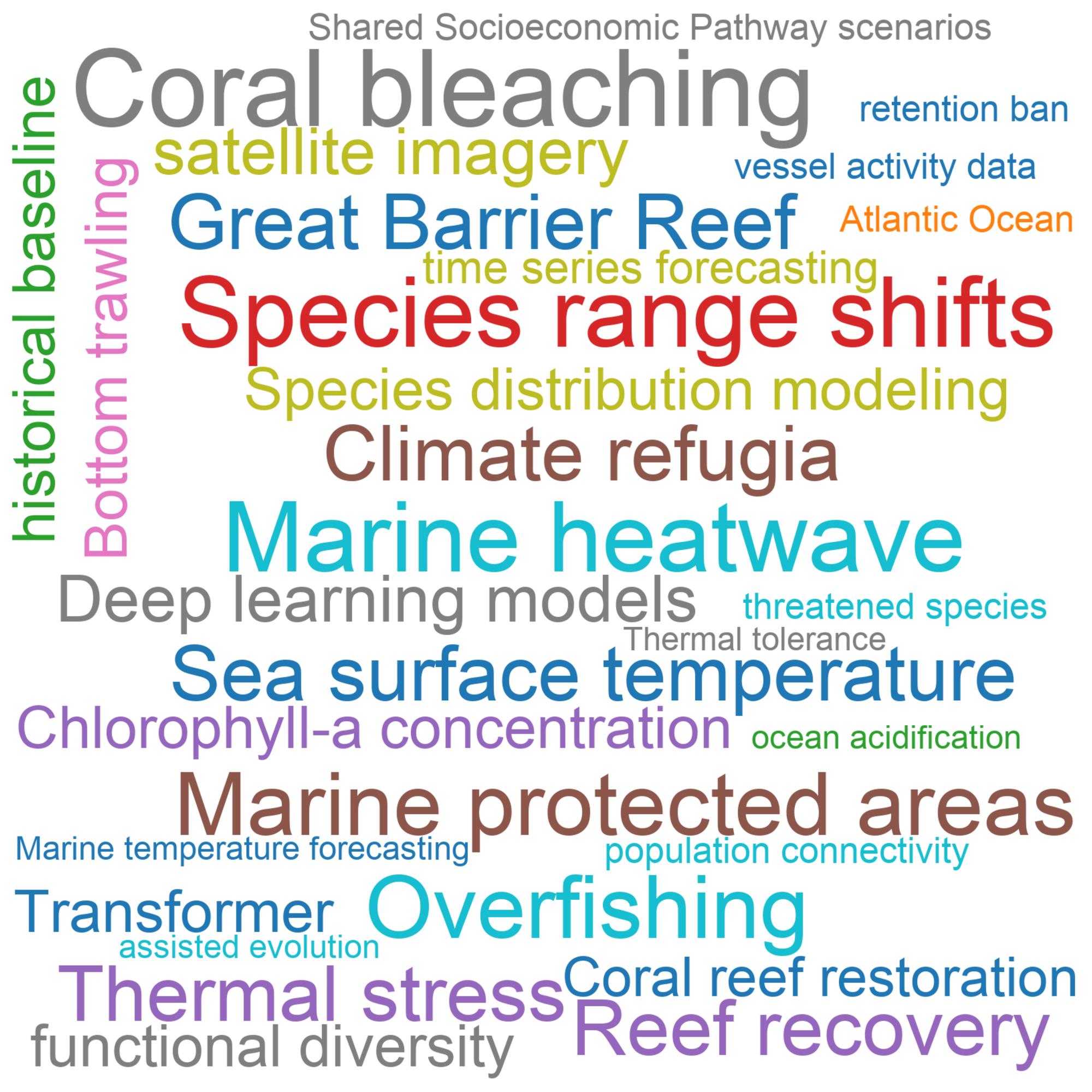
In the Class of 2026, marine and fisheries research is predominantly characterized by studies on climate impacts and ecosystem management. The most frequent topics include Coral bleaching, Marine heatwave, and Species range shifts, reflecting an intense focus on how marine environments respond to changing climate conditions. Additionally, topics like Marine protected areas and Overfishing are highly prevalent, indicating that researchers are heavily invested in actionable conservation strategies and sustainable fisheries management. The prominence of these topics suggests a dual focus on understanding environmental stressors and implementing protective measures to safeguard vulnerable marine ecosystems.
How Did Topics Shift from the Class of 2025 to the Class of 2026?
The transition to the Class of 2026 highlights a distinct pivot towards specific conservation areas and recovery mechanisms. Topics such as Great Barrier Reef, Marine protected areas, and Reef recovery emerged rapidly, alongside an increased focus on Overfishing. Conversely, broader stress indicators like Marine heatwave, Thermal stress, and Sea surface temperature experienced significant declines. This evolution underscores a broader trend in marine research: a move from broadly documenting the occurrence of thermal stress and heatwaves towards localized conservation efforts and evaluating the effectiveness of protective strategies in mitigating these impacts.
Methodology
PRI identifies high-impact research using a transparent, topic-agnostic framework applied consistently across scientific domains. Bibliographic records are drawn from OpenAlex, including publication dates, citation relationships, and document types.
This ranking covers the Class of 2026 cohort: journal articles published in 2024. Reviews and other non-article document types are excluded to ensure comparability.
Research impact is quantified with an 18-month post-publication citation window—the number of citing works published within 18 months of each paper's publication date. This metric captures early impact while controlling for publication age.
An LLM-based relevance classifier then reviews each candidate's title and abstract to confirm substantive alignment with the target domain. Only papers classified as relevant appear in the final ranking.
Zheng Su, Tinsley Li, Thematic Shifts in Early-High-Impact Cancer Genomics and Diagnostics Research: A Bibliometric and Semantic Analysis. bioRxiv 2026.07.04.736459; doi: https://doi.org/10.64898/2026.07.04.736459
Cite this ranking
Pepkio Research Index (PRI). Topics and Trends in Most Cited Marine and fisheries research Papers, Class of 2026. https://pri.pepkio.com/top-papers/marine-and-fisheries-research/2026. Accessed 2026-10-14.

Methodology
Zheng Su, Tinsley Li, Thematic Shifts in Early-High-Impact Cancer Genomics and Diagnostics Research: A Bibliometric and Semantic Analysis. bioRxiv 2026.07.04.736459; doi: https://doi.org/10.64898/2026.07.04.736459