
What topics and trends defined most-cited Species Distribution and Climate Change research in the Class of 2026?
Species distribution and climate change research shifts from basic accuracy metrics toward actionable conservation prioritization and ensemble modeling. Bioclimatic variables, biodiversity monitoring, and vascular plants dominate high-impact literature. Projections incorporating ecosystem functioning, habitat fragmentation, and local adaptation surge dramatically, while traditional metrics like AUC performance and thermal tolerance limits recede among top-cited publications.
At a glance
- Field
- Species Distribution and Climate Change
- Cohort label
- Class of 2026 (2024 publications)
- Papers analyzed
- 9,030
- Papers ranked
- 20
- Top topics in ranked papers
- Conservation prioritization, Bioclimatic variables, Ensemble modeling, Biodiversity monitoring, Vascular plants
- Publication window
- Jan 1, 2024 – Dec 31, 2024
- Eligibility
- Research articles; reviews excluded
- Citation window
- 18 months post-publication
- 18m citation range
- 40–139
- Data source
- OpenAlex · Retrieved Jul 2026
- License
- CC BY 4.0
Rankings
20 papers ranked by 18-month citation count
Climate change extinctions
Science202410.1126/science.adp4461
Mechanisms, detection and impacts of species redistributions under climate change
Nature Reviews Earth & Environment202410.1038/s43017-024-00527-z
Biodiversity impacts of the 2019–2020 Australian megafires
Nature202410.1038/s41586-024-08174-6
Shifts in native tree species distributions in Europe under climate change
Journal of Environmental Management202410.1016/j.jenvman.2024.123504
Assisted tree migration can preserve the European forest carbon sink under climate change
Nature Climate Change202410.1038/s41558-024-02080-5
Extinction risk predictions for the world's flowering plants to support their conservation
New Phytologist202410.1111/nph.19592
Accounting for albedo change to identify climate-positive tree cover restoration
Nature Communications202410.1038/s41467-024-46577-1
Revealing uncertainty in the status of biodiversity change
Nature202410.1038/s41586-024-07236-z
Global expansion of human-wildlife overlap in the 21st century
Science Advances202410.1126/sciadv.adp7706
Managing climate-change refugia to prevent extinctions
Trends in Ecology & Evolution202410.1016/j.tree.2024.05.002
Rapid shifts in grassland communities driven by climate change
Nature Ecology & Evolution202410.1038/s41559-024-02552-z
Climate velocities and species tracking in global mountain regions
Nature202410.1038/s41586-024-07264-9
Predicting the potential habitat suitability of Saussurea species in China under future climate scenarios using the optimized Maximum Entropy (MaxEnt) model
Journal of Cleaner Production202410.1016/j.jclepro.2024.143552
More than 17,000 tree species are at risk from rapid global change
Nature Communications202410.1038/s41467-023-44321-9
Anthropogenic climate and land-use change drive short- and long-term biodiversity shifts across taxa
Nature Ecology & Evolution202410.1038/s41559-024-02326-7
Interactions between climate change and urbanization will shape the future of biodiversity
Nature Climate Change202410.1038/s41558-024-01996-2
Global patterns of plant functional traits and their relationships to climate
Communications Biology202410.1038/s42003-024-06777-3
Treating gaps and biases in biodiversity data as a missing data problem
Biological reviews/Biological reviews of the Cambridge Philosophical Society202410.1111/brv.13127
Unexpected westward range shifts in European forest plants link to nitrogen deposition
Science202410.1126/science.ado0878
65% cover is the sustainable vegetation threshold on the Loess Plateau
Environmental Science and Ecotechnology202410.1016/j.ese.2024.100442
Topic trends
Dominant research themes and year-over-year shifts in Species Distribution and Climate Change
What Topics Define the Class of 2026?
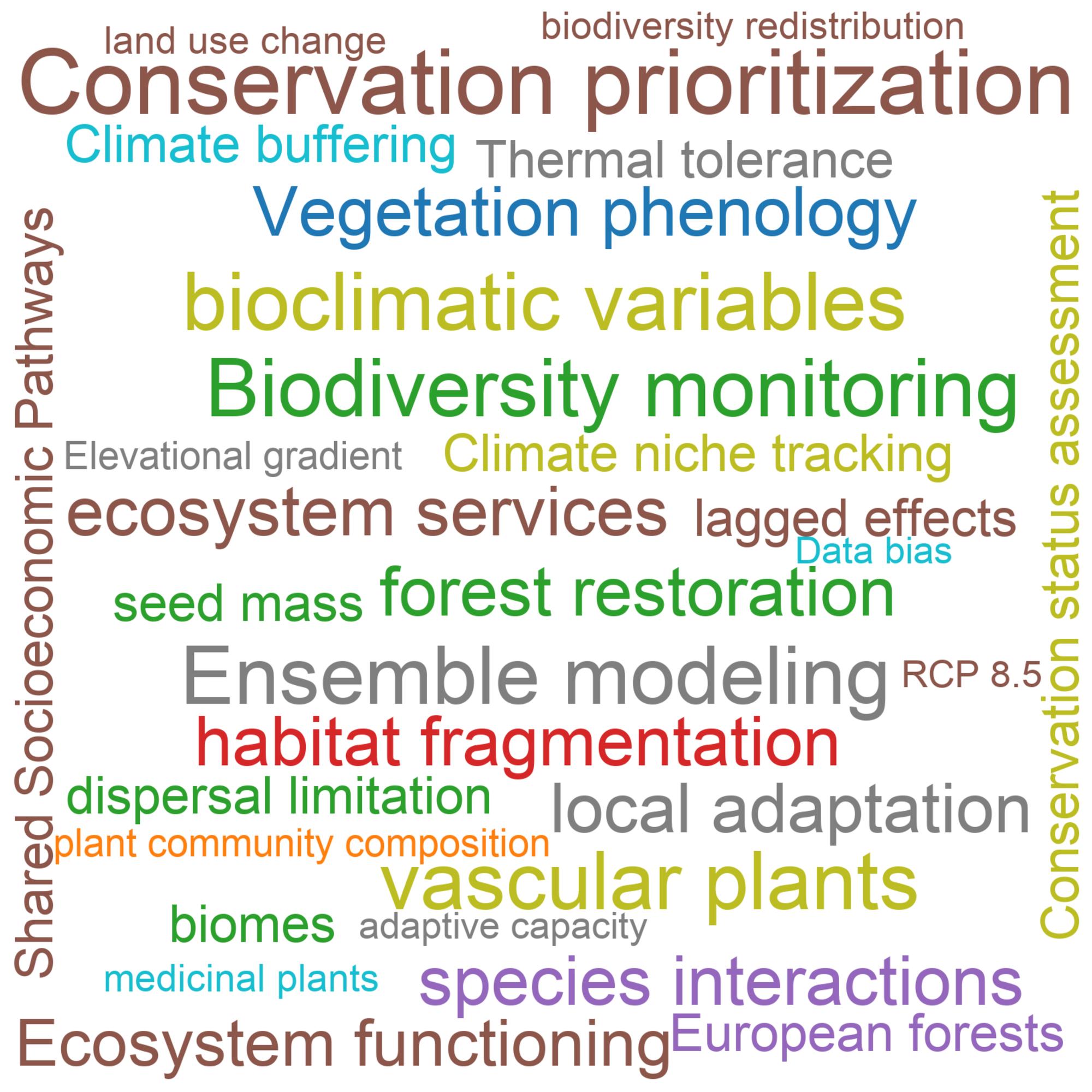
The informative word cloud across top-cited Species Distribution and Climate Change research highlights an analytical transition toward actionable biodiversity protection, refined predictive modeling, and mechanistic ecological assessments. Conservation prioritization leads the 2024 cohort at a normalized frequency of 0.10 (5 mentions), underscoring how high-impact spatial modeling increasingly connects species distribution projections directly to spatial planning and reserve design. A prominent cluster of methodological and ecological drivers follows at a normalized frequency of 0.08 (4 mentions each), including bioclimatic variables, ensemble modeling, biodiversity monitoring, and targeted plant taxa such as vascular plants. High-impact literature frequently employs multi-algorithm ensemble techniques alongside high-resolution climate covariates to track biome-level vulnerability. Furthermore, a diverse array of ecosystem-level processes surfaces at a normalized frequency of 0.06 (3 mentions each), spanning ecosystem functioning, vegetation phenology, ecosystem services, habitat fragmentation, local adaptation, species interactions, and forest restoration. After filtering out broad generic descriptors, these patterns reflect a mature research domain that integrates climate niche modeling with empirical ecological dynamics, habitat connectivity, and proactive conservation management.
How Did Topics Shift from the Class of 2025 to the Class of 2026?
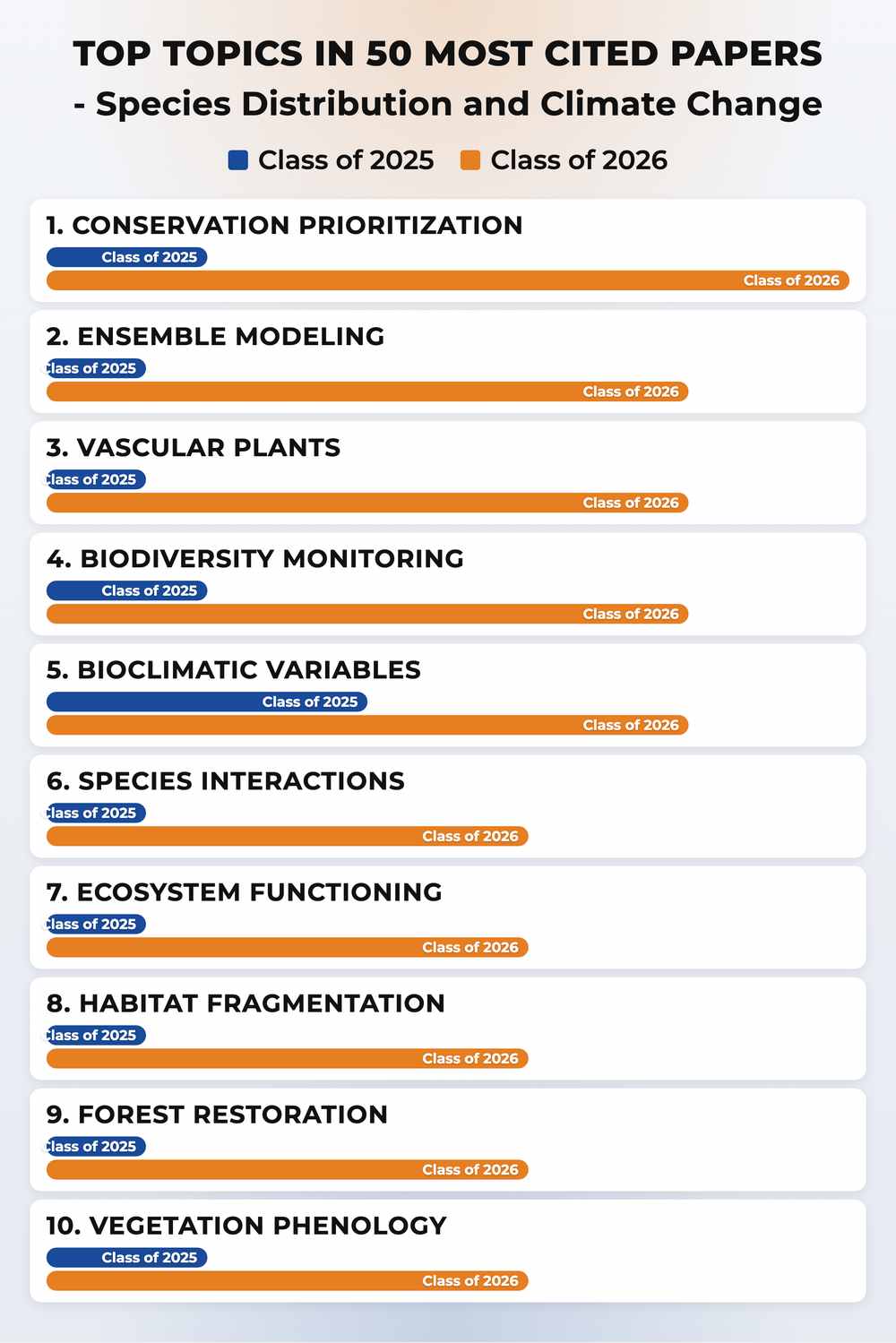
Comparing normalized concept frequencies between the Class of 2025 (2023 publications) and Class of 2026 (2024 publications) reveals a pronounced operational shift from basic model validation and physiological threshold testing toward integrated conservation application and ecosystem complexity. Conservation prioritization experienced the largest gain (+0.08 normalized frequency, expanding from 0.02 to 0.10), while ensemble modeling (+0.08) and vascular plants (+0.08) surged from zero baseline presence in top-cited 2023 literature. Biodiversity monitoring (+0.06), ecosystem functioning (+0.06), forest restoration (+0.06), habitat fragmentation (+0.06), and species interactions (+0.06) also demonstrated multi-fold increases, highlighting heightened focus on multi-trophic interactions and restoration ecology. Conversely, traditional model assessment metrics and isolated physiological measures declined: AUC fell from 0.08 to 0.04 (-0.04), and Thermal tolerance dropped from 0.08 to 0.04 (-0.04). Land use change (-0.02) and Data bias (-0.02) also receded relative to direct conservation frameworks. Together, these topic dynamics demonstrate that leading species distribution research is moving beyond single-species physiological limits and raw accuracy metrics toward ensemble spatial forecasting, ecosystem functioning, and actionable habitat restoration.
Methodology
PRI identifies high-impact research using a transparent, topic-agnostic framework applied consistently across scientific domains. Bibliographic records are drawn from OpenAlex, including publication dates, citation relationships, and document types.
This ranking covers the Class of 2026 cohort: journal articles published in 2024. Reviews and other non-article document types are excluded to ensure comparability.
Research impact is quantified with an 18-month post-publication citation window—the number of citing works published within 18 months of each paper's publication date. This metric captures early impact while controlling for publication age.
An LLM-based relevance classifier then reviews each candidate's title and abstract to confirm substantive alignment with the target domain. Only papers classified as relevant appear in the final ranking.
Zheng Su, Tinsley Li, Thematic Shifts in Early-High-Impact Cancer Genomics and Diagnostics Research: A Bibliometric and Semantic Analysis. bioRxiv 2026.07.04.736459; doi: https://doi.org/10.64898/2026.07.04.736459
Cite this ranking
Pepkio Research Index (PRI). Topics and Trends in Most Cited Species Distribution and Climate Change Papers, Class of 2026. https://pri.pepkio.com/top-papers/species-distribution-and-climate-change/2026. Accessed 2026-10-16.

Methodology
Zheng Su, Tinsley Li, Thematic Shifts in Early-High-Impact Cancer Genomics and Diagnostics Research: A Bibliometric and Semantic Analysis. bioRxiv 2026.07.04.736459; doi: https://doi.org/10.64898/2026.07.04.736459