
What topics and trends defined most-cited Ecology and Vegetation Dynamics Studies research in the Class of 2026?
Ecology and vegetation dynamics literature shifts toward predictive trait-based spatial modeling and scenario-driven conservation. Species distribution modeling, grassland resilience, and land use change dominate high-impact research. Projections incorporating Shared Socioeconomic Pathways, functional traits, and dryland biodiversity surge dramatically, while traditional carbon sequestration metrics decline.
At a glance
- Field
- Ecology and Vegetation Dynamics Studies
- Cohort label
- Class of 2026 (2024 publications)
- Papers analyzed
- 8,523
- Papers ranked
- 20
- Top topics in ranked papers
- Species distribution modeling, Grasslands, Land use change, Biodiversity hotspots, Functional traits
- Publication window
- Jan 1, 2024 – Dec 31, 2024
- Eligibility
- Research articles; reviews excluded
- Citation window
- 18 months post-publication
- 18m citation range
- 48–257
- Data source
- OpenAlex · Retrieved Jul 2026
- License
- CC BY 4.0
Rankings
20 papers ranked by 18-month citation count
Critical transitions in the Amazon forest system
Nature202410.1038/s41586-023-06970-0
Mechanisms, detection and impacts of species redistributions under climate change
Nature Reviews Earth & Environment202410.1038/s43017-024-00527-z
The Atlantic Forest of South America: Spatiotemporal dynamics of the vegetation and implications for conservation
Biological Conservation202410.1016/j.biocon.2024.110499
A global meta-analysis on the effects of organic and inorganic fertilization on grasslands and croplands
Nature Communications202410.1038/s41467-024-47829-w
Shifts in native tree species distributions in Europe under climate change
Journal of Environmental Management202410.1016/j.jenvman.2024.123504
Extreme drought impacts have been underestimated in grasslands and shrublands globally
Proceedings of the National Academy of Sciences202410.1073/pnas.2309881120
Plant diversity darkspots for global collection priorities
New Phytologist202410.1111/nph.20024
Unforeseen plant phenotypic diversity in a dry and grazed world
Nature202410.1038/s41586-024-07731-3
Plant diversity enhances ecosystem multifunctionality via multitrophic diversity
Nature Ecology & Evolution202410.1038/s41559-024-02517-2
Functional traits—not nativeness—shape the effects of large mammalian herbivores on plant communities
Science202410.1126/science.adh2616
Rural depopulation has reshaped the plant diversity distribution pattern in China
Resources Conservation and Recycling202410.1016/j.resconrec.2024.108054
Amazon forest biogeography predicts resilience and vulnerability to drought
Nature202410.1038/s41586-024-07568-w
Revealing uncertainty in the status of biodiversity change
Nature202410.1038/s41586-024-07236-z
Global evaluation of current and future threats to drylands and their vertebrate biodiversity
Nature Ecology & Evolution202410.1038/s41559-024-02450-4
Enhancing ecosystem productivity and stability with increasing canopy structural complexity in global forests
Science Advances202410.1126/sciadv.adl1947
Managing climate-change refugia to prevent extinctions
Trends in Ecology & Evolution202410.1016/j.tree.2024.05.002
Accelerated succession in Himalayan alpine treelines under climatic warming
Nature Plants202410.1038/s41477-024-01855-0
Rapid shifts in grassland communities driven by climate change
Nature Ecology & Evolution202410.1038/s41559-024-02552-z
Climate velocities and species tracking in global mountain regions
Nature202410.1038/s41586-024-07264-9
Predicting the potential habitat suitability of Saussurea species in China under future climate scenarios using the optimized Maximum Entropy (MaxEnt) model
Journal of Cleaner Production202410.1016/j.jclepro.2024.143552
Topic trends
Dominant research themes and year-over-year shifts in Ecology and Vegetation Dynamics Studies
What Topics Define the Class of 2026?
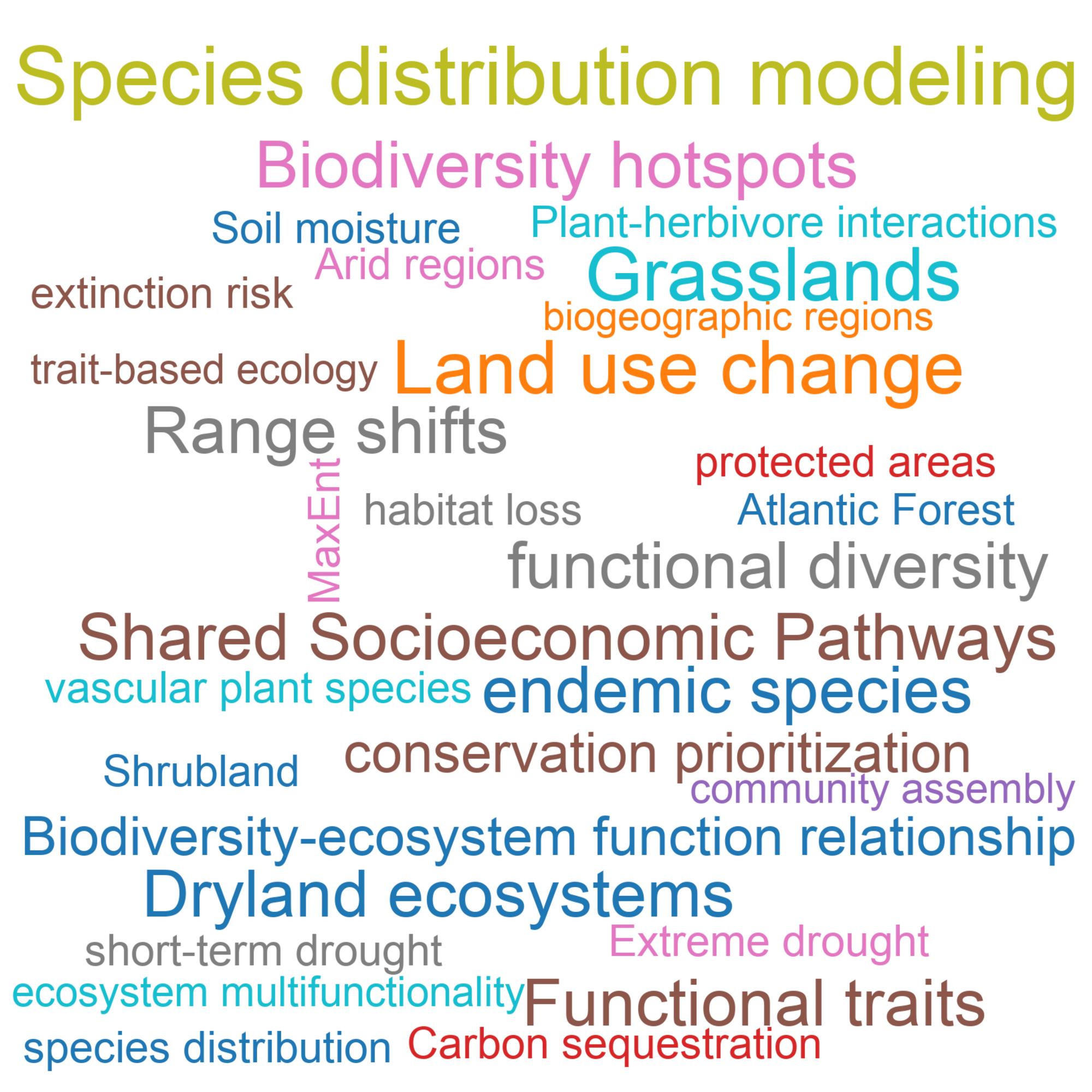
Research across the Class of 2026 in Ecology and Vegetation Dynamics Studies emphasizes predictive modeling, habitat disturbance, and functional biodiversity across vulnerable biomes. Species distribution modeling leads topic occurrences (12% of ranked literature), reflecting widespread reliance on high-resolution spatial algorithms to forecast plant range realignments under changing environmental pressures. Land use change (10%) and grassland dynamics (10%) represent central empirical pillars, driven by accelerating agricultural expansion, habitat fragmentation, and rangeland degradation. Studies targeting dryland ecosystems (8%) and biodiversity hotspots (8%) highlight growing analytical focus on sensitive ecosystems experiencing acute hydroclimatic stress. Furthermore, functional traits (8%) and functional diversity (8%) demonstrate a methodological pivot toward trait-based ecological frameworks, replacing traditional taxonomic counts with mechanistic assessments of ecosystem resilience. Range shifts (8%) and endemic species vulnerability (8%) further structure the literature as researchers track species displacement patterns along latitudinal and elevation gradients. Integrated climate-socioeconomic modeling, specifically Shared Socioeconomic Pathways (8%), underscores the field's shift toward coupling climate projections with anthropogenic policy scenarios. Together, these topics define a modern ecological landscape centered on predictive spatial dynamics, trait-driven ecosystem assessments, and climate change adaptation strategies.
How Did Topics Shift from the Class of 2025 to the Class of 2026?
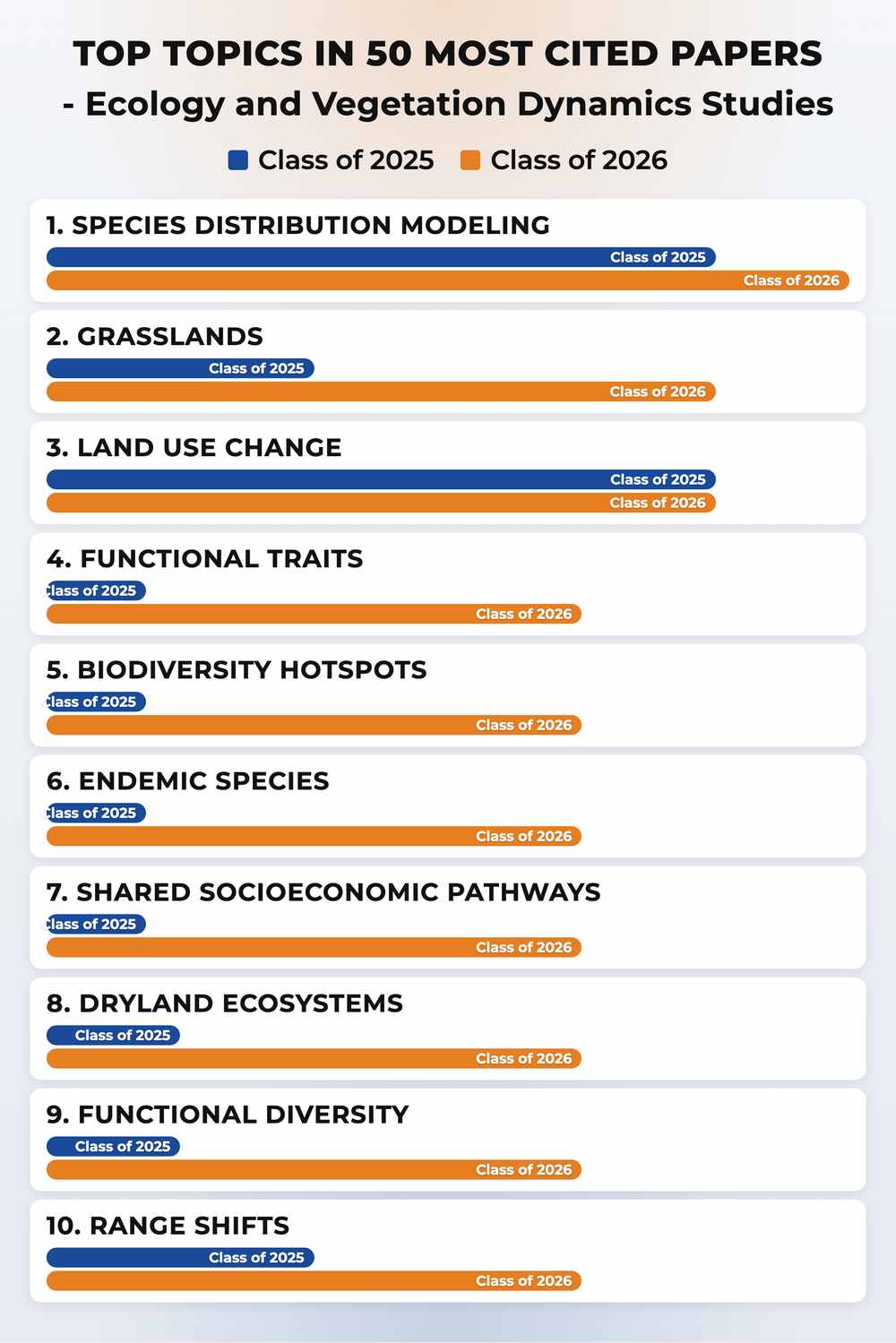
Comparing the Class of 2025 (2023 publications) to the Class of 2026 (2024 publications) reveals a pronounced transition from descriptive carbon accounting toward scenario-driven climate forecasting and functional conservation. The most notable emerging topics include Shared Socioeconomic Pathways, biodiversity hotspots, endemic species, functional traits, and conservation prioritization, all showing dramatic increases from near-zero baseline occurrences in the previous cohort to significant prevalence in 2024 literature. Dryland ecosystems and functional diversity also registered substantial multi-fold growth, reflecting expanded ecological field investigations across moisture-limited regions. Conversely, traditional ecosystem metrics experienced relative declines: carbon sequestration topics dropped from 12% in 2023 to 4% in 2024, and compositional turnover shifted downward from 6% to 4%. Meanwhile, baseline methodologies such as species distribution modeling (12%) and land use change assessments (10%) maintained steady core representation across both cohorts. These shifts illustrate a field-wide realignment from static habitat inventories and broad carbon dynamics toward predictive trait-based modeling, fine-scale climate scenario projections, and targeted conservation strategies.
Methodology
PRI identifies high-impact research using a transparent, topic-agnostic framework applied consistently across scientific domains. Bibliographic records are drawn from OpenAlex, including publication dates, citation relationships, and document types.
This ranking covers the Class of 2026 cohort: journal articles published in 2024. Reviews and other non-article document types are excluded to ensure comparability.
Research impact is quantified with an 18-month post-publication citation window—the number of citing works published within 18 months of each paper's publication date. This metric captures early impact while controlling for publication age.
An LLM-based relevance classifier then reviews each candidate's title and abstract to confirm substantive alignment with the target domain. Only papers classified as relevant appear in the final ranking.
Zheng Su, Tinsley Li, Thematic Shifts in Early-High-Impact Cancer Genomics and Diagnostics Research: A Bibliometric and Semantic Analysis. bioRxiv 2026.07.04.736459; doi: https://doi.org/10.64898/2026.07.04.736459
Cite this ranking
Pepkio Research Index (PRI). Topics and Trends in Most Cited Ecology and Vegetation Dynamics Studies Papers, Class of 2026. https://pri.pepkio.com/top-papers/ecology-and-vegetation-dynamics-studies/2026. Accessed 2026-10-16.

Methodology
Zheng Su, Tinsley Li, Thematic Shifts in Early-High-Impact Cancer Genomics and Diagnostics Research: A Bibliometric and Semantic Analysis. bioRxiv 2026.07.04.736459; doi: https://doi.org/10.64898/2026.07.04.736459