
What topics and trends defined most-cited Fish Ecology and Management Studies research in the Class of 2026?
The latest research in Fish Ecology and Management underscores a strong pivot towards ecosystem-wide conservation strategies. Prominent themes like biogeographic regions, dam impacts, and environmental DNA reflect modern, comprehensive approaches to monitoring ecosystem health. Noticeable surges in biomonitoring contrast with declines in traditional, localized aquaculture assessments.
At a glance
- Field
- Fish Ecology and Management Studies
- Cohort label
- Class of 2026 (2024 publications)
- Papers analyzed
- 8209
- Papers ranked
- 20
- Top topics in ranked papers
- Biogeographic regions, dam impacts, environmental DNA, biomonitoring
- Publication window
- Jan 1, 2024 – Dec 31, 2024
- Eligibility
- Research articles; reviews excluded
- Citation window
- 18 months post-publication
- 18m citation range
- 26–68
- Data source
- OpenAlex · Retrieved July 2026
- License
- CC BY 4.0
Rankings
20 papers ranked by 18-month citation count
The Global Dam Watch database of river barrier and reservoir information for large-scale applications
Scientific Data202410.1038/s41597-024-03752-9
Ecological erosion and expanding extinction risk of sharks and rays
Science202410.1126/science.adn1477
Stock assessment models overstate sustainability of the world’s fisheries
Science202410.1126/science.adl6282
Uniformity and deformation: A benchmark for multi-fish real-time tracking in the farming
Expert Systems with Applications202410.1016/j.eswa.2024.125653
Biological invasions are a population‐level rather than a species‐level phenomenon
Global Change Biology202410.1111/gcb.17312
Utilizing Deep Learning and the Internet of Things to Monitor the Health of Aquatic Ecosystems to Conserve Biodiversity
Natural and Engineering Sciences202410.28978/nesciences.1491795
Floodplain lakes: Linking hydrology to ecology and conservation
Earth-Science Reviews202410.1016/j.earscirev.2024.104967
Fishes of the upper rio Paraná basin: diversity, biogeography and conservation
Neotropical Ichthyology202410.1590/1982-0224-2023-0066
Fishing for oil and meat drives irreversible defaunation of deepwater sharks and rays
Science202410.1126/science.ade9121
Passive eDNA sampling facilitates biodiversity monitoring and rare species detection
Environment International202410.1016/j.envint.2024.108706
An Integrated Smart Pond Water Quality Monitoring and Fish Farming Recommendation Aquabot System
Sensors202410.3390/s24113682
Harnessing multimodal data fusion to advance accurate identification of fish feeding intensity
Biosystems Engineering202410.1016/j.biosystemseng.2024.08.001
Phylogenomics of Characidae, a hyper-diverse Neotropical freshwater fish lineage, with a phylogenetic classification including four families (Teleostei: Characiformes)
Zoological Journal of the Linnean Society202410.1093/zoolinnean/zlae101
Salmon Aquaculture in Chile: Production Growth and Socioeconomic Impacts
Reviews in Aquaculture202410.1111/raq.12993
Emergence of lake conditions that exceed natural temperature variability
Nature Geoscience202410.1038/s41561-024-01491-5
Land use and river-lake connectivity: Biodiversity determinants of lake ecosystems
Environmental Science and Ecotechnology202410.1016/j.ese.2024.100434
Underestimated nutrient from aquaculture ponds to Lake Eutrophication: A case study on Taihu Lake Basin
Journal of Hydrology202410.1016/j.jhydrol.2024.130749
River ecological status is shaped by agricultural land use intensity across Europe
Water Research202410.1016/j.watres.2024.121136
Past and recent anthropogenic pressures drive rapid changes in riverine fish communities
Nature Ecology & Evolution202410.1038/s41559-023-02271-x
Unravelling large-scale patterns and drivers of biodiversity in dry rivers
Nature Communications202410.1038/s41467-024-50873-1
Topic trends
Dominant research themes and year-over-year shifts in Fish Ecology and Management Studies
What Topics Define the Class of 2026?
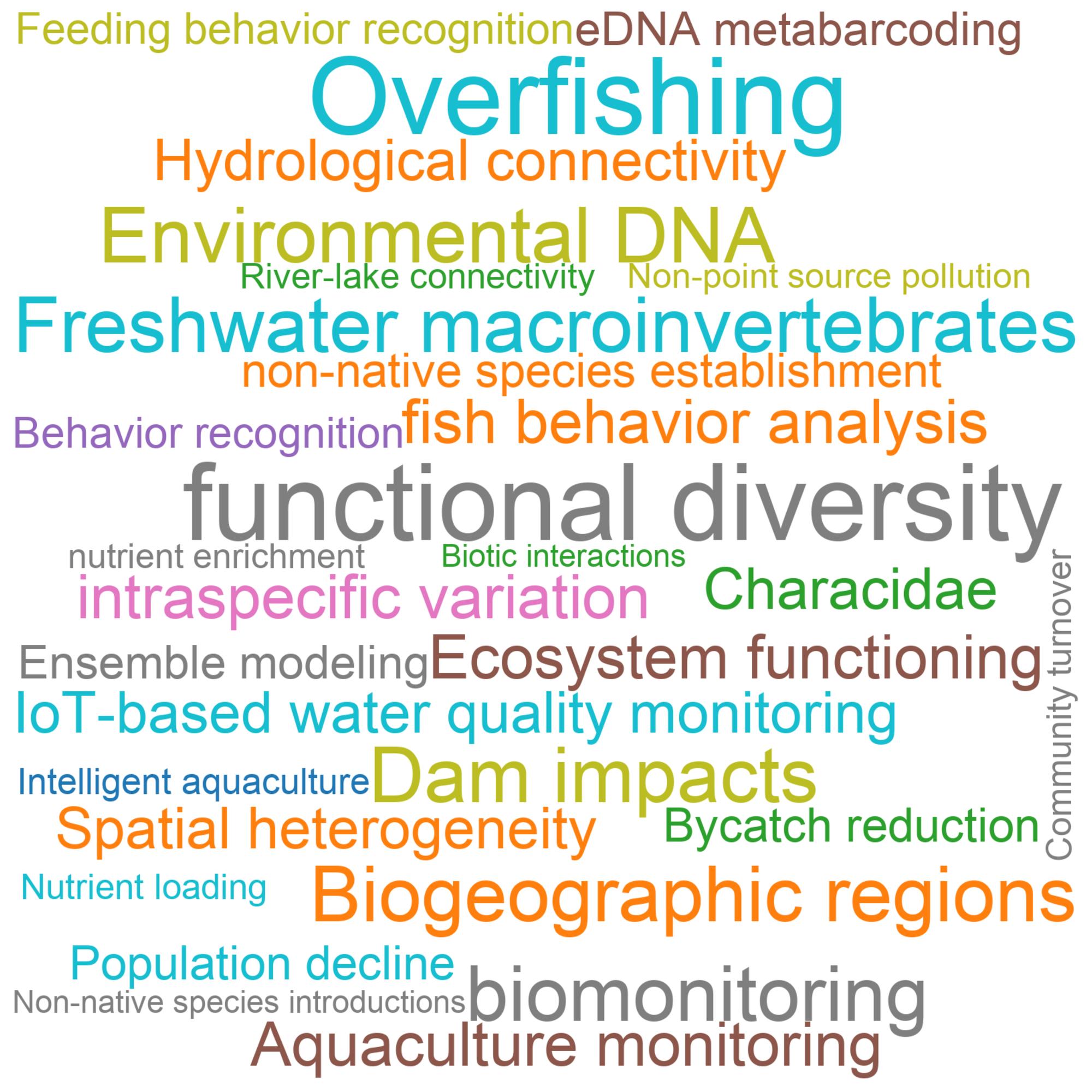
The Class of 2026 in Fish Ecology and Management Studies is dominated by a diverse set of research areas that reflect a dual focus on conservation biology and the anthropogenic impacts on aquatic ecosystems. Topics such as biogeographic regions, functional diversity, and freshwater macroinvertebrates highlight the field's ongoing dedication to understanding intricate biodiversity patterns and ecosystem functions. Simultaneously, pressing issues like overfishing and dam impacts underscore the critical need to address human-induced stressors on aquatic life. The prominence of modern techniques is notably evident, with environmental DNA (eDNA) and advanced biomonitoring playing an increasingly vital role in observing and managing these fragile ecosystems. Together, these topics illustrate a discipline that is successfully leveraging novel monitoring tools to tackle urgent ecological challenges and refine broad-scale management strategies.
How Did Topics Shift from the Class of 2025 to the Class of 2026?
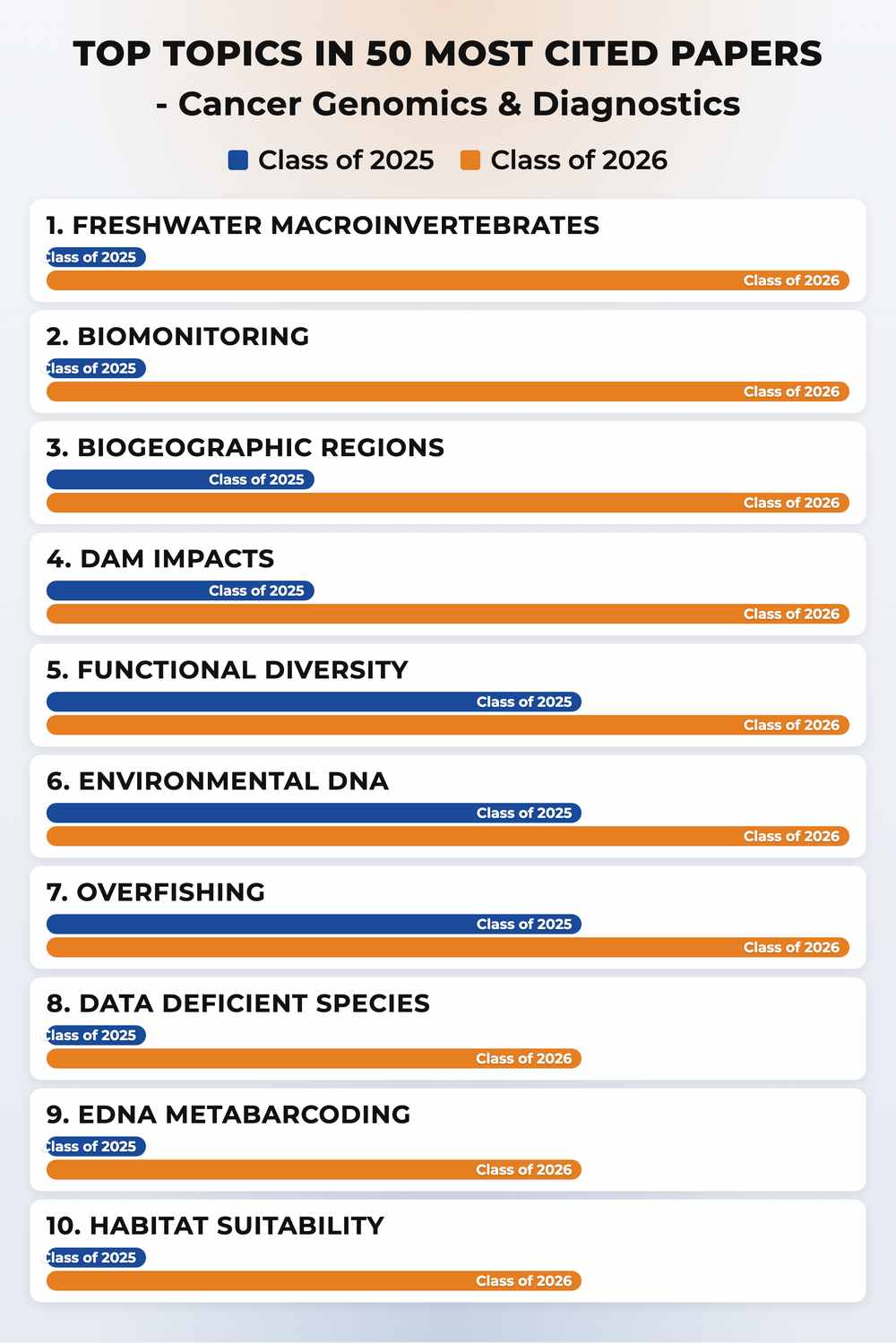
Between the Class of 2025 and 2026, research focus shifted significantly toward advanced ecological assessment and extensive conservation planning. The most striking increases were observed in biomonitoring and freshwater macroinvertebrates, both showing substantial growth as researchers prioritize robust and scalable indicators of ecosystem health. Similarly, studies addressing biogeographic regions and dam impacts saw notable upward trends, reflecting an increased global emphasis on understanding large-scale habitat connectivity and the far-reaching consequences of infrastructure. Conversely, topics such as aquaculture monitoring and community turnover experienced relative declines. This pattern suggests a broader transition within the field: moving away from localized, commercially-focused monitoring toward holistic, biodiversity-centric ecological tracking using innovative approaches. The data clearly indicates that the discipline is rapidly evolving to meet complex, ecosystem-wide challenges head-on.
Methodology
PRI identifies high-impact research using a transparent, topic-agnostic framework applied consistently across scientific domains. Bibliographic records are drawn from OpenAlex, including publication dates, citation relationships, and document types.
This ranking covers the Class of 2026 cohort: journal articles published in 2024. Reviews and other non-article document types are excluded to ensure comparability.
Research impact is quantified with an 18-month post-publication citation window—the number of citing works published within 18 months of each paper's publication date. This metric captures early impact while controlling for publication age.
An LLM-based relevance classifier then reviews each candidate's title and abstract to confirm substantive alignment with the target domain. Only papers classified as relevant appear in the final ranking.
Zheng Su, Tinsley Li, Thematic Shifts in Early-High-Impact Cancer Genomics and Diagnostics Research: A Bibliometric and Semantic Analysis. bioRxiv 2026.07.04.736459; doi: https://doi.org/10.64898/2026.07.04.736459
Cite this ranking
Pepkio Research Index (PRI). Topics and Trends in Most Cited Fish Ecology and Management Studies Papers, Class of 2026. https://pri.pepkio.com/top-papers/fish-ecology-and-management-studies/2026. Accessed 2026-10-14.

Methodology
Zheng Su, Tinsley Li, Thematic Shifts in Early-High-Impact Cancer Genomics and Diagnostics Research: A Bibliometric and Semantic Analysis. bioRxiv 2026.07.04.736459; doi: https://doi.org/10.64898/2026.07.04.736459