
What topics and trends defined most-cited Wildlife Ecology and Conservation research in the Class of 2026?
The Class of 2026 for Wildlife Ecology and Conservation research reveals a significant shift toward proactive landscape management. Studies increasingly focus on spatial connectivity, ecological corridors, and security patterns, moving away from merely documenting threats like habitat loss and extinction risk to designing large-scale structural conservation solutions.
At a glance
- Field
- Wildlife Ecology and Conservation
- Cohort label
- Class of 2026 (2024 publications)
- Papers analyzed
- 8,640
- Papers ranked
- 20
- Top topics in ranked papers
- Ecological corridors, Ecological security pattern, Ecological source areas
- Publication window
- Jan 1, 2024 – Dec 31, 2024
- Eligibility
- Research articles; reviews excluded
- Citation window
- 18 months post-publication
- 18m citation range
- 38–109
- Data source
- OpenAlex · Retrieved Jul 2026
- License
- CC BY 4.0
Rankings
20 papers ranked by 18-month citation count
Mechanisms, detection and impacts of species redistributions under climate change
Nature Reviews Earth & Environment202410.1038/s43017-024-00527-z
The economic impacts of ecosystem disruptions: Costs from substituting biological pest control
Science202410.1126/science.adg0344
Biodiversity impacts of the 2019–2020 Australian megafires
Nature202410.1038/s41586-024-08174-6
The Social Costs of Keystone Species Collapse: Evidence from the Decline of Vultures in India
American Economic Review202410.1257/aer.20230016
Functional traits—not nativeness—shape the effects of large mammalian herbivores on plant communities
Science202410.1126/science.adh2616
Guidelines for appropriate use of BirdNET scores and other detector outputs
Journal für Ornithologie202410.1007/s10336-024-02144-5
Revealing uncertainty in the status of biodiversity change
Nature202410.1038/s41586-024-07236-z
Global evaluation of current and future threats to drylands and their vertebrate biodiversity
Nature Ecology & Evolution202410.1038/s41559-024-02450-4
Global expansion of human-wildlife overlap in the 21st century
Science Advances202410.1126/sciadv.adp7706
The global loss of avian functional and phylogenetic diversity from anthropogenic extinctions
Science202410.1126/science.adk7898
Mapping the planet’s critical areas for biodiversity and nature’s contributions to people
Nature Communications202410.1038/s41467-023-43832-9
Spatiotemporal dynamics and forecasting of ecological security pattern under the consideration of protecting habitat: a case study of the Poyang Lake ecoregion
International Journal of Digital Earth202410.1080/17538947.2024.2376277
Anthropogenic climate and land-use change drive short- and long-term biodiversity shifts across taxa
Nature Ecology & Evolution202410.1038/s41559-024-02326-7
Mammal responses to global changes in human activity vary by trophic group and landscape
Nature Ecology & Evolution202410.1038/s41559-024-02363-2
Ecological network assessment in dynamic landscapes: Multi-scenario simulation and conservation priority analysis
Land Use Policy202410.1016/j.landusepol.2024.107059
Treating gaps and biases in biodiversity data as a missing data problem
Biological reviews/Biological reviews of the Cambridge Philosophical Society202410.1111/brv.13127
Application of MSPA-MCR models to construct ecological security pattern in the basin: A case study of Dawen River basin
Ecological Indicators202410.1016/j.ecolind.2024.111887
The impact of habitat loss and fragmentation on biodiversity in global protected areas
The Science of The Total Environment202410.1016/j.scitotenv.2024.173004
Incorporating barriers restoration and stepping stones establishment to enhance the connectivity of watershed ecological security patterns
Applied Geography202410.1016/j.apgeog.2024.103347
Identifying ecological security patterns to prioritize conservation and restoration:A case study in Xishuangbanna tropical region, China
Journal of Cleaner Production202410.1016/j.jclepro.2024.141222
Topic trends
Dominant research themes and year-over-year shifts in Wildlife Ecology and Conservation
What Topics Define the Class of 2026?
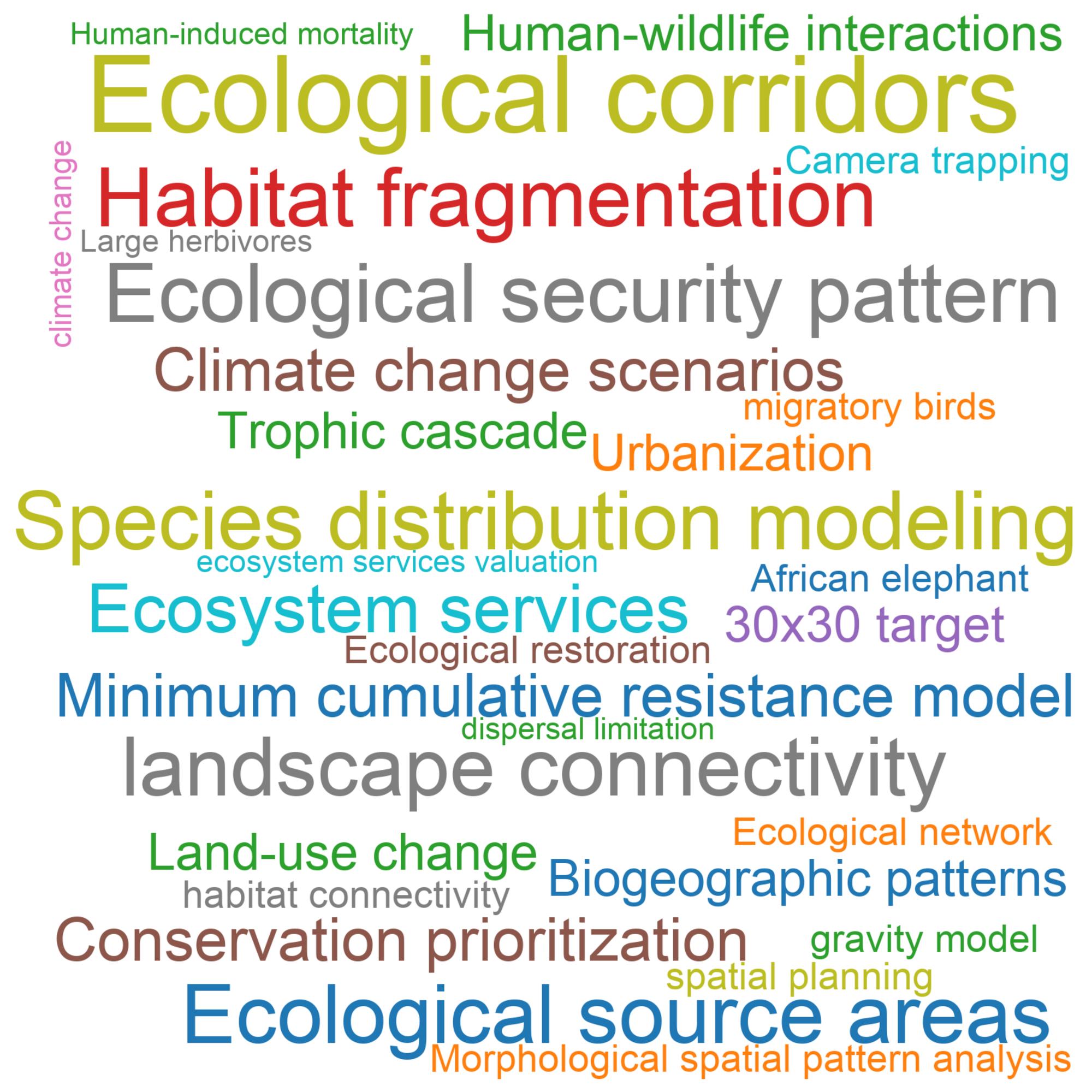
In the Class of 2026, research in Wildlife Ecology and Conservation is heavily focused on landscape-level connectivity and ecological security. Dominant topics include "Ecological corridors", "Ecological security pattern", and "Ecological source areas", which collectively highlight a structural approach to conservation. This spatial focus is further reinforced by the prominence of "Habitat fragmentation" and "landscape connectivity". The methodological backbone supporting these priorities is "Species distribution modeling", a critical tool for identifying key habitats. This cluster of topics implies that the field is moving beyond simply cataloging biodiversity, prioritizing actionable, large-scale spatial planning to ensure species persistence across fragmented landscapes.
How Did Topics Shift from the Class of 2025 to the Class of 2026?
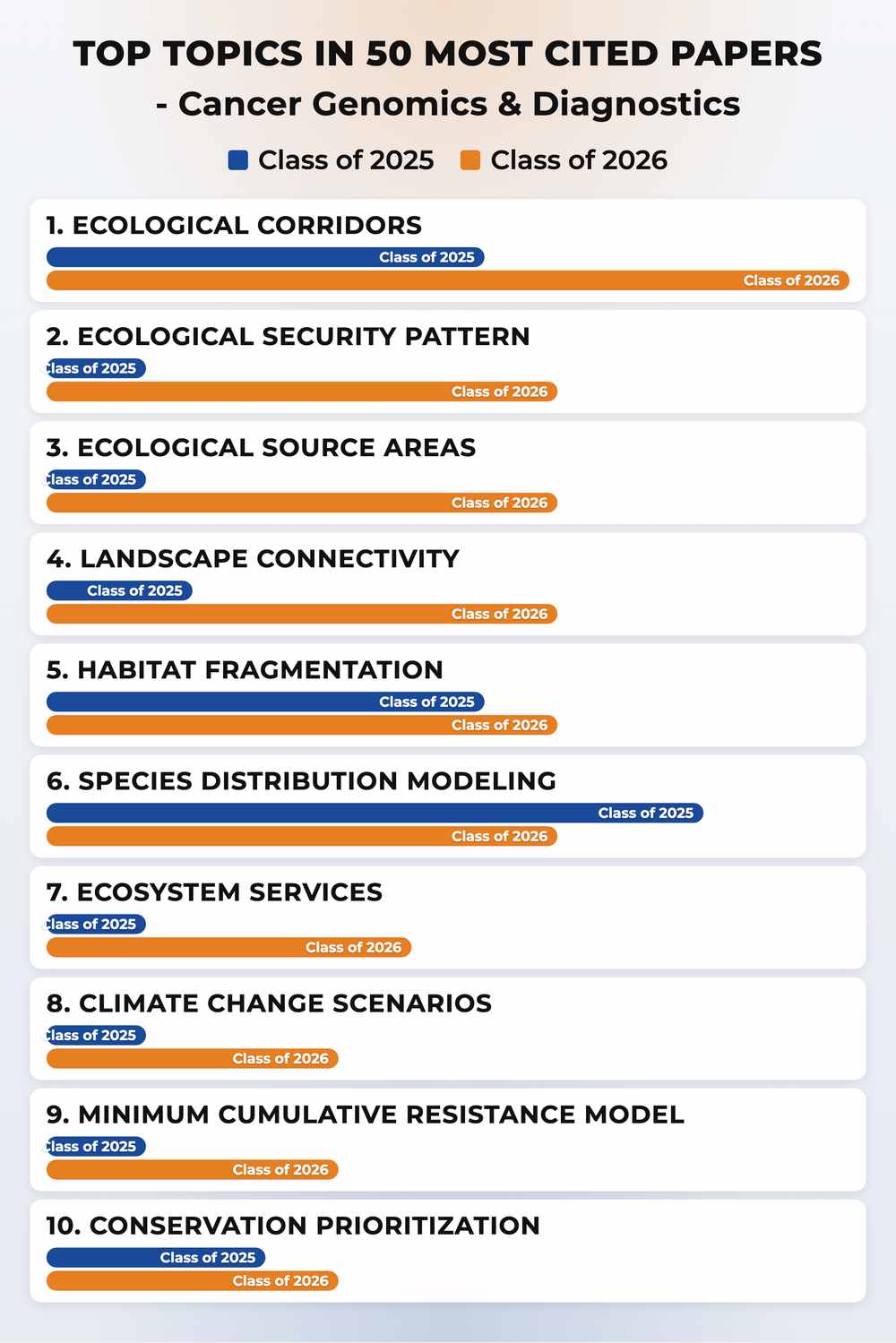
The shift from the Class of 2025 to the Class of 2026 illustrates a clear transition from documenting environmental threats toward developing proactive conservation frameworks. Topics like "Ecological security pattern", "Ecological source areas", and "Ecosystem services" saw massive growth, becoming central to the highest-cited papers. Concurrently, traditional impact-focused themes such as "Extinction risk", "Habitat loss", and "Urbanization" experienced a relative decline in prominence. This pattern suggests that the research community is increasingly focused on systemic solutions and large-scale spatial planning—identifying critical areas and preserving connectivity—rather than just quantifying the magnitude of ecological decline.
Methodology
PRI identifies high-impact research using a transparent, topic-agnostic framework applied consistently across scientific domains. Bibliographic records are drawn from OpenAlex, including publication dates, citation relationships, and document types.
This ranking covers the Class of 2026 cohort: journal articles published in 2024. Reviews and other non-article document types are excluded to ensure comparability.
Research impact is quantified with an 18-month post-publication citation window—the number of citing works published within 18 months of each paper's publication date. This metric captures early impact while controlling for publication age.
An LLM-based relevance classifier then reviews each candidate's title and abstract to confirm substantive alignment with the target domain. Only papers classified as relevant appear in the final ranking.
Zheng Su, Tinsley Li, Thematic Shifts in Early-High-Impact Cancer Genomics and Diagnostics Research: A Bibliometric and Semantic Analysis. bioRxiv 2026.07.04.736459; doi: https://doi.org/10.64898/2026.07.04.736459
Cite this ranking
Pepkio Research Index (PRI). Topics and Trends in Most Cited Wildlife Ecology and Conservation Papers, Class of 2026. https://pri.pepkio.com/top-papers/wildlife-ecology-and-conservation/2026. Accessed 2026-10-14.

Methodology
Zheng Su, Tinsley Li, Thematic Shifts in Early-High-Impact Cancer Genomics and Diagnostics Research: A Bibliometric and Semantic Analysis. bioRxiv 2026.07.04.736459; doi: https://doi.org/10.64898/2026.07.04.736459