
What topics and trends defined most-cited Botany and Plant Ecology Studies research in the Class of 2026?
Functional diversity, ecosystem multifunctionality, and microbial interactions dominate the Botany and Plant Ecology Class of 2026. Research is shifting rapidly toward climate-focused and applied solutions, with massive surges in studies on carbon storage, phytoremediation, and microbial diversity, while traditional descriptive floristic inventories and niche studies have declined.
At a glance
- Field
- Botany and Plant Ecology Studies
- Cohort label
- Class of 2026 (2024 publications)
- Papers analyzed
- 4,897
- Papers ranked
- 20
- Top topics in ranked papers
- Alpine grassland, ecosystem multifunctionality, microbial community structure
- Publication window
- Jan 1, 2024 – Dec 31, 2024
- Eligibility
- Research articles; reviews excluded
- Citation window
- 18 months post-publication
- 18m citation range
- 17–97
- Data source
- OpenAlex · Retrieved Jul 2026
- License
- CC BY 4.0
Rankings
20 papers ranked by 18-month citation count
A second update to the checklist of the vascular flora native to Italy
Plant Biosystems - An International Journal Dealing with all Aspects of Plant Biology202410.1080/11263504.2024.2320126
Shifts in native tree species distributions in Europe under climate change
Journal of Environmental Management202410.1016/j.jenvman.2024.123504
Nitrogen availability in soil controls uptake of different nitrogen forms by plants
New Phytologist202410.1111/nph.20335
A second update to the checklist of the vascular flora alien to Italy
Plant Biosystems - An International Journal Dealing with all Aspects of Plant Biology202410.1080/11263504.2024.2320129
<scp>FloraVeg</scp>.<scp>EU</scp> — An online database of European vegetation, habitats and flora
Applied Vegetation Science202410.1111/avsc.12798
A model suitable for estimating above-ground biomass of potatoes at different regional levels
Computers and Electronics in Agriculture202410.1016/j.compag.2024.109081
Global distribution and drivers of relative contributions among soil nitrogen sources to terrestrial plants
Nature Communications202410.1038/s41467-024-50674-6
Soil quality and ecosystem multifunctionality after 13-year of organic and nitrogen fertilization
The Science of The Total Environment202410.1016/j.scitotenv.2024.172789
Worldwide forest surveys reveal forty-three new species in <i> Phytophthora</i> major Clade 2 with fundamental implications for the evolution and biogeography of the genus and global plant biosecurity
Studies in Mycology202410.3114/sim.2024.107.04
Plant biomass partitioning in alpine meadows under different herbivores as influenced by soil bulk density and available nutrients
CATENA202410.1016/j.catena.2024.108017
Does restoring apex predators to food webs restore ecosystems? Large carnivores in <scp>Y</scp>ellowstone as a model system
Ecological Monographs202410.1002/ecm.1598
Map of forest tree species for Poland based on Sentinel-2 data
Earth system science data202410.5194/essd-16-2877-2024
Adaptive convergence and divergence underpin the diversity of Asteraceae in a semi-arid lowland region
Flora202410.1016/j.flora.2024.152554
Plant species diversity and functional diversity relations in the degradation process of desert steppe in an arid area of northwest China
Journal of Environmental Management202410.1016/j.jenvman.2024.121534
Diversity and distribution of Raunkiær's life forms in European vegetation
Journal of Vegetation Science202410.1111/jvs.13229
Major tree species of Central European forests differ in their proportion of positive, negative, and nonstationary growth trends
Global Change Biology202410.1111/gcb.17146
Arbuscular mycorrhizal fungi alter microbiome structure of rhizosphere soil to enhance Festuca elata tolerance to Cd
Applied Soil Ecology202410.1016/j.apsoil.2024.105735
The spatial variations and driving factors of C, N, P stoichiometric characteristics of plant and soil in the terrestrial ecosystem
The Science of The Total Environment202410.1016/j.scitotenv.2024.175543
The Bryophyte Phylogeny Group: A revised familial classification system based on plastid phylogenomic data
Journal of Systematics and Evolution202410.1111/jse.13063
Examining the Sensitivity of Satellite-Derived Vegetation Indices to Plant Drought Stress in Grasslands in Poland
Plants202410.3390/plants13162319
Topic trends
Dominant research themes and year-over-year shifts in Botany and Plant Ecology Studies
What Topics Define the Class of 2026?
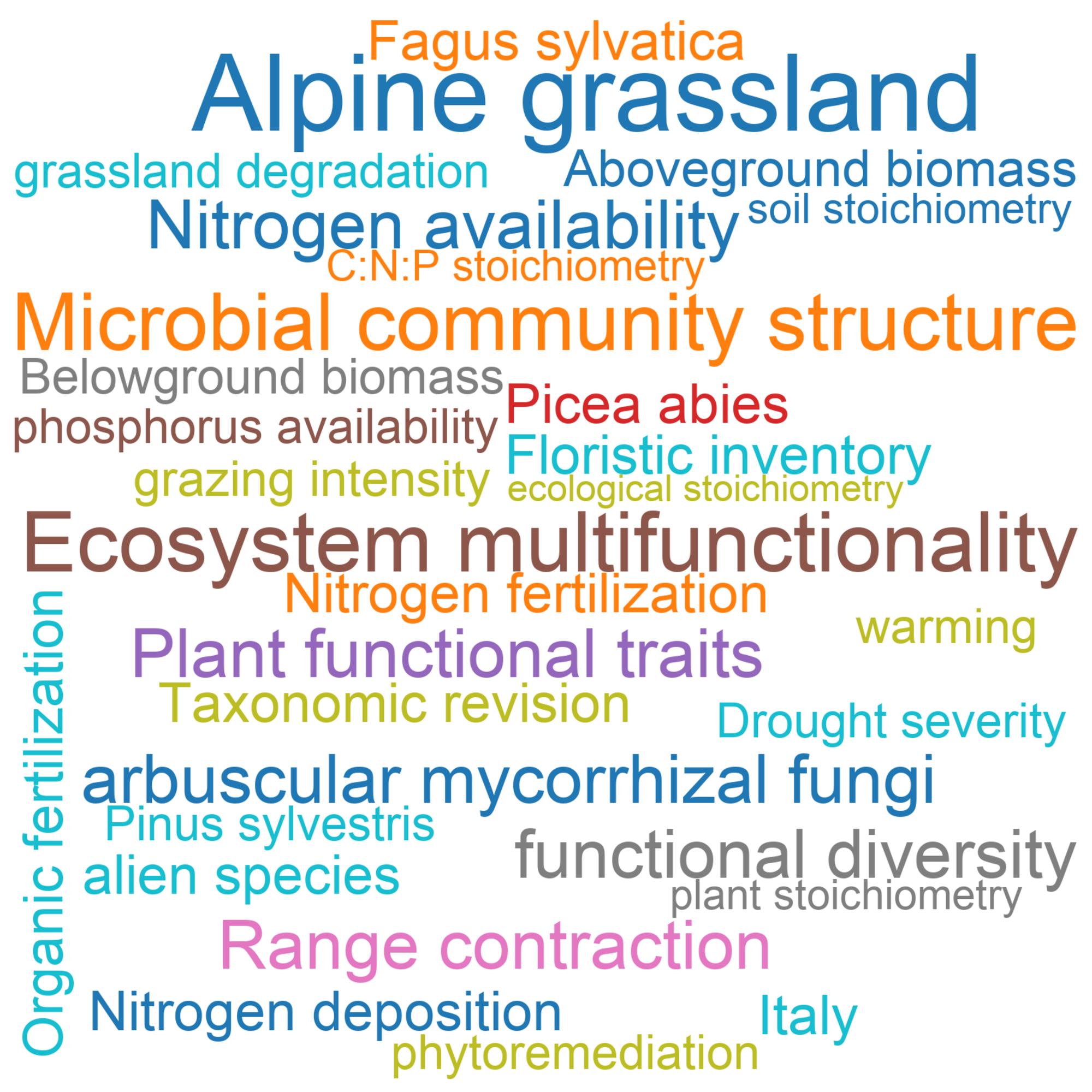
In the Class of 2026 for Botany and Plant Ecology Studies, functional diversity, ecosystem multifunctionality, and microbial community emerged as the most dominant themes. The high frequency of these topics indicates a strong emphasis on understanding how different plant species and microbial communities interact to support complex ecosystem processes. Researchers are increasingly focusing on how biodiversity directly impacts ecosystem resilience and the multifaceted services that these ecosystems provide. Additionally, significant attention was given to species diversity, soil moisture, and phytoremediation. The prominence of arbuscular mycorrhizal fungi further highlights the critical role of below-ground interactions and symbioses in shaping above-ground plant health and community structure. Together, these topics reflect a paradigm shift towards holistic, trait-based approaches that integrate microbial dynamics and functional traits to better predict ecological outcomes in varying environments.
How Did Topics Shift from the Class of 2025 to the Class of 2026?
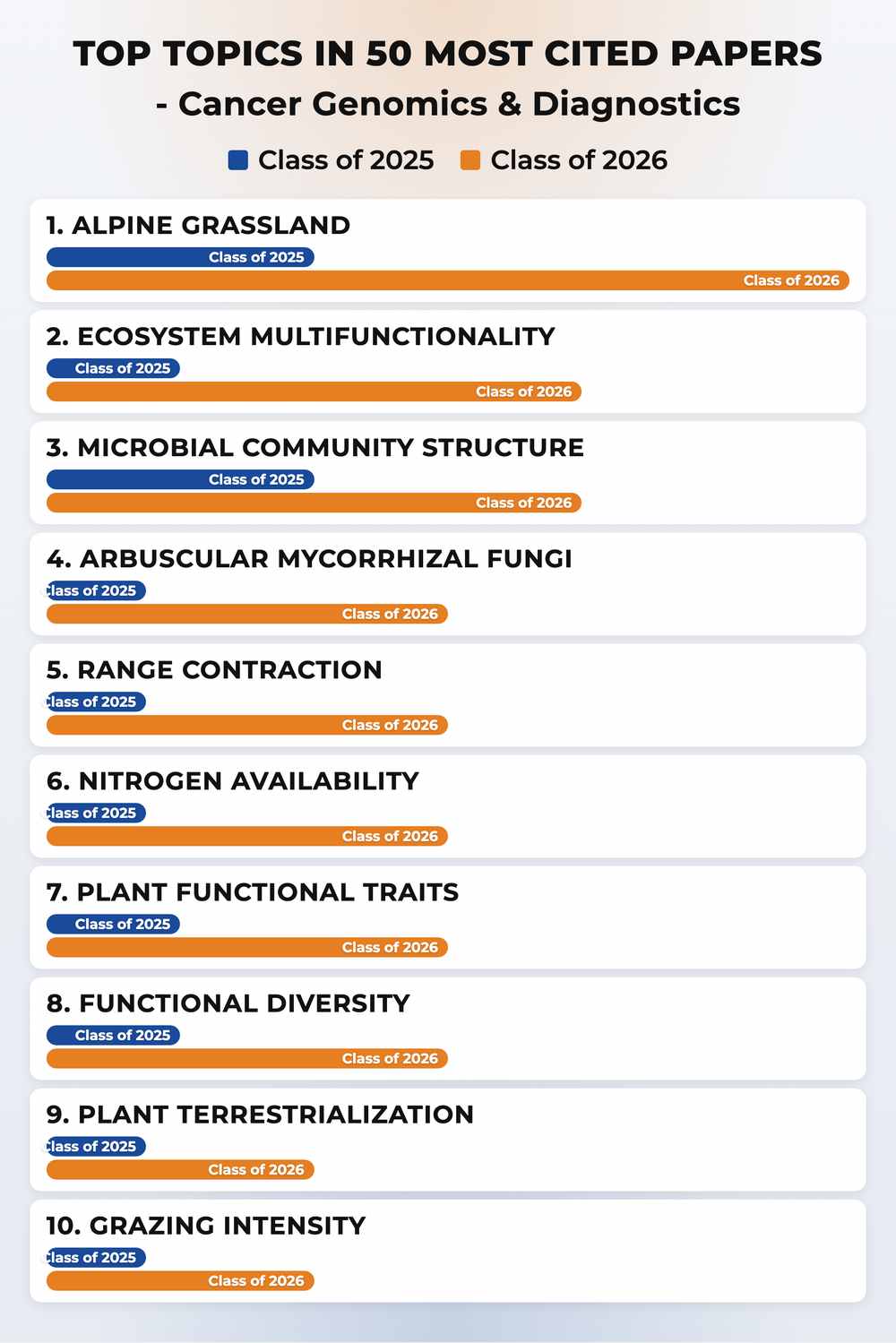
The transition from the Class of 2025 to the Class of 2026 revealed notable shifts in research priorities within Botany and Plant Ecology. We observed significant surges in topics related to microbial diversity, phytoremediation, and carbon storage, reflecting an urgent shift toward applied ecological solutions and climate change mitigation strategies. Climate warming and arbuscular mycorrhizal fungi also saw substantial increases, underscoring a growing recognition of the interconnectedness of climate stressors and symbiotic soil interactions. Conversely, more traditional descriptive approaches such as floristic inventory, along with specific studies on bryophytes, mosses, and alpine meadows, experienced relative declines. This shift suggests that the field is moving rapidly from cataloging plant life and studying isolated ecological niches toward functional, systems-level analyses aimed at addressing global environmental challenges.
Methodology
PRI identifies high-impact research using a transparent, topic-agnostic framework applied consistently across scientific domains. Bibliographic records are drawn from OpenAlex, including publication dates, citation relationships, and document types.
This ranking covers the Class of 2026 cohort: journal articles published in 2024. Reviews and other non-article document types are excluded to ensure comparability.
Research impact is quantified with an 18-month post-publication citation window—the number of citing works published within 18 months of each paper's publication date. This metric captures early impact while controlling for publication age.
An LLM-based relevance classifier then reviews each candidate's title and abstract to confirm substantive alignment with the target domain. Only papers classified as relevant appear in the final ranking.
Zheng Su, Tinsley Li, Thematic Shifts in Early-High-Impact Cancer Genomics and Diagnostics Research: A Bibliometric and Semantic Analysis. bioRxiv 2026.07.04.736459; doi: https://doi.org/10.64898/2026.07.04.736459
Cite this ranking
Pepkio Research Index (PRI). Topics and Trends in Most Cited Botany and Plant Ecology Studies Papers, Class of 2026. https://pri.pepkio.com/top-papers/botany-and-plant-ecology-studies/2026. Accessed 2026-10-14.

Methodology
Zheng Su, Tinsley Li, Thematic Shifts in Early-High-Impact Cancer Genomics and Diagnostics Research: A Bibliometric and Semantic Analysis. bioRxiv 2026.07.04.736459; doi: https://doi.org/10.64898/2026.07.04.736459