
What topics and trends defined most-cited Soil Carbon and Nitrogen Dynamics research in the Class of 2026?
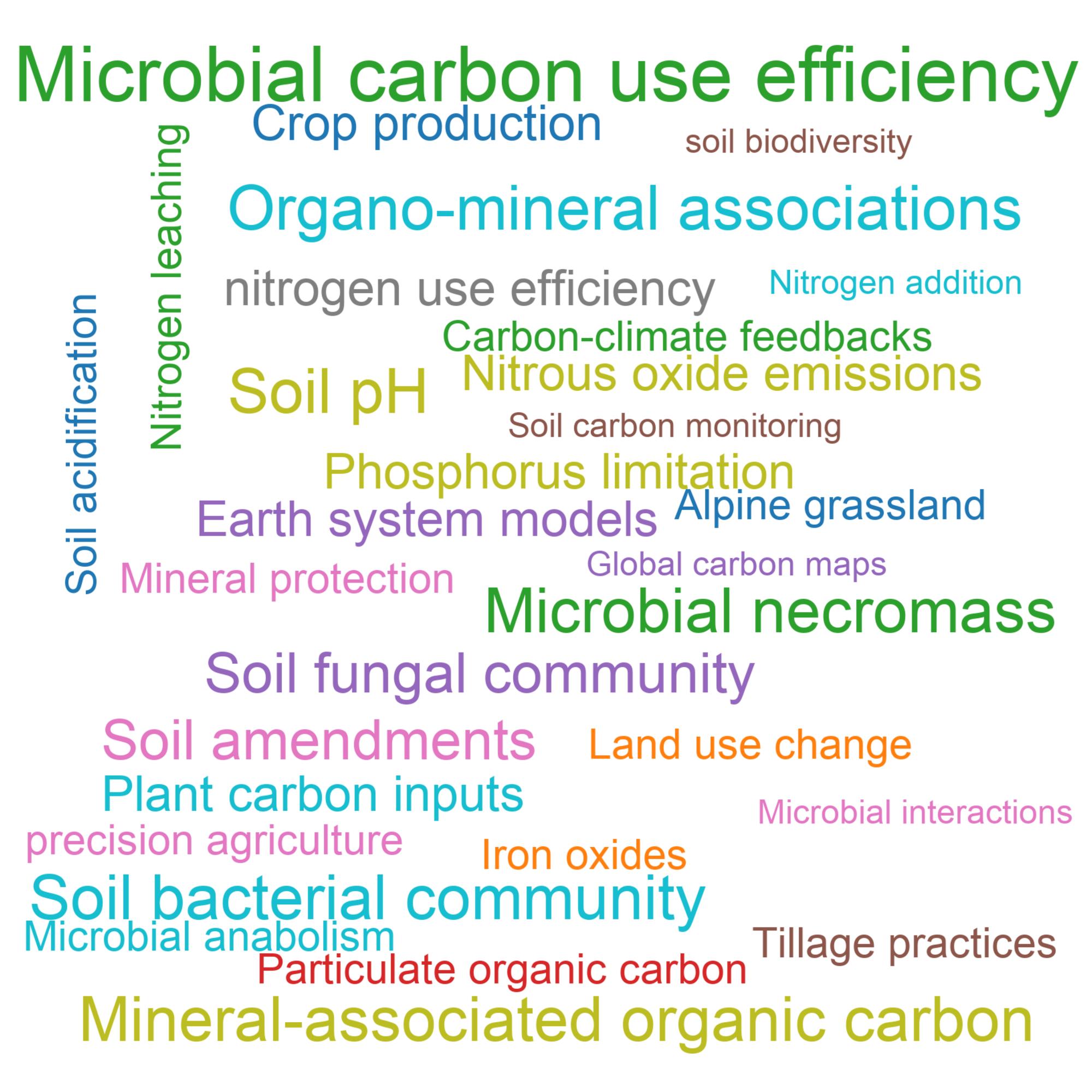
The Class of 2026 is defined by a shift towards microscopic microbial mechanisms and global predictive modeling, moving away from traditional macroscopic agricultural management. Microbial carbon use efficiency and organo-mineral associations emerged as dominant themes, reflecting the field's deep focus on biological and physical pathways for carbon stabilization.
At a glance
- Field
- Soil Carbon and Nitrogen Dynamics
- Cohort label
- Class of 2026 (2024 publications)
- Papers analyzed
- 8,999
- Papers ranked
- 20
- Top topics in ranked papers
- Microbial carbon use efficiency, mineral-associated organic carbon, microbial necromass
- Publication window
- Jan 1, 2024 – Dec 31, 2024
- Eligibility
- Research articles; reviews excluded
- Citation window
- 18 months post-publication
- 18m citation range
- 69–138
- Data source
- OpenAlex · Retrieved July 2026
- License
- CC BY 4.0
Rankings
20 papers ranked by 18-month citation count
Soil microbiomes show consistent and predictable responses to extreme events
Nature202410.1038/s41586-024-08185-3
Nutrient-induced acidification modulates soil biodiversity-function relationships
Nature Communications202410.1038/s41467-024-47323-3
Important role of Fe oxides in global soil carbon stabilization and stocks
Nature Communications202410.1038/s41467-024-54832-8
Land conversion to agriculture induces taxonomic homogenization of soil microbial communities globally
Nature Communications202410.1038/s41467-024-47348-8
Plant diversity drives positive microbial associations in the rhizosphere enhancing carbon use efficiency in agricultural soils
Nature Communications202410.1038/s41467-024-52449-5
Global turnover of soil mineral-associated and particulate organic carbon
Nature Communications202410.1038/s41467-024-49743-7
Balancing agricultural production and environmental sustainability: Based on Economic Analysis From North China Plain
Environmental Research202410.1016/j.envres.2024.118784
Reducing the uncertainty in estimating soil microbial-derived carbon storage
Proceedings of the National Academy of Sciences202410.1073/pnas.2401916121
Size, distribution, and vulnerability of the global soil inorganic carbon
Science202410.1126/science.adi7918
Conservation agriculture improves soil health and sustains crop yields after long-term warming
Nature Communications202410.1038/s41467-024-53169-6
Microbial trait multifunctionality drives soil organic matter formation potential
Nature Communications202410.1038/s41467-024-53947-2
Enhancing soil health to minimize cadmium accumulation in agro-products: the role of microorganisms, organic matter, and nutrients
Environmental Pollution202410.1016/j.envpol.2024.123890
Microbially mediated mechanisms underlie soil carbon accrual by conservation agriculture under decade-long warming
Nature Communications202410.1038/s41467-023-44647-4
Optimized agricultural management reduces global cropland nitrogen losses to air and water
Nature Food202410.1038/s43016-024-01076-w
Biochar and organic fertilizer applications enhance soil functional microbial abundance and agroecosystem multifunctionality
Biochar202410.1007/s42773-023-00296-w
Simplified microbial network reduced microbial structure stability and soil functionality in alpine grassland along a natural aridity gradient
Soil Biology and Biochemistry202410.1016/j.soilbio.2024.109366
Optimizing cover crop practices as a sustainable solution for global agroecosystem services
Nature Communications202410.1038/s41467-024-54536-z
Microbial and mineral interactions decouple litter quality from soil organic matter formation
Nature Communications202410.1038/s41467-024-54446-0
Microbial competition for phosphorus limits the CO2 response of a mature forest
Nature202410.1038/s41586-024-07491-0
Reducing soil nitrogen losses from fertilizer use in global maize and wheat production
Nature Geoscience202410.1038/s41561-024-01542-x
Topic trends
Dominant research themes and year-over-year shifts in Soil Carbon and Nitrogen Dynamics
What Topics Define the Class of 2026?
In the Class of 2026, research in soil carbon and nitrogen dynamics is largely defined by microbial mechanisms and soil organic matter interactions. The most prominent theme is Microbial Carbon Use Efficiency, reflecting a deep focus on how microorganisms process and stabilize carbon. This aligns closely with strong clusters around Mineral-Associated Organic Carbon, Organo-Mineral Associations, and Microbial Necromass, highlighting a paradigm shift toward understanding the physical and biological carbon stabilization pathways at microscopic scales. Furthermore, foundational variables like Soil pH and Soil Bacterial Communities continue to play dominant roles as researchers seek to map these intricate microbial-physicochemical relationships. The prominence of Soil Amendments and Soil Fungal Communities also underscores a highly applied angle, as the field connects fundamental microbial ecology with practical strategies to enhance soil health and sustainable agricultural practices. Overall, this cohort represents a convergence of mechanistic soil microbiology and applied carbon sequestration strategies.
How Did Topics Shift from the Class of 2025 to the Class of 2026?
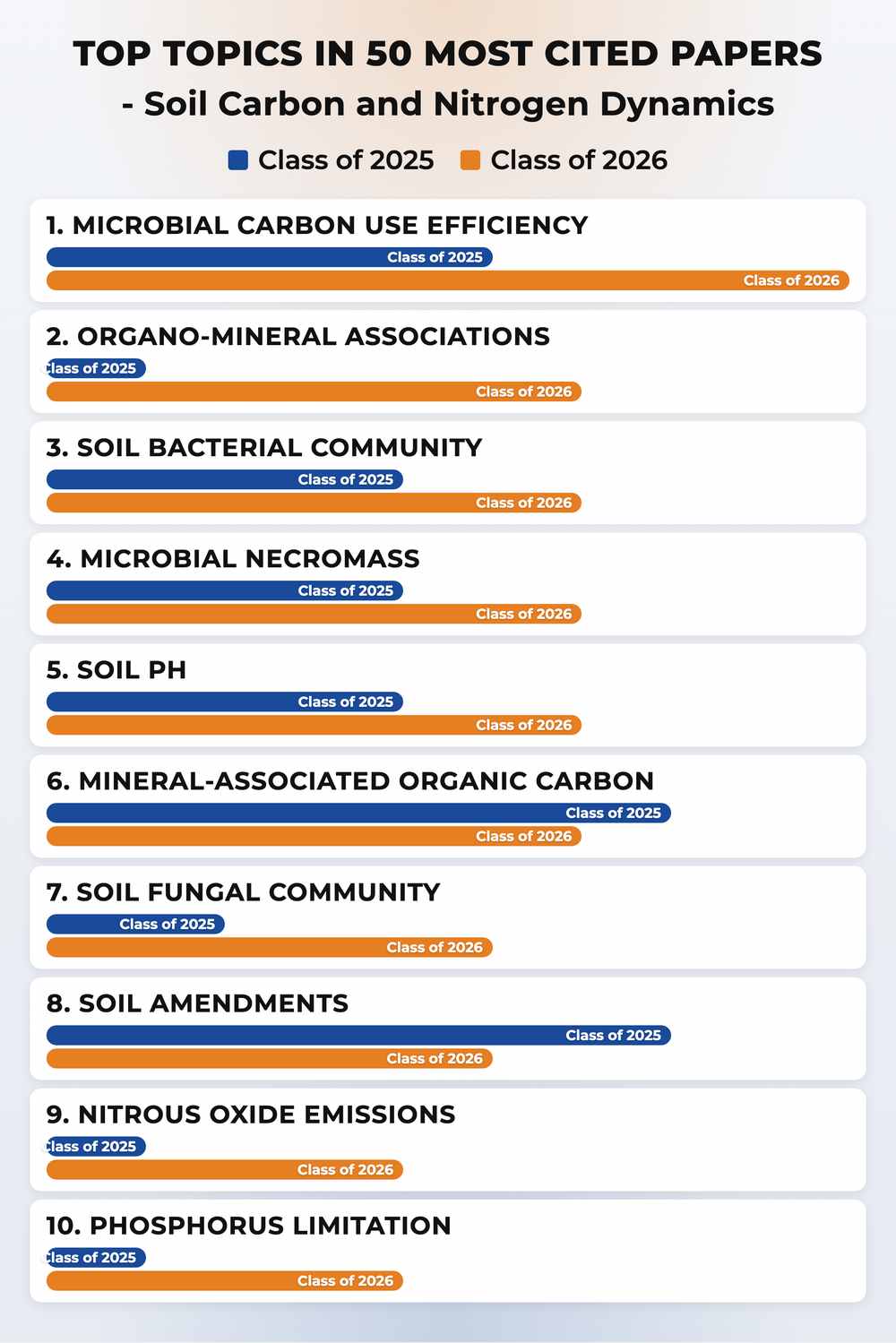
The transition from the Class of 2025 to the Class of 2026 reveals a distinct shift from broad agricultural management to specialized mechanistic studies and Earth system modeling. The most explosive growth was seen in Organo-Mineral Associations, Earth System Models, Nitrous Oxide Emissions, and Phosphorus Limitation, which emerged rapidly to dominate recent discussions. Similarly, Microbial Carbon Use Efficiency saw significant growth, underscoring the field's pivot toward microscopic drivers of carbon stabilization. Conversely, macro-level agricultural topics experienced notable declines; concepts such as Crop Production, Plant Carbon Inputs, and Fertilization Management saw their prominence halved compared to the previous year. This cohort shift suggests that while agricultural applications remain relevant, the cutting-edge of the field has moved aggressively toward integrating granular microbial and mineral interactions into predictive global climate models and understanding complex biogeochemical feedbacks like greenhouse gas emissions.
Methodology
PRI identifies high-impact research using a transparent, topic-agnostic framework applied consistently across scientific domains. Bibliographic records are drawn from OpenAlex, including publication dates, citation relationships, and document types.
This ranking covers the Class of 2026 cohort: journal articles published in 2024. Reviews and other non-article document types are excluded to ensure comparability.
Research impact is quantified with an 18-month post-publication citation window—the number of citing works published within 18 months of each paper's publication date. This metric captures early impact while controlling for publication age.
An LLM-based relevance classifier then reviews each candidate's title and abstract to confirm substantive alignment with the target domain. Only papers classified as relevant appear in the final ranking.
Zheng Su, Tinsley Li, Thematic Shifts in Early-High-Impact Cancer Genomics and Diagnostics Research: A Bibliometric and Semantic Analysis. bioRxiv 2026.07.04.736459; doi: https://doi.org/10.64898/2026.07.04.736459
Cite this ranking
Pepkio Research Index (PRI). Topics and Trends in Most Cited Soil Carbon and Nitrogen Dynamics Papers, Class of 2026. https://pri.pepkio.com/top-papers/soil-carbon-and-nitrogen-dynamics/2026. Accessed 2026-10-16.

Methodology
Zheng Su, Tinsley Li, Thematic Shifts in Early-High-Impact Cancer Genomics and Diagnostics Research: A Bibliometric and Semantic Analysis. bioRxiv 2026.07.04.736459; doi: https://doi.org/10.64898/2026.07.04.736459