
What topics and trends defined most-cited Insect-Plant Interactions and Control research in the Class of 2026?
The Class of 2026 highlights a shift toward uncovering specialized biochemical interactions and ecological dynamics, with topics like secondary metabolites and range expansion rising sharply. Concurrently, traditional focuses on general insecticide resistance and basic jasmonate pathways have slightly declined, reflecting a pivot toward nuanced biological control and targeted molecular interventions.
At a glance
- Field
- Insect-Plant Interactions and Control
- Cohort label
- Class of 2026 (2024 publications)
- Papers analyzed
- 7,020
- Papers ranked
- 20
- Top topics in ranked papers
- Insecticide resistance, jasmonate signaling, jasmonates, detoxification, RNA interference
- Publication window
- Jan 1, 2024 – Dec 31, 2024
- Eligibility
- Research articles; reviews excluded
- Citation window
- 18 months post-publication
- 18m citation range
- 23–98
- Data source
- OpenAlex · Retrieved Jul 2026
- License
- CC BY 4.0
Rankings
20 papers ranked by 18-month citation count
Pervasive sublethal effects of agrochemicals on insects at environmentally relevant concentrations
Science202410.1126/science.ado0251
Structural basis for odorant recognition of the insect odorant receptor OR-Orco heterocomplex
Science202410.1126/science.adn6881
Jasmonic Acid (JA) in Plant Immune Response: Unravelling Complex Molecular Mechanisms and Networking of Defence Signalling Against Pathogens
Journal of Plant Growth Regulation202410.1007/s00344-024-11264-4
The JA-to-ABA signaling relay promotes lignin deposition for wound healing in Arabidopsis
Molecular Plant202410.1016/j.molp.2024.09.003
Gut bacteria of lepidopteran herbivores facilitate digestion of plant toxins
Proceedings of the National Academy of Sciences202410.1073/pnas.2412165121
Multiomic analyses reveal key sectors of jasmonate-mediated defense responses in rice
The Plant Cell202410.1093/plcell/koae159
The MYC2–PUB22–JAZ4 module plays a crucial role in jasmonate signaling in tomato
Molecular Plant202410.1016/j.molp.2024.02.006
Molecular Crosstalk of Jasmonate with Major Phytohormones and Plant Growth Regulators During Diverse Stress Responses
Journal of Plant Growth Regulation202410.1007/s00344-024-11412-w
Nanoparticle LDH enhances RNAi efficiency of dsRNA in piercing-sucking pests by promoting dsRNA stability and transport in plants
Journal of Nanobiotechnology202410.1186/s12951-024-02819-4
Pyridine Derivatives as Insecticides. Part 5. New Thieno[2,3-<i>b</i>]pyridines and Pyrazolo[3,4-<i>b</i>]pyridines Containing Mainly Ethyl Nicotinate Scaffold and Their Insecticidal Activity toward <i>Aphis gossypii</i> (Glover,1887)
Journal of Agricultural and Food Chemistry202410.1021/acs.jafc.4c03112
Insufficient pollinator visitation often limits yield in crop systems worldwide
Nature Ecology & Evolution202410.1038/s41559-024-02460-2
GPCR–MAPK signaling pathways underpin fitness trade-offs in whitefly
Proceedings of the National Academy of Sciences202410.1073/pnas.2402407121
Differential induction of JA/SA determines plant defense against successive leaf-chewing and phloem-feeding insects
Journal of Pest Science202410.1007/s10340-024-01821-x
Animal‐pollinated crops and cultivars—A quantitative assessment of pollinator dependence values and evaluation of methodological approaches
Journal of Applied Ecology202410.1111/1365-2664.14634
Area-wide survey and monitoring of insecticide resistance in the brown planthopper, Nilaparvata lugens (Stål), from 2020 to 2023 in China
Pesticide Biochemistry and Physiology202410.1016/j.pestbp.2024.106173
Nanoparticle-delivered RNAi-based pesticide target screening for the rice pest white-backed planthopper and risk assessment for a natural predator
The Science of The Total Environment202410.1016/j.scitotenv.2024.171286
Mechanistic exploration of odorant binding protein-mediated chlorpyrifos resistance in Nilaparvata lugens: Insights from insecticide sequestration and transcriptional regulation
International Journal of Biological Macromolecules202410.1016/j.ijbiomac.2024.138108
Widespread establishment of adventive populations of Leptopilina japonica (Hymenoptera, Figitidae) in North America and development of a multiplex PCR assay to identify key parasitoids of Drosophila suzukii (Diptera, Drosophilidae)
NeoBiota202410.3897/neobiota.93.121219
Global insect herbivory and its response to climate change
Current Biology202410.1016/j.cub.2024.04.062
The role of ATP-binding cassette transporters in arthropod pesticide toxicity and resistance
Current Opinion in Insect Science202410.1016/j.cois.2024.101200
Topic trends
Dominant research themes and year-over-year shifts in Insect-Plant Interactions and Control
What Topics Define the Class of 2026?
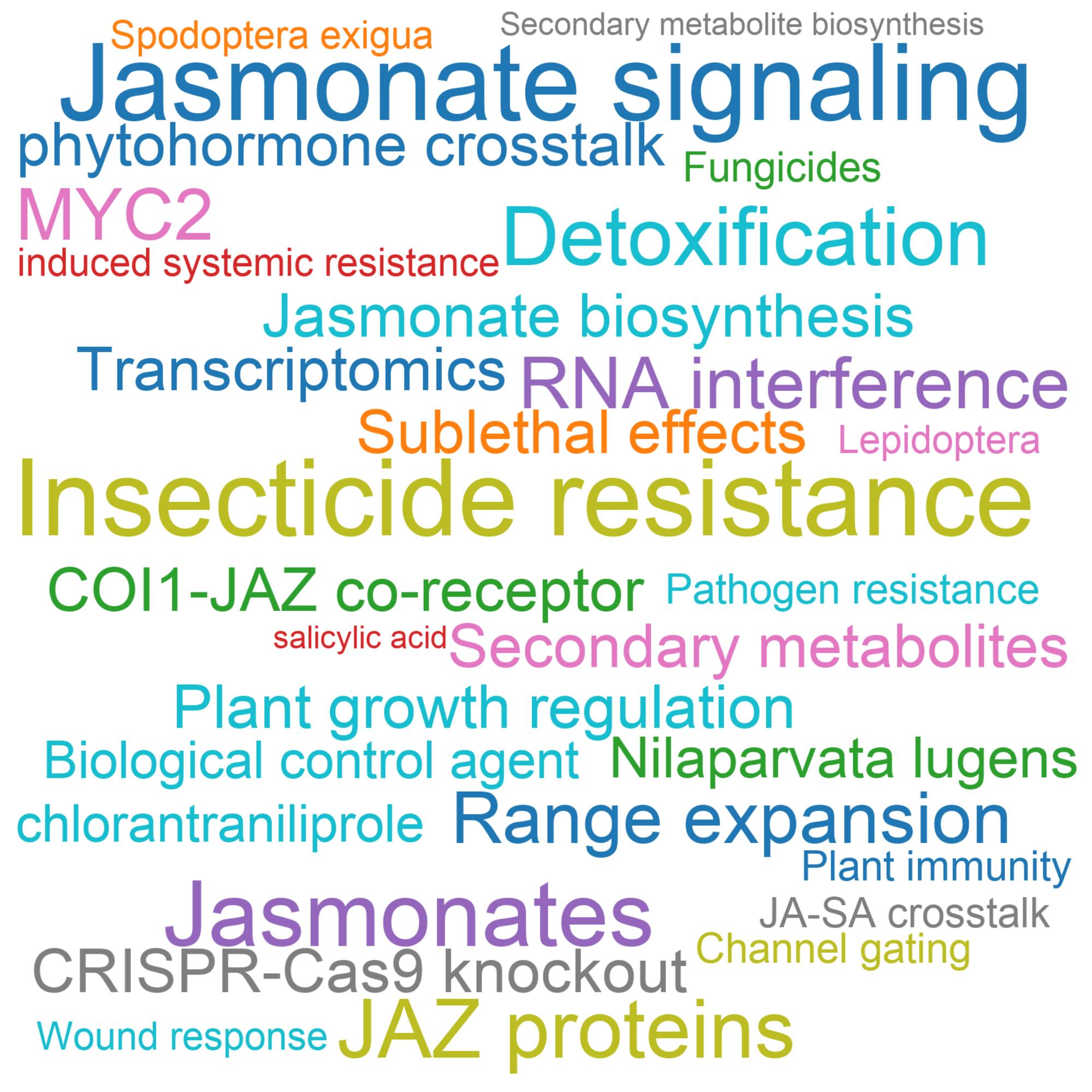
In the Class of 2026, research on insect-plant interactions and control is predominantly defined by deep molecular analyses of plant defense pathways and insect adaptation mechanisms. The most prominent topics include "Insecticide resistance" and "Jasmonate signaling," alongside "Jasmonates" and "Detoxification." This highlights a dual focus: understanding how plants utilize the jasmonate pathway—including key components like JAZ proteins and MYC2—to orchestrate defenses against herbivores, and how insects concurrently develop resistance or detoxification mechanisms to overcome these defenses or chemical controls. The strong presence of "RNA interference" indicates an active interest in advanced biotechnological strategies for pest management. Together, these topics reveal a field that is moving beyond observational ecology toward characterizing the intricate, molecular-level arms race between plants and insects, aiming to leverage these insights for more targeted, sustainable agricultural interventions.
How Did Topics Shift from the Class of 2025 to the Class of 2026?
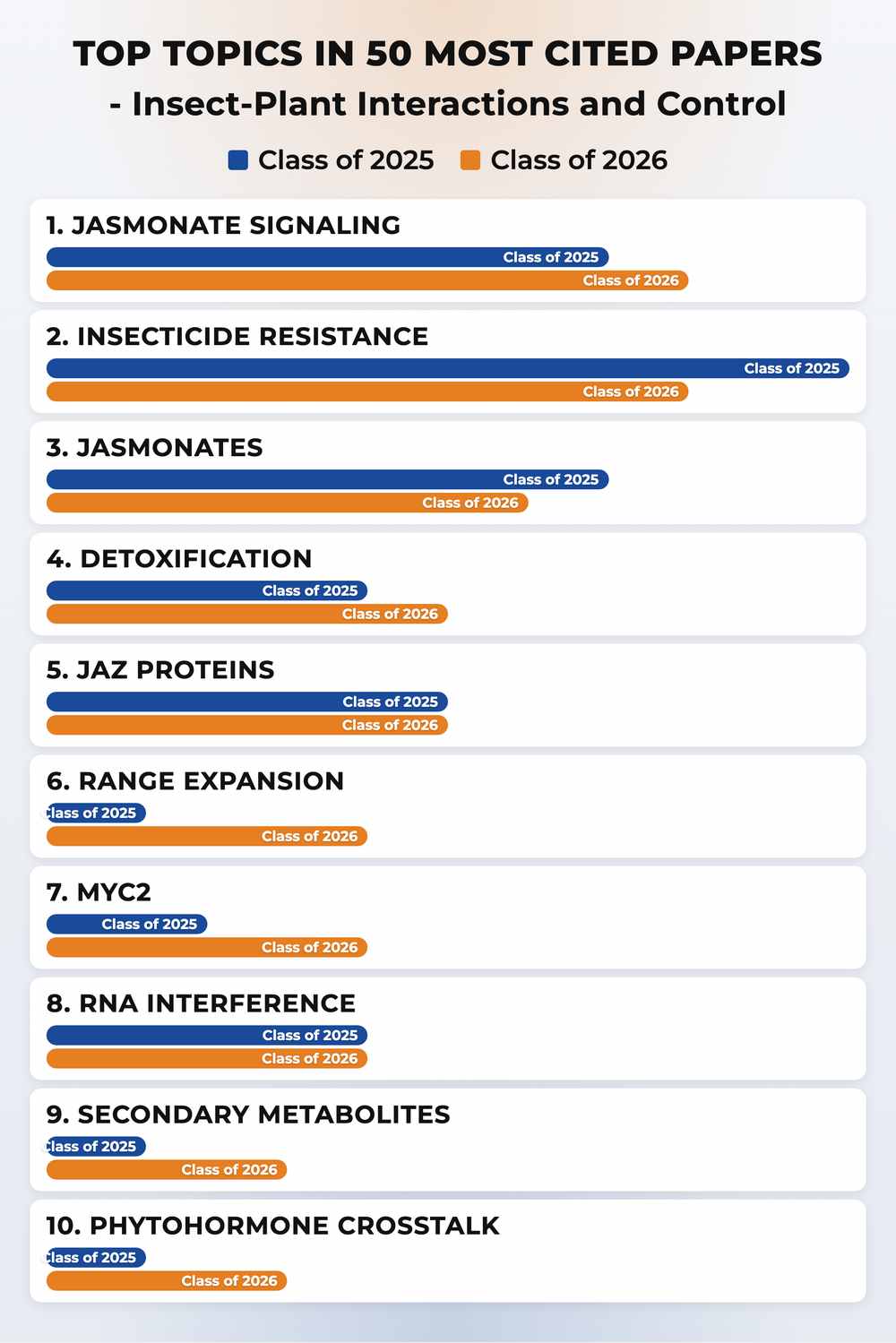
The transition from the Class of 2025 to the Class of 2026 reveals a notable shift toward specialized biochemical responses and ecological applications. Topics such as "Secondary metabolites" and "Range expansion" emerged rapidly, exhibiting the largest fold-change increases. There was also a marked rise in focus on "Biological control agent," "Plant growth regulation," and "Bioactive secondary metabolites." These trends indicate that researchers are increasingly interested in exploring how specific plant-derived compounds and natural enemies can be harnessed to mitigate pest pressures, particularly as pest ranges shift due to environmental changes. Conversely, traditionally heavily studied areas like "Insecticide resistance," "Jasmonates," and "Overexpression" experienced moderate declines in relative frequency. This evolution underscores a broader trend in the field: a pivot away from cataloging general resistance phenomena and basic pathway mapping, toward investigating nuanced, context-dependent chemical interactions and developing integrated, biological control strategies suited for dynamic ecological landscapes.
Methodology
PRI identifies high-impact research using a transparent, topic-agnostic framework applied consistently across scientific domains. Bibliographic records are drawn from OpenAlex, including publication dates, citation relationships, and document types.
This ranking covers the Class of 2026 cohort: journal articles published in 2024. Reviews and other non-article document types are excluded to ensure comparability.
Research impact is quantified with an 18-month post-publication citation window—the number of citing works published within 18 months of each paper's publication date. This metric captures early impact while controlling for publication age.
An LLM-based relevance classifier then reviews each candidate's title and abstract to confirm substantive alignment with the target domain. Only papers classified as relevant appear in the final ranking.
Zheng Su, Tinsley Li, Thematic Shifts in Early-High-Impact Cancer Genomics and Diagnostics Research: A Bibliometric and Semantic Analysis. bioRxiv 2026.07.04.736459; doi: https://doi.org/10.64898/2026.07.04.736459
Cite this ranking
Pepkio Research Index (PRI). Topics and Trends in Most Cited Insect-Plant Interactions and Control Papers, Class of 2026. https://pri.pepkio.com/top-papers/insect-plant-interactions-and-control/2026. Accessed 2026-10-14.

Methodology
Zheng Su, Tinsley Li, Thematic Shifts in Early-High-Impact Cancer Genomics and Diagnostics Research: A Bibliometric and Semantic Analysis. bioRxiv 2026.07.04.736459; doi: https://doi.org/10.64898/2026.07.04.736459