
What topics and trends defined most-cited Insect and Arachnid Ecology and Behavior research in the Class of 2026?
The 2026 ranking reveals a field pivoting toward high-resolution neuroscience and targeted ecological interventions. While broad pollinator studies declined, mapping the Drosophila connectome and investigating specific climate change impacts and pest management strategies saw significant growth.
At a glance
- Field
- Insect and Arachnid Ecology and Behavior
- Cohort label
- Class of 2026 (2024 publications)
- Papers analyzed
- 7,201
- Papers ranked
- 20
- Top topics in ranked papers
- Connectome, Honey bee, Drosophila, Apis mellifera, Neonicotinoids
- Publication window
- Jan 1, 2024 – Dec 31, 2024
- Eligibility
- Research articles; reviews excluded
- Citation window
- 18 months post-publication
- 18m citation range
- 32–120
- Data source
- OpenAlex · Retrieved July 2026
- License
- CC BY 4.0
Rankings
20 papers ranked by 18-month citation count
Neurotransmitter classification from electron microscopy images at synaptic sites in Drosophila melanogaster
Cell202410.1016/j.cell.2024.03.016
The global atlas of edible insects: analysis of diversity and commonality contributing to food systems and sustainability
Scientific Reports202410.1038/s41598-024-55603-7
Connectomic reconstruction of a female Drosophila ventral nerve cord
Nature202410.1038/s41586-024-07389-x
A Drosophila computational brain model reveals sensorimotor processing
Nature202410.1038/s41586-024-07763-9
Life-history stage determines the diet of ectoparasitic mites on their honey bee hosts
Nature Communications202410.1038/s41467-024-44915-x
Genomic data provide insights into the classification of extant termites
Nature Communications202410.1038/s41467-024-51028-y
Bumblebees socially learn behaviour too complex to innovate alone
Nature202410.1038/s41586-024-07126-4
miR-276 and miR-182013-5p modulate insect metamorphosis and reproduction via dually regulating juvenile hormone acid methyltransferase
Communications Biology202410.1038/s42003-024-07285-0
Thermal infrared directs host-seeking behaviour in Aedes aegypti mosquitoes
Nature202410.1038/s41586-024-07848-5
Pollen nutrition structures bee and plant community interactions
Proceedings of the National Academy of Sciences202410.1073/pnas.2317228120
Impact of pesticide use on wild bee distributions across the United States
Nature Sustainability202410.1038/s41893-024-01413-8
Impact of pesticides on non-target invertebrates in agricultural ecosystems
Pesticide Biochemistry and Physiology202410.1016/j.pestbp.2024.105974
Unveiling lignocellulolytic potential: a genomic exploration of bacterial lineages within the termite gut
Microbiome202410.1186/s40168-024-01917-7
Diverting organic waste from landfills via insect biomanufacturing using engineered black soldier flies (Hermetia illucens)
Communications Biology202410.1038/s42003-024-06516-8
Wild insects and honey bees are equally important to crop yields in a global analysis
Global Ecology and Biogeography202410.1111/geb.13843
Disruption of an ant-plant mutualism shapes interactions between lions and their primary prey
Science202410.1126/science.adg1464
A modular circuit coordinates the diversification of courtship strategies
Nature202410.1038/s41586-024-08028-1
The coevolution of fungus-ant agriculture
Science202410.1126/science.adn7179
Insecticides, more than herbicides, land use, and climate, are associated with declines in butterfly species richness and abundance in the American Midwest
PLoS ONE202410.1371/journal.pone.0304319
Honey bee stressor networks are complex and dependent on crop and region
Current Biology202410.1016/j.cub.2024.03.039
Topic trends
Dominant research themes and year-over-year shifts in Insect and Arachnid Ecology and Behavior
What Topics Define the Class of 2026?
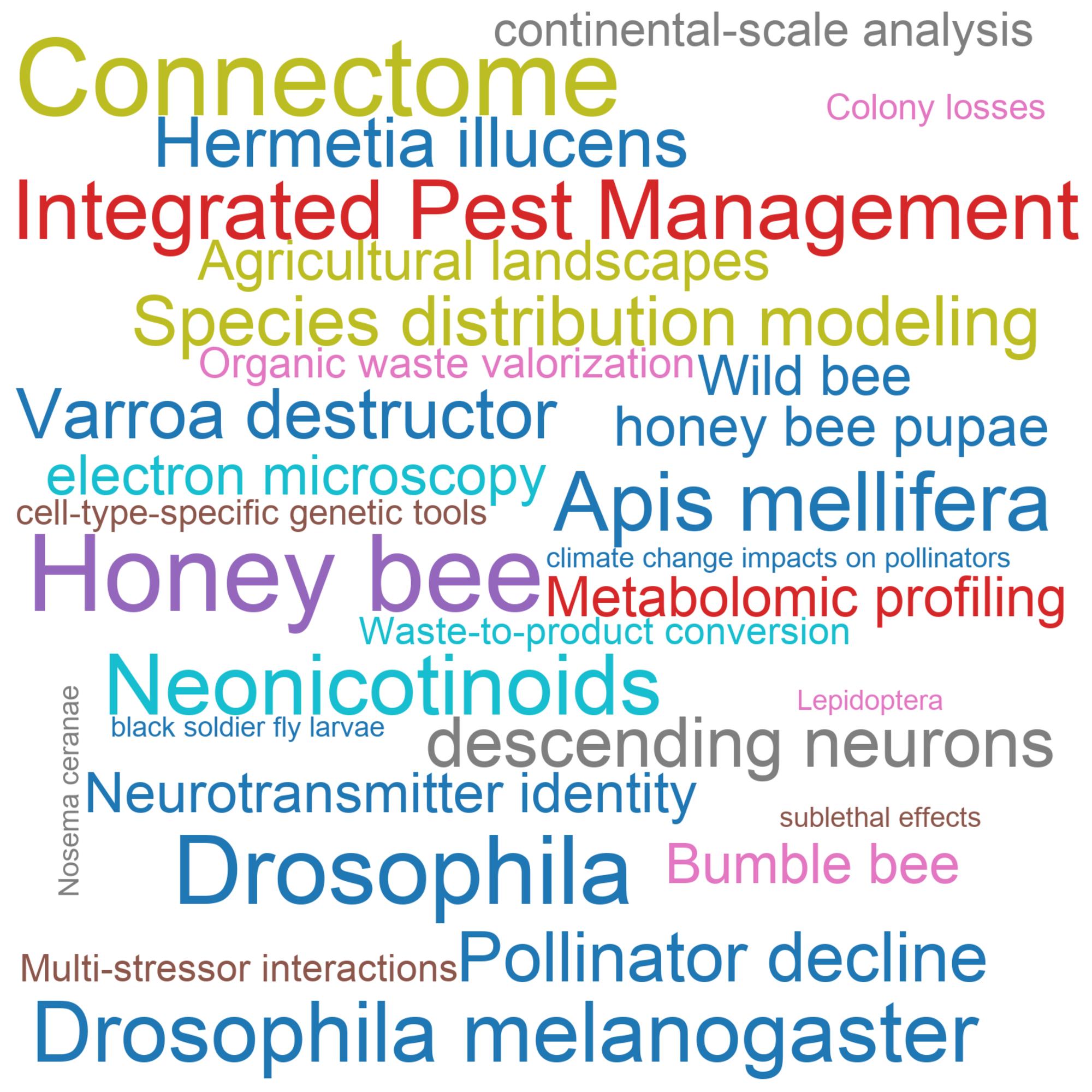
The Class of 2026 for Insect and Arachnid Ecology and Behavior is heavily defined by high-resolution neurobiology and critical agricultural challenges. The 'Connectome' emerges as a leading topic, appearing in 12% of the top papers as massive structural mappings of the Drosophila brain approach completion. Studies involving 'Honey bee' and 'Apis mellifera' remain central, though their relative frequency suggests a broadening of focus toward 'Neonicotinoids' and 'Integrated Pest Management', each capturing 8% of the top literature. Advanced 'Species distribution modeling' and tracking of 'Varroa destructor' underscore a strong focus on ecological mapping and pathogen management in changing environments.
How Did Topics Shift from the Class of 2025 to the Class of 2026?
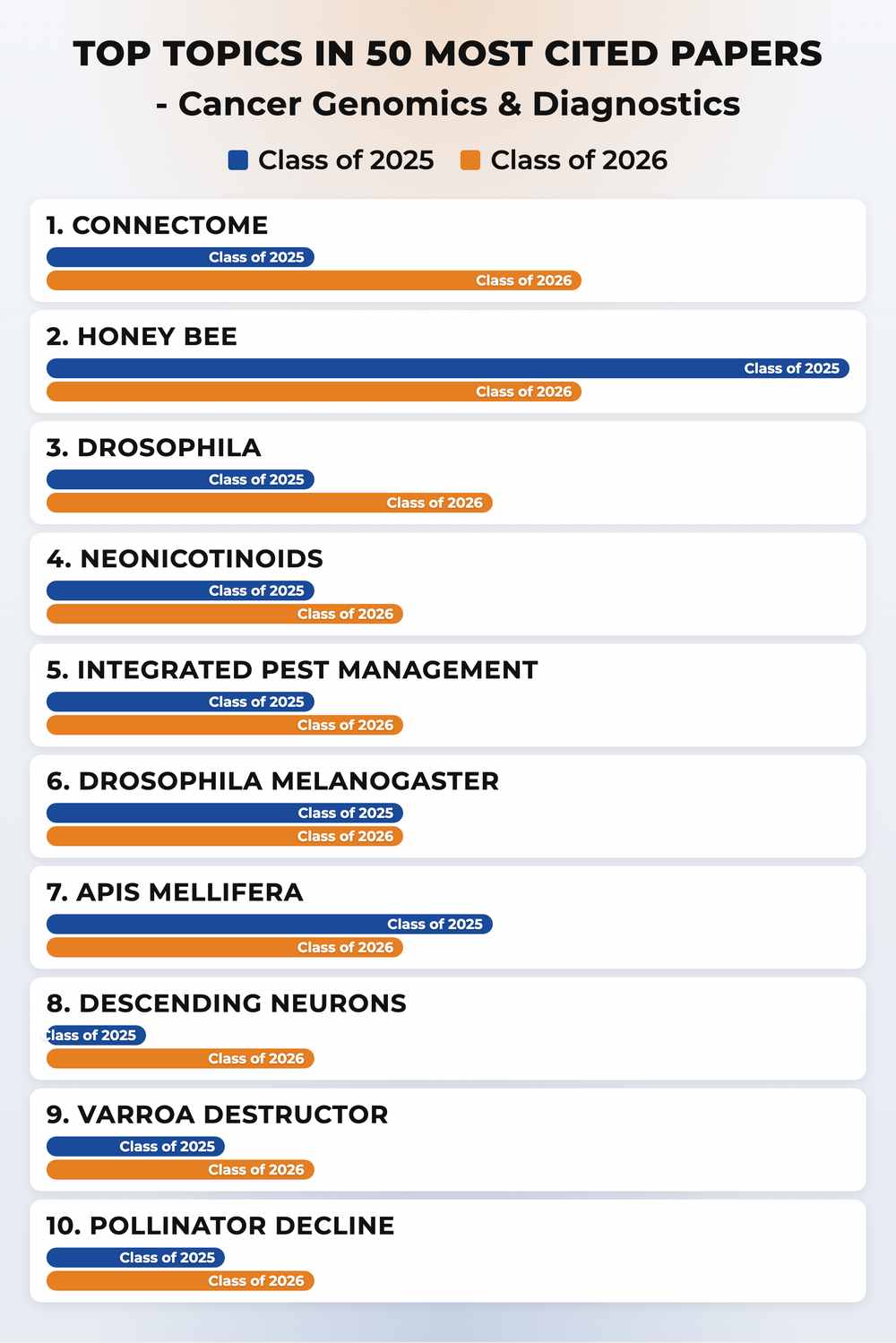
Between the Class of 2025 and 2026, the field experienced a notable shift from broad pollinator ecology toward targeted neurobiology and specific environmental stressors. 'Connectome' and 'descending neurons' saw remarkable two- to three-fold increases in frequency, reflecting the maturation of insect brain-mapping initiatives. Similarly, interest surged in 'climate change impacts on pollinators' and 'gene silencing', highlighting a pivot toward mechanistic stress responses and novel intervention strategies. Conversely, general terms like 'Honey bee', 'Bumble bee', and 'Wild bee' experienced sharp declines, dropping by up to 50% as research questions became more granular and focused on specific pathways or localized ecological modeling.
Methodology
PRI identifies high-impact research using a transparent, topic-agnostic framework applied consistently across scientific domains. Bibliographic records are drawn from OpenAlex, including publication dates, citation relationships, and document types.
This ranking covers the Class of 2026 cohort: journal articles published in 2024. Reviews and other non-article document types are excluded to ensure comparability.
Research impact is quantified with an 18-month post-publication citation window—the number of citing works published within 18 months of each paper's publication date. This metric captures early impact while controlling for publication age.
An LLM-based relevance classifier then reviews each candidate's title and abstract to confirm substantive alignment with the target domain. Only papers classified as relevant appear in the final ranking.
Zheng Su, Tinsley Li, Thematic Shifts in Early-High-Impact Cancer Genomics and Diagnostics Research: A Bibliometric and Semantic Analysis. bioRxiv 2026.07.04.736459; doi: https://doi.org/10.64898/2026.07.04.736459
Cite this ranking
Pepkio Research Index (PRI). Topics and Trends in Most Cited Insect and Arachnid Ecology and Behavior Papers, Class of 2026. https://pri.pepkio.com/top-papers/insect-and-arachnid-ecology-and-behavior/2026. Accessed 2026-10-16.

Methodology
Zheng Su, Tinsley Li, Thematic Shifts in Early-High-Impact Cancer Genomics and Diagnostics Research: A Bibliometric and Semantic Analysis. bioRxiv 2026.07.04.736459; doi: https://doi.org/10.64898/2026.07.04.736459