
What topics and trends defined most-cited Fish Biology and Ecology Studies research in the Class of 2026?
The Class of 2026 for Fish Biology and Ecology Studies is dominated by research on the Nile tilapia (Oreochromis niloticus), alongside deep physiological mechanisms and evolutionary analyses. The field is rapidly shifting toward advanced genetic methodologies like admixture analysis and molecular phylogeny, while significantly emphasizing the ecological impacts of dams and hydropower.
At a glance
- Field
- Fish Biology and Ecology Studies
- Cohort label
- Class of 2026 (2024 publications)
- Papers analyzed
- 6,537
- Papers ranked
- 20
- Top topics in ranked papers
- Oreochromis niloticus, physiology and nutrition, molecular phylogeny, environmental impacts
- Publication window
- Jan 1, 2024 – Dec 31, 2024
- Eligibility
- Research articles; reviews excluded
- Citation window
- 18 months post-publication
- 18m citation range
- 16–143
- Data source
- OpenAlex · Retrieved July 2026
- License
- CC BY 4.0
Rankings
20 papers ranked by 18-month citation count
Hydropower impacts on riverine biodiversity
Nature Reviews Earth & Environment202410.1038/s43017-024-00596-0
Global shark fishing mortality still rising despite widespread regulatory change
Science202410.1126/science.adf8984
Fishes of the upper rio Paraná basin: diversity, biogeography and conservation
Neotropical Ichthyology202410.1590/1982-0224-2023-0066
Increase in the Abundance of Invasive Fish Species in the Ciliwung River, DKI Jakarta and West Java Provinces
ADI Journal on Recent Innovation (AJRI)202410.34306/ajri.v6i1.1060
Phylogenomics of Characidae, a hyper-diverse Neotropical freshwater fish lineage, with a phylogenetic classification including four families (Teleostei: Characiformes)
Zoological Journal of the Linnean Society202410.1093/zoolinnean/zlae101
Dams trigger exponential population declines of migratory fish
Science Advances202410.1126/sciadv.adi6580
Checklist of the species of the Order Characiformes (Teleostei: Ostariophysi)
Neotropical Ichthyology202410.1590/1982-0224-2023-0086
The influence of climate changes on heavy metals accumulation in Alosa immaculata from the Danube River Basin
Marine Pollution Bulletin202410.1016/j.marpolbul.2024.116145
Overfishing and climate change elevate extinction risk of endemic sharks and rays in the southwest Indian Ocean hotspot
PLoS ONE202410.1371/journal.pone.0306813
Diet and habitat as determinants of intestine length in fishes
Reviews in Fish Biology and Fisheries202410.1007/s11160-024-09853-3
Threats of dams to the persistence of the world's freshwater fishes
Global Change Biology202410.1111/gcb.17166
Genetic diversity and population structure of farmed and wild Nile tilapia (Oreochromis niloticus) in Uganda: The potential for aquaculture selection and breeding programs
Genomics202410.1016/j.ygeno.2024.110781
Forecasting of tilapia (Oreochromis niloticus) production in Bangladesh using ARIMA model
Heliyon202410.1016/j.heliyon.2024.e27111
A global analysis of the introduction pathways and characteristics associated with non-native fish species introduction, establishment, and impacts
Ecological Processes202410.1186/s13717-024-00495-8
The effects of nano-curcumin on growth performance, feed utilization, blood biochemistry, disease resistance, and gene expression in European seabass (Dicentrarchus labrax) fingerlings
Aquaculture Reports202410.1016/j.aqrep.2024.102034
Diversity of fishes along the coast of Türkiye
TURKISH JOURNAL OF ZOOLOGY202410.55730/1300-0179.3197
Distribution of fish larvae and juveniles on salinity in an estuary predicted from remote sensing and fuzzy logic approach
Aquatic Ecology202410.1007/s10452-024-10119-0
Ancient and Recent Hybridization in the <i>Oreochromis</i> Cichlid Fishes
Molecular Biology and Evolution202410.1093/molbev/msae116
Assessment of the role of mangroves for Periophthalmus modestus applying machine learning and remote sensing: a case study in a large estuary from Vietnam
Aquatic Ecology202410.1007/s10452-024-10111-8
Sustainable captive breeding practices for native Indonesian freshwater fish
Animal Reproduction Science202410.1016/j.anireprosci.2024.107623
Topic trends
Dominant research themes and year-over-year shifts in Fish Biology and Ecology Studies
What Topics Define the Class of 2026?
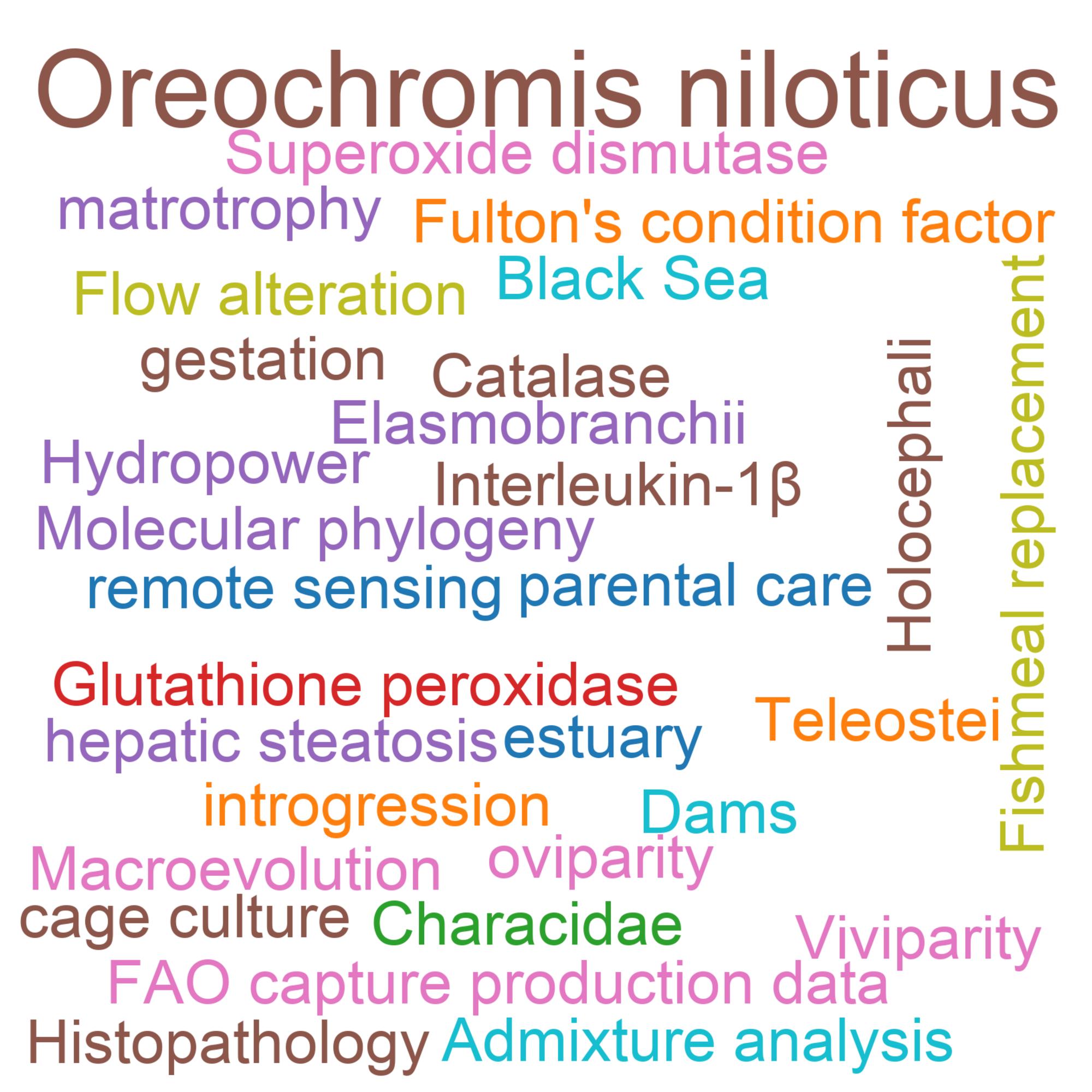
In the Class of 2026 for Fish Biology and Ecology Studies, research on the Nile tilapia (Oreochromis niloticus) dominates the informative topics, reflecting its immense global importance in aquaculture and environmental studies. Secondary defining topics cluster around physiology and nutrition, highlighted by studies on specific growth rate, enzymatic activities like amylase and lipase, and oxidative stress markers such as catalase and superoxide dismutase. Another major theme centers on evolutionary and phylogenetic research, encompassing admixture analysis, molecular phylogeny, and studies of specific lineages like Elasmobranchii and Teleostei. Additionally, anthropogenic impacts and environmental management are prominent, evidenced by research on dams, hydropower, and flow alteration, alongside broad-scale analytical tools like remote sensing and FAO capture production data.
How Did Topics Shift from the Class of 2025 to the Class of 2026?
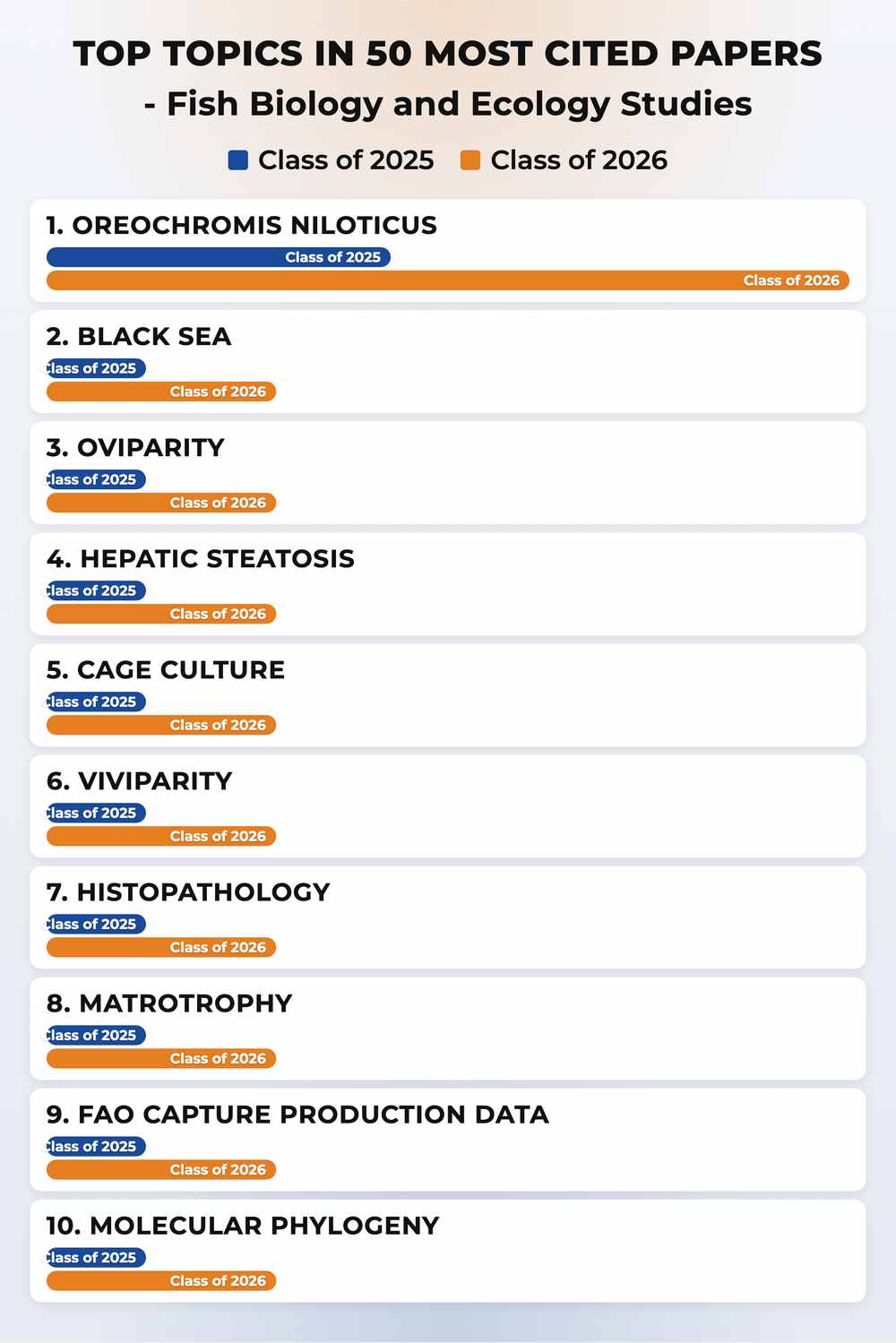
The shift from 2025 to 2026 reveals a pronounced surge in studies focusing on specific physiological and ecological mechanisms. Oreochromis niloticus saw the most substantial growth, more than doubling in normalized frequency. Novel emerging topics that had no presence in the top tier of 2025 include admixture analysis, impacts of dams and hydropower, and molecular phylogeny. This indicates a methodological pivot towards advanced genetic and evolutionary analyses. We also observe a rising emphasis on reproductive strategies, with matrotrophy, oviparity, and viviparity emerging as key research areas. Conversely, traditional topics like general specific growth rate experienced a slight decline in relative frequency, suggesting that researchers are moving toward more specialized molecular, evolutionary, and environmental disruption assessments rather than generalized physiological metrics.
Methodology
PRI identifies high-impact research using a transparent, topic-agnostic framework applied consistently across scientific domains. Bibliographic records are drawn from OpenAlex, including publication dates, citation relationships, and document types.
This ranking covers the Class of 2026 cohort: journal articles published in 2024. Reviews and other non-article document types are excluded to ensure comparability.
Research impact is quantified with an 18-month post-publication citation window—the number of citing works published within 18 months of each paper's publication date. This metric captures early impact while controlling for publication age.
An LLM-based relevance classifier then reviews each candidate's title and abstract to confirm substantive alignment with the target domain. Only papers classified as relevant appear in the final ranking.
Zheng Su, Tinsley Li, Thematic Shifts in Early-High-Impact Cancer Genomics and Diagnostics Research: A Bibliometric and Semantic Analysis. bioRxiv 2026.07.04.736459; doi: https://doi.org/10.64898/2026.07.04.736459
Cite this ranking
Pepkio Research Index (PRI). Topics and Trends in Most Cited Fish Biology and Ecology Studies Papers, Class of 2026. https://pri.pepkio.com/top-papers/fish-biology-and-ecology-studies/2026. Accessed 2026-10-16.

Methodology
Zheng Su, Tinsley Li, Thematic Shifts in Early-High-Impact Cancer Genomics and Diagnostics Research: A Bibliometric and Semantic Analysis. bioRxiv 2026.07.04.736459; doi: https://doi.org/10.64898/2026.07.04.736459