
What topics and trends defined most-cited Avian ecology and behavior research in the Class of 2026?
The Class of 2026 in avian ecology is dominated by research on migration phenology, stopover site conservation, and the devastating impacts of Highly Pathogenic Avian Influenza (HPAI). A notable shift from 2025 includes increased focus on the East Asian-Australasian Flyway and evaluating agri-environment schemes to mitigate agricultural intensification.
At a glance
- Field
- Avian ecology and behavior
- Cohort label
- Class of 2026 (2024 publications)
- Papers analyzed
- 6,242
- Papers ranked
- 20
- Top topics in ranked papers
- Migration phenology, HPAI, stopover sites, agri-environment schemes
- Publication window
- Jan 1, 2024 – Dec 31, 2024
- Eligibility
- Research articles; reviews excluded
- Citation window
- 18 months post-publication
- 18m citation range
- 17–182
- Data source
- OpenAlex · Retrieved Jul 2026
- License
- CC BY 4.0
Rankings
20 papers ranked by 18-month citation count
Moult terminology: envisioning an evolutionary approach
Journal of Avian Biology202410.1111/jav.03169
The Social Costs of Keystone Species Collapse: Evidence from the Decline of Vultures in India
American Economic Review202410.1257/aer.20230016
Highly pathogenic avian influenza causes mass mortality in Sandwich Tern<i>Thalasseus sandvicensis</i>breeding colonies across north-western Europe
Bird Conservation International202410.1017/s0959270923000400
Catastrophic and persistent loss of common murres after a marine heatwave
Science202410.1126/science.adq4330
Wetland habitats supporting waterbird diversity: Conservation perspective on biodiversity-ecosystem functioning relationship
Journal of Environmental Management202410.1016/j.jenvman.2024.120663
Extracting Diurnal Activity Patterns of Birds in Communal Roosts From Polarimetric Weather Radar Data
IEEE Transactions on Geoscience and Remote Sensing202410.1109/tgrs.2024.3513294
Learning shapes the development of migratory behavior
Proceedings of the National Academy of Sciences202410.1073/pnas.2306389121
Blaming the wind? The impact of wind turbine on bird biodiversity
Journal of Development Economics202410.1016/j.jdeveco.2024.103402
Advances in breeding phenology outpace latitudinal and elevational shifts for North American birds tracking temperature
Nature Ecology & Evolution202410.1038/s41559-024-02536-z
Tracking data highlight the importance of human-induced mortality for large migratory birds at a flyway scale
Biological Conservation202410.1016/j.biocon.2024.110525
Predicting resilience of migratory birds to environmental change
Proceedings of the National Academy of Sciences202410.1073/pnas.2311146121
Seabird bycatch in European waters
Animal Conservation202410.1111/acv.12948
Declines in UK breeding populations of seabird species of conservation concern following the outbreak of high pathogenicity avian influenza (HPAI) in 2021–2022
Bird Study202410.1080/00063657.2024.2438641
African savanna raptors show evidence of widespread population collapse and a growing dependence on protected areas
Nature Ecology & Evolution202410.1038/s41559-023-02236-0
Advances in remote sensing of emperor penguins: first multi-year time series documenting trends in the global population
Proceedings of the Royal Society B Biological Sciences202410.1098/rspb.2023.2067
Bill Length of Non‐breeding Shorebirds Influences the Water Depth Preferences for Foraging in the West Coast of India
Ecology and Evolution202410.1002/ece3.70396
Decoupling of bird migration from the changing phenology of spring green-up
Proceedings of the National Academy of Sciences202410.1073/pnas.2308433121
The respiratory system influences flight mechanics in soaring birds
Nature202410.1038/s41586-024-07485-y
Accelerated farmland bird population declines in European countries after their recent EU accession
The Science of The Total Environment202410.1016/j.scitotenv.2024.174281
Extreme elevational migration spurred cryptic speciation in giant hummingbirds
Proceedings of the National Academy of Sciences202410.1073/pnas.2313599121
Topic trends
Dominant research themes and year-over-year shifts in Avian ecology and behavior
What Topics Define the Class of 2026?
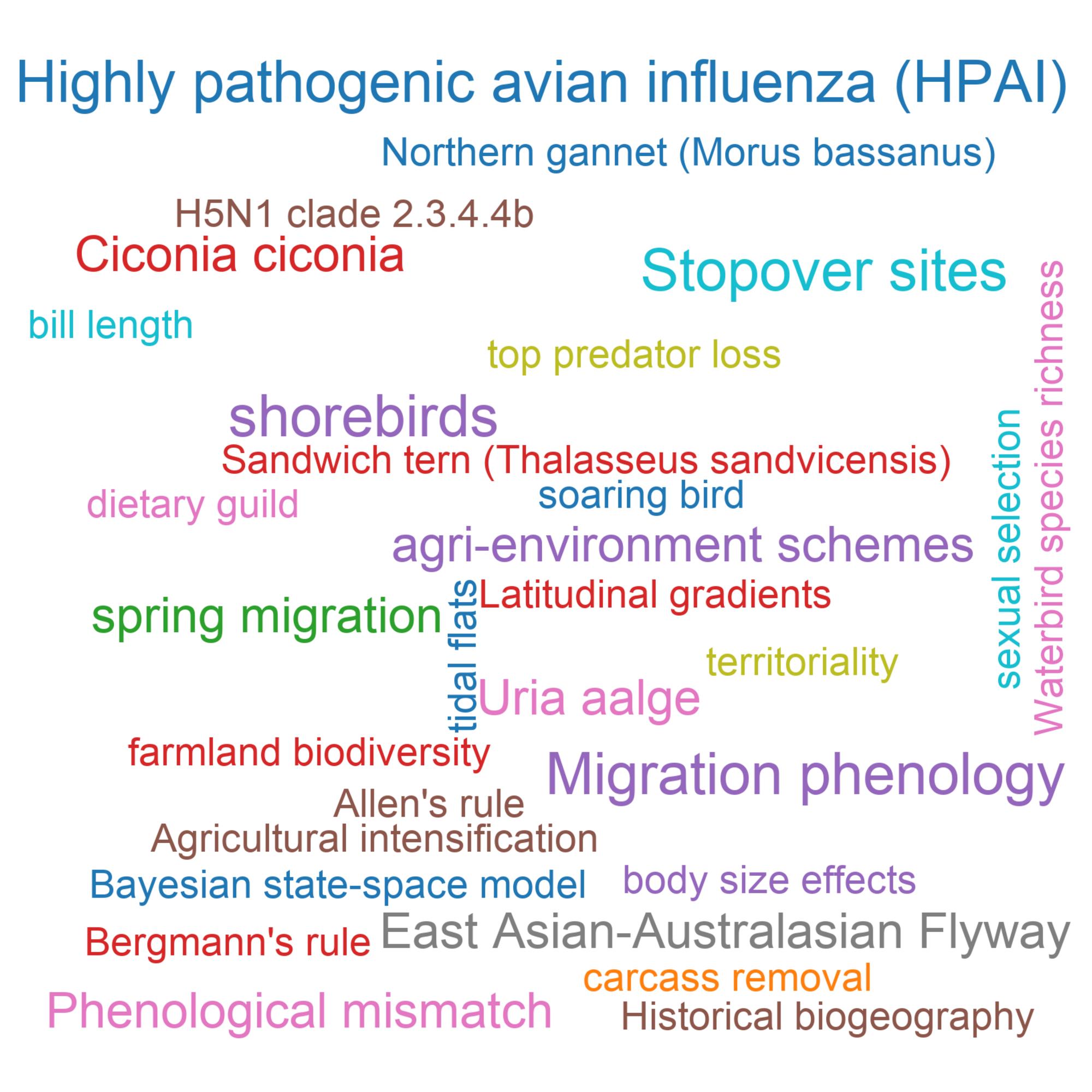
The Class of 2026 for avian ecology and behavior is defined by a strong focus on the impact of global environmental changes on bird populations, particularly concerning migration patterns and emerging diseases. A dominant theme is the study of migration, encompassing 'Migration phenology', 'Stopover sites', 'spring migration', and the 'East Asian-Australasian Flyway'. Researchers are deeply investigating how birds adjust their migratory timing and routes in response to shifting environmental conditions, often analyzing 'Phenological mismatch' where birds arrive at breeding or stopover grounds out of sync with peak food availability. Another major defining topic is 'Highly pathogenic avian influenza (HPAI)', reflecting the urgent ecological and conservation concerns surrounding the recent global outbreaks and their devastating impacts on wild bird populations, such as 'shorebirds' and seabirds like 'Uria aalge' (Common Murre). Furthermore, conservation strategies in human-altered landscapes are prominent, highlighted by terms like 'agri-environment schemes' and 'Agricultural intensification'. These indicate a continued emphasis on understanding how birds, including specific species like 'Ciconia ciconia' (White Stork) and the endangered 'African penguin', navigate and survive in ecosystems increasingly modified by agricultural practices and climate change.
How Did Topics Shift from the Class of 2025 to the Class of 2026?
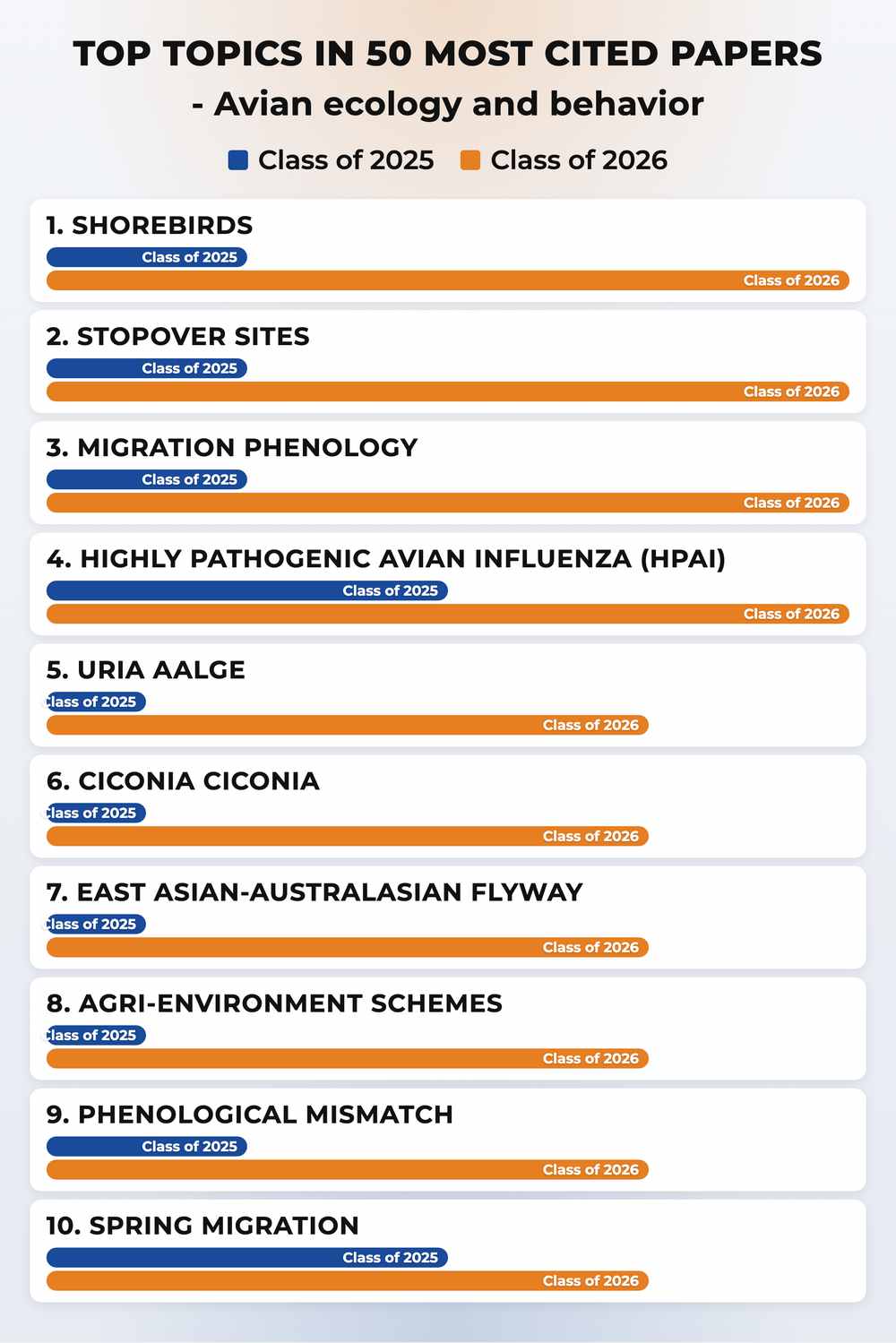
Between the Class of 2025 and the Class of 2026, the thematic focus in avian ecology shifted noticeably towards specific conservation challenges and refined studies of migratory behavior. We observe a significant rise in research concerning the 'East Asian-Australasian Flyway' and 'Stopover sites', which both saw massive increases in prominence. This reflects a growing prioritization of critical habitats that are under severe threat from coastal development and climate change, emphasizing the need for targeted conservation along these international corridors. Similarly, 'Migration phenology' saw a four-fold increase in frequency, indicating that researchers are increasingly prioritizing the study of how shifting seasons are altering avian life cycles. The emergence of terms like 'agri-environment schemes' as a top riser highlights an expanding focus on evaluating practical, policy-driven conservation efforts in agricultural landscapes. Additionally, the rise of 'Highly pathogenic avian influenza (HPAI)'—doubling in frequency—underscores a rapid, reactive shift in the field to address the acute and unprecedented mortality events in wild bird populations, demonstrating how avian ecology swiftly adapts to emerging, critical threats to global avian biodiversity.
Methodology
PRI identifies high-impact research using a transparent, topic-agnostic framework applied consistently across scientific domains. Bibliographic records are drawn from OpenAlex, including publication dates, citation relationships, and document types.
This ranking covers the Class of 2026 cohort: journal articles published in 2024. Reviews and other non-article document types are excluded to ensure comparability.
Research impact is quantified with an 18-month post-publication citation window—the number of citing works published within 18 months of each paper's publication date. This metric captures early impact while controlling for publication age.
An LLM-based relevance classifier then reviews each candidate's title and abstract to confirm substantive alignment with the target domain. Only papers classified as relevant appear in the final ranking.
Zheng Su, Tinsley Li, Thematic Shifts in Early-High-Impact Cancer Genomics and Diagnostics Research: A Bibliometric and Semantic Analysis. bioRxiv 2026.07.04.736459; doi: https://doi.org/10.64898/2026.07.04.736459
Cite this ranking
Pepkio Research Index (PRI). Topics and Trends in Most Cited Avian ecology and behavior Papers, Class of 2026. https://pri.pepkio.com/top-papers/avian-ecology-and-behavior/2026. Accessed 2026-10-16.

Methodology
Zheng Su, Tinsley Li, Thematic Shifts in Early-High-Impact Cancer Genomics and Diagnostics Research: A Bibliometric and Semantic Analysis. bioRxiv 2026.07.04.736459; doi: https://doi.org/10.64898/2026.07.04.736459