
What topics and trends defined most-cited Aquatic Ecosystems and Phytoplankton Dynamics research in the Class of 2026?
Aquatic ecosystem research in the Class of 2026 is driven by eutrophication and harmful cyanobacterial blooms. Recent studies show a pronounced shift toward 16S rRNA microbial profiling, external nutrient runoff, and hydraulic retention management, alongside declining focus on traditional internal phosphorus loading and static trophic status metrics.
At a glance
- Field
- Aquatic Ecosystems and Phytoplankton Dynamics
- Cohort label
- Class of 2026 (2024 publications)
- Papers analyzed
- 4,122
- Papers ranked
- 20
- Top topics in ranked papers
- Eutrophication, Cyanobacteria, Chlorophyll-a, Harmful Algal Blooms, Sediment-Water Interface
- Publication window
- Jan 1, 2024 – Dec 31, 2024
- Eligibility
- Research articles; reviews excluded
- Citation window
- 18 months post-publication
- 18m citation range
- 29–183
- Data source
- OpenAlex · Retrieved Jul 2026
- License
- CC BY 4.0
Rankings
20 papers ranked by 18-month citation count
Harmful algal blooms in inland waters
Nature Reviews Earth & Environment202410.1038/s43017-024-00578-2
The microbial phosphorus cycle in aquatic ecosystems
Nature Reviews Microbiology202410.1038/s41579-024-01119-w
Biochar-enhanced bioremediation of eutrophic waters impacted by algal blooms
Journal of Environmental Management202410.1016/j.jenvman.2024.122044
Removal of chemicals from effluent using photobioreactor technology to improve environmental and health impacts
Zeitschrift für Physikalische Chemie202410.1515/zpch-2023-0450
Restoration of submerged vegetation modulates microbial communities to decrease nitrogen and phosphorus loads in sediment-water systems
Water Research202410.1016/j.watres.2024.122835
Monitoring, simulation and early warning of cyanobacterial harmful algal blooms: An upgraded framework for eutrophic lakes
Environmental Research202410.1016/j.envres.2024.120296
The biological functions of microcystins
Water Research202410.1016/j.watres.2024.122119
Nitrogen and phosphorus trends in lake sediments of China may diverge
Nature Communications202410.1038/s41467-024-46968-4
Consistent stoichiometric long-term relationships between nutrients and chlorophyll-a across shallow lakes
Nature Communications202410.1038/s41467-024-45115-3
The application of magical microalgae in carbon sequestration and emission reduction: Removal mechanisms and potential analysis
Renewable and Sustainable Energy Reviews202410.1016/j.rser.2024.114417
A growth phase analysis on the influence of light intensity on microalgal stress and potential biofuel production
Energy Conversion and Management202410.1016/j.enconman.2024.118511
Astaxanthin Alleviates Hepatic Lipid Metabolic Dysregulation Induced by Microcystin-LR
Toxins202410.3390/toxins16090401
Fate, abundance and ecological risks of microcystins in aquatic environment: The implication of microplastics
Water Research202410.1016/j.watres.2024.121121
From disruption to adaptation: Response of phytoplankton communities in representative impounded lakes to China's South-to-North Water Diversion Project
Water Research202410.1016/j.watres.2024.122001
Enhancing water quality and ecosystems of reclaimed water-replenished river: A case study of Dongsha River, Beijing, China
The Science of The Total Environment202410.1016/j.scitotenv.2024.172024
The future of algal blooms in lakes globally is in our hands
Water Research202410.1016/j.watres.2024.122533
Emergence of lake conditions that exceed natural temperature variability
Nature Geoscience202410.1038/s41561-024-01491-5
Projected response of algal blooms in global lakes to future climatic and land use changes: Machine learning approaches
Water Research202410.1016/j.watres.2024.122889
Impact of cascade reservoirs on nutrients transported downstream and regulation method based on hydraulic retention time
Water Research202410.1016/j.watres.2024.121187
Cyanobacterial Blooms in Environmental Water: Causes and Solutions
Current Pollution Reports202410.1007/s40726-024-00322-w
Topic trends
Dominant research themes and year-over-year shifts in Aquatic Ecosystems and Phytoplankton Dynamics
What Topics Define the Class of 2026?
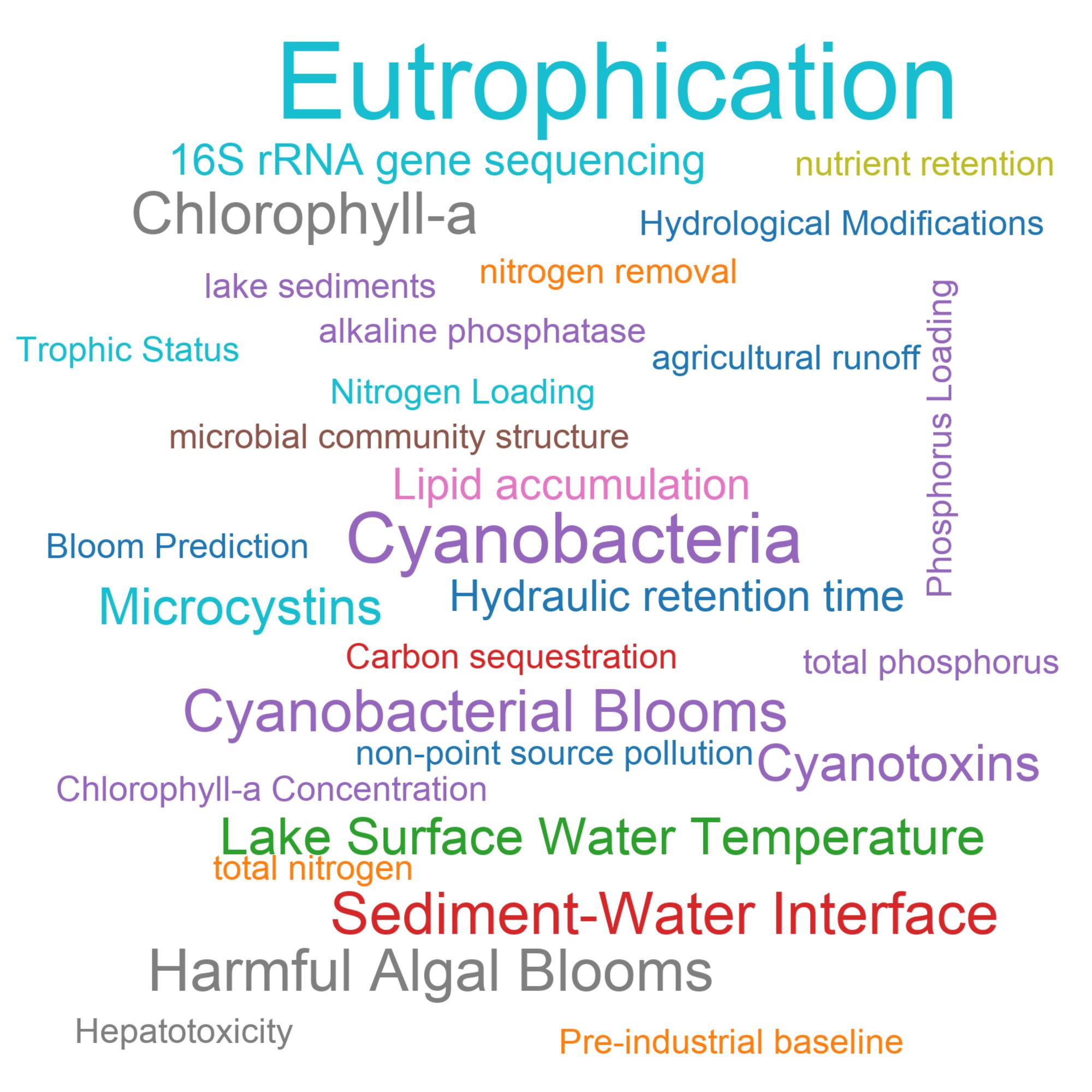
Research in the Class of 2026 for aquatic ecosystems and phytoplankton dynamics is heavily dominated by eutrophication and harmful algal bloom dynamics. Eutrophication leads as the central focal topic, appearing in nearly a third of all analyzed studies (32% normalized frequency). Close behind, cyanobacterial proliferation—including Harmful Algal Blooms (HABs) and specific toxic strains—represents a critical concentration of scientific effort (10% normalized frequency each). Studies frequently couple biological monitoring using Chlorophyll-a measurements with chemical risk assessments of cyanotoxins and microcystins released into freshwater bodies. Beyond bloom events, researchers are prioritizing physical and biochemical mechanisms occurring at the sediment-water interface (10%), investigating how nutrient release and internal cycling fuel persistent algal growth. Climate interactions also feature prominently, with lake surface water temperature recognized as a primary thermal driver governing ecological stability. Furthermore, recent studies integrate molecular diagnostic tools such as 16S rRNA gene sequencing to decode microbial community structure, alongside hydrological controls like hydraulic retention time. Together, these thematic clusters reflect an integrated research landscape focused on mitigating water quality degradation, understanding toxin release mechanisms, and managing nutrient dynamics under changing environmental conditions.
How Did Topics Shift from the Class of 2025 to the Class of 2026?
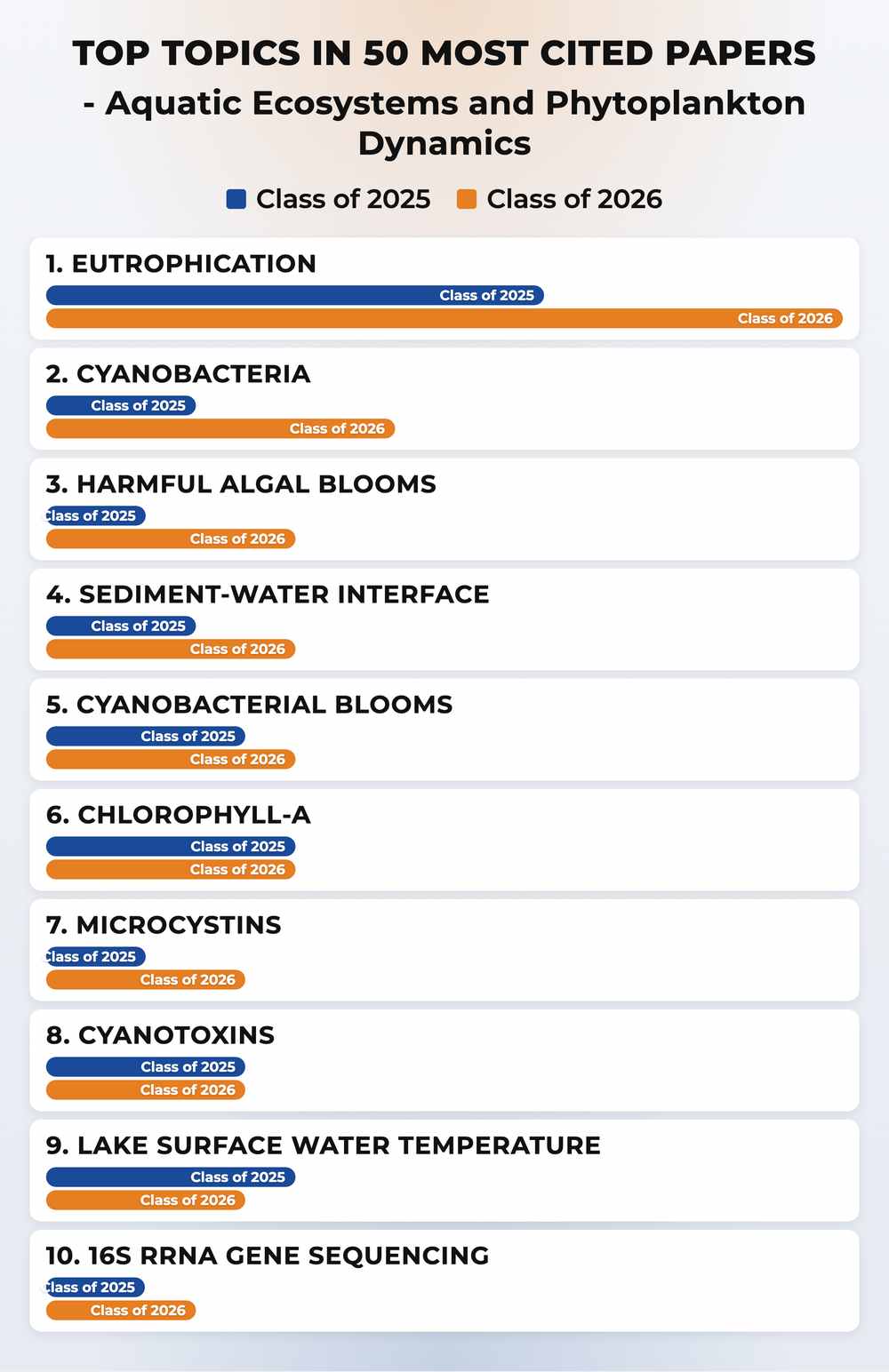
Comparing topic distribution between the Class of 2025 and the Class of 2026 reveals a distinct shift from descriptive water quality monitoring toward molecular-scale diagnostics and external catchment management. Microbial profiling via 16S rRNA gene sequencing emerged as the fastest-rising methodology (rising from absent to 6% normalized frequency), alongside hydraulic retention time and lipid accumulation research. Concurrently, broader watershed management topics such as agricultural runoff, non-point source pollution, and external nitrogen/phosphorus loading gained substantial momentum. Harmful Algal Blooms also experienced a 2.5-fold increase in representation (surging to 10%), while cyanobacteria studies expanded by more than 2.3-fold. In contrast, traditional broad-scale baseline metrics experienced notable declines. Internal phosphorus loading and general trophic status assessments both saw 50% reductions in research emphasis (dropping to 4% normalized frequency), while lake surface water temperature tracking declined slightly from 10% to 8%. This evolution demonstrates that the field is pivoting away from passive monitoring of internal nutrient pools and static trophic classifications. Instead, contemporary aquatic ecosystem research emphasizes actionable external load reduction, high-throughput genomic tracking of cyanobacterial dynamics, and precise hydrological management.
Methodology
PRI identifies high-impact research using a transparent, topic-agnostic framework applied consistently across scientific domains. Bibliographic records are drawn from OpenAlex, including publication dates, citation relationships, and document types.
This ranking covers the Class of 2026 cohort: journal articles published in 2024. Reviews and other non-article document types are excluded to ensure comparability.
Research impact is quantified with an 18-month post-publication citation window—the number of citing works published within 18 months of each paper's publication date. This metric captures early impact while controlling for publication age.
An LLM-based relevance classifier then reviews each candidate's title and abstract to confirm substantive alignment with the target domain. Only papers classified as relevant appear in the final ranking.
Zheng Su, Tinsley Li, Thematic Shifts in Early-High-Impact Cancer Genomics and Diagnostics Research: A Bibliometric and Semantic Analysis. bioRxiv 2026.07.04.736459; doi: https://doi.org/10.64898/2026.07.04.736459
Cite this ranking
Pepkio Research Index (PRI). Topics and Trends in Most Cited Aquatic Ecosystems and Phytoplankton Dynamics Papers, Class of 2026. https://pri.pepkio.com/top-papers/aquatic-ecosystems-and-phytoplankton-dynamics/2026. Accessed 2026-10-21.

Methodology
Zheng Su, Tinsley Li, Thematic Shifts in Early-High-Impact Cancer Genomics and Diagnostics Research: A Bibliometric and Semantic Analysis. bioRxiv 2026.07.04.736459; doi: https://doi.org/10.64898/2026.07.04.736459