
What topics and trends defined most-cited Mesenchymal stem cell research research in the Class of 2026?
Mesenchymal stem cell research in the Class of 2026 pivoted toward redox regulation, organelle transfer, and single-cell resolution. ROS scavenging emerged while NF-κB signaling and single-cell RNA sequencing quadrupled. Meanwhile, research on raw adipose and bone marrow MSC sources contracted in relative share as focus shifted to cell-free exosomes and bio-functional GelMA hydrogels.
At a glance
- Field
- Mesenchymal stem cell research
- Cohort label
- Class of 2026 (2024 publications)
- Papers analyzed
- 5,184
- Papers ranked
- 20
- Top topics in ranked papers
- Adipose-derived MSCs, Exosomes/Extracellular vesicles, Immunomodulation, Macrophage polarization, Gelatin methacryloyl (GelMA)
- Publication window
- Jan 1, 2024 – Dec 31, 2024
- Eligibility
- Research articles; reviews excluded
- Citation window
- 18 months post-publication
- 18m citation range
- 31–141
- Data source
- OpenAlex · Retrieved Jul 2026
- License
- CC BY 4.0
Rankings
20 papers ranked by 18-month citation count
Exosome-coated oxygen nanobubble-laden hydrogel augments intracellular delivery of exosomes for enhanced wound healing
Nature Communications202410.1038/s41467-024-47696-5
Curcumin-primed olfactory mucosa-derived mesenchymal stem cells mitigate cerebral ischemia/reperfusion injury-induced neuronal PANoptosis by modulating microglial polarization
Phytomedicine202410.1016/j.phymed.2024.155635
Generation of complex bone marrow organoids from human induced pluripotent stem cells
Nature Methods202410.1038/s41592-024-02172-2
Delphi-driven consensus definition for mesenchymal stromal cells and clinical reporting guidelines for mesenchymal stromal cell–based therapeutics
Cytotherapy202410.1016/j.jcyt.2024.10.008
Safety and potential effects of intrathecal injection of allogeneic human umbilical cord mesenchymal stem cell-derived exosomes in complete subacute spinal cord injury: a first-in-human, single-arm, open-label, phase I clinical trial
Stem Cell Research & Therapy202410.1186/s13287-024-03868-0
Intrathecal delivery of adipose-derived mesenchymal stem cells in traumatic spinal cord injury: Phase I trial
Nature Communications202410.1038/s41467-024-46259-y
An injury-induced mesenchymal-epithelial cell niche coordinates regenerative responses in the lung
Science202410.1126/science.ado5561
Piezoelectric hydrogel for treatment of periodontitis through bioenergetic activation
Bioactive Materials202410.1016/j.bioactmat.2024.02.011
Exosomes from hypoxic urine-derived stem cells facilitate healing of diabetic wound by targeting SERPINE1 through miR-486-5p
Biomaterials202410.1016/j.biomaterials.2024.122893
Cause and consequence of heterogeneity in human mesenchymal stem cells: Challenges in clinical application
Pathology - Research and Practice202410.1016/j.prp.2024.155354
Engineering exosomes derived from TNF-α preconditioned IPFP-MSCs enhance both yield and therapeutic efficacy for osteoarthritis
Journal of Nanobiotechnology202410.1186/s12951-024-02795-9
LNP-RNA-engineered adipose stem cells for accelerated diabetic wound healing
Nature Communications202410.1038/s41467-024-45094-5
TGF-β1 mediates hypoxia-preconditioned olfactory mucosa mesenchymal stem cells improved neural functional recovery in Parkinson’s disease models and patients
Military Medical Research202410.1186/s40779-024-00550-7
Effectiveness of Exosome Treatment in Androgenetic Alopecia: Outcomes of a Prospective Study
Aesthetic Plastic Surgery202410.1007/s00266-024-04332-3
Multifunctional Scaffold Comprising Metal–Organic Framework, Hydrogel, and Demineralized Bone Matrix for the Treatment of Steroid‐Induced Femoral Head Necrosis
Small202410.1002/smll.202407758
Connexin 43 regulates intercellular mitochondrial transfer from human mesenchymal stromal cells to chondrocytes
Stem Cell Research & Therapy202410.1186/s13287-024-03932-9
Exosomes loaded a smart bilayer-hydrogel scaffold with ROS-scavenging and macrophage-reprogramming properties for repairing cartilage defect
Bioactive Materials202410.1016/j.bioactmat.2024.04.017
Glycoengineered extracellular vesicles released from antibacterial hydrogel facilitate diabetic wound healing by promoting angiogenesis
Journal of Extracellular Vesicles202410.1002/jev2.70013
3D culture of alginate-hyaluronic acid hydrogel supports the stemness of human mesenchymal stem cells
Scientific Reports202410.1038/s41598-024-54912-1
Human placental mesenchymal stromal cell‐derived small extracellular vesicles as a treatment for severe COVID‐19: A double‐blind randomized controlled clinical trial
Journal of Extracellular Vesicles202410.1002/jev2.12492
Topic trends
Dominant research themes and year-over-year shifts in Mesenchymal stem cell research
What Topics Define the Class of 2026?
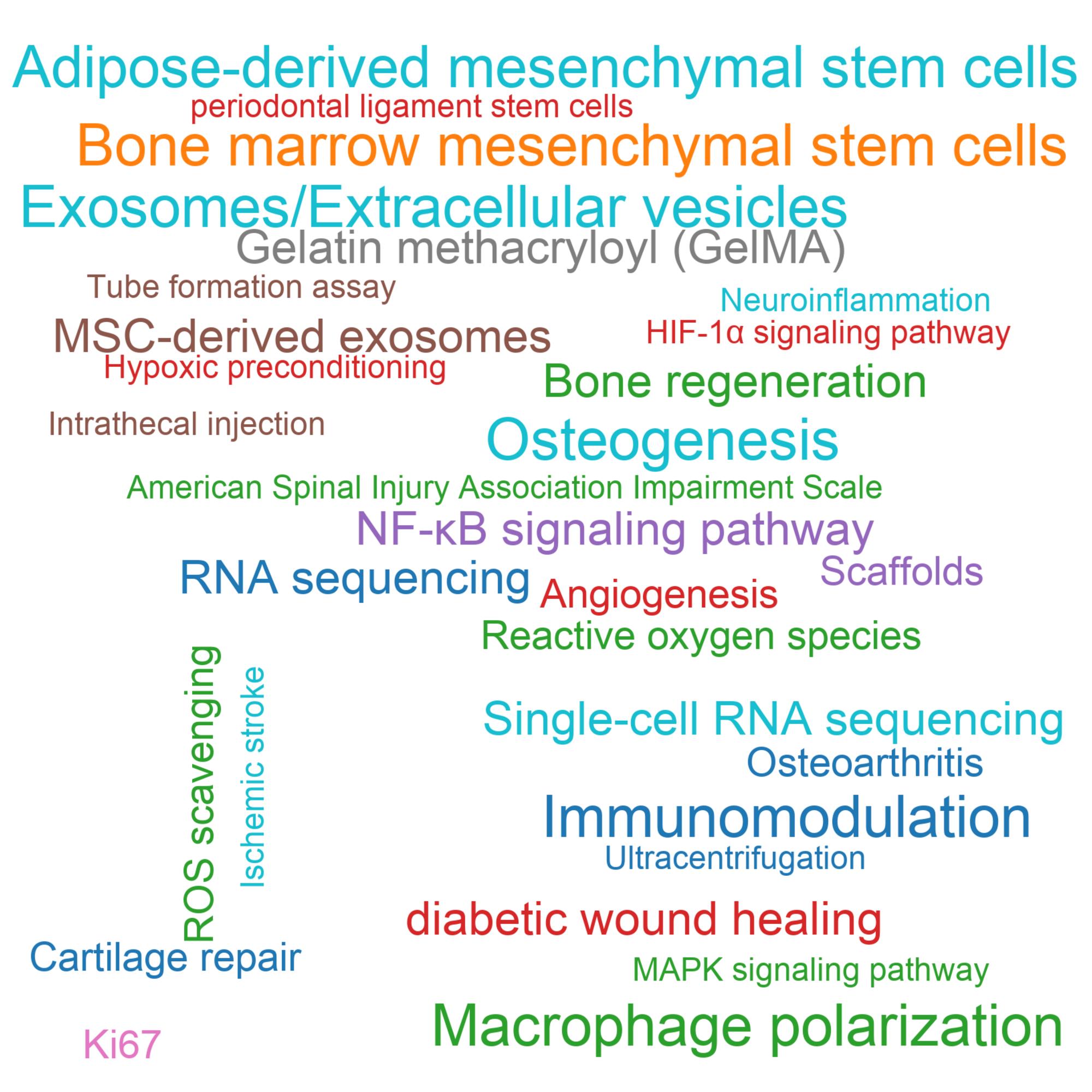
Research in the Class of 2026 for mesenchymal stem cell (MSC) research is strongly defined by paracrine cell-free therapies, bio-functional hydrogels, and deep cellular immunomodulation. Extracellular vesicles and MSC-derived exosomes (featured in 15% and 10% of top papers, respectively) dominate therapeutic modalities, reflecting a field-wide shift toward acellular therapeutics over direct cell transplantation. Specific cell sources remain evenly balanced between adipose-derived MSCs (15%) and bone marrow MSCs (15%). Mechanistically, regenerative efficacy is tightly coupled with immunomodulation (15%) and macrophage polarization (15%), alongside rising attention to reactive oxygen species (ROS) scavenging (7.5%) to alleviate oxidative stress in microenvironments. In tissue engineering, bone regeneration (10%) and osteogenesis (15%) lead functional applications, heavily supported by advanced biomaterial matrices such as gelatin methacryloyl (GelMA, 10%) and hydrogel scaffolds. Clinically, diabetic wound healing (10%) and cartilage repair (7.5%) serve as primary target pathologies. Furthermore, single-cell RNA sequencing (10%) and NF-κB signaling pathway analysis (10%) represent core analytical approaches, highlighting a mechanistic push to decode MSC heterogeneity and inflammatory signaling during tissue repair.
How Did Topics Shift from the Class of 2025 to the Class of 2026?
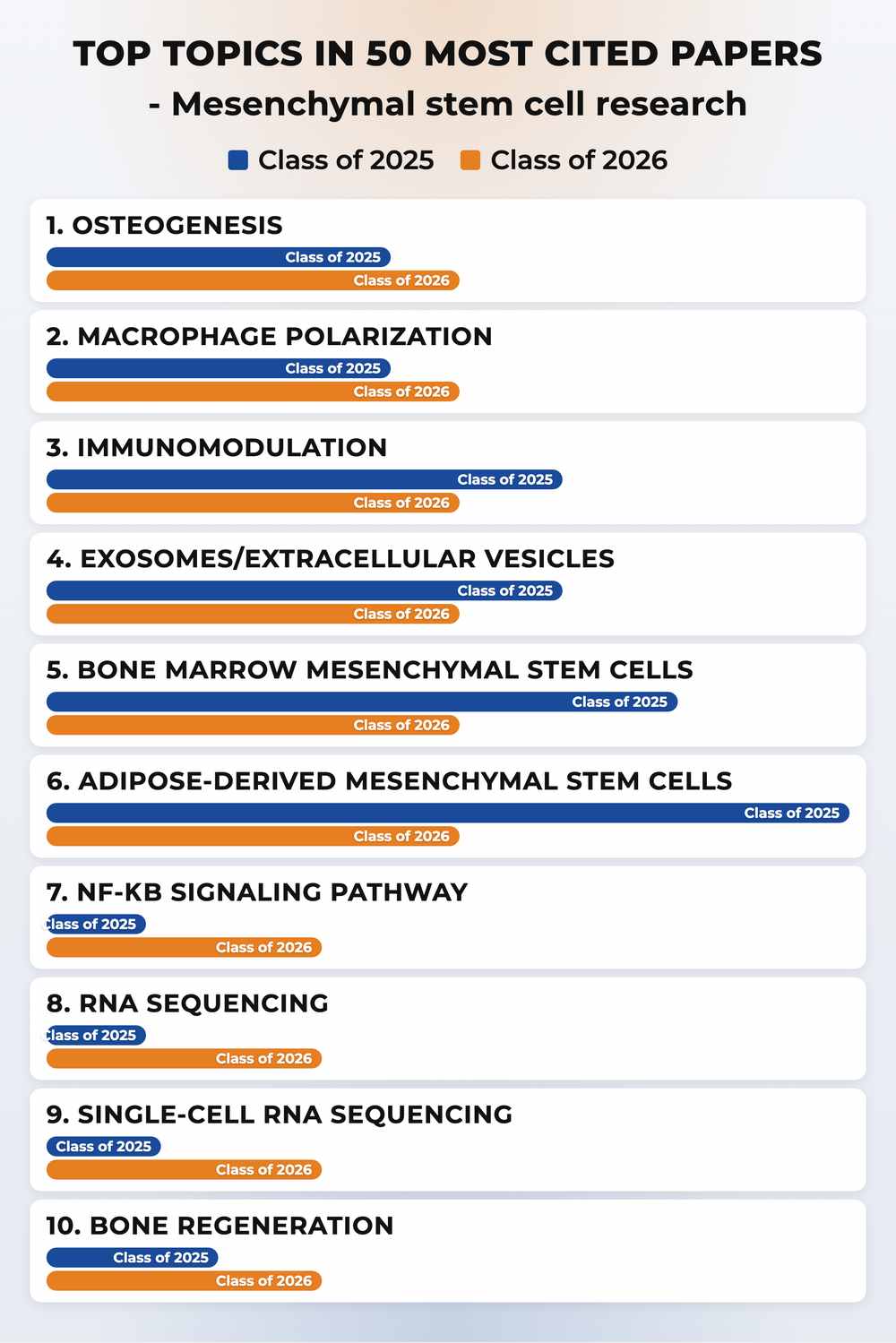
Comparing the Class of 2025 (2023 publications) to the Class of 2026 (2024 publications) reveals a transition from general stem cell profiling toward specialized microenvironmental organelle transfer, redox regulation, and high-resolution omics. Reactive oxygen species (ROS) scavenging surged from zero baseline mentions in 2023 to 7.5% in 2024, accompanied by a nearly 5-fold rise in NF-κB signaling pathway studies (rising from 2.1% to 10.0%). Next-generation transcriptomics saw dramatic gains, with single-cell RNA sequencing doubling (4.2% to 10.0%) and broader RNA sequencing expanding nearly 5-fold (2.1% to 10.0%). Novel biophysical mechanisms also gained momentum, marked by the emergence of intercellular mitochondrial transfer, YAP mechanotransduction, and dental pulp stem cells (all emerging from 0% in 2023 to 5.0% in 2024). Conversely, foundational topic shares contracted: adipose-derived MSCs dropped from 29.2% (14 papers) to 15.0% (6 papers), while bone marrow MSCs fell from 22.9% (11 papers) to 15.0% (6 papers). Similarly, broad functional endpoints like cartilage repair and angiogenesis contracted from 12.5% to 7.5%. This evolution highlights a field moving beyond descriptive stem cell characterization toward targeted organelle dynamics, oxidative stress control, and single-cell resolution therapeutics.
Methodology
PRI identifies high-impact research using a transparent, topic-agnostic framework applied consistently across scientific domains. Bibliographic records are drawn from OpenAlex, including publication dates, citation relationships, and document types.
This ranking covers the Class of 2026 cohort: journal articles published in 2024. Reviews and other non-article document types are excluded to ensure comparability.
Research impact is quantified with an 18-month post-publication citation window—the number of citing works published within 18 months of each paper's publication date. This metric captures early impact while controlling for publication age.
An LLM-based relevance classifier then reviews each candidate's title and abstract to confirm substantive alignment with the target domain. Only papers classified as relevant appear in the final ranking.
Zheng Su, Tinsley Li, Thematic Shifts in Early-High-Impact Cancer Genomics and Diagnostics Research: A Bibliometric and Semantic Analysis. bioRxiv 2026.07.04.736459; doi: https://doi.org/10.64898/2026.07.04.736459
Cite this ranking
Pepkio Research Index (PRI). Topics and Trends in Most Cited Mesenchymal stem cell research Papers, Class of 2026. https://pri.pepkio.com/top-papers/mesenchymal-stem-cell-research/2026. Accessed 2026-09-13.

Methodology
Zheng Su, Tinsley Li, Thematic Shifts in Early-High-Impact Cancer Genomics and Diagnostics Research: A Bibliometric and Semantic Analysis. bioRxiv 2026.07.04.736459; doi: https://doi.org/10.64898/2026.07.04.736459