
What topics and trends defined most-cited Acute Myeloid Leukemia Research research in the Class of 2026?
AML research in the Class of 2026 is driven by measurable residual disease (MRD) surveillance and venetoclax-azacitidine combination therapies. Topic evolution shows a dramatic 5-fold surge in KMT2A rearrangement and Menin inhibitor studies, while general single-cell transcriptomics and isolated baseline gene mutation analyses showed relative declines.
At a glance
- Field
- Acute Myeloid Leukemia Research
- Cohort label
- Class of 2026 (2024 publications)
- Papers analyzed
- 6,270
- Papers ranked
- 20
- Top topics in ranked papers
- Measurable residual disease (MRD), Venetoclax, KMT2A rearrangement, Azacitidine, Menin inhibitor
- Publication window
- Jan 1, 2024 – Dec 31, 2024
- Eligibility
- Research articles; reviews excluded
- Citation window
- 18 months post-publication
- 18m citation range
- 36–147
- Data source
- OpenAlex · Retrieved Jul 2026
- License
- CC BY 4.0
Rankings
20 papers ranked by 18-month citation count
Genetic risk classification for adults with AML receiving less-intensive therapies: the 2024 ELN recommendations
Blood202410.1182/blood.2024025409
Menin Inhibition With Revumenib for <i>KMT2A</i> -Rearranged Relapsed or Refractory Acute Leukemia (AUGMENT-101)
Journal of Clinical Oncology202410.1200/jco.24.00826
Gilteritinib as Post-Transplant Maintenance for AML With Internal Tandem Duplication Mutation of <i>FLT3</i>
Journal of Clinical Oncology202410.1200/jco.23.02474
Long‐term follow‐up of <scp>VIALE‐A</scp>: Venetoclax and azacitidine in chemotherapy‐ineligible untreated acute myeloid leukemia
American Journal of Hematology202410.1002/ajh.27246
Genetic risk stratification and outcomes among treatment-naive patients with AML treated with venetoclax and azacitidine
Blood202410.1182/blood.2024024944
Ziftomenib in relapsed or refractory acute myeloid leukaemia (KOMET-001): a multicentre, open-label, multi-cohort, phase 1 trial
The Lancet Oncology202410.1016/s1470-2045(24)00386-3
RAS-mutant leukaemia stem cells drive clinical resistance to venetoclax
Nature202410.1038/s41586-024-08137-x
Global, regional, and national burden of acute myeloid leukemia, 1990–2021: a systematic analysis for the global burden of disease study 2021
Biomarker Research202410.1186/s40364-024-00649-y
Azacitidine, Venetoclax, and Gilteritinib in Newly Diagnosed and Relapsed or Refractory <i>FLT3</i>-Mutated AML
Journal of Clinical Oncology202410.1200/jco.23.01911
Analysis of somatic mutations in whole blood from 200,618 individuals identifies pervasive positive selection and novel drivers of clonal hematopoiesis
Nature Genetics202410.1038/s41588-024-01755-1
Adult skull bone marrow is an expanding and resilient haematopoietic reservoir
Nature202410.1038/s41586-024-08163-9
Molecular, clinical, and therapeutic determinants of outcome in <i>NPM1</i>-mutated AML
Blood202410.1182/blood.2024024310
A new genomic framework to categorize pediatric acute myeloid leukemia
Nature Genetics202410.1038/s41588-023-01640-3
Postinduction molecular MRD identifies patients with <i>NPM1</i> AML who benefit from allogeneic transplant in first remission
Blood202410.1182/blood.2023023096
Preclinical efficacy of the potent, selective menin-KMT2A inhibitor JNJ-75276617 (bleximenib) in <i>KMT2A</i>- and <i>NPM1</i>-altered leukemias
Blood202410.1182/blood.2023022480
Single-cell transcriptomes identify patient-tailored therapies for selective co-inhibition of cancer clones
Nature Communications202410.1038/s41467-024-52980-5
Comprehensive characterization of IFNγ signaling in acute myeloid leukemia reveals prognostic and therapeutic strategies
Nature Communications202410.1038/s41467-024-45916-6
Measurable Residual <i>FLT3</i> Internal Tandem Duplication Before Allogeneic Transplant for Acute Myeloid Leukemia
JAMA Oncology202410.1001/jamaoncol.2024.0985
Mimicking clinical trials with synthetic acute myeloid leukemia patients using generative artificial intelligence
npj Digital Medicine202410.1038/s41746-024-01076-x
Remission induction versus immediate allogeneic haematopoietic stem cell transplantation for patients with relapsed or poor responsive acute myeloid leukaemia (ASAP): a randomised, open-label, phase 3, non-inferiority trial
The Lancet Haematology202410.1016/s2352-3026(24)00065-6
Topic trends
Dominant research themes and year-over-year shifts in Acute Myeloid Leukemia Research
What Topics Define the Class of 2026?
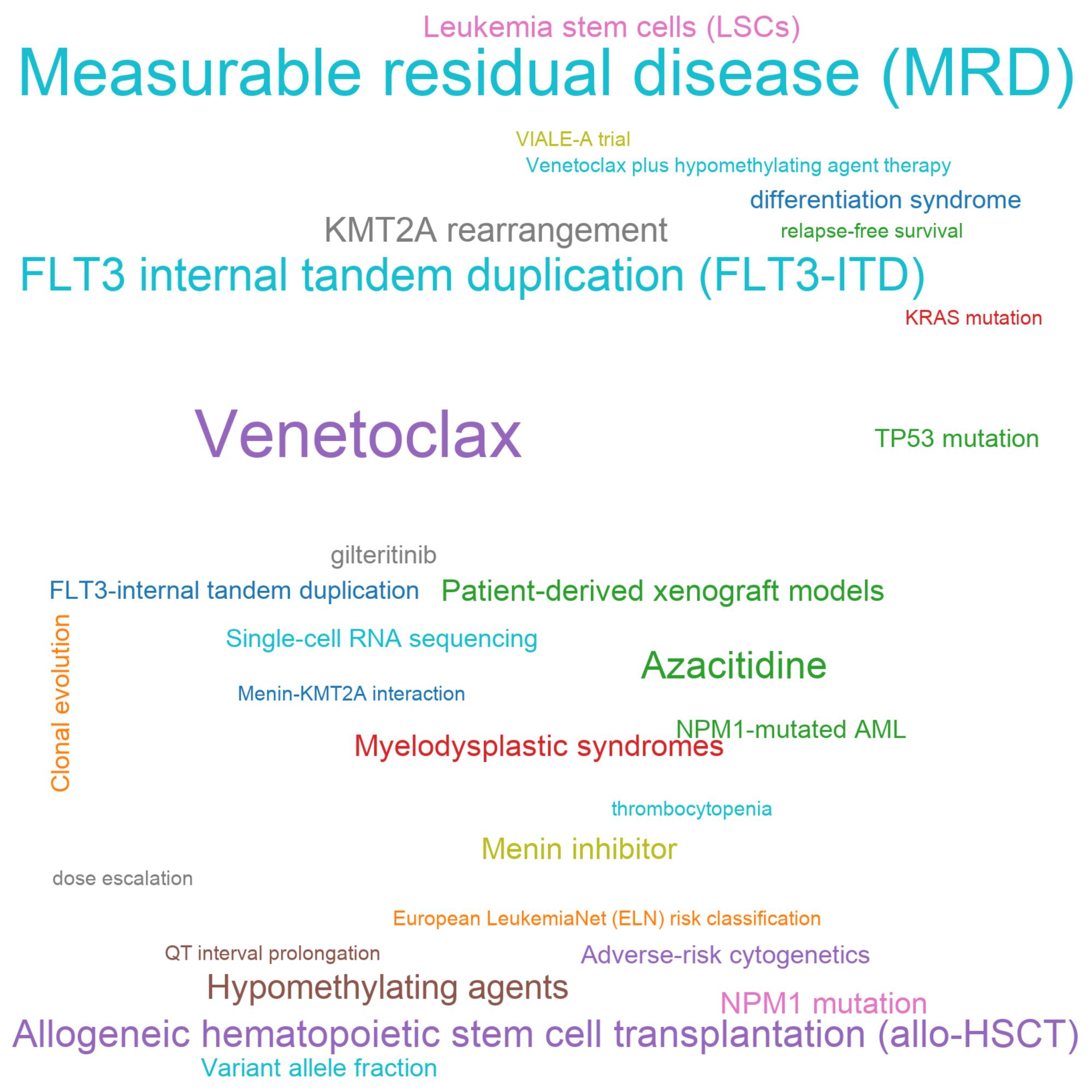
The 2026 cohort of high-impact acute myeloid leukemia (AML) research is anchored by minimal residual disease (MRD) tracking and combination targeted therapy regimens. Measurable residual disease (MRD) monitoring stands out as the single most prevalent informative focus (24% paper frequency, 12 mentions), underscoring a field-wide transition toward precise molecular response criteria and ultra-sensitive relapse risk stratification post-remission. In parallel, BCL-2 inhibitor venetoclax remains a therapeutic centerpiece (24% paper frequency), frequently investigated alongside hypomethylating agents like azacitidine (12% frequency) to optimize low-intensity frontline protocols and overcome clonal resistance. Genomic driver research continues to emphasize FLT3 internal tandem duplication (FLT3-ITD, 12% frequency) and NPM1 mutations, alongside rising interest in KMT2A rearrangements (10% frequency) and novel Menin inhibitors (8% frequency). Therapeutic evaluation heavily relies on leukemia stem cell (LSC) targeting and patient-derived xenograft (PDX) models (8% frequency each) to decipher chemoresistance mechanisms. Collectively, these focal points reflect a paradigm shift in AML oncology away from uniform intensive chemotherapy toward biomarker-driven, low-toxicity regimens that combine epigenetic priming, targeted apoptotic activation, and rigorous longitudinal MRD surveillance.
How Did Topics Shift from the Class of 2025 to the Class of 2026?
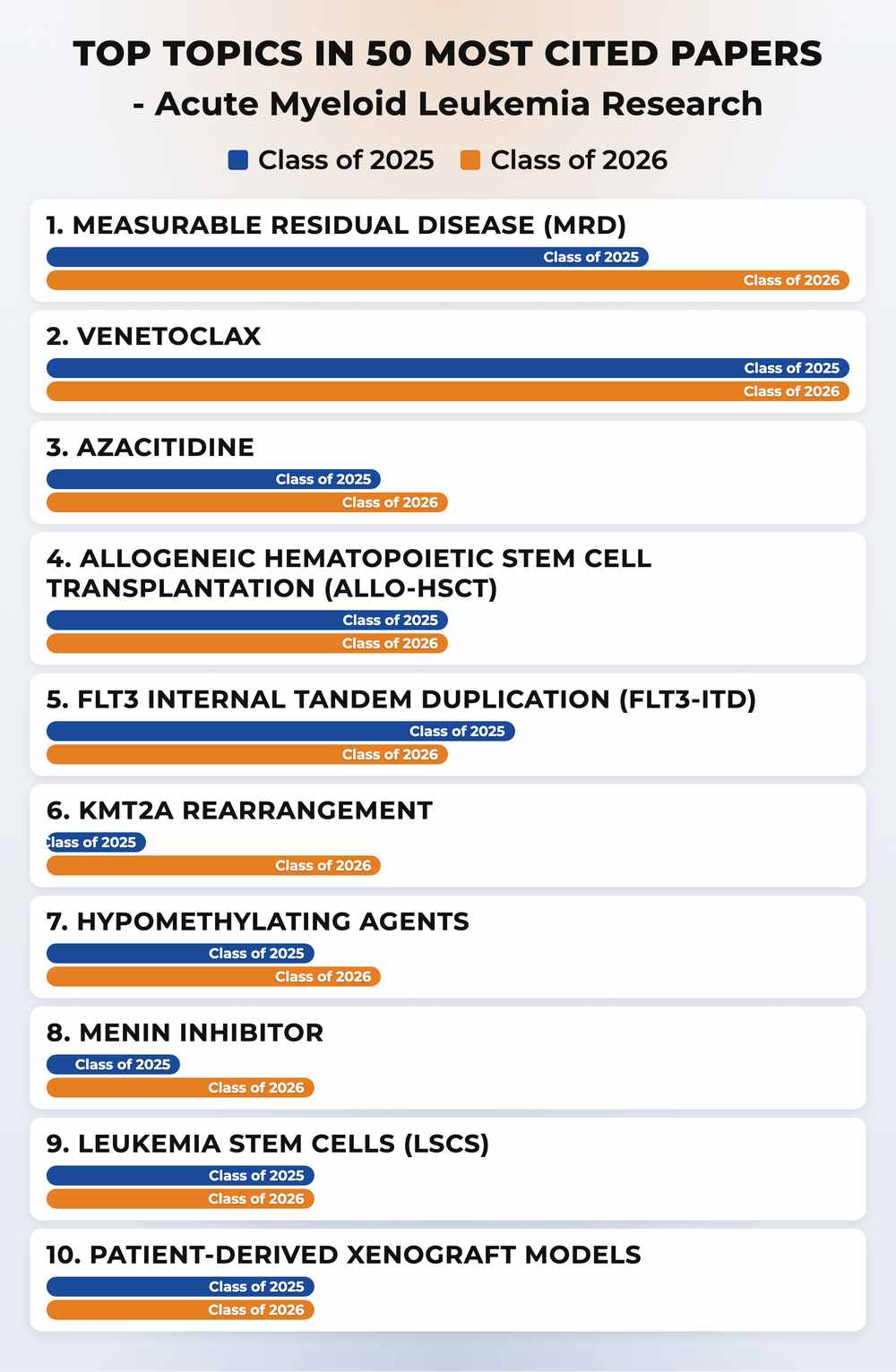
Comparing top-ranked publications across consecutive cohorts reveals a decisive pivot toward targeted epigenetic reader inhibition and refined molecular subclassifications. The most pronounced expansion occurred in KMT2A rearrangement studies, which surged 5.0-fold from 2% in the Class of 2025 to 10% in the Class of 2026 (5 mentions). This surge closely mirrors the rise of Menin inhibitors (doubling to 8% frequency) and Menin-KMT2A interaction mechanisms, signaling rapid clinical translation of novel targeted therapeutics for genetically defined AML subsets. Secondary FLT3-targeted investigations also gained momentum, with FLT3-internal tandem duplication studies expanding 3.0-fold (to 6% frequency) and gilteritinib evaluation rising 50%. Conversely, exploratory broad-profiling methodologies experienced a relative decline; single-cell RNA sequencing fell from 10% to 6% frequency (-40%), and foundational mutation studies focusing solely on DNMT3A and ASXL1 both decreased by 50% (from 8% to 4%). Similarly, traditional static risk models like the European LeukemiaNet (ELN) classification saw reduced relative prominence (-33%). Overall, topic evolution highlights an accelerating transition from generalized genomics toward mechanism-driven, target-specific interventions tailored to high-risk leukemic drivers.
Methodology
PRI identifies high-impact research using a transparent, topic-agnostic framework applied consistently across scientific domains. Bibliographic records are drawn from OpenAlex, including publication dates, citation relationships, and document types.
This ranking covers the Class of 2026 cohort: journal articles published in 2024. Reviews and other non-article document types are excluded to ensure comparability.
Research impact is quantified with an 18-month post-publication citation window—the number of citing works published within 18 months of each paper's publication date. This metric captures early impact while controlling for publication age.
An LLM-based relevance classifier then reviews each candidate's title and abstract to confirm substantive alignment with the target domain. Only papers classified as relevant appear in the final ranking.
Zheng Su, Tinsley Li, Thematic Shifts in Early-High-Impact Cancer Genomics and Diagnostics Research: A Bibliometric and Semantic Analysis. bioRxiv 2026.07.04.736459; doi: https://doi.org/10.64898/2026.07.04.736459
Cite this ranking
Pepkio Research Index (PRI). Topics and Trends in Most Cited Acute Myeloid Leukemia Research Papers, Class of 2026. https://pri.pepkio.com/top-papers/acute-myeloid-leukemia-research/2026. Accessed 2026-09-13.

Methodology
Zheng Su, Tinsley Li, Thematic Shifts in Early-High-Impact Cancer Genomics and Diagnostics Research: A Bibliometric and Semantic Analysis. bioRxiv 2026.07.04.736459; doi: https://doi.org/10.64898/2026.07.04.736459