
What topics and trends defined most-cited Water Quality and Pollution Assessment research in the Class of 2026?
The Class of 2026 research in Water Quality and Pollution Assessment is defined by a strong focus on heavy metals, human health risk assessment, and the Water Quality Index. We observe a significant shift towards health-centric risk assessments and principal component analysis, indicating a more rigorous, data-driven approach to evaluating environmental and public health hazards.
At a glance
- Field
- Water Quality and Pollution Assessment
- Cohort label
- Class of 2026 (2024 publications)
- Papers analyzed
- 5,957
- Papers ranked
- 20
- Top topics in ranked papers
- Heavy metals, Human health risk assessment, Water Quality Index
- Publication window
- Jan 1, 2024 – Dec 31, 2024
- Eligibility
- Research articles; reviews excluded
- Citation window
- 18 months post-publication
- 18m citation range
- 58–138
- Data source
- OpenAlex · Retrieved June 2026
- License
- CC BY 4.0
Rankings
20 papers ranked by 18-month citation count
Current and future global water scarcity intensifies when accounting for surface water quality
Nature Climate Change202410.1038/s41558-024-02007-0
Pollution analysis of metals in the sediments of lagoon lakes in Türkiye: Toxicological risk assessment and source insights
Process Safety and Environmental Protection202410.1016/j.psep.2024.11.085
Appraisal of metallic accumulation in the surface sediment of a fish breeding dam in Türkiye: A stochastical approach to ecotoxicological risk assessment
Marine Pollution Bulletin202410.1016/j.marpolbul.2024.116488
Metal pollution assessment in the surface sediments of a river system in Türkiye: Integrating toxicological risk assessment and source identification
Marine Pollution Bulletin202410.1016/j.marpolbul.2024.116514
Toxicological risk assessment using spring water quality indices in plateaus of Giresun Province/Türkiye: a holistic hydrogeochemical data analysis
Environmental Geochemistry and Health202410.1007/s10653-024-02054-8
Evaluation of water quality indexes with novel machine learning and SHapley Additive ExPlanation (SHAP) approaches
Journal of Water Process Engineering202410.1016/j.jwpe.2024.104789
Investigation of groundwater quality in the Southern Coast of the Black Sea: application of computational health risk assessment in Giresun, Türkiye
Environmental Science and Pollution Research202410.1007/s11356-024-34712-w
RETRACTED: Trace element pollution tracking in the complex multi-aquifer groundwater system of Al-Hassa oasis (Saudi Arabia) using spatial, chemometric and index-based techniques
Environmental Research202410.1016/j.envres.2024.118320
Reliable water quality prediction and parametric analysis using explainable AI models
Scientific Reports202410.1038/s41598-024-56775-y
Assessing sources of groundwater quality and health risks using graphical, multivariate, and index techniques from a part of Rajasthan, India
Groundwater for Sustainable Development202410.1016/j.gsd.2024.101356
Unveiling the nutritional value and potentially toxic elements in fish species from Miliç Wetland, Türkiye: A probabilistic human health risk assessment using Monte Carlo simulation
Marine Pollution Bulletin202410.1016/j.marpolbul.2024.117417
Incorporation of water quality index models with machine learning-based techniques for real-time assessment of aquatic ecosystems
Environmental Pollution202410.1016/j.envpol.2024.124242
Toward Decontamination in Coastal Regions: Groundwater Quality, Fluoride, Nitrate, and Human Health Risk Assessments within Multi-Aquifer Al-Hassa, Saudi Arabia
Water202410.3390/w16101401
Assessment of drinking water quality and identifying pollution sources in a chromite mining region
Journal of Hazardous Materials202410.1016/j.jhazmat.2024.136050
Assessing microbiological and heavy metal pollution in surface waters associated with potential human health risk assessment at fish ingestion exposure
Journal of Hazardous Materials202410.1016/j.jhazmat.2024.135187
New approach into human health risk assessment associated with heavy metals in surface water and groundwater using Monte Carlo Method
Scientific Reports202410.1038/s41598-023-50000-y
Integrated Geospatial and Geostatistical Multi-Criteria Evaluation of Urban Groundwater Quality Using Water Quality Indices
Water202410.3390/w16172549
Interpretable prediction, classification and regulation of water quality: A case study of Poyang Lake, China
The Science of The Total Environment202410.1016/j.scitotenv.2024.175407
Seasonal Variations and Assessment of Surface Water Quality Using Water Quality Index (WQI) and Principal Component Analysis (PCA): A Case Study
Sustainability202410.3390/su16135644
Groundwater quality assessment using water quality index and principal component analysis in the Achnera block, Agra district, Uttar Pradesh, Northern India
Scientific Reports202410.1038/s41598-024-56056-8
Topic trends
Dominant research themes and year-over-year shifts in Water Quality and Pollution Assessment
What Topics Define the Class of 2026?
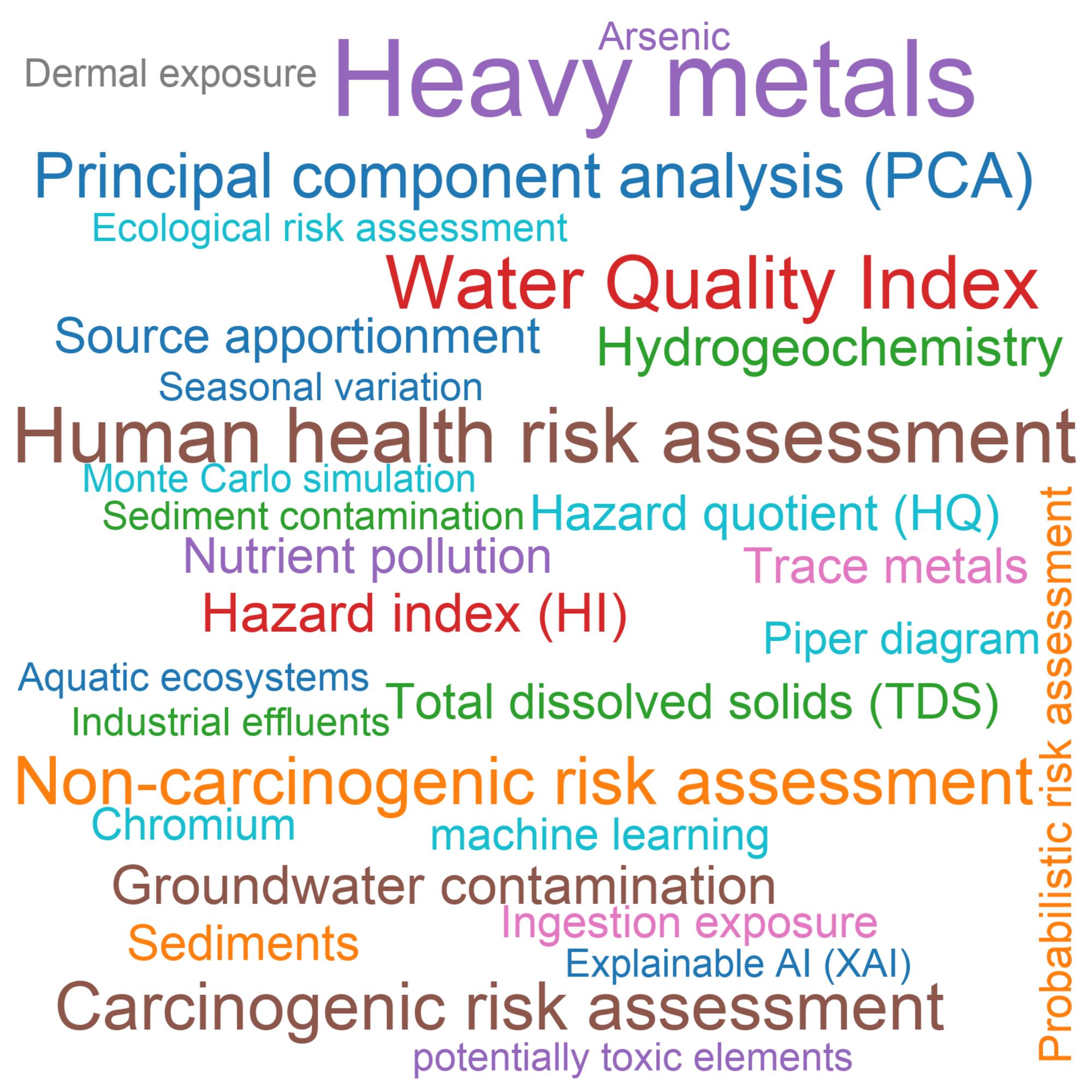
The most prominent topic defining the 2024 cohort is Heavy Metals, highlighting its continued significance as a major pollutant in environmental studies. Following closely are Human Health Risk Assessment and Water Quality Index, indicating that research is highly focused on not only tracking pollution but also directly evaluating its impact on public health. Carcinogenic and non-carcinogenic risk assessments also feature heavily, reflecting a comprehensive approach to understanding both immediate and long-term consequences of water contamination. This clustering of topics suggests that the field is deeply engaged in linking environmental monitoring with actionable health outcomes, driving a more integrated perspective on water safety.
How Did Topics Shift from the Class of 2025 to the Class of 2026?
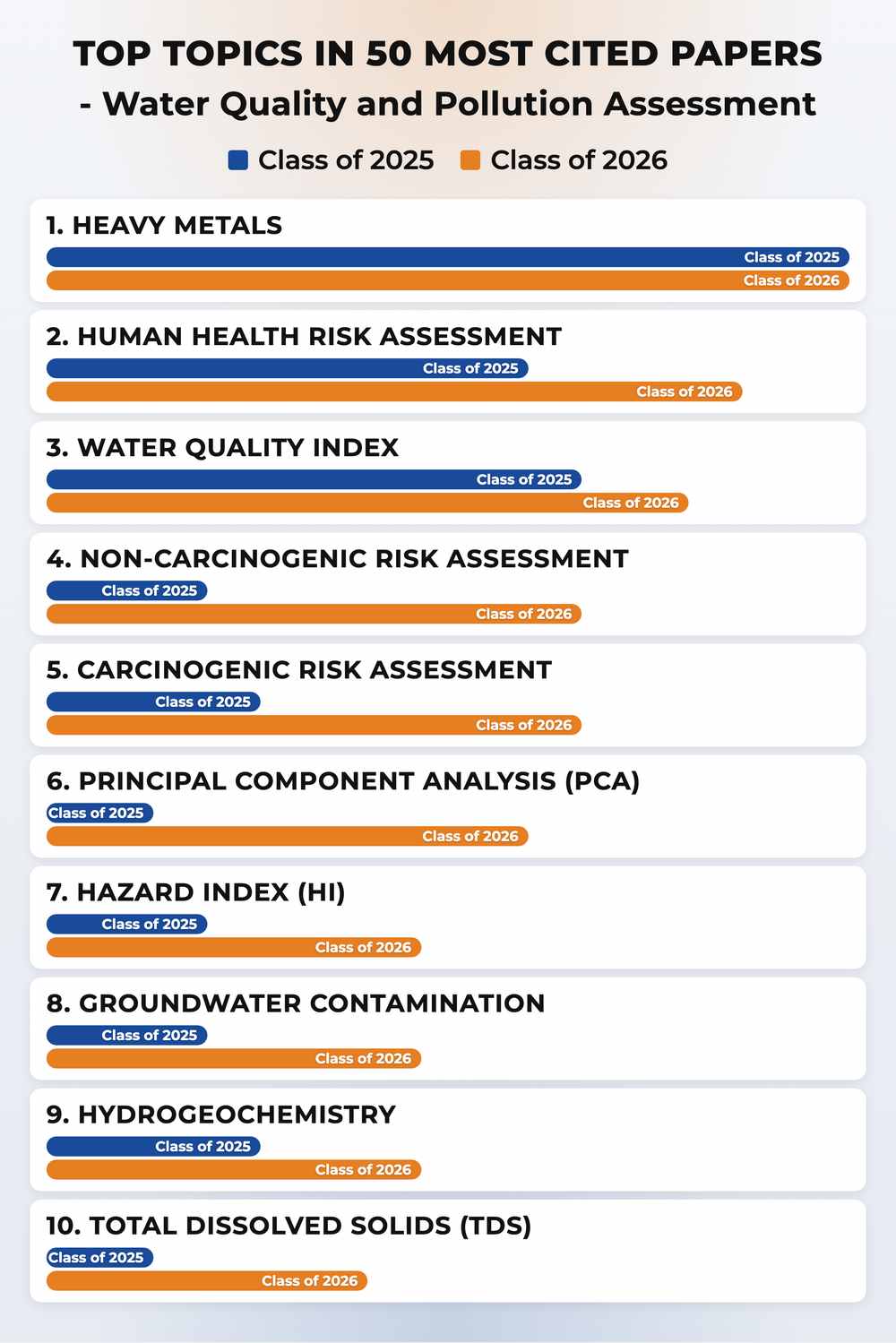
From the previous cohort, the most striking shift is the surge in advanced risk assessment techniques and statistical modeling. Principal Component Analysis (PCA) saw a remarkable 4.5-fold increase, emphasizing a growing reliance on data-driven methodologies to trace pollution sources. Similarly, Non-carcinogenic and Carcinogenic Risk Assessments grew by over 2.5-fold, underscoring an intensified focus on detailed health-impact evaluations. Meanwhile, foundational topics like Heavy Metals and Water Quality Index remained relatively stable. This pattern suggests that while the core pollutants being studied remain consistent, the analytical tools and health-focused frameworks applied to them have become significantly more sophisticated.
Methodology
PRI identifies high-impact research using a transparent, topic-agnostic framework applied consistently across scientific domains. Bibliographic records are drawn from OpenAlex, including publication dates, citation relationships, and document types.
This ranking covers the Class of 2026 cohort: journal articles published in 2024. Reviews and other non-article document types are excluded to ensure comparability.
Research impact is quantified with an 18-month post-publication citation window—the number of citing works published within 18 months of each paper's publication date. This metric captures early impact while controlling for publication age.
An LLM-based relevance classifier then reviews each candidate's title and abstract to confirm substantive alignment with the target domain. Only papers classified as relevant appear in the final ranking.
Zheng Su, Tinsley Li, Thematic Shifts in Early-High-Impact Cancer Genomics and Diagnostics Research: A Bibliometric and Semantic Analysis. bioRxiv 2026.07.04.736459; doi: https://doi.org/10.64898/2026.07.04.736459
Cite this ranking
Pepkio Research Index (PRI). Topics and Trends in Most Cited Water Quality and Pollution Assessment Papers, Class of 2026. https://pri.pepkio.com/top-papers/water-quality-and-pollution-assessment/2026. Accessed 2026-10-24.

Methodology
Zheng Su, Tinsley Li, Thematic Shifts in Early-High-Impact Cancer Genomics and Diagnostics Research: A Bibliometric and Semantic Analysis. bioRxiv 2026.07.04.736459; doi: https://doi.org/10.64898/2026.07.04.736459