
What topics and trends defined most-cited Hydrology and Watershed Management Studies research in the Class of 2026?
High-impact hydrology research in the Class of 2026 emphasizes hybrid modeling, multi-source data fusion, and real-time flood forecasting evaluated via Nash-Sutcliffe efficiency. Attention mechanisms and support vector machines rose sharply, replacing standalone LSTM and CNN sequence models, while predictive focus shifted toward multi-step forecasting, groundwater dynamics, and extreme flood management.
At a glance
- Field
- Hydrology and Watershed Management Studies
- Cohort label
- Class of 2026 (2024 publications)
- Papers analyzed
- 9,612
- Papers ranked
- 20
- Top topics in ranked papers
- Nash-Sutcliffe efficiency, Hybrid modeling, Streamflow prediction, Flood forecasting, Ensemble learning
- Publication window
- Jan 1, 2024 – Dec 31, 2024
- Eligibility
- Research articles; reviews excluded
- Citation window
- 18 months post-publication
- 18m citation range
- 69–732
- Data source
- OpenAlex · Retrieved Jul 2026
- License
- CC BY 4.0
Rankings
20 papers ranked by 18-month citation count
Comparative Analysis of Flood Estimation using Log-Pearson Type III and Gumbel Max Models in the Cauvery River, India
International Journal of Innovative Science and Research Technology (IJISRT)202410.38124/ijisrt/ijisrt24apr2402
A triple increase in global river basins with water scarcity due to future pollution
Nature Communications202410.1038/s41467-024-44947-3
Global prediction of extreme floods in ungauged watersheds
Nature202410.1038/s41586-024-07145-1
River water quality shaped by land–river connectivity in a changing climate
Nature Climate Change202410.1038/s41558-023-01923-x
Investigating the impacts of climate change on hydroclimatic extremes in the Tar-Pamlico River basin, North Carolina
Journal of Environmental Management202410.1016/j.jenvman.2024.121375
River discharge prediction based multivariate climatological variables using hybridized long short-term memory with nature inspired algorithm
Journal of Hydrology202410.1016/j.jhydrol.2024.132453
Water security assessment for effective water resource management based on multi-temporal blue and green water footprints
Journal of Hydrology202410.1016/j.jhydrol.2024.130761
Majority of global river flow sustained by groundwater
Nature Geoscience202410.1038/s41561-024-01483-5
Assessing the accuracy of OpenET satellite-based evapotranspiration data to support water resource and land management applications
Nature Water202410.1038/s44221-023-00181-7
Response of streamflow and sediment variability to cascade dam development and climate change in the Sai Gon Dong Nai River basin
Climate Dynamics202410.1007/s00382-024-07319-7
Climate Change and Hydrological Extremes
Current Climate Change Reports202410.1007/s40641-024-00198-4
Streamflow seasonality in a snow-dwindling world
Nature202410.1038/s41586-024-07299-y
Widespread societal and ecological impacts from projected Tibetan Plateau lake expansion
Nature Geoscience202410.1038/s41561-024-01446-w
Anthropogenic climate change has influenced global river flow seasonality
Science202410.1126/science.adi9501
A deep learning interpretable model for river dissolved oxygen multi-step and interval prediction based on multi-source data fusion
Journal of Hydrology202410.1016/j.jhydrol.2024.130637
Evidence of human influence on Northern Hemisphere snow loss
Nature202410.1038/s41586-023-06794-y
NOAA's National Water Model: Advancing operational hydrology through continental‐scale modeling
JAWRA Journal of the American Water Resources Association202410.1111/1752-1688.13184
Impact of groundwater nitrogen legacy on water quality
Nature Sustainability202410.1038/s41893-024-01369-9
A methodological framework for assessing sea level rise impacts on nitrate loading in coastal agricultural watersheds using SWAT+: A case study of the Tar-Pamlico River basin, North Carolina, USA
The Science of The Total Environment202410.1016/j.scitotenv.2024.175523
Tree water uptake patterns across the globe
New Phytologist202410.1111/nph.19762
Topic trends
Dominant research themes and year-over-year shifts in Hydrology and Watershed Management Studies
What Topics Define the Class of 2026?
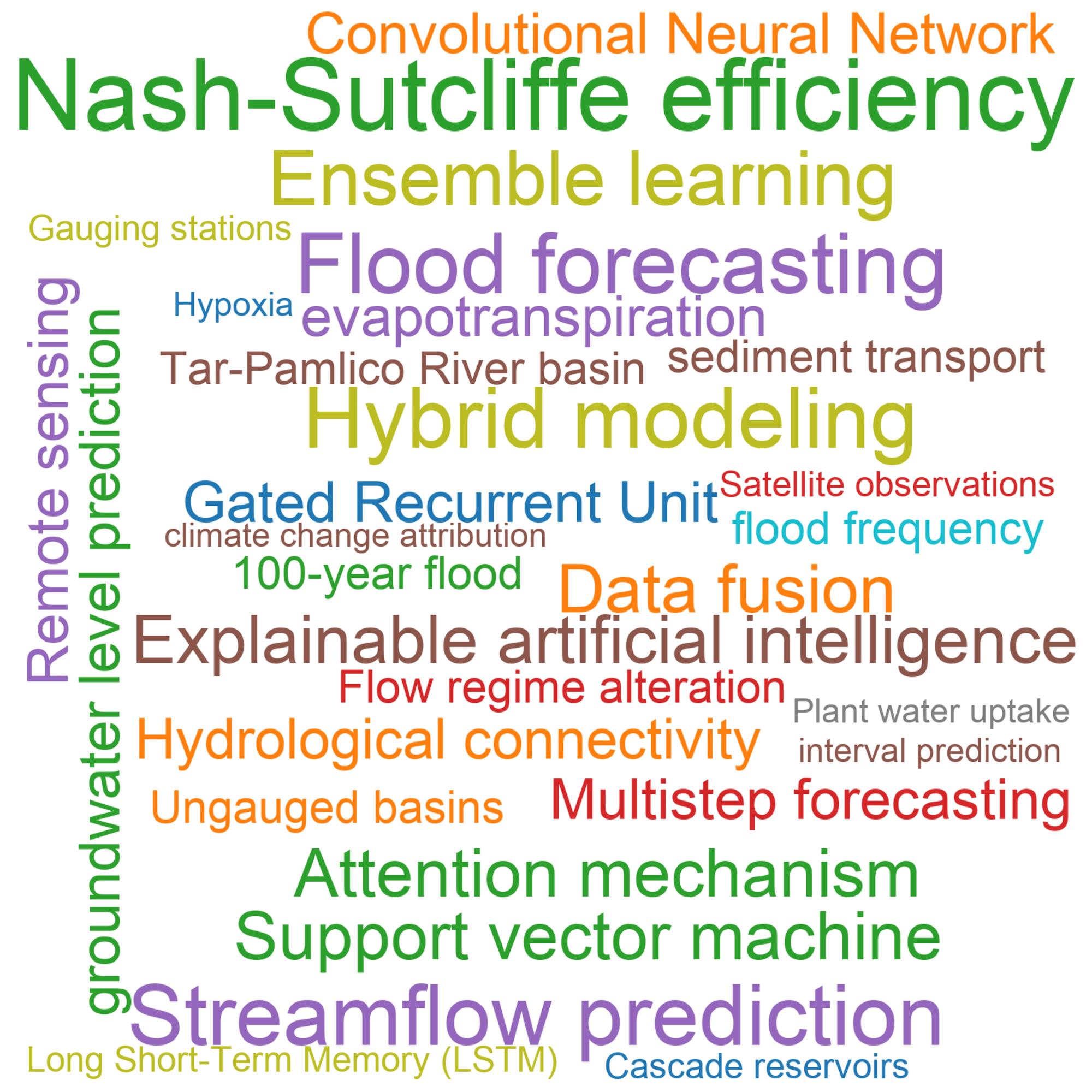
The Class of 2026 in Hydrology and Watershed Management Studies is defined by a strong convergence between deep learning architectures, empirical statistical metrics, and process-oriented hydrological modeling. Benchmark goodness-of-fit metrics, led by Nash-Sutcliffe efficiency (appearing in 16% of top-cited publications), anchor model evaluation standards across regional streamflow prediction (12%) and real-time flood forecasting (12%). Researchers are increasingly moving beyond standalone hydrodynamic or physical models, adopting hybrid modeling frameworks (12%) that integrate physics-informed constraints with ensemble learning (10%) and data fusion (8%). AI-driven methods feature prominently in high-impact literature: deep learning architectures such as Gated Recurrent Units (6%) and Attention mechanisms (8%) are frequently combined with Support Vector Machines (8%) to enhance predictive skill in non-linear watershed systems. Furthermore, there is growing interest in model interpretability and spatial scaling, as evidenced by rising mentions of Explainable Artificial Intelligence (8%), satellite-based Remote Sensing (6%), and hydrological connectivity (6%). Together, these dominant clusters underscore a methodological shift toward hybrid, data-assimilated forecasting systems designed to resolve extreme hydrometeorological events across complex topographies.
How Did Topics Shift from the Class of 2025 to the Class of 2026?
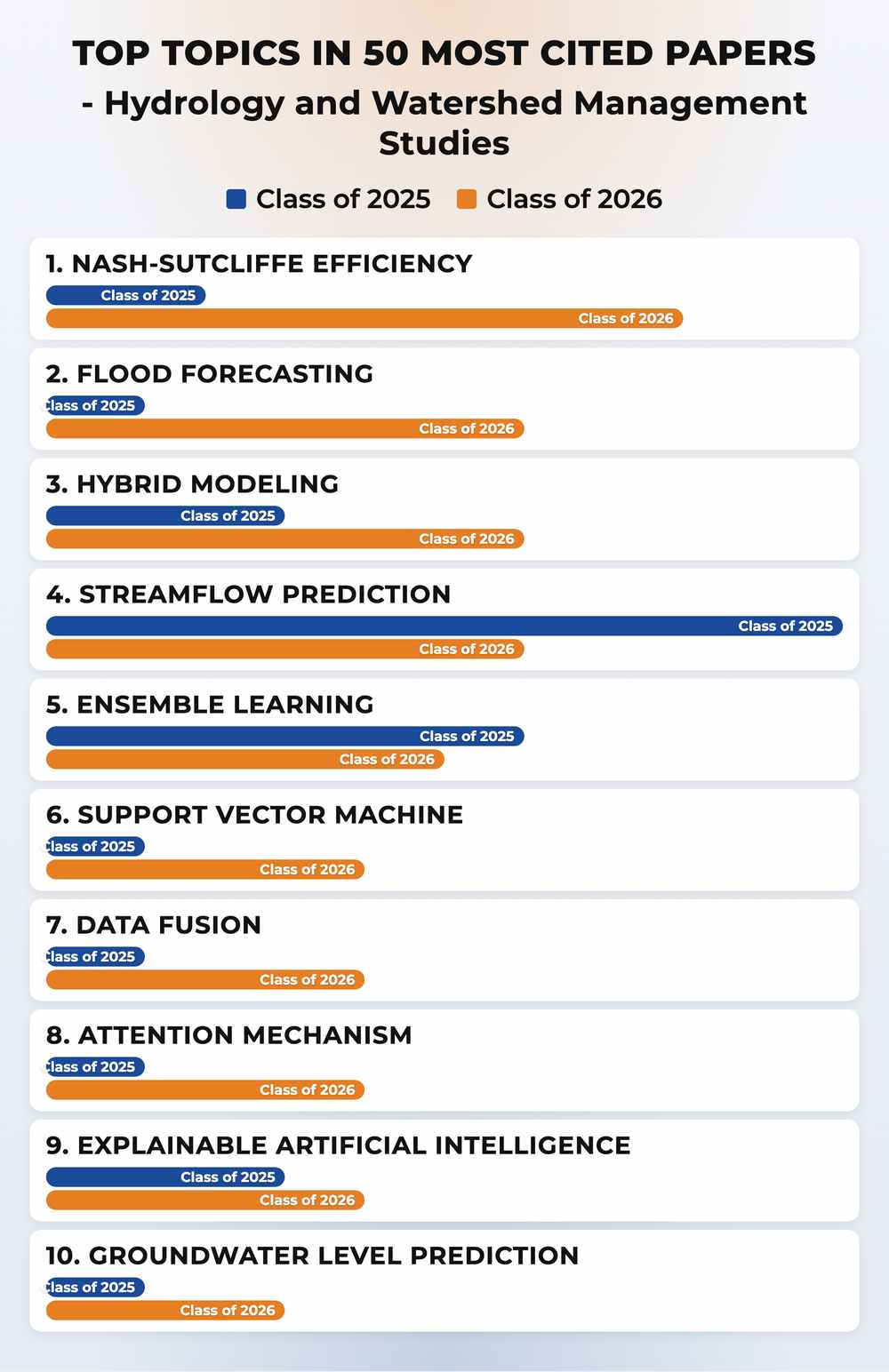
Comparative analysis between the Class of 2025 and Class of 2026 reveals a significant evolution in computational paradigms and target applications across watershed management. The most dramatic shift is the rapid ascent of multi-source data fusion (rising to 8% of top publications) and specialized prediction targets like groundwater level prediction (6%) and multistep forecasting (6%). Operational flood risk assessment surged sharply, with flood forecasting expanding six-fold (2% to 12%) alongside increased focus on extreme events such as the 100-year flood (4%) and flow regime alterations (4%). Methodologically, attention-based neural mechanisms (up four-fold to 8%) and support vector machines (8%) gained substantial traction. Conversely, foundational deep learning architectures experienced notable relative declines: Long Short-Term Memory (LSTM) networks dropped sharply from 18% to 4%, while Convolutional Neural Networks (CNNs) decreased from 14% to 6%, indicating a transition away from generic sequence models toward hybrid, attention-gated architectures and data assimilation schemes. Traditional broad process studies, such as basin-wide evapotranspiration estimation (14% down to 6%), also saw diminished relative prominence as research shifted toward high-resolution, predictive water management.
Methodology
PRI identifies high-impact research using a transparent, topic-agnostic framework applied consistently across scientific domains. Bibliographic records are drawn from OpenAlex, including publication dates, citation relationships, and document types.
This ranking covers the Class of 2026 cohort: journal articles published in 2024. Reviews and other non-article document types are excluded to ensure comparability.
Research impact is quantified with an 18-month post-publication citation window—the number of citing works published within 18 months of each paper's publication date. This metric captures early impact while controlling for publication age.
An LLM-based relevance classifier then reviews each candidate's title and abstract to confirm substantive alignment with the target domain. Only papers classified as relevant appear in the final ranking.
Zheng Su, Tinsley Li, Thematic Shifts in Early-High-Impact Cancer Genomics and Diagnostics Research: A Bibliometric and Semantic Analysis. bioRxiv 2026.07.04.736459; doi: https://doi.org/10.64898/2026.07.04.736459
Cite this ranking
Pepkio Research Index (PRI). Topics and Trends in Most Cited Hydrology and Watershed Management Studies Papers, Class of 2026. https://pri.pepkio.com/top-papers/hydrology-and-watershed-management-studies/2026. Accessed 2026-10-24.

Methodology
Zheng Su, Tinsley Li, Thematic Shifts in Early-High-Impact Cancer Genomics and Diagnostics Research: A Bibliometric and Semantic Analysis. bioRxiv 2026.07.04.736459; doi: https://doi.org/10.64898/2026.07.04.736459