
What topics and trends defined most-cited Forest ecology and management research in the Class of 2026?
Forest ecology research in 2024 centers on carbon sequestration, soil organic carbon, and high-resolution inventory modeling. Key emerging shifts showcase rapid adoption of Sentinel satellite data, XGBoost modeling, and explicit carbon sink assessments, alongside nationwide forest inventory integration and climate-driven species range shift modeling.
At a glance
- Field
- Forest ecology and management
- Cohort label
- Class of 2026 (2024 publications)
- Papers analyzed
- 4,510
- Papers ranked
- 20
- Top topics in ranked papers
- Carbon sequestration, forest inventory, carbon sink, Sentinel satellite data, soil organic carbon
- Publication window
- Jan 1, 2024 – Dec 31, 2024
- Eligibility
- Research articles; reviews excluded
- Citation window
- 18 months post-publication
- 18m citation range
- 35–100
- Data source
- OpenAlex · Retrieved Jul 2026
- License
- CC BY 4.0
Rankings
20 papers ranked by 18-month citation count
Integration of machine learning and remote sensing for above ground biomass estimation through Landsat-9 and field data in temperate forests of the Himalayan region
Ecological Informatics202410.1016/j.ecoinf.2024.102732
Carbon sequestration potential of tree planting in China
Nature Communications202410.1038/s41467-024-52785-6
Maximizing carbon sequestration potential in Chinese forests through optimal management
Nature Communications202410.1038/s41467-024-47143-5
Climate-induced tree-mortality pulses are obscured by broad-scale and long-term greening
Nature Ecology & Evolution202410.1038/s41559-024-02372-1
Characterizing the structural complexity of the Earth’s forests with spaceborne lidar
Nature Communications202410.1038/s41467-024-52468-2
SegmentAnyTree: A sensor and platform agnostic deep learning model for tree segmentation using laser scanning data
Remote Sensing of Environment202410.1016/j.rse.2024.114367
The global distribution and drivers of wood density and their impact on forest carbon stocks
Nature Ecology & Evolution202410.1038/s41559-024-02564-9
Automated forest inventory: Analysis of high-density airborne LiDAR point clouds with 3D deep learning
Remote Sensing of Environment202410.1016/j.rse.2024.114078
Dynamics of nitrogen mineralization and fine root decomposition in sub-tropical Shorea robusta Gaertner f. forests of Central Himalaya, India
The Science of The Total Environment202410.1016/j.scitotenv.2024.170896
A climate-induced tree species bottleneck for forest management in Europe
Nature Ecology & Evolution202410.1038/s41559-024-02406-8
More than 17,000 tree species are at risk from rapid global change
Nature Communications202410.1038/s41467-023-44321-9
Enhanced woody biomass production in a mature temperate forest under elevated CO2
Nature Climate Change202410.1038/s41558-024-02090-3
TreeLearn: A deep learning method for segmenting individual trees from ground-based LiDAR forest point clouds
Ecological Informatics202410.1016/j.ecoinf.2024.102888
Improving Forest Above-Ground Biomass Estimation by Integrating Individual Machine Learning Models
Forests202410.3390/f15060975
Effects of plant diversity on productivity strengthen over time due to trait-dependent shifts in species overyielding
Nature Communications202410.1038/s41467-024-46355-z
Resilience of genetic diversity in forest trees over the Quaternary
Nature Communications202410.1038/s41467-024-52612-y
Forest aging limits future carbon sink in China
One Earth202410.1016/j.oneear.2024.04.011
Sub-meter tree height mapping of California using aerial images and LiDAR-informed U-Net model
Remote Sensing of Environment202410.1016/j.rse.2024.114099
High-resolution canopy height map in the Landes forest (France) based on GEDI, Sentinel-1, and Sentinel-2 data with a deep learning approach
International Journal of Applied Earth Observation and Geoinformation202410.1016/j.jag.2024.103711
Vegetation restoration affects soil hydrological processes in typical natural and planted forests on the Loess Plateau
Journal of Hydrology202410.1016/j.jhydrol.2024.132465
Topic trends
Dominant research themes and year-over-year shifts in Forest ecology and management
What Topics Define the Class of 2026?
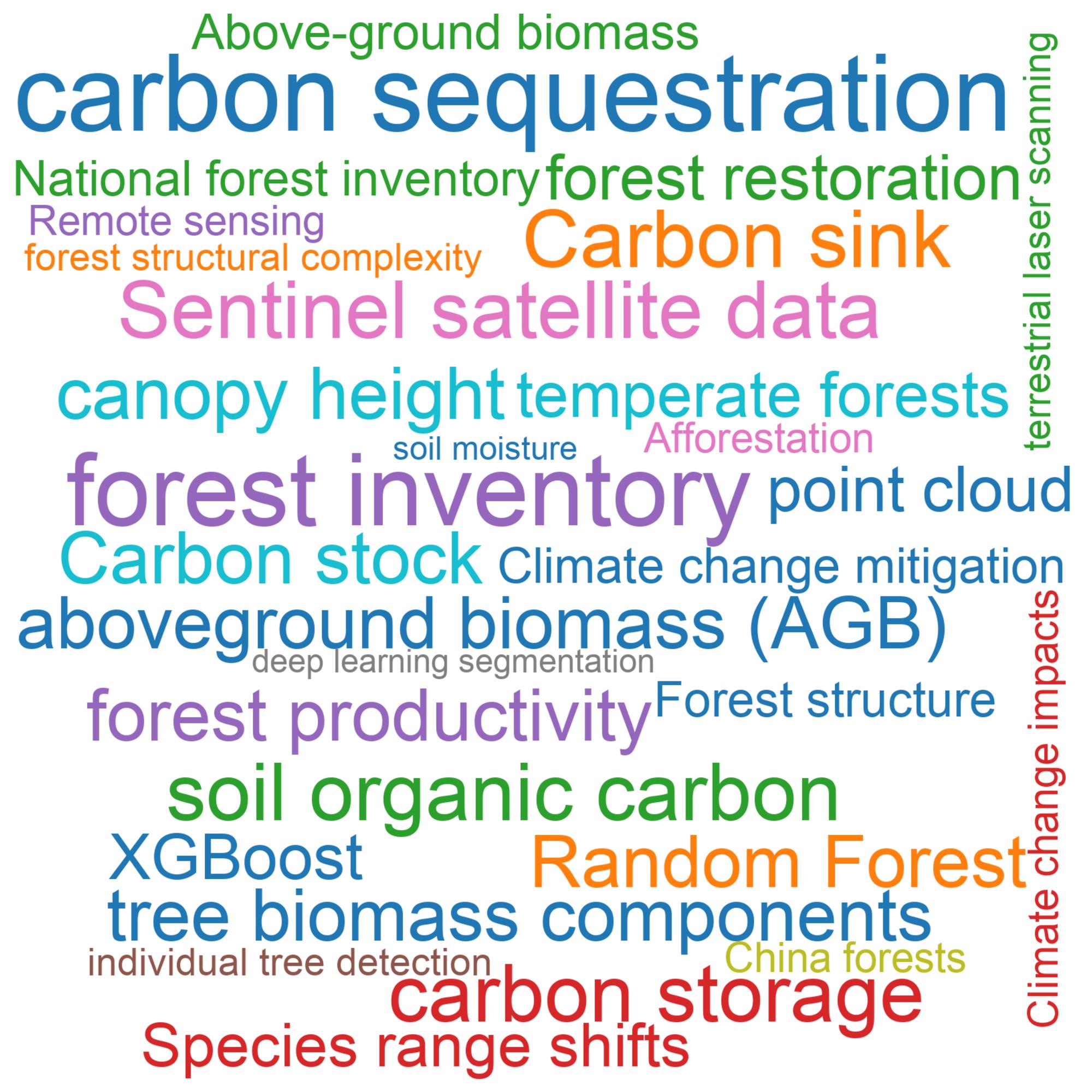
The Class of 2026 in forest ecology and management is dominated by quantitative carbon accounting, high-resolution remote sensing, and structural biomass estimation. Carbon sequestration emerges as the most prominent canonical concept (20.0% normalized frequency), accompanied by related carbon dynamics including carbon storage (12.0%), soil organic carbon (12.0%), and carbon sink capacity (12.0%). Concurrently, methodological frameworks for assessing forest inventory (18.0%) and aboveground biomass (10.0%) form the foundational backbone of high-impact research. Remote sensing techniques, particularly those leveraging Sentinel satellite data (12.0%), canopy height models (10.0%), and point cloud LiDAR datasets (8.0%), continue to drive scalable forest monitoring across regional and global scales. Machine learning models like Random Forest (10.0%) and XGBoost (8.0%) are widely deployed for integrating multi-source spatial data with field measurements. Furthermore, climate change mitigation (8.0%) and forest restoration (8.0%) highlight the transition toward actionable ecological interventions, underscoring how modern forest ecology combines earth observation technology with ecosystem-service evaluation.
How Did Topics Shift from the Class of 2025 to the Class of 2026?
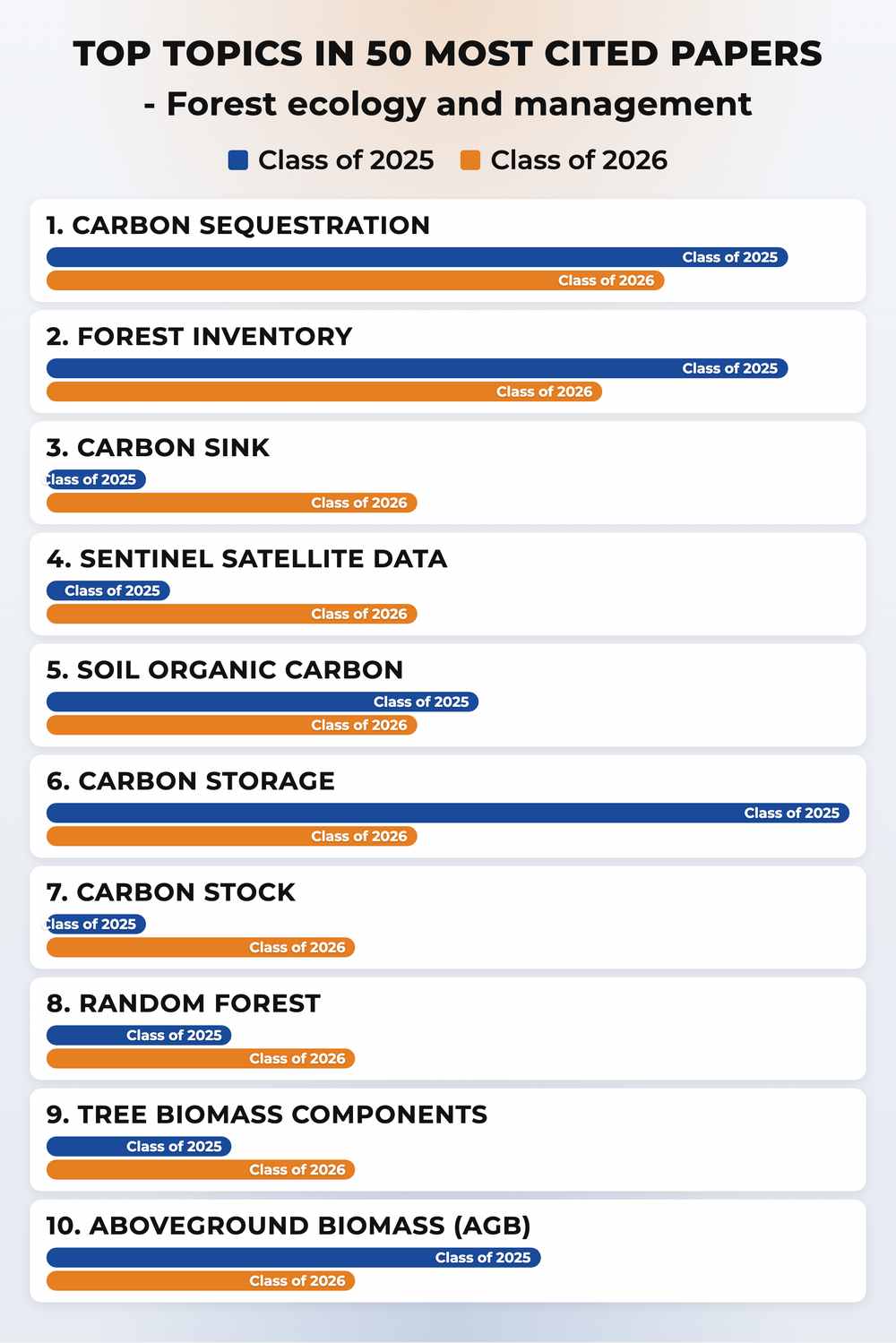
Comparing the Class of 2025 to the Class of 2026 reveals a significant shift toward operational satellite imagery, multi-source machine learning, and targeted climate resilience metrics. High-gain topics are led by Sentinel satellite data (increasing from 2 to 6 mentions) and explicit carbon sink modeling (rising from 1 to 6 mentions). Newly emerging topics gaining traction in 2024 include Carbon stock (5 mentions), National forest inventory (4 mentions), Species range shifts (4 mentions), and XGBoost algorithms (4 mentions), reflecting a push toward standardized national assessments and advanced predictive modeling. In contrast, several traditional broad descriptors saw relative declines in focus, including general biomass estimation (dropping from 11 to 3 mentions), forest productivity (from 13 to 5 mentions), and forest structural complexity (from 8 to 3 mentions). Rather than signaling reduced interest in these core ecological concepts, the trend points to methodological refinement, where general biomass and canopy profiling have evolved into specific remote-sensing techniques, standardized inventory data processing, and fine-scale carbon accounting.
Methodology
PRI identifies high-impact research using a transparent, topic-agnostic framework applied consistently across scientific domains. Bibliographic records are drawn from OpenAlex, including publication dates, citation relationships, and document types.
This ranking covers the Class of 2026 cohort: journal articles published in 2024. Reviews and other non-article document types are excluded to ensure comparability.
Research impact is quantified with an 18-month post-publication citation window—the number of citing works published within 18 months of each paper's publication date. This metric captures early impact while controlling for publication age.
An LLM-based relevance classifier then reviews each candidate's title and abstract to confirm substantive alignment with the target domain. Only papers classified as relevant appear in the final ranking.
Zheng Su, Tinsley Li, Thematic Shifts in Early-High-Impact Cancer Genomics and Diagnostics Research: A Bibliometric and Semantic Analysis. bioRxiv 2026.07.04.736459; doi: https://doi.org/10.64898/2026.07.04.736459
Cite this ranking
Pepkio Research Index (PRI). Topics and Trends in Most Cited Forest ecology and management Papers, Class of 2026. https://pri.pepkio.com/top-papers/forest-ecology-and-management/2026. Accessed 2026-10-21.

Methodology
Zheng Su, Tinsley Li, Thematic Shifts in Early-High-Impact Cancer Genomics and Diagnostics Research: A Bibliometric and Semantic Analysis. bioRxiv 2026.07.04.736459; doi: https://doi.org/10.64898/2026.07.04.736459