
What topics and trends defined most-cited Heavy metals in environment research in the Class of 2026?
Environmental heavy metal research in the Class of 2026 shifted decisively toward quantitative risk metrics and stochastic modeling. Carcinogenic and non-carcinogenic risk quadrupled, supported by expanding multivariate source apportionment and Monte Carlo simulations, while general descriptive assessments and traditional phytoremediation studies saw notable declines.
At a glance
- Field
- Heavy metals in environment
- Cohort label
- Class of 2026 (2024 publications)
- Papers analyzed
- 10,203
- Papers ranked
- 20
- Top topics in ranked papers
- Carcinogenic risk, non-carcinogenic risk, hazard quotient, source apportionment, soil contamination
- Publication window
- Jan 1, 2024 – Dec 31, 2024
- Eligibility
- Research articles; reviews excluded
- Citation window
- 18 months post-publication
- 18m citation range
- 62–150
- Data source
- OpenAlex · Retrieved Jul 2026
- License
- CC BY 4.0
Rankings
20 papers ranked by 18-month citation count
Heavy metals pollution from smelting activities: A threat to soil and groundwater
Ecotoxicology and Environmental Safety202410.1016/j.ecoenv.2024.116189
Pollution analysis of metals in the sediments of lagoon lakes in Türkiye: Toxicological risk assessment and source insights
Process Safety and Environmental Protection202410.1016/j.psep.2024.11.085
Combined pollution of soil by heavy metals, microplastics, and pesticides: Mechanisms and anthropogenic drivers
Journal of Hazardous Materials202410.1016/j.jhazmat.2024.136812
Appraisal of metallic accumulation in the surface sediment of a fish breeding dam in Türkiye: A stochastical approach to ecotoxicological risk assessment
Marine Pollution Bulletin202410.1016/j.marpolbul.2024.116488
Metal pollution assessment in the surface sediments of a river system in Türkiye: Integrating toxicological risk assessment and source identification
Marine Pollution Bulletin202410.1016/j.marpolbul.2024.116514
Escalating arsenic contamination throughout Chinese soils
Nature Sustainability202410.1038/s41893-024-01341-7
Toxicological risk assessment using spring water quality indices in plateaus of Giresun Province/Türkiye: a holistic hydrogeochemical data analysis
Environmental Geochemistry and Health202410.1007/s10653-024-02054-8
Enhancing soil health to minimize cadmium accumulation in agro-products: the role of microorganisms, organic matter, and nutrients
Environmental Pollution202410.1016/j.envpol.2024.123890
Ecological and health risk assessments of heavy metal contamination in soils surrounding a coal power plant
Journal of Hazardous Materials202410.1016/j.jhazmat.2024.136751
Exploring the impact of heavy metals toxicity in the aquatic ecosystem
International Journal of Energy and Water Resources202410.1007/s42108-024-00284-1
Foliar Application of Nanoparticles Reduced Cadmium Content in Wheat (<i>Triticum aestivum</i> L.) Grains via Long-Distance “Leaf–Root–Microorganism” Regulation
Environmental Science & Technology202410.1021/acs.est.3c10506
Biochar-based adsorption for heavy metal removal in water: a sustainable and cost-effective approach
Environmental Geochemistry and Health202410.1007/s10653-024-02214-w
Spatiotemporal variations, source identification, and risk assessment of potentially toxic elements in the surface water of Felent Stream impacted by the silver mine
Environmental Monitoring and Assessment202410.1007/s10661-024-13013-2
Investigation of groundwater quality in the Southern Coast of the Black Sea: application of computational health risk assessment in Giresun, Türkiye
Environmental Science and Pollution Research202410.1007/s11356-024-34712-w
RETRACTED: Trace element pollution tracking in the complex multi-aquifer groundwater system of Al-Hassa oasis (Saudi Arabia) using spatial, chemometric and index-based techniques
Environmental Research202410.1016/j.envres.2024.118320
Silicon and iron nanoparticles protect rice against lead (Pb) stress by improving oxidative tolerance and minimizing Pb uptake
Scientific Reports202410.1038/s41598-024-55810-2
Soil pollution indices and health risk assessment of metal(loid)s in the agricultural soil of pistachio orchards
Scientific Reports202410.1038/s41598-024-59450-4
Smooth Vetch (<i>Vicia villosa</i> var.) Coupled with Ball-Milled Composite Mineral Derived from Shell Powder and Phosphate Rock for Remediation of Cadmium-Polluted Farmland: Insights into Synergetic Mechanisms
ACS ES&T Engineering202410.1021/acsestengg.4c00177
Unveiling the nutritional value and potentially toxic elements in fish species from Miliç Wetland, Türkiye: A probabilistic human health risk assessment using Monte Carlo simulation
Marine Pollution Bulletin202410.1016/j.marpolbul.2024.117417
Assessment of drinking water quality and identifying pollution sources in a chromite mining region
Journal of Hazardous Materials202410.1016/j.jhazmat.2024.136050
Topic trends
Dominant research themes and year-over-year shifts in Heavy metals in environment
What Topics Define the Class of 2026?
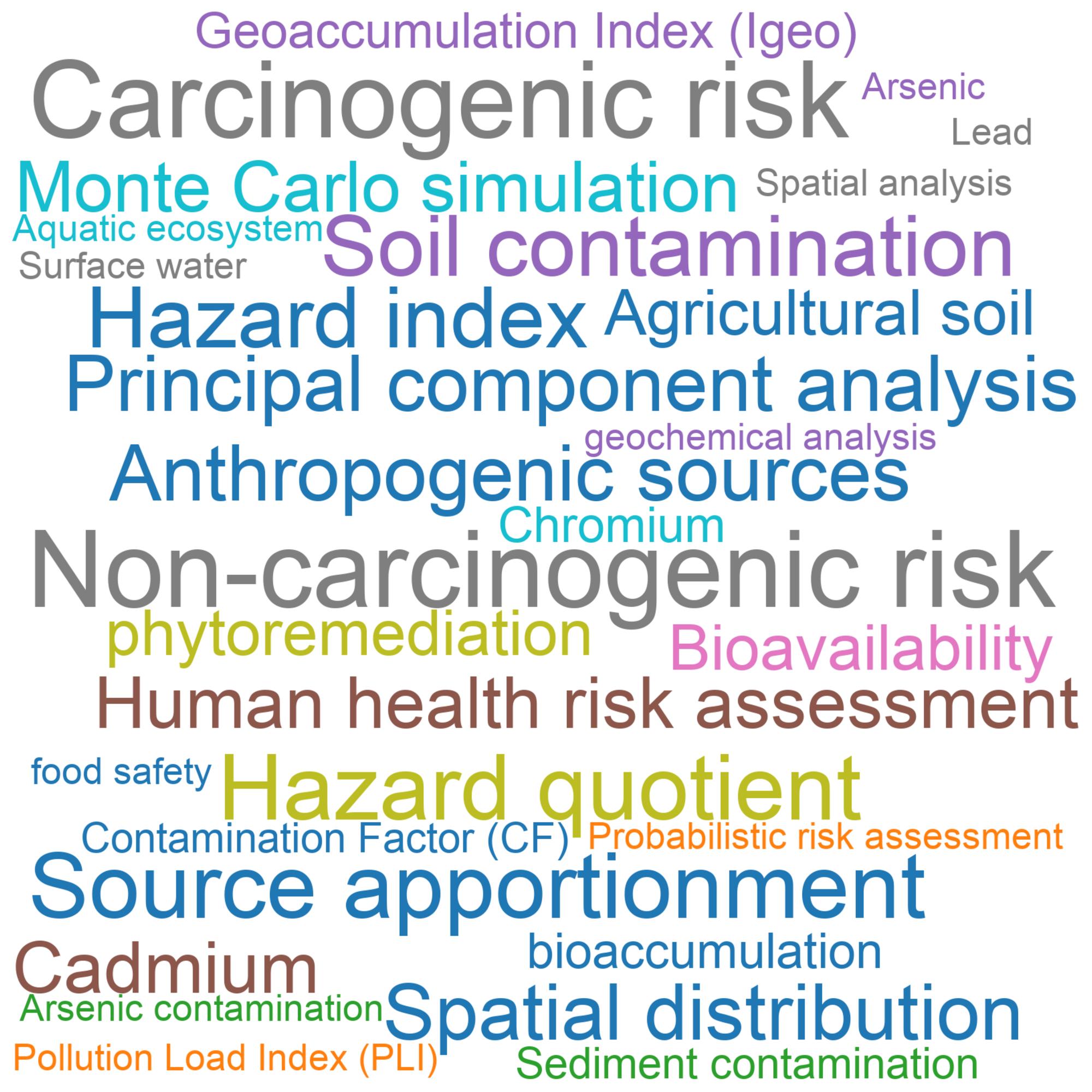
Research in the Class of 2026 is heavily anchored in quantitative human health risk assessment and source identification of heavy metal contamination in environmental matrices. Quantitative risk metrics dominate the literature, led by carcinogenic risk and non-carcinogenic risk (each present in 24% of top papers), alongside the hazard quotient (18%) and hazard index (16%). These indices reflect a systematic effort to translate environmental chemical concentrations into actionable public health warnings. Soil contamination (16%) and surface water or sediment pollution serve as the primary media of concern, with particular emphasis on agricultural lands where toxic elements threaten food safety. Geochemical and statistical methodologies are central to identifying contamination origins: source apportionment (18%), principal component analysis (14%), and spatial distribution mapping (14%) are routinely combined with positive matrix factorization to isolate anthropogenic sources—such as industrial discharges, mining, and agricultural inputs—from natural geogenic baselines. Elemental research focuses primarily on highly toxic species including cadmium, chromium, arsenic, and lead, alongside evaluations of bioaccumulation, bioavailability, and phytoremediation strategies. Together, these themes demonstrate a shift from simple elemental monitoring toward integrated, spatial-statistical risk modeling to safeguard ecosystem and human health.
How Did Topics Shift from the Class of 2025 to the Class of 2026?
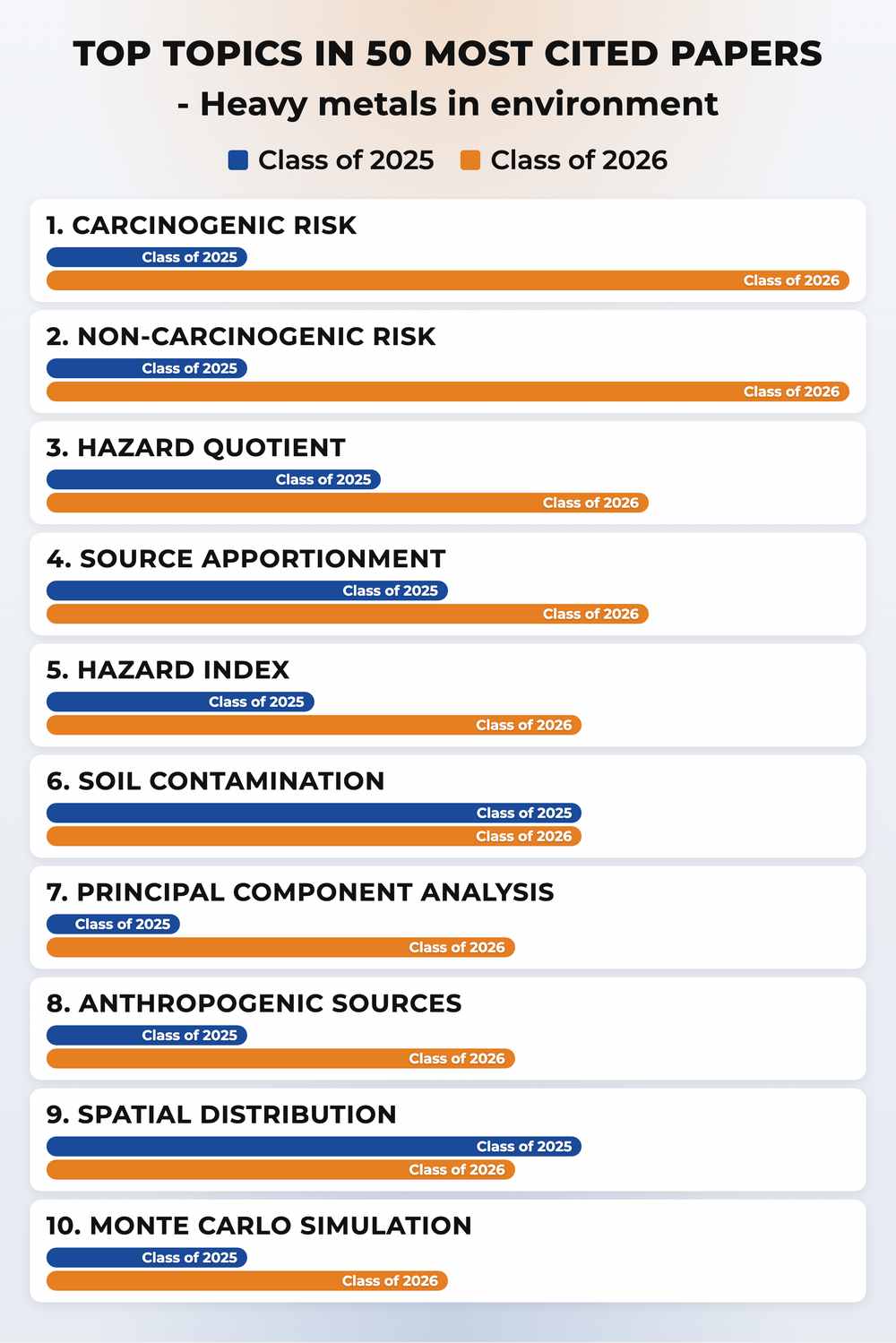
Comparing the Class of 2025 to the Class of 2026 reveals a pronounced evolution toward probabilistic modeling and specific toxicological metrics. Quantitative risk endpoints experienced the most dramatic surge: carcinogenic risk and non-carcinogenic risk both quadrupled from a normalized frequency of 0.06 in 2025 to 0.24 in 2026 (4.0-fold increase). Concurrently, hazard index (0.08 to 0.16) and hazard quotient (0.10 to 0.18) expanded significantly. Advanced statistical and stochastic tools gained strong momentum, highlighted by principal component analysis (3.5-fold increase to 0.14), Monte Carlo simulation (2.0-fold increase to 0.12), and the emergence of probabilistic risk assessment (0.08). Emphasis on anthropogenic source tracking also grew markedly (2.33-fold increase to 0.14). In contrast, broad descriptive terminology saw a noticeable decline. General human health risk assessment fell by 45% (0.22 to 0.12) as researchers adopted more granular health indices. Conventional remediation and index-based studies also moderated, with phytoremediation declining from 0.16 to 0.10 (down 37.5%) and enrichment factor dropping to 0.06. These trends demonstrate a clear discipline-wide transition from descriptive spatial surveys and general remediation toward high-resolution, probabilistic risk forecasting and multivariate source apportionment.
Methodology
PRI identifies high-impact research using a transparent, topic-agnostic framework applied consistently across scientific domains. Bibliographic records are drawn from OpenAlex, including publication dates, citation relationships, and document types.
This ranking covers the Class of 2026 cohort: journal articles published in 2024. Reviews and other non-article document types are excluded to ensure comparability.
Research impact is quantified with an 18-month post-publication citation window—the number of citing works published within 18 months of each paper's publication date. This metric captures early impact while controlling for publication age.
An LLM-based relevance classifier then reviews each candidate's title and abstract to confirm substantive alignment with the target domain. Only papers classified as relevant appear in the final ranking.
Zheng Su, Tinsley Li, Thematic Shifts in Early-High-Impact Cancer Genomics and Diagnostics Research: A Bibliometric and Semantic Analysis. bioRxiv 2026.07.04.736459; doi: https://doi.org/10.64898/2026.07.04.736459
Cite this ranking
Pepkio Research Index (PRI). Topics and Trends in Most Cited Heavy metals in environment Papers, Class of 2026. https://pri.pepkio.com/top-papers/heavy-metals-in-environment/2026. Accessed 2026-10-24.

Methodology
Zheng Su, Tinsley Li, Thematic Shifts in Early-High-Impact Cancer Genomics and Diagnostics Research: A Bibliometric and Semantic Analysis. bioRxiv 2026.07.04.736459; doi: https://doi.org/10.64898/2026.07.04.736459