
What topics and trends defined most-cited Retinal Development and Disorders research in the Class of 2026?
The Class of 2026 is driven by advanced cellular models, particularly retinal organoids, alongside a major translational push toward therapeutics. Anti-VEGF therapy saw a striking 6-fold increase, reflecting rapid clinical advancements, while inherited dystrophies like retinitis pigmentosa heavily dominated the highest-impact papers.
At a glance
- Field
- Retinal Development and Disorders
- Cohort label
- Class of 2026 (2024 publications)
- Papers analyzed
- 3,261
- Papers ranked
- 20
- Top topics in ranked papers
- Retinal pigment epithelium, Retinal organoid, retinitis pigmentosa
- Publication window
- Jan 1, 2024 – Dec 31, 2024
- Eligibility
- Research articles; reviews excluded
- Citation window
- 18 months post-publication
- 18m citation range
- 23–118
- Data source
- OpenAlex · Retrieved September 2026
- License
- CC BY 4.0
Rankings
20 papers ranked by 18-month citation count
Gene Editing for <i>CEP290</i> -Associated Retinal Degeneration
New England Journal of Medicine202410.1056/nejmoa2309915
Gene therapy for neovascular age-related macular degeneration by subretinal delivery of RGX-314: a phase 1/2a dose-escalation study
The Lancet202410.1016/s0140-6736(24)00310-6
Eye-brain connections revealed by multimodal retinal and brain imaging genetics
Nature Communications202410.1038/s41467-024-50309-w
A highly reproducible and efficient method for retinal organoid differentiation from human pluripotent stem cells
Proceedings of the National Academy of Sciences202410.1073/pnas.2317285121
Robust reprogramming of glia into neurons by inhibition of Notch signaling and nuclear factor I (NFI) factors in adult mammalian retina
Science Advances202410.1126/sciadv.adn2091
6PPD, Not 6PPD-Quinone, Induced Serious Zebrafish Eye Damage by Disrupting the Thyroid Signaling Pathway
Environmental Science & Technology202410.1021/acs.est.4c11264
Comprehensive single-cell atlas of the mouse retina
iScience202410.1016/j.isci.2024.109916
Real-world six-month outcomes in patients switched to faricimab following partial response to anti-VEGF therapy for neovascular age-related macular degeneration and diabetic macular oedema
Eye202410.1038/s41433-024-03364-y
Integrating genetic regulation and single-cell expression with GWAS prioritizes causal genes and cell types for glaucoma
Nature Communications202410.1038/s41467-023-44380-y
RPE melanin and its influence on the progression of AMD
Ageing Research Reviews202410.1016/j.arr.2024.102358
Retinal detachment
Nature Reviews Disease Primers202410.1038/s41572-024-00501-5
Safety and efficacy of ATSN-101 in patients with Leber congenital amaurosis caused by biallelic mutations in GUCY2D: a phase 1/2, multicentre, open-label, unilateral dose escalation study
The Lancet202410.1016/s0140-6736(24)01447-8
Senolytic and senomorphic agent procyanidin C1 alleviates structural and functional decline in the aged retina
Proceedings of the National Academy of Sciences202410.1073/pnas.2311028121
Disease Activity and Therapeutic Response to Pegcetacoplan for Geographic Atrophy Identified by Deep Learning-Based Analysis of OCT
Ophthalmology202410.1016/j.ophtha.2024.08.017
An adeno-associated virus variant enabling efficient ocular-directed gene delivery across species
Nature Communications202410.1038/s41467-024-48221-4
Real-World Safety and Effectiveness of Voretigene Neparvovec: Results up to 2 Years from the Prospective, Registry-Based PERCEIVE Study
Biomolecules202410.3390/biom14010122
CRB1-associated retinal degeneration is dependent on bacterial translocation from the gut
Cell202410.1016/j.cell.2024.01.040
Phase 1/2 AAV5-hRKp.RPGR (Botaretigene Sparoparvovec) Gene Therapy: Safety and Efficacy in RPGR-Associated X-Linked Retinitis Pigmentosa
American Journal of Ophthalmology202410.1016/j.ajo.2024.05.034
Single-cell analyses reveal transient retinal progenitor cells in the ciliary margin of developing human retina
Nature Communications202410.1038/s41467-024-47933-x
Spectrum of Genetic Variants in the Most Common Genes Causing Inherited Retinal Disease in a Large Molecularly Characterized United Kingdom Cohort
Ophthalmology Retina202410.1016/j.oret.2024.01.012
Topic trends
Dominant research themes and year-over-year shifts in Retinal Development and Disorders
What Topics Define the Class of 2026?
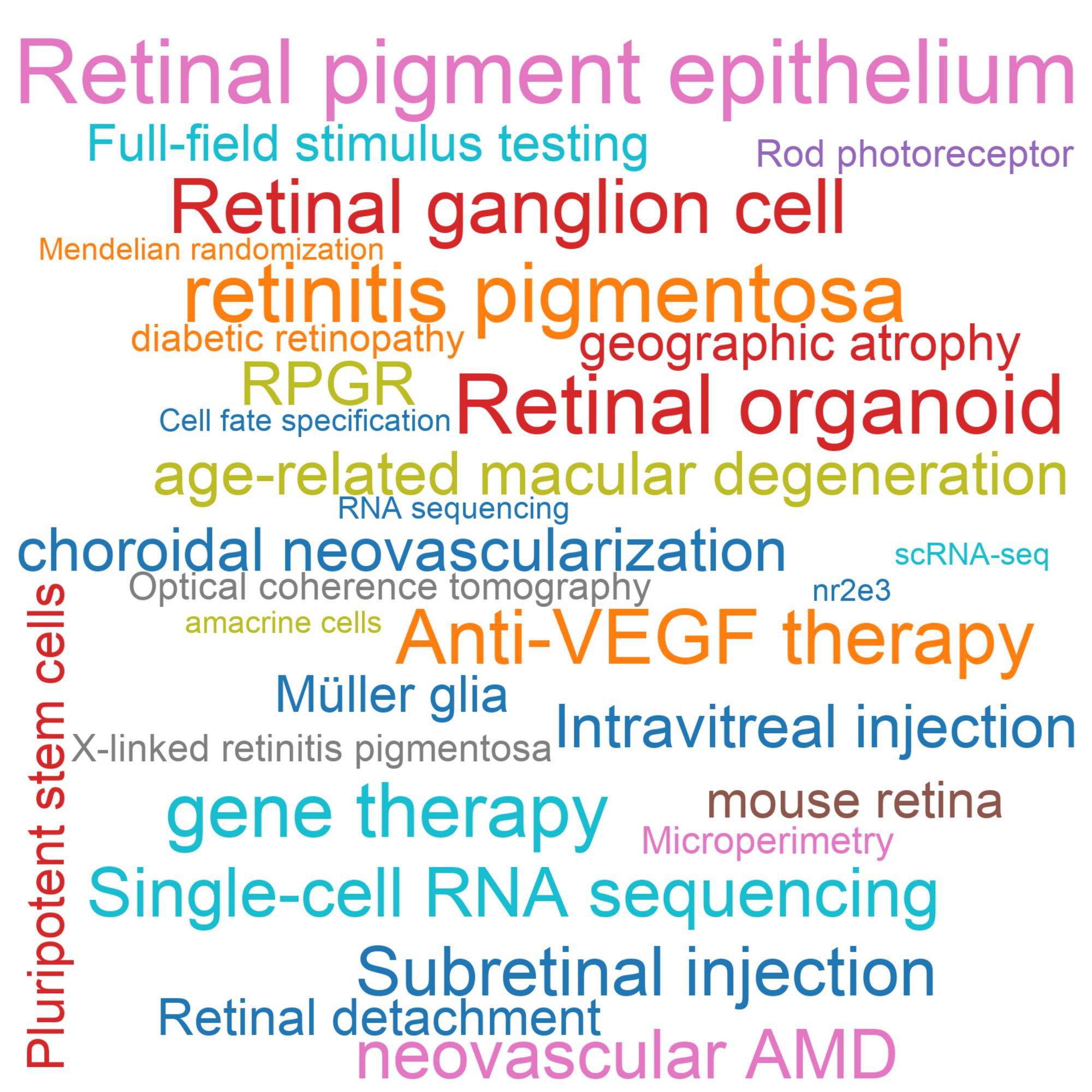
The Class of 2026 in Retinal Development and Disorders is defined by a strong focus on cellular models and specific disease states. Retinal pigment epithelium and retinal organoids emerge as the most prominent topics, reflecting the field's ongoing reliance on advanced in vitro models for studying retinal biology and disease mechanisms. Retinitis pigmentosa is the most highly featured disorder, indicating a major clinical focus on inherited retinal dystrophies. Additionally, therapeutic strategies like anti-VEGF therapy and gene therapy play a significant role, highlighting the translational emphasis of recent high-impact publications.
How Did Topics Shift from the Class of 2025 to the Class of 2026?
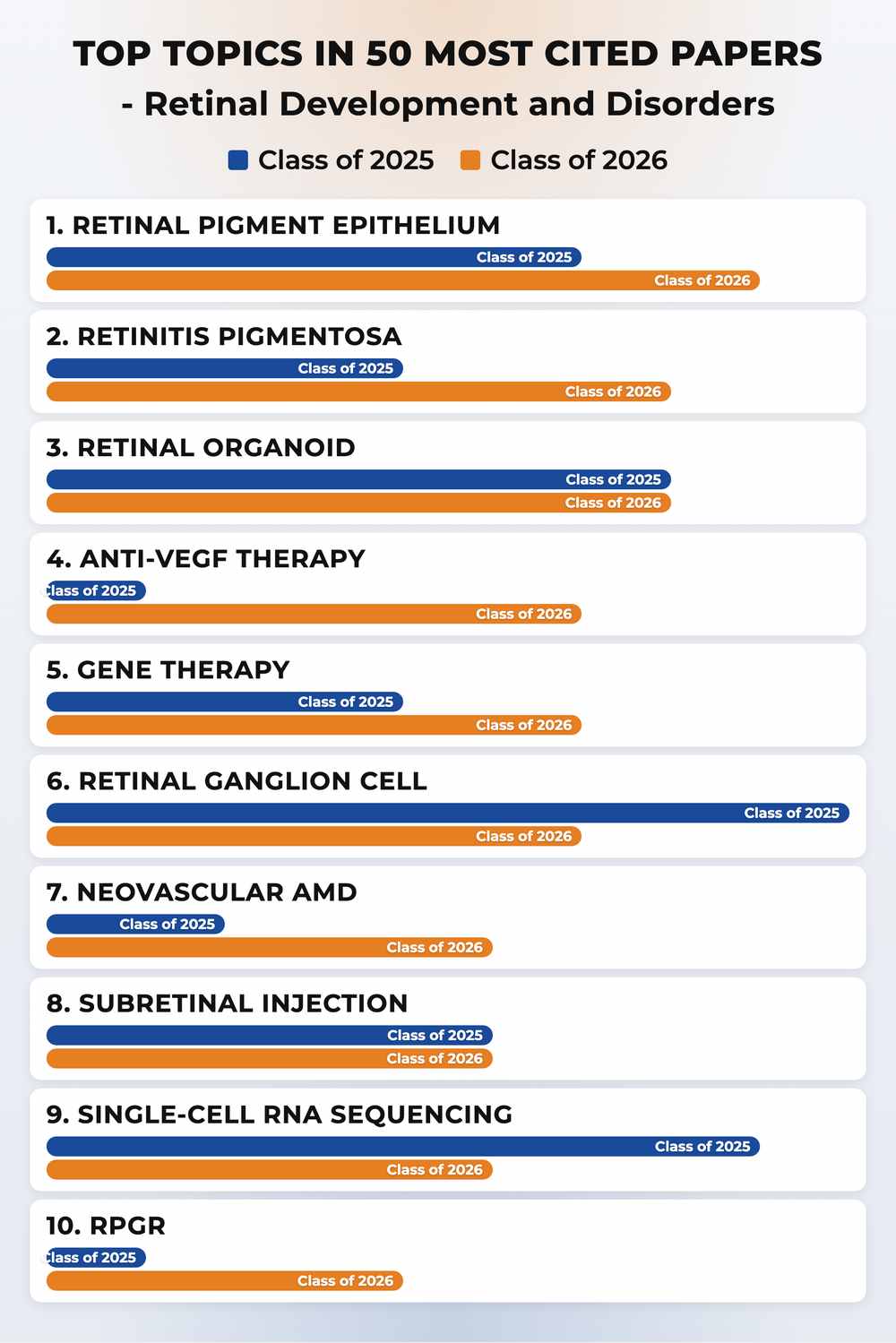
The transition from the Class of 2025 to the Class of 2026 reveals a pronounced shift toward targeted therapeutics. Notably, anti-VEGF therapy experienced the most dramatic rise, with a 6-fold increase in frequency among top papers, reflecting its expanding applications and new treatment regimens. Retinitis pigmentosa and neovascular AMD also saw significant growth, underscoring an increased emphasis on both inherited and age-related retinal diseases. Conversely, foundational topics such as single-cell RNA sequencing and retinal ganglion cells saw a relative decrease in prominence, suggesting a maturation of basic transcriptomic mapping efforts in favor of translational and clinical applications.
Methodology
PRI identifies high-impact research using a transparent, topic-agnostic framework applied consistently across scientific domains. Bibliographic records are drawn from OpenAlex, including publication dates, citation relationships, and document types.
This ranking covers the Class of 2026 cohort: journal articles published in 2024. Reviews and other non-article document types are excluded to ensure comparability.
Research impact is quantified with an 18-month post-publication citation window—the number of citing works published within 18 months of each paper's publication date. This metric captures early impact while controlling for publication age.
An LLM-based relevance classifier then reviews each candidate's title and abstract to confirm substantive alignment with the target domain. Only papers classified as relevant appear in the final ranking.
Zheng Su, Tinsley Li, Thematic Shifts in Early-High-Impact Cancer Genomics and Diagnostics Research: A Bibliometric and Semantic Analysis. bioRxiv 2026.07.04.736459; doi: https://doi.org/10.64898/2026.07.04.736459
Cite this ranking
Pepkio Research Index (PRI). Topics and Trends in Most Cited Retinal Development and Disorders Papers, Class of 2026. https://pri.pepkio.com/top-papers/retinal-development-and-disorders/2026. Accessed 2026-10-24.

Methodology
Zheng Su, Tinsley Li, Thematic Shifts in Early-High-Impact Cancer Genomics and Diagnostics Research: A Bibliometric and Semantic Analysis. bioRxiv 2026.07.04.736459; doi: https://doi.org/10.64898/2026.07.04.736459