
What topics and trends defined most-cited Adipose Tissue and Metabolism research in the Class of 2026?
Adipose tissue research shifted sharply toward organelle energetics and single-cell resolution in 2024. Mitochondrial dysfunction (10%) and single-nucleus RNA sequencing (8%) experienced rapid growth, while energy expenditure (12%) doubled. Conversely, classical themes like fatty acid β-oxidation (10%) and broad metabolomics (4%) saw reduced relative focus.
At a glance
- Field
- Adipose Tissue and Metabolism
- Cohort label
- Class of 2026 (2024 publications)
- Papers analyzed
- 8,101
- Papers ranked
- 20
- Top topics in ranked papers
- Insulin resistance, energy expenditure, thermogenesis, mitochondrial dysfunction, multi-omics
- Publication window
- Jan 1, 2024 – Dec 31, 2024
- Eligibility
- Research articles; reviews excluded
- Citation window
- 18 months post-publication
- 18m citation range
- 54–439
- Data source
- OpenAlex · Retrieved Jul 2026
- License
- CC BY 4.0
Rankings
20 papers ranked by 18-month citation count
Tirzepatide for the Treatment of Obstructive Sleep Apnea and Obesity
New England Journal of Medicine202410.1056/nejmoa2404881
Nonlinear dynamics of multi-omics profiles during human aging
Nature Aging202410.1038/s43587-024-00692-2
Adipose tissue retains an epigenetic memory of obesity after weight loss
Nature202410.1038/s41586-024-08165-7
Inhibition of IL-11 signalling extends mammalian healthspan and lifespan
Nature202410.1038/s41586-024-07701-9
Temporal dynamics of the multi-omic response to endurance exercise training
Nature202410.1038/s41586-023-06877-w
Hypoxia induces mitochondrial protein lactylation to limit oxidative phosphorylation
Cell Research202410.1038/s41422-023-00864-6
Lipid droplets and cellular lipid flux
Nature Cell Biology202410.1038/s41556-024-01364-4
Overnutrition causes insulin resistance and metabolic disorder through increased sympathetic nervous system activity
Cell Metabolism202410.1016/j.cmet.2024.09.012
A brain-to-gut signal controls intestinal fat absorption
Nature202410.1038/s41586-024-07929-5
Acquisition of epithelial plasticity in human chronic liver disease
Nature202410.1038/s41586-024-07465-2
Glycolytic enzyme PFKL governs lipolysis by promoting lipid droplet–mitochondria tethering to enhance β-oxidation and tumor cell proliferation
Nature Metabolism202410.1038/s42255-024-01047-2
Obesity causes mitochondrial fragmentation and dysfunction in white adipocytes due to RalA activation
Nature Metabolism202410.1038/s42255-024-00978-0
Trigonelline is an NAD+ precursor that improves muscle function during ageing and is reduced in human sarcopenia
Nature Metabolism202410.1038/s42255-024-00997-x
Cardiometabolic characteristics of people with metabolically healthy and unhealthy obesity
Cell Metabolism202410.1016/j.cmet.2024.03.002
Environmental concentrations of 6PPD and 6PPD-quinone induce hepatic lipid metabolism disorders in male black-spotted frogs
Journal of Hazardous Materials202410.1016/j.jhazmat.2024.136400
Leptin-activated hypothalamic BNC2 neurons acutely suppress food intake
Nature202410.1038/s41586-024-08108-2
IgG is an aging factor that drives adipose tissue fibrosis and metabolic decline
Cell Metabolism202410.1016/j.cmet.2024.01.015
BCAA-nitrogen flux in brown fat controls metabolic health independent of thermogenesis
Cell202410.1016/j.cell.2024.03.030
Unveiling adipose populations linked to metabolic health in obesity
Cell Metabolism202410.1016/j.cmet.2024.11.006
A β-hydroxybutyrate shunt pathway generates anti-obesity ketone metabolites
Cell202410.1016/j.cell.2024.10.032
Topic trends
Dominant research themes and year-over-year shifts in Adipose Tissue and Metabolism
What Topics Define the Class of 2026?
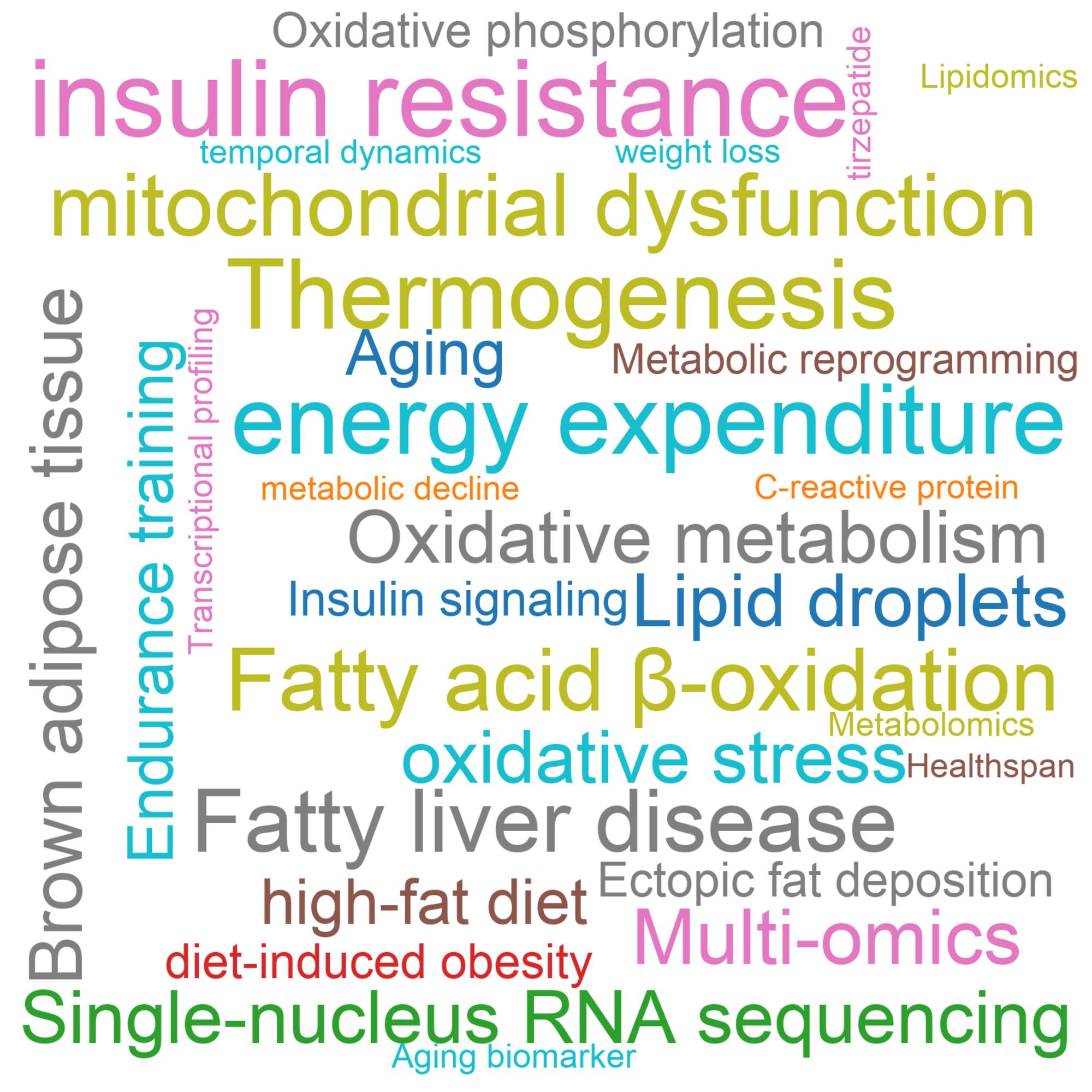
Research in the Class of 2026 (2024 publications) for Adipose Tissue and Metabolism is anchored by foundational cardiometabolic mechanisms, with insulin resistance leading overall thematic representation across 14% of highly cited studies. Core energetic processes remain central, prominently featuring energy expenditure (12%) and thermogenic regulation (12%), alongside fatty acid β-oxidation (10%) and metabolic dysfunction in fatty liver disease (10%). High-impact literature increasingly investigates organelle-level perturbations, marked by a strong focus on mitochondrial dysfunction (10%), oxidative metabolism (8%), and lipid droplet dynamics (8%). Methodologically, the field exhibits a decisive shift toward high-resolution single-cell and systemic profiling, heavily driven by single-nucleus RNA sequencing (8%) and multi-omics integration (8%). These interconnected themes highlight a broader scientific transition from observational lipid physiology toward precise molecular dissecting of how brown, white, and visceral adipose depots control systemic insulin sensitivity, cellular senescence, and inter-organ metabolic crosstalk under diet-induced stress.
How Did Topics Shift from the Class of 2025 to the Class of 2026?
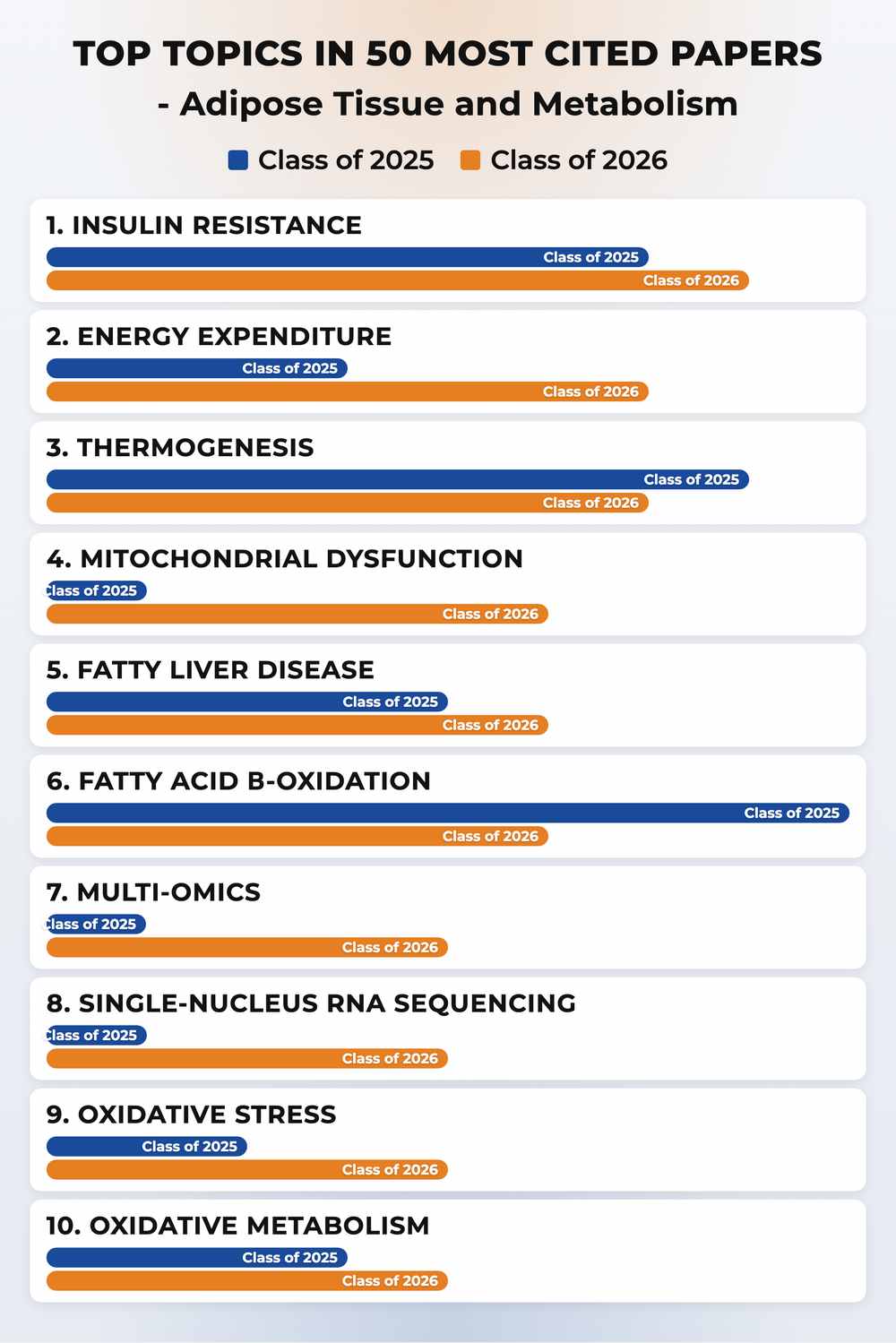
Comparing the Class of 2025 to the Class of 2026 reveals a significant shift from classical descriptive lipid storage toward high-resolution single-cell genomics and organelle energetics. The most dramatic thematic acceleration is led by mitochondrial dysfunction, which rose fivefold from a 2% mention rate in 2023 to 10% in 2024. Single-nucleus RNA sequencing similarly quadrupled to 8%, underscoring the rapid adoption of single-cell transcriptomics to resolve adipose cellular heterogeneity. Furthermore, energy expenditure doubled to 12%, while multi-omics integration and diet-induced obesity models emerged as prominent new drivers in top-cited literature. Conversely, traditional bioenergetic categories experienced relative declines in research concentration. Fatty acid β-oxidation decreased from 16% to 10%, brown adipose tissue dropped from 14% to 8%, and broad metabolomics profiling fell from 12% to 4%. Together, these trajectories demonstrate a structural migration in adipose metabolism research away from global metabolite profiling and toward cell-type-specific transcriptional regulation, mitochondrial quality control, and functional organelle remodeling.
Methodology
PRI identifies high-impact research using a transparent, topic-agnostic framework applied consistently across scientific domains. Bibliographic records are drawn from OpenAlex, including publication dates, citation relationships, and document types.
This ranking covers the Class of 2026 cohort: journal articles published in 2024. Reviews and other non-article document types are excluded to ensure comparability.
Research impact is quantified with an 18-month post-publication citation window—the number of citing works published within 18 months of each paper's publication date. This metric captures early impact while controlling for publication age.
An LLM-based relevance classifier then reviews each candidate's title and abstract to confirm substantive alignment with the target domain. Only papers classified as relevant appear in the final ranking.
Zheng Su, Tinsley Li, Thematic Shifts in Early-High-Impact Cancer Genomics and Diagnostics Research: A Bibliometric and Semantic Analysis. bioRxiv 2026.07.04.736459; doi: https://doi.org/10.64898/2026.07.04.736459
Cite this ranking
Pepkio Research Index (PRI). Topics and Trends in Most Cited Adipose Tissue and Metabolism Papers, Class of 2026. https://pri.pepkio.com/top-papers/adipose-tissue-and-metabolism/2026. Accessed 2026-10-16.

Methodology
Zheng Su, Tinsley Li, Thematic Shifts in Early-High-Impact Cancer Genomics and Diagnostics Research: A Bibliometric and Semantic Analysis. bioRxiv 2026.07.04.736459; doi: https://doi.org/10.64898/2026.07.04.736459
Source data
The full ranking corpus and analysis files are openly available on an external repository. Please cite the dataset below when reusing this data.
View source dataset →Pepkio Research Index (2026). Adipose Tissue and Metabolism Ranking Dataset (Class of 2026). Figshare.