
What topics and trends defined most-cited Reproductive Biology and Fertility research in the Class of 2026?
The Class of 2026 highlights a major research shift toward female reproductive aging and polycystic ovary syndrome (PCOS). Studies increasingly focus on oxidative stress and the ovarian microenvironment, leveraging single-cell transcriptomics to map cellular changes. This reflects a concerted effort to understand and therapeutically target the molecular drivers of age-related fertility decline.
At a glance
- Field
- Reproductive Biology and Fertility
- Cohort label
- Class of 2026 (2024 publications)
- Papers analyzed
- 7,510
- Papers ranked
- 20
- Top topics in ranked papers
- Female reproductive aging, Polycystic ovary syndrome, oxidative stress, Granulosa cells
- Publication window
- Jan 1, 2024 – Dec 31, 2024
- Eligibility
- Research articles; reviews excluded
- Citation window
- 18 months post-publication
- 18m citation range
- 31–89
- Data source
- OpenAlex · Retrieved July 2026
- License
- CC BY 4.0
Rankings
20 papers ranked by 18-month citation count
A single-cell atlas of the aging mouse ovary
Nature Aging202410.1038/s43587-023-00552-5
Spatiotemporal transcriptomic changes of human ovarian aging and the regulatory role of FOXP1
Nature Aging202410.1038/s43587-024-00607-1
Deep learning versus manual morphology-based embryo selection in IVF: a randomized, double-blind noninferiority trial
Nature Medicine202410.1038/s41591-024-03166-5
Molecular and genetic insights into human ovarian aging from single-nuclei multi-omics analyses
Nature Aging202410.1038/s43587-024-00762-5
A conserved fertilization complex bridges sperm and egg in vertebrates
Cell202410.1016/j.cell.2024.09.035
Rejuvenation of aged oocyte through exposure to young follicular microenvironment
Nature Aging202410.1038/s43587-024-00697-x
The cycling and aging mouse female reproductive tract at single-cell resolution
Cell202410.1016/j.cell.2024.01.021
Hallmarks of female reproductive aging in physiologic aging mice
Nature Aging202410.1038/s43587-024-00769-y
The microbial metabolite agmatine acts as an FXR agonist to promote polycystic ovary syndrome in female mice
Nature Metabolism202410.1038/s42255-024-01041-8
Does recurrent implantation failure exist? Prevalence and outcomes of five consecutive euploid blastocyst transfers in 123 987 patients
Human Reproduction202410.1093/humrep/deae040
3D reconstruction of a gastrulating human embryo
Cell202410.1016/j.cell.2024.03.041
Cellular atlas of the human ovary using morphologically guided spatial transcriptomics and single-cell sequencing
Science Advances202410.1126/sciadv.adm7506
The first two blastomeres contribute unequally to the human embryo
Cell202410.1016/j.cell.2024.04.029
Iron accumulation in ovarian microenvironment damages the local redox balance and oocyte quality in aging mice
Redox Biology202410.1016/j.redox.2024.103195
Mapping putative enhancers in mouse oocytes and early embryos reveals TCF3/12 as key folliculogenesis regulators
Nature Cell Biology202410.1038/s41556-024-01422-x
Maintaining mitochondrial DNA copy number mitigates ROS-induced oocyte decline and female reproductive aging
Communications Biology202410.1038/s42003-024-06888-x
M6A demethylase FTO-stabilized exosomal circBRCA1 alleviates oxidative stress-induced granulosa cell damage via the miR-642a-5p/FOXO1 axis
Journal of Nanobiotechnology202410.1186/s12951-024-02583-5
Semaglutide Alleviates Ovary Inflammation via the AMPK/SIRT1/NF‑κB Signaling Pathway in Polycystic Ovary Syndrome Mice
Drug Design Development and Therapy202410.2147/dddt.s484531
Mechanisms of minor pole–mediated spindle bipolarization in human oocytes
Science202410.1126/science.ado1022
A 20-year overview of fertility preservation in boys: new insights gained through a comprehensive international survey
Human Reproduction Open202410.1093/hropen/hoae010
Topic trends
Dominant research themes and year-over-year shifts in Reproductive Biology and Fertility
What Topics Define the Class of 2026?
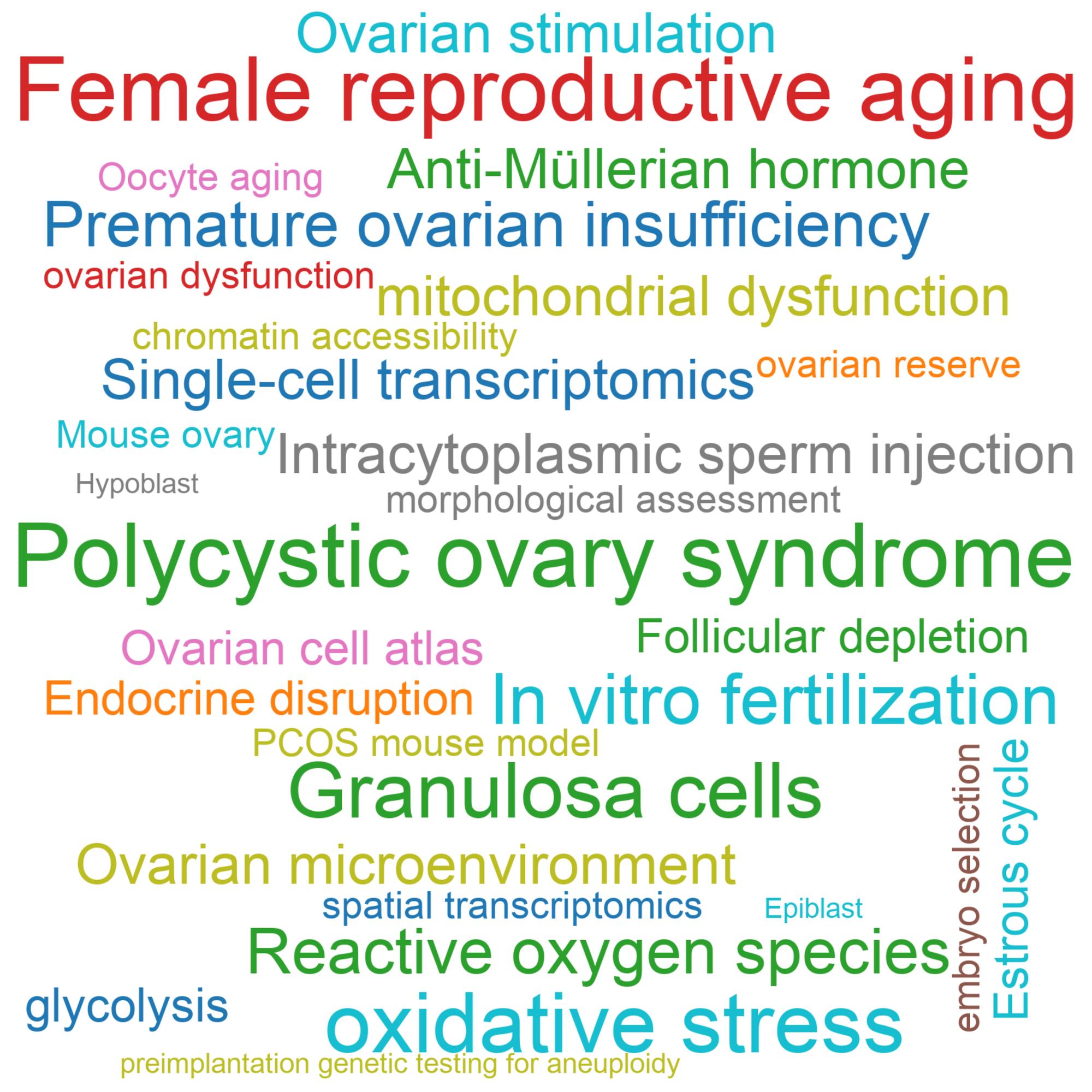
The Class of 2026 in Reproductive Biology and Fertility is heavily focused on addressing reproductive aging and prevalent endocrine disorders. "Female reproductive aging" and "Polycystic ovary syndrome" (PCOS) are the most dominant themes, indicating a major research emphasis on understanding age-related fertility decline and complex metabolic-reproductive conditions. A significant cluster of research investigates the cellular and molecular mechanisms underlying these issues, highlighted by prominent concepts like "oxidative stress", "Reactive oxygen species", and the "Ovarian microenvironment". Studies frequently center on "Granulosa cells", which play a critical role in follicle development and are highly susceptible to stress and aging. Clinical interventions remain central to the field, with extensive focus on "In vitro fertilization", "Intracytoplasmic sperm injection", and "Ovarian stimulation" aimed at overcoming these biological hurdles. The widespread use of "Single-cell transcriptomics" underscores a methodological shift toward high-resolution profiling of reproductive tissues, enabling researchers to map the ovarian microenvironment and cellular states with unprecedented detail. Overall, the current landscape reflects a concerted effort to connect molecular dysfunction—such as oxidative damage and endocrine disruption—with practical strategies to improve fertility outcomes in the face of aging and conditions like PCOS.
How Did Topics Shift from the Class of 2025 to the Class of 2026?
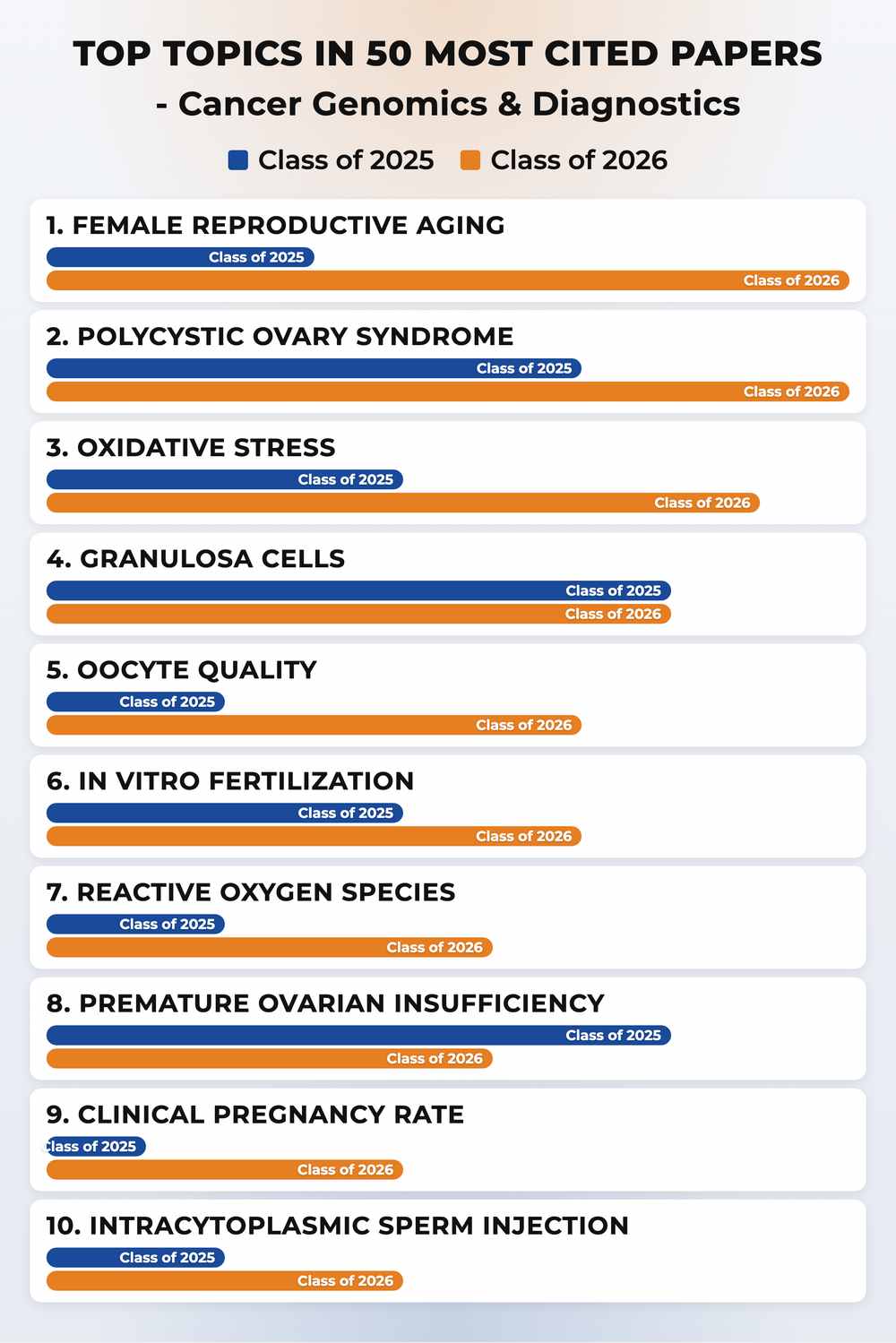
The transition from the Class of 2025 to the Class of 2026 reveals a pronounced shift toward studying the molecular drivers of reproductive decline, with "Female reproductive aging" experiencing a striking threefold increase in prominence. This surge is accompanied by a heightened focus on the cellular mechanisms of aging and damage, evidenced by significant rises in "oxidative stress" (twofold increase) and "Reactive oxygen species". Polycystic ovary syndrome (PCOS) also saw continued growth, solidifying its position as a central challenge in the field. Notably, advanced molecular mapping has rapidly gained traction, with the concept of the "Ovarian cell atlas" emerging prominently, alongside increased applications of single-cell transcriptomics to dissect the ovarian microenvironment. Conversely, some previously dominant topics have seen a relative decline; attention to "Premature ovarian insufficiency" and "Male infertility" decreased, suggesting a reallocation of research focus toward the ubiquitous challenge of age-related female fertility decline. Overall, these shifts highlight a field increasingly leveraging high-resolution molecular techniques and focusing on oxidative damage to understand and mitigate the effects of reproductive aging and endocrine disorders.
Methodology
PRI identifies high-impact research using a transparent, topic-agnostic framework applied consistently across scientific domains. Bibliographic records are drawn from OpenAlex, including publication dates, citation relationships, and document types.
This ranking covers the Class of 2026 cohort: journal articles published in 2024. Reviews and other non-article document types are excluded to ensure comparability.
Research impact is quantified with an 18-month post-publication citation window—the number of citing works published within 18 months of each paper's publication date. This metric captures early impact while controlling for publication age.
An LLM-based relevance classifier then reviews each candidate's title and abstract to confirm substantive alignment with the target domain. Only papers classified as relevant appear in the final ranking.
Zheng Su, Tinsley Li, Thematic Shifts in Early-High-Impact Cancer Genomics and Diagnostics Research: A Bibliometric and Semantic Analysis. bioRxiv 2026.07.04.736459; doi: https://doi.org/10.64898/2026.07.04.736459
Cite this ranking
Pepkio Research Index (PRI). Topics and Trends in Most Cited Reproductive Biology and Fertility Papers, Class of 2026. https://pri.pepkio.com/top-papers/reproductive-biology-and-fertility/2026. Accessed 2026-10-14.

Methodology
Zheng Su, Tinsley Li, Thematic Shifts in Early-High-Impact Cancer Genomics and Diagnostics Research: A Bibliometric and Semantic Analysis. bioRxiv 2026.07.04.736459; doi: https://doi.org/10.64898/2026.07.04.736459