
What topics and trends defined most-cited Sperm and Testicular Function research in the Class of 2026?
The Class of 2026 for Sperm and Testicular Function highlights the dominant role of oxidative stress and related biomarkers like Malondialdehyde and reactive oxygen species. While traditional themes such as apoptosis saw a relative decline, we observed rapid emergence in areas including endocrine disruption, Leydig cell function, and testicular aging.
At a glance
- Field
- Sperm and Testicular Function
- Cohort label
- Class of 2026 (2024 publications)
- Papers analyzed
- 4,732
- Papers ranked
- 20
- Top topics in ranked papers
- Oxidative stress, Malondialdehyde, Reactive oxygen species, Superoxide dismutase
- Publication window
- Jan 1, 2024 – Dec 31, 2024
- Eligibility
- Research articles; reviews excluded
- Citation window
- 18 months post-publication
- 18m citation range
- 20–136
- Data source
- OpenAlex · Retrieved July 2026
- License
- CC BY 4.0
Rankings
20 papers ranked by 18-month citation count
Microplastic presence in dog and human testis and its potential association with sperm count and weights of testis and epididymis
Toxicological Sciences202410.1093/toxsci/kfae060
A 20-year overview of fertility preservation in boys: new insights gained through a comprehensive international survey
Human Reproduction Open202410.1093/hropen/hoae010
Intracytoplasmic sperm injection versus conventional in-vitro fertilisation for couples with infertility with non-severe male factor: a multicentre, open-label, randomised controlled trial
The Lancet202410.1016/s0140-6736(23)02416-9
Signatures of metabolic diseases on spermatogenesis and testicular metabolism
Nature Reviews Urology202410.1038/s41585-024-00866-y
Immunoregulation and male reproductive function: Impacts and mechanistic insights into inflammation
Andrology202410.1111/andr.13772
Epididymal acquired sperm microRNAs modify post-fertilization embryonic gene expression
Cell Reports202410.1016/j.celrep.2024.114698
Toward clinical exomes in diagnostics and management of male infertility
The American Journal of Human Genetics202410.1016/j.ajhg.2024.03.013
Single-cell RNA sequencing reveals transcriptomic landscape and potential targets for human testicular ageing
Human Reproduction202410.1093/humrep/deae199
DEHP-mediated oxidative stress leads to impaired testosterone synthesis in Leydig cells through the cAMP/PKA/SF-1/StAR pathway
Environmental Pollution202410.1016/j.envpol.2024.125503
Unravelling the epigenetic impact: Oxidative stress and its role in male infertility-associated sperm dysfunction
Reproductive Toxicology202410.1016/j.reprotox.2023.108531
Semen microbiota are dramatically altered in men with abnormal sperm parameters
Scientific Reports202410.1038/s41598-024-51686-4
Melatonin alleviates heat stress-induced spermatogenesis dysfunction in male dairy goats by regulating arachidonic acid metabolism mediated by remodeling the gut microbiota
Microbiome202410.1186/s40168-024-01942-6
Damage to Mitochondria During the Cryopreservation, Causing <scp>ROS</scp> Leakage, Leading to Oxidative Stress and Decreased Quality of Ram Sperm
Reproduction in Domestic Animals202410.1111/rda.14737
Pathogenesis of testicular dysfunction in diabetes: exploring the mechanism and therapeutic interventions
Journal of Assisted Reproduction and Genetics202410.1007/s10815-024-03314-3
Small noncoding RNAs and sperm nuclear basic proteins reflect the environmental impact on germ cells
Molecular Medicine202410.1186/s10020-023-00776-6
Genetic etiological spectrum of sperm morphological abnormalities
Journal of Assisted Reproduction and Genetics202410.1007/s10815-024-03274-8
Proanthocyanidin alleviates testicular torsion/detorsion-induced ischemia/reperfusion injury in rats
Tissue and Cell202410.1016/j.tice.2024.102459
Stem Leydig cells support macrophage immunological homeostasis through mitochondrial transfer in mice
Nature Communications202410.1038/s41467-024-46190-2
Multiple ageing effects on testicular/epididymal germ cells lead to decreased male fertility in mice
Communications Biology202410.1038/s42003-023-05685-2
Bi-allelic variants in <i>DNAH3</i> cause male infertility with asthenoteratozoospermia in humans and mice
Human Reproduction Open202410.1093/hropen/hoae003
Topic trends
Dominant research themes and year-over-year shifts in Sperm and Testicular Function
What Topics Define the Class of 2026?
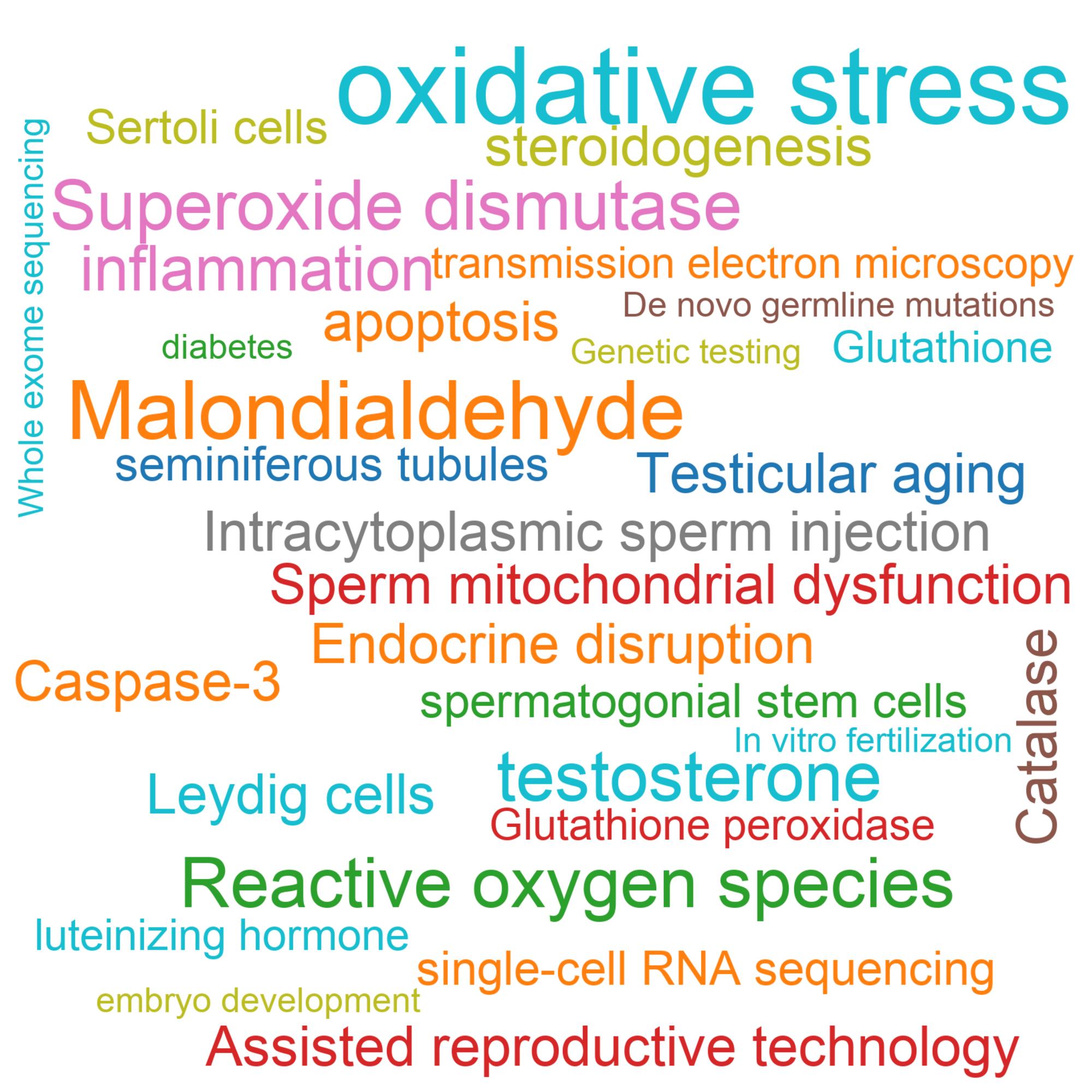
In the 2024 cohort for Sperm and Testicular Function (Class of 2026), oxidative stress and its associated biochemical markers dominate the research landscape. A prominent cluster of highly cited papers focuses heavily on biomarkers like Malondialdehyde (MDA), reactive oxygen species (ROS), and superoxide dismutase (SOD), reflecting an intense, ongoing effort to understand the molecular mechanisms underlying male infertility and reproductive toxicity. The strong presence of these themes indicates that oxidative damage remains a central paradigm in evaluating sperm quality and testicular health. Alongside oxidative stress, testosterone regulation continues to be a foundational concept. This concentration of research highlights that mitigating cellular damage and preserving hormonal balance are the primary therapeutic and diagnostic targets for researchers in this field. The dominance of these well-established biomarkers suggests a maturation in the field, where researchers are increasingly refining diagnostic thresholds and exploring targeted interventions to combat oxidative damage in reproductive tissues.
How Did Topics Shift from the Class of 2025 to the Class of 2026?
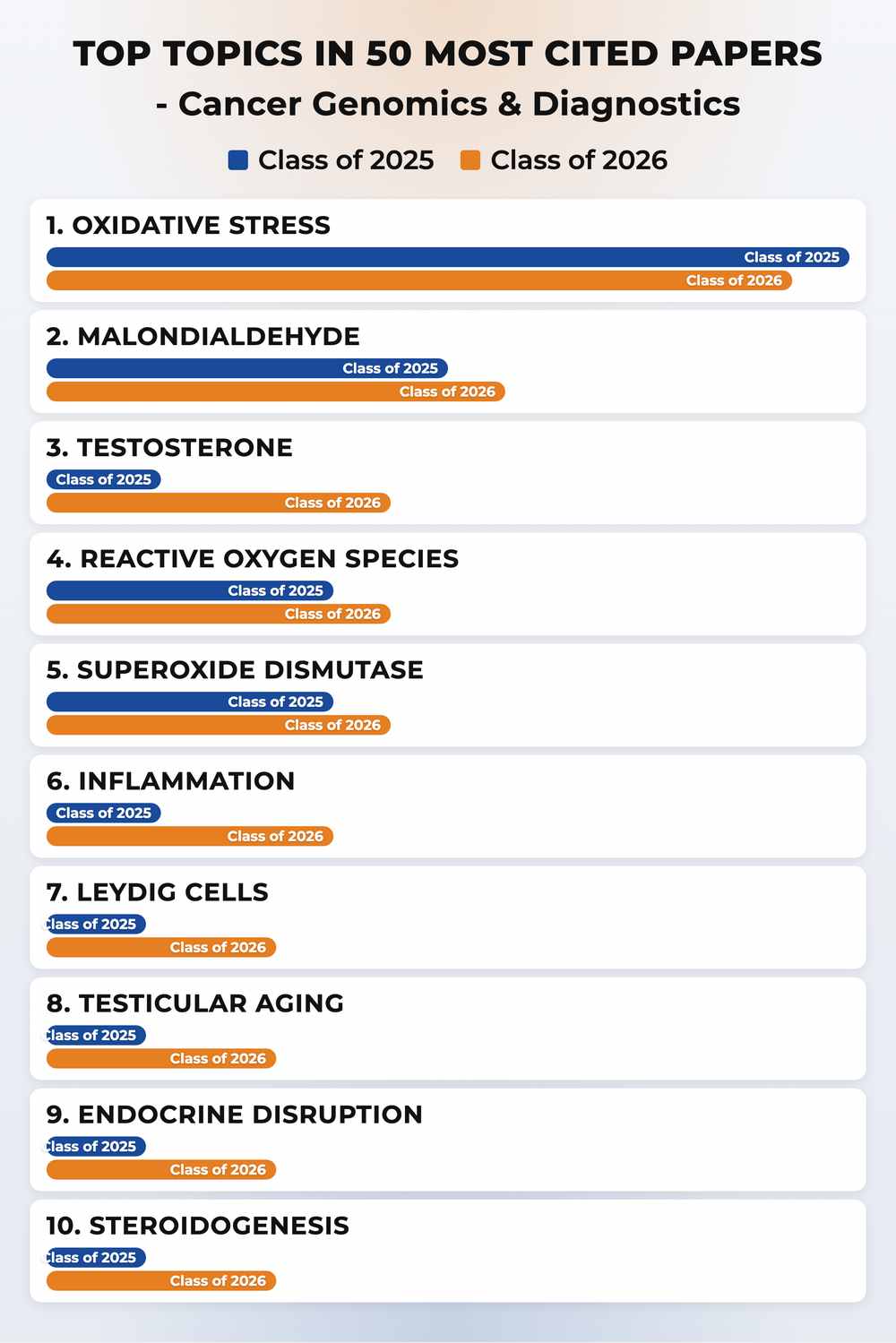
Comparing the Class of 2025 to the Class of 2026 reveals significant shifts in research priorities within Sperm and Testicular Function. The most notable trend is the rapid emergence of topics such as endocrine disruption, Leydig cell biology, and testicular aging. These fast-rising concepts indicate a growing focus on how environmental toxicants and aging processes impact male reproductive health at a cellular level, moving beyond general descriptions of infertility. Conversely, traditional mechanistic topics like mitochondrial membrane potential, apoptosis, and glutathione peroxidase experienced relative declines in their normalized frequencies. This shift suggests that while fundamental cellular death pathways were heavily studied in previous cohorts, current high-impact research is pivoting towards more specific environmental impacts (such as endocrine disruptors) and specialized cellular functions (such as Leydig cells). Overall, the field is evolving from broad studies of cell death and survival towards a more nuanced understanding of how external factors and aging specifically disrupt testicular endocrine function and spermatogenesis.
Methodology
PRI identifies high-impact research using a transparent, topic-agnostic framework applied consistently across scientific domains. Bibliographic records are drawn from OpenAlex, including publication dates, citation relationships, and document types.
This ranking covers the Class of 2026 cohort: journal articles published in 2024. Reviews and other non-article document types are excluded to ensure comparability.
Research impact is quantified with an 18-month post-publication citation window—the number of citing works published within 18 months of each paper's publication date. This metric captures early impact while controlling for publication age.
An LLM-based relevance classifier then reviews each candidate's title and abstract to confirm substantive alignment with the target domain. Only papers classified as relevant appear in the final ranking.
Zheng Su, Tinsley Li, Thematic Shifts in Early-High-Impact Cancer Genomics and Diagnostics Research: A Bibliometric and Semantic Analysis. bioRxiv 2026.07.04.736459; doi: https://doi.org/10.64898/2026.07.04.736459
Cite this ranking
Pepkio Research Index (PRI). Topics and Trends in Most Cited Sperm and Testicular Function Papers, Class of 2026. https://pri.pepkio.com/top-papers/sperm-and-testicular-function/2026. Accessed 2026-10-16.

Methodology
Zheng Su, Tinsley Li, Thematic Shifts in Early-High-Impact Cancer Genomics and Diagnostics Research: A Bibliometric and Semantic Analysis. bioRxiv 2026.07.04.736459; doi: https://doi.org/10.64898/2026.07.04.736459