
What topics and trends defined most-cited Estrogen and related hormone effects research in the Class of 2026?
Research in the Class of 2026 centers on menopausal hormone therapy and targeted breast cancer care. Menopause and coronary heart disease risk saw major increases, while estradiol and selective estrogen receptor degraders gained momentum. Conversely, traditional aromatase inhibitors declined sharply as attention shifted toward novel combination therapies and precision cardiometabolic risk management.
At a glance
- Field
- Estrogen and related hormone effects
- Cohort label
- Class of 2026 (2024 publications)
- Papers analyzed
- 2,723
- Papers ranked
- 20
- Top topics in ranked papers
- Menopause, menopausal hormone therapy, advanced breast cancer, CDK4/6 inhibitors, SERDs
- Publication window
- Jan 1, 2024 – Dec 31, 2024
- Eligibility
- Research articles; reviews excluded
- Citation window
- 18 months post-publication
- 18m citation range
- 25–70
- Data source
- OpenAlex · Retrieved Jul 2026
- License
- CC BY 4.0
Rankings
20 papers ranked by 18-month citation count
Elinzanetant for the Treatment of Vasomotor Symptoms Associated With Menopause
JAMA202410.1001/jama.2024.14618
Camizestrant, a next-generation oral SERD, versus fulvestrant in post-menopausal women with oestrogen receptor-positive, HER2-negative advanced breast cancer (SERENA-2): a multi-dose, open-label, randomised, phase 2 trial
The Lancet Oncology202410.1016/s1470-2045(24)00387-5
An empowerment model for managing menopause
The Lancet202410.1016/s0140-6736(23)02799-x
Elacestrant in ER+, HER2− Metastatic Breast Cancer with <i>ESR1</i> -Mutated Tumors: Subgroup Analyses from the Phase III EMERALD Trial by Prior Duration of Endocrine Therapy plus CDK4/6 Inhibitor and in Clinical Subgroups
Clinical Cancer Research202410.1158/1078-0432.ccr-24-1073
Menopausal Hormone Therapy Use Among Postmenopausal Women
JAMA Health Forum202410.1001/jamahealthforum.2024.3128
Exploring the effects of estrogen deficiency and aging on organismal homeostasis during menopause
Nature Aging202410.1038/s43587-024-00767-0
Hallmarks of female reproductive aging in physiologic aging mice
Nature Aging202410.1038/s43587-024-00769-y
Estrogen and cardiovascular disease
Progress in Cardiovascular Diseases202410.1016/j.pcad.2024.01.015
In vivo brain estrogen receptor density by neuroendocrine aging and relationships with cognition and symptomatology
Scientific Reports202410.1038/s41598-024-62820-7
Contemporary menopausal hormone therapy and risk of cardiovascular disease: Swedish nationwide register based emulated target trial
BMJ202410.1136/bmj-2023-078784
Menopause transition and cardiovascular disease risk
Maturitas202410.1016/j.maturitas.2024.107974
Capivasertib and fulvestrant for patients with hormone receptor-positive, HER2-negative advanced breast cancer (CAPItello-291): patient-reported outcomes from a phase 3, randomised, double-blind, placebo-controlled trial
The Lancet Oncology202410.1016/s1470-2045(24)00373-5
Assessing male reproductive toxicity of environmental pollutant di-ethylhexyl phthalate with network toxicology and molecular docking strategy
Reproductive Toxicology202410.1016/j.reprotox.2024.108749
Giredestrant for Estrogen Receptor–Positive, HER2-Negative, Previously Treated Advanced Breast Cancer: Results From the Randomized, Phase II acelERA Breast Cancer Study
Journal of Clinical Oncology202410.1200/jco.23.01500
A phase I dose escalation and expansion trial of the next-generation oral SERD camizestrant in women with ER-positive, HER2-negative advanced breast cancer: SERENA-1 monotherapy results
Annals of Oncology202410.1016/j.annonc.2024.04.012
Activity and safety of enobosarm, a novel, oral, selective androgen receptor modulator, in androgen receptor-positive, oestrogen receptor-positive, and HER2-negative advanced breast cancer (Study G200802): a randomised, open-label, multicentre, multinational, parallel design, phase 2 trial
The Lancet Oncology202410.1016/s1470-2045(24)00004-4
Inhibition of GPX4 enhances CDK4/6 inhibitor and endocrine therapy activity in breast cancer
Nature Communications202410.1038/s41467-024-53837-7
Use of menopausal hormone therapy beyond age 65 years and its effects on women's health outcomes by types, routes, and doses
Menopause The Journal of The North American Menopause Society202410.1097/gme.0000000000002335
Exploring the role of trifarotene against RAR-α: an investigation of expression pattern and clinicopathological significance of RAR-α in breast cancer
Frontiers in Pharmacology202410.3389/fphar.2024.1361679
Hormonal biomarkers remain prognostically relevant within the molecular subgroups in endometrial cancer
Gynecologic Oncology202410.1016/j.ygyno.2024.10.028
Topic trends
Dominant research themes and year-over-year shifts in Estrogen and related hormone effects
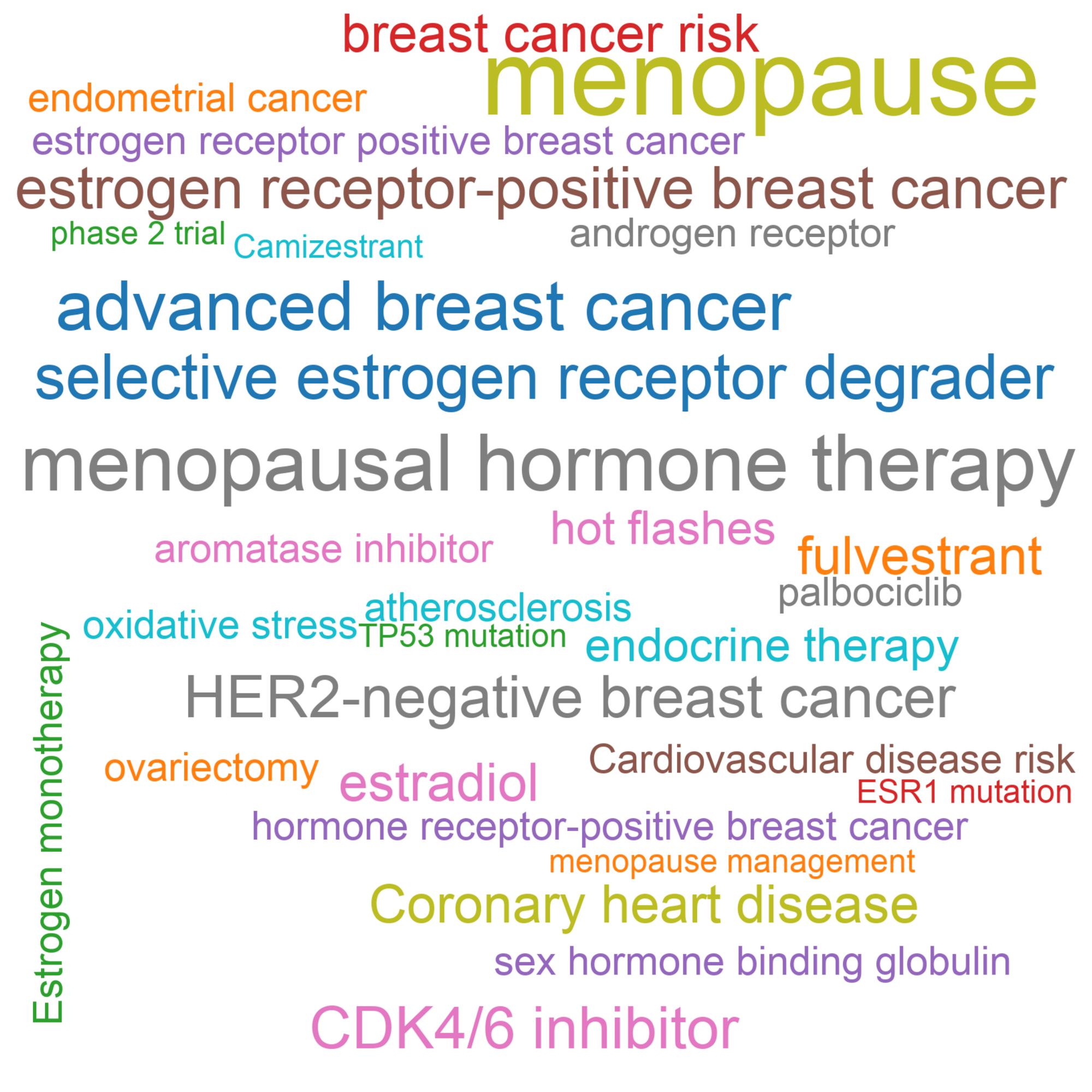
What Topics Define the Class of 2026?
The Class of 2026 cohort in estrogen and related hormone research is driven by two major pillars: postmenopausal hormone therapy alongside women's cardiometabolic health, and targeted therapeutic strategies for hormone receptor-positive (HR+) advanced breast cancer. Menopause and menopausal hormone therapy (MHT) dominate the landscape, appearing in 28% and 18% of top-ranked publications respectively. High-impact investigations focus on clarifying long-term cardiovascular risks, cognitive function, and individual risk-benefit profiles associated with systemic MHT and estrogen monotherapy. Estradiol signaling and sex hormone-binding globulin (SHBG) emerge as key physiological biomarkers for metabolic and endocrine assessment in aging populations. In parallel, oncology research centers heavily on targeted interventions for advanced and HER2-negative breast cancer. Selective estrogen receptor degraders (SERDs), such as fulvestrant and novel oral agents, along with CDK4/6 inhibitors remain central clinical focal points. Studies evaluate combination regimens aimed at overcoming endocrine resistance, managing hot flashes, and tailoring risk stratifications for estrogen receptor-positive disease. Together, these focal points reflect a dual clinical focus: optimizing long-term systemic hormone safety during menopausal transitions while refining endocrine and targeted therapies for estrogen-driven malignancies.
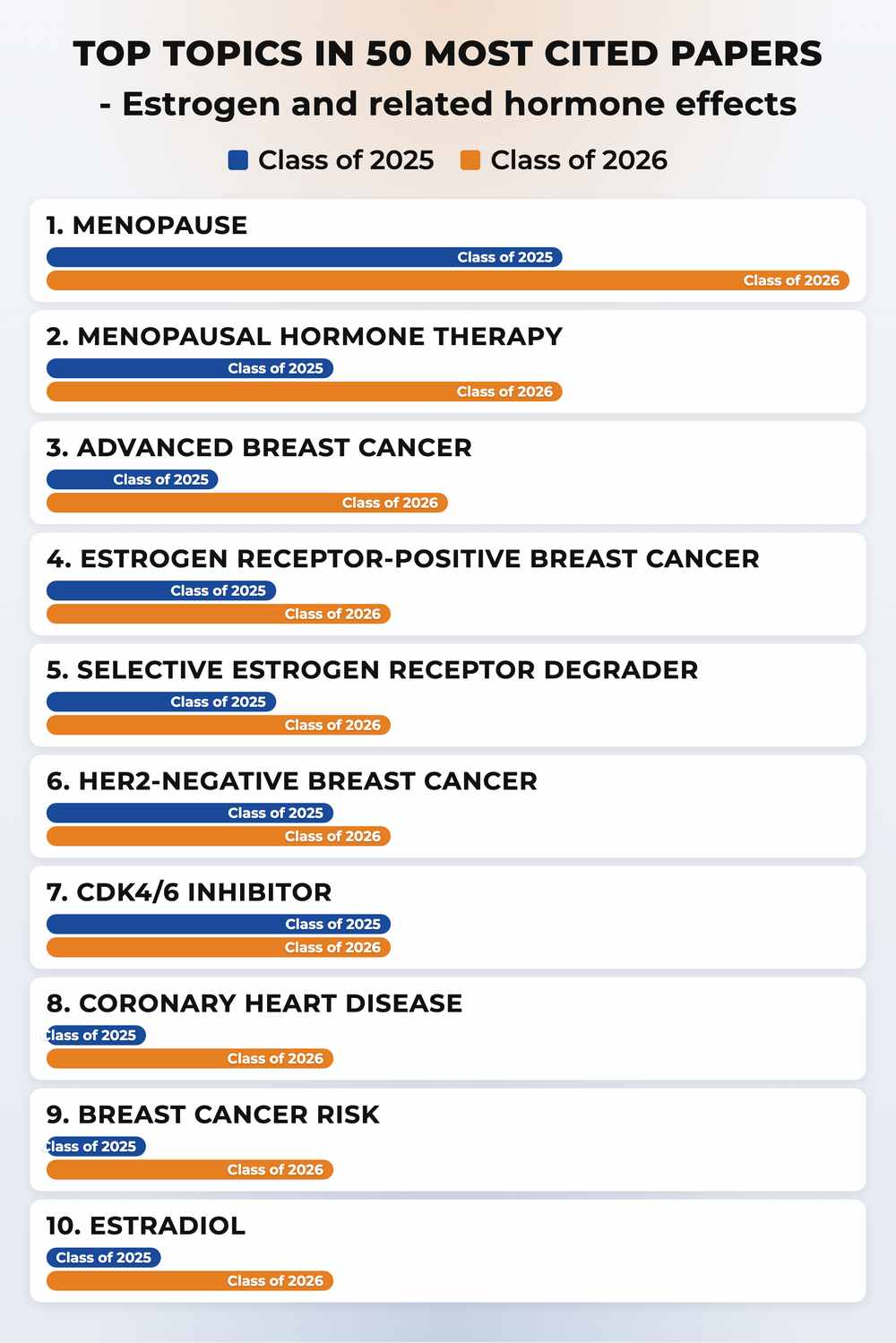
How Did Topics Shift from the Class of 2025 to the Class of 2026?
Comparing the Class of 2025 to the Class of 2026 reveals significant thematic shifts in estrogen research, characterized by a surging interest in postmenopausal health outcomes and a strategic pivot in oncology therapeutics. The most prominent growth occurred in menopausal hormone therapy and postmenopausal risk assessment. Menopause research rose by 10 percentage points (from 18% to 28%), while coronary heart disease emerged sharply as a major focal area (reaching 10% of ranked literature from zero in the previous cohort). Estradiol evaluation (+6 percentage points) and breast cancer risk modeling (+8 percentage points) also recorded strong upward momentum, driven by large-scale clinical trials and colocalization analyses examining systemic hormone exposure. Conversely, traditional monotherapies and older treatment frameworks experienced noticeable declines. Aromatase inhibitors saw the steepest drop, falling from 18% in 2025 down to 6% in 2026 (-12 percentage points), reflecting a transition toward next-generation combination therapies. Generic hormone receptor-positive breast cancer classifications also contracted as studies adopted more granular molecular subtyping, such as HER2-negative and ESR1-mutated designations. These shifts highlight a field broadening its scope beyond localized tumor suppression toward comprehensive cardiovascular risk management, precision risk stratification, and novel SERD-based therapeutic regimens.
Methodology
PRI identifies high-impact research using a transparent, topic-agnostic framework applied consistently across scientific domains. Bibliographic records are drawn from OpenAlex, including publication dates, citation relationships, and document types.
This ranking covers the Class of 2026 cohort: journal articles published in 2024. Reviews and other non-article document types are excluded to ensure comparability.
Research impact is quantified with an 18-month post-publication citation window—the number of citing works published within 18 months of each paper's publication date. This metric captures early impact while controlling for publication age.
An LLM-based relevance classifier then reviews each candidate's title and abstract to confirm substantive alignment with the target domain. Only papers classified as relevant appear in the final ranking.
Zheng Su, Tinsley Li, Thematic Shifts in Early-High-Impact Cancer Genomics and Diagnostics Research: A Bibliometric and Semantic Analysis. bioRxiv 2026.07.04.736459; doi: https://doi.org/10.64898/2026.07.04.736459
Cite this ranking
Pepkio Research Index (PRI). Topics and Trends in Most Cited Estrogen and related hormone effects Papers, Class of 2026. https://pri.pepkio.com/top-papers/estrogen-and-related-hormone-effects/2026. Accessed 2026-09-03.

Methodology
Zheng Su, Tinsley Li, Thematic Shifts in Early-High-Impact Cancer Genomics and Diagnostics Research: A Bibliometric and Semantic Analysis. bioRxiv 2026.07.04.736459; doi: https://doi.org/10.64898/2026.07.04.736459