
What topics and trends defined most-cited Plant Water Relations and Carbon Dynamics research in the Class of 2026?
Plant water relations research in 2024 shifted decisively toward dynamic carbon-water coupling and climate stress thresholds. Soil moisture anchored top literature, while gross primary productivity (+10%), carbon flux (+8%), and elevated CO2 (+8%) expanded rapidly. Broad evapotranspiration terms declined (-8%), reflecting an evolving focus on mechanistic ecohydrological flux modeling.
At a glance
- Field
- Plant Water Relations and Carbon Dynamics
- Cohort label
- Class of 2026 (2024 publications)
- Papers analyzed
- 6,551
- Papers ranked
- 20
- Top topics in ranked papers
- Soil moisture, carbon sequestration, evapotranspiration, gross primary productivity, carbon flux
- Publication window
- Jan 1, 2024 – Dec 31, 2024
- Eligibility
- Research articles; reviews excluded
- Citation window
- 18 months post-publication
- 18m citation range
- 62–141
- Data source
- OpenAlex · Retrieved Jul 2026
- License
- CC BY 4.0
Rankings
20 papers ranked by 18-month citation count
Global rise in forest fire emissions linked to climate change in the extratropics
Science202410.1126/science.adl5889
Global influence of soil texture on ecosystem water limitation
Nature202410.1038/s41586-024-08089-2
Dominant role of soil moisture in mediating carbon and water fluxes in dryland ecosystems
Nature Geoscience202410.1038/s41561-023-01351-8
Global critical soil moisture thresholds of plant water stress
Nature Communications202410.1038/s41467-024-49244-7
Biodiversity loss reduces global terrestrial carbon storage
Nature Communications202410.1038/s41467-024-47872-7
Plant Adaptation to Drought Stress: The Role of Anatomical and Morphological Characteristics in Maintaining the Water Status
Journal of soil science and plant nutrition202410.1007/s42729-024-02141-w
Assessing the accuracy of OpenET satellite-based evapotranspiration data to support water resource and land management applications
Nature Water202410.1038/s44221-023-00181-7
Plant responses to changing rainfall frequency and intensity
Nature Reviews Earth & Environment202410.1038/s43017-024-00534-0
Black biodegradable mulching increases grain yield and net return while decreasing carbon footprint in rain-fed conditions of the Loess Plateau
Field Crops Research202410.1016/j.fcr.2024.109590
Exploring spatiotemporal dynamics of NDVI and climate-driven responses in ecosystems: Insights for sustainable management and climate resilience
Ecological Informatics202410.1016/j.ecoinf.2024.102532
Maximizing carbon sequestration potential in Chinese forests through optimal management
Nature Communications202410.1038/s41467-024-47143-5
Extreme drought impacts have been underestimated in grasslands and shrublands globally
Proceedings of the National Academy of Sciences202410.1073/pnas.2309881120
Enhanced observations from an optimized soil-canopy-photosynthesis and energy flux model revealed evapotranspiration-shading cooling dynamics of urban vegetation during extreme heat
Remote Sensing of Environment202410.1016/j.rse.2024.114098
Temperature responses of ecosystem respiration
Nature Reviews Earth & Environment202410.1038/s43017-024-00569-3
Climate-induced tree-mortality pulses are obscured by broad-scale and long-term greening
Nature Ecology & Evolution202410.1038/s41559-024-02372-1
Tree water uptake patterns across the globe
New Phytologist202410.1111/nph.19762
Microbial competition for phosphorus limits the CO2 response of a mature forest
Nature202410.1038/s41586-024-07491-0
Future increase in compound soil drought-heat extremes exacerbated by vegetation greening
Nature Communications202410.1038/s41467-024-55175-0
Assisted tree migration can preserve the European forest carbon sink under climate change
Nature Climate Change202410.1038/s41558-024-02080-5
Large global-scale vegetation sensitivity to daily rainfall variability
Nature202410.1038/s41586-024-08232-z
Topic trends
Dominant research themes and year-over-year shifts in Plant Water Relations and Carbon Dynamics
What Topics Define the Class of 2026?
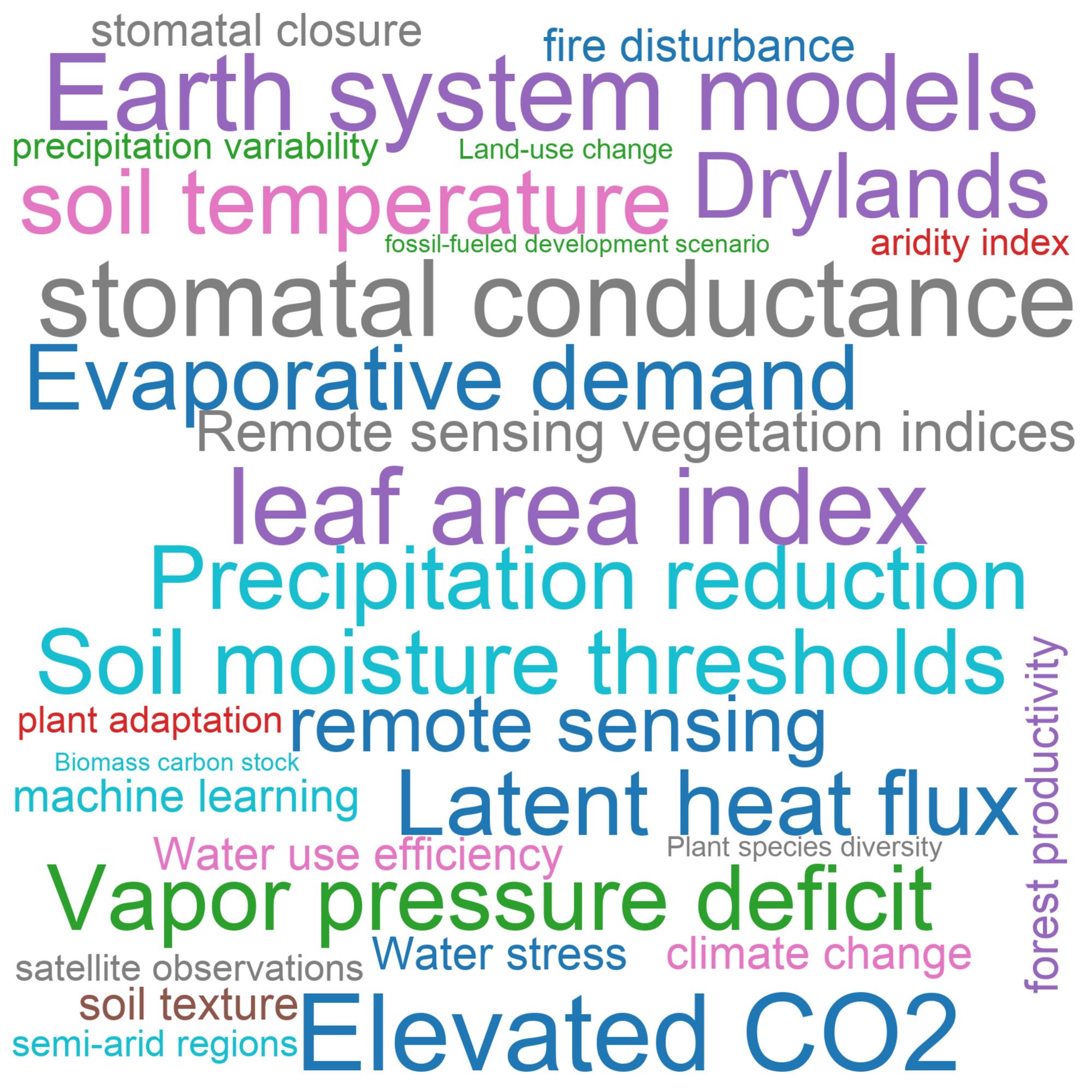
Research in the Class of 2026 centers on the tight coupling between plant water availability and terrestrial carbon cycling under environmental change. Soil moisture serves as the foundational anchor, appearing in 14% of top-ranked studies (7 of 50 papers). Three major functional metrics—carbon sequestration, evapotranspiration, and gross primary productivity (GPP)—each define 10% of the high-impact corpus (5 papers each), reflecting a strong emphasis on quantifying ecosystem-scale carbon uptake and water loss. A distinct cluster of mechanistic and modeling concepts prominent in the top papers includes carbon flux, Earth system models, elevated CO2, leaf area index, and stomatal conductance, each representing 8% of publications (4 papers each). These studies examine how plant physiological regulation directly governs land-atmosphere exchanges. Furthermore, ecohydrological drivers such as drylands, evaporative demand, land-atmosphere interactions, latent heat flux, precipitation reduction, and soil moisture thresholds each feature in 6% of the corpus (3 papers each). Collectively, this thematic landscape illustrates how current research integrates fine-scale leaf stomatal responses with macro-scale ecohydrological modeling to resolve ecosystem resilience under climate variability.
How Did Topics Shift from the Class of 2025 to the Class of 2026?
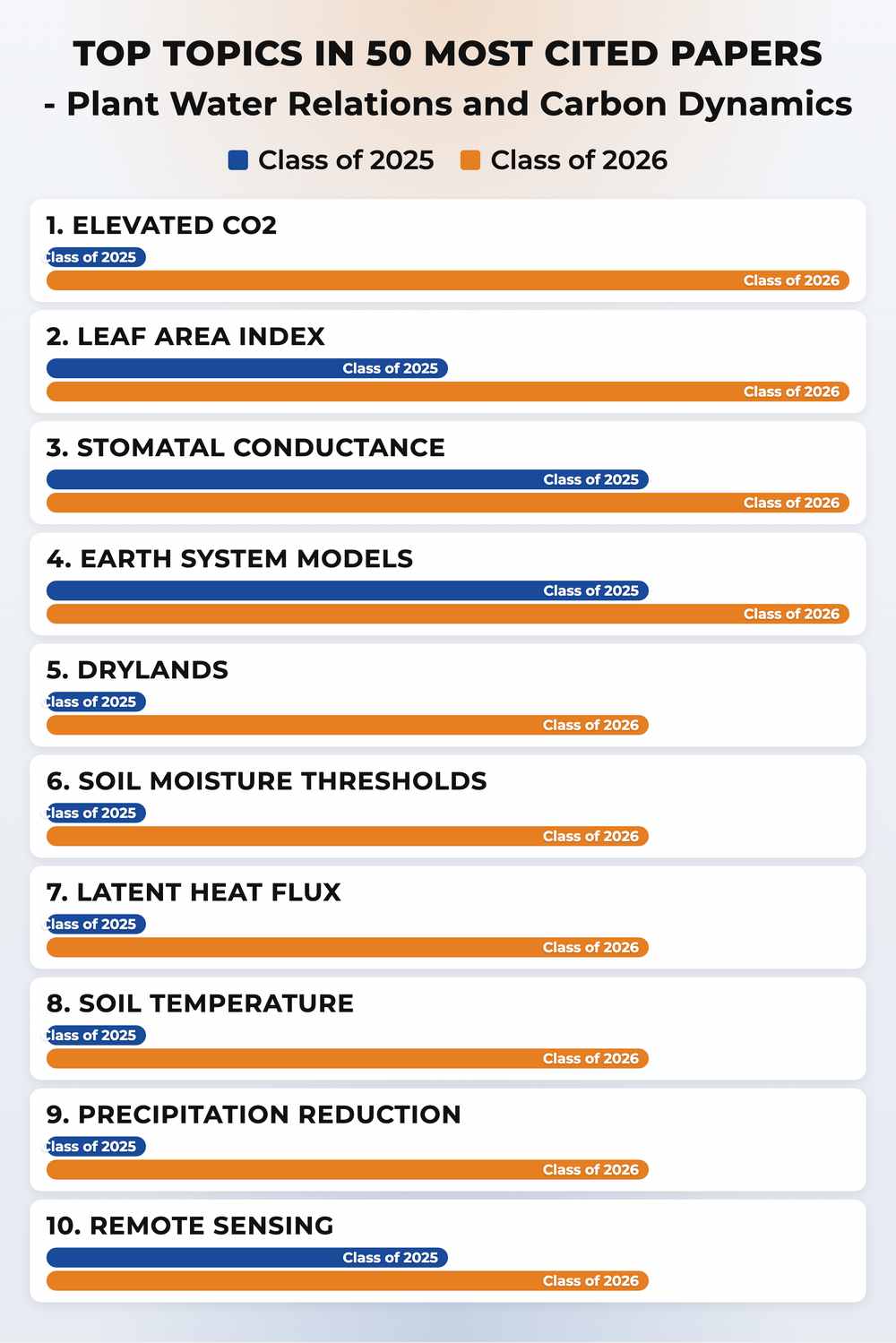
The transition from the Class of 2025 to the Class of 2026 reveals a significant thematic shift toward dynamic flux modeling and experimental stress controls. The most dramatic rise occurred in gross primary productivity, surging from 0% in 2023 to 10% of top papers in 2024 (+10 percentage points, 5 papers). Parallel increases were recorded for carbon flux and elevated CO2 (both rising from 0% to 8%, +8 percentage points), alongside rapid emergence in drylands, latent heat flux, precipitation reduction, soil moisture thresholds, and soil temperature (all expanding from 0% to 6%, +6 percentage points). Carbon sequestration also gained momentum, growing from 6% to 10% (+4 percentage points). Conversely, several broad observational and baseline terms contracted. Evapotranspiration experienced the largest drop, declining from 18% in 2023 (9 papers) to 10% in 2024 (5 papers, -8 percentage points). Ecosystem carbon storage similarly eased from 10% to 6% (-4 percentage points), while land-atmosphere interactions, remote sensing vegetation indices, and vapor pressure deficit each shifted down from 8% to 6% (-2 percentage points). This shift highlights a reorientation away from general moisture monitoring toward predictive, threshold-driven carbon-water interaction models.
Methodology
PRI identifies high-impact research using a transparent, topic-agnostic framework applied consistently across scientific domains. Bibliographic records are drawn from OpenAlex, including publication dates, citation relationships, and document types.
This ranking covers the Class of 2026 cohort: journal articles published in 2024. Reviews and other non-article document types are excluded to ensure comparability.
Research impact is quantified with an 18-month post-publication citation window—the number of citing works published within 18 months of each paper's publication date. This metric captures early impact while controlling for publication age.
An LLM-based relevance classifier then reviews each candidate's title and abstract to confirm substantive alignment with the target domain. Only papers classified as relevant appear in the final ranking.
Zheng Su, Tinsley Li, Thematic Shifts in Early-High-Impact Cancer Genomics and Diagnostics Research: A Bibliometric and Semantic Analysis. bioRxiv 2026.07.04.736459; doi: https://doi.org/10.64898/2026.07.04.736459
Cite this ranking
Pepkio Research Index (PRI). Topics and Trends in Most Cited Plant Water Relations and Carbon Dynamics Papers, Class of 2026. https://pri.pepkio.com/top-papers/plant-water-relations-and-carbon-dynamics/2026. Accessed 2026-10-24.

Methodology
Zheng Su, Tinsley Li, Thematic Shifts in Early-High-Impact Cancer Genomics and Diagnostics Research: A Bibliometric and Semantic Analysis. bioRxiv 2026.07.04.736459; doi: https://doi.org/10.64898/2026.07.04.736459