
What topics and trends defined most-cited Mycotoxins in Agriculture and Food research in the Class of 2026?
Mycotoxin research in 2024 is anchored by Aflatoxin B1, zearalenone, and point-of-care detection. Research sharply shifted toward electrochemical biosensors, aptamers, and SERS-based sensing, while enzymatic degradation and multi-toxin co-occurrence gained momentum as traditional patulin and general ROS studies declined.
At a glance
- Field
- Mycotoxins in Agriculture and Food
- Cohort label
- Class of 2026 (2024 publications)
- Papers analyzed
- 3,199
- Papers ranked
- 20
- Top topics in ranked papers
- Aflatoxin B1, zearalenone, point-of-care detection, electrochemical biosensors, enzymatic degradation
- Publication window
- Jan 1, 2024 – Dec 31, 2024
- Eligibility
- Research articles; reviews excluded
- Citation window
- 18 months post-publication
- 18m citation range
- 24–77
- Data source
- OpenAlex · Retrieved Jul 2026
- License
- CC BY 4.0
Rankings
20 papers ranked by 18-month citation count
Preparation of dual recognition adsorbents based on molecularly imprinted polymers and aptamer for highly sensitive recognition and enrichment of ochratoxin A
Journal of Hazardous Materials202410.1016/j.jhazmat.2024.135112
A biosensor integrating the electrochemical and fluorescence strategies for detection of aflatoxin B1 based on a dual-functionalized platform
Analytica Chimica Acta202410.1016/j.aca.2024.343085
Magnetic metal-organic frameworks-based ratiometric SERS aptasensor for sensitive detection of patulin in apples
Food Chemistry202410.1016/j.foodchem.2024.142200
Highly conductive AuNPs/Co-MOF nanocomposites synergistic hybridization chain reaction enzyme-free electrochemical aptasensor for ultrasensitive detection of Aflatoxin B1
Chemical Engineering Journal202410.1016/j.cej.2024.153596
Ultrasensitive electrochemical sensing for simultaneous rapid detection of zearalenone and ochratoxin A in feedstuffs and foodstuffs
Chemical Engineering Journal202410.1016/j.cej.2024.154807
Rapid, on-site quantitative determination of mycotoxins in grains using a multiple time-resolved fluorescent microsphere immunochromatographic test strip
Biosensors and Bioelectronics202410.1016/j.bios.2024.116357
Neurotoxic mechanisms of mycotoxins: Focus on aflatoxin B1 and T-2 toxin
Environmental Pollution202410.1016/j.envpol.2024.124359
Removal of aflatoxin M1 in milk using magnetic laccase/MoS2/chitosan nanocomposite as an efficient sorbent
Chemosphere202410.1016/j.chemosphere.2024.143334
Multiplexed lateral-flow immunoassays for the simultaneous detection of several mycotoxins in foodstuffs
Trends in Food Science & Technology202410.1016/j.tifs.2024.104858
Co-contamination and interactions of multiple mycotoxins and heavy metals in rice, maize, soybeans, and wheat flour marketed in Shanghai City
Journal of Hazardous Materials202410.1016/j.jhazmat.2024.134695
Electrochemistry–glucosemeter–smartphone integrated multi-mode biosensor for accurate detection of aflatoxin B1
Analytica Chimica Acta202410.1016/j.aca.2024.343398
Integrated network toxicology, molecular docking, and in vivo experiments to elucidate molecular mechanism of aflatoxin B1 hepatotoxicity
Ecotoxicology and Environmental Safety202410.1016/j.ecoenv.2024.116278
Probiotic-derived extracellular vesicles alleviate AFB1-induced intestinal injury by modulating the gut microbiota and AHR activation
Journal of Nanobiotechnology202410.1186/s12951-024-02979-3
Aggregation-induced emission nanoparticles facilitating multicolor lateral flow immunoassay for rapid and simultaneous detection of aflatoxin B1 and zearalenone
Food Chemistry202410.1016/j.foodchem.2024.138997
Enzyme-assisted patulin detoxification: Recent applications and perspectives
Trends in Food Science & Technology202410.1016/j.tifs.2024.104383
Therapeutic detoxification of quercetin for aflatoxin B1-related toxicity: Roles of oxidative stress, inflammation, and metabolic enzymes
Environmental Pollution202410.1016/j.envpol.2024.123474
Quantitative SERS sensor for mycotoxins with extraction and identification function
Food Chemistry202410.1016/j.foodchem.2024.140040
Near-infrared spectroscopy based on colorimetric sensor array coupled with convolutional neural network detecting zearalenone in wheat
Food Chemistry X202410.1016/j.fochx.2024.101322
Lateral flow assay for simultaneous detection of multiple mycotoxins using nanozyme to amplify signals
Food Chemistry202410.1016/j.foodchem.2024.140398
Quantification of 700 mycotoxins and other secondary metabolites of fungi and plants in grain products
npj Science of Food202410.1038/s41538-024-00294-7
Topic trends
Dominant research themes and year-over-year shifts in Mycotoxins in Agriculture and Food
What Topics Define the Class of 2026?
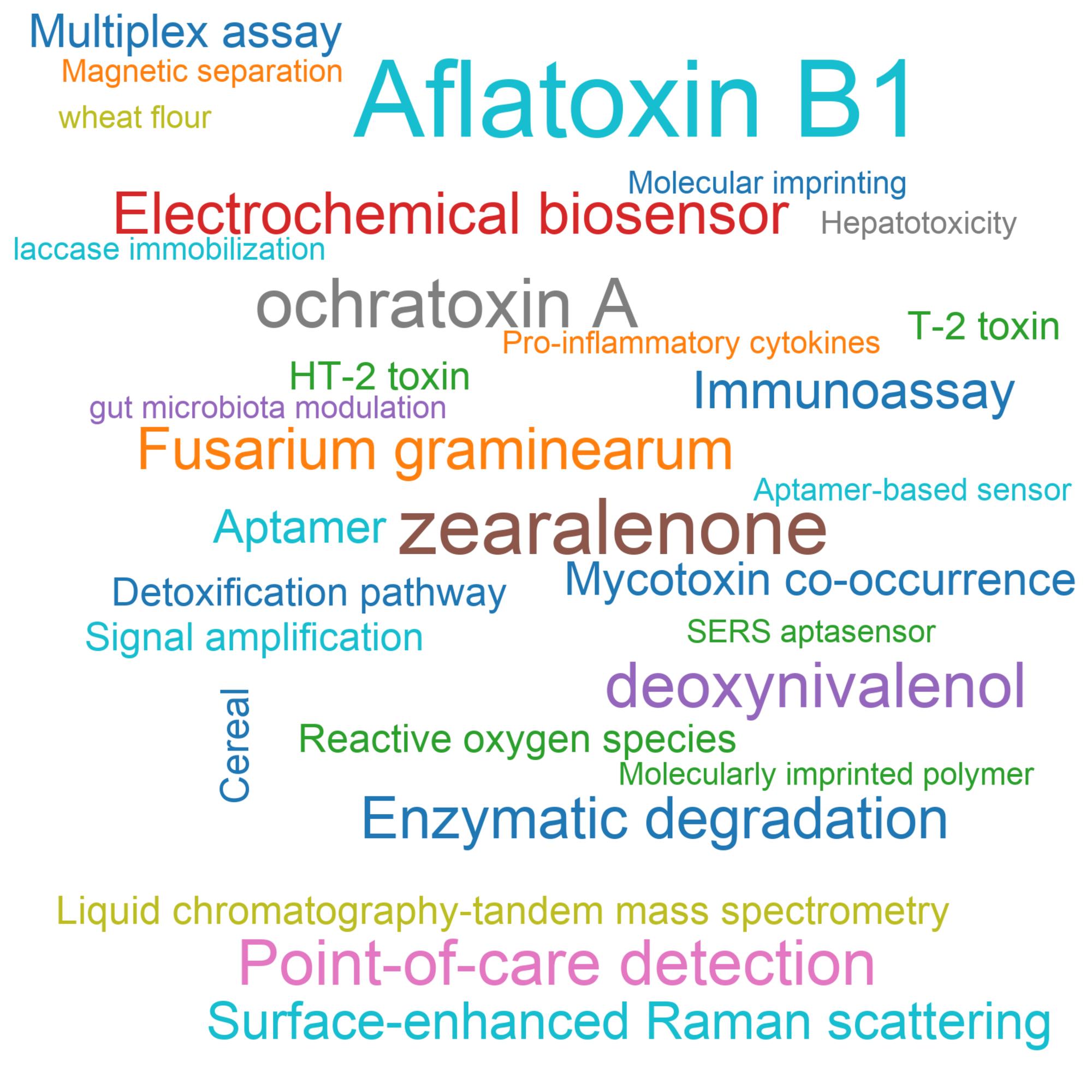
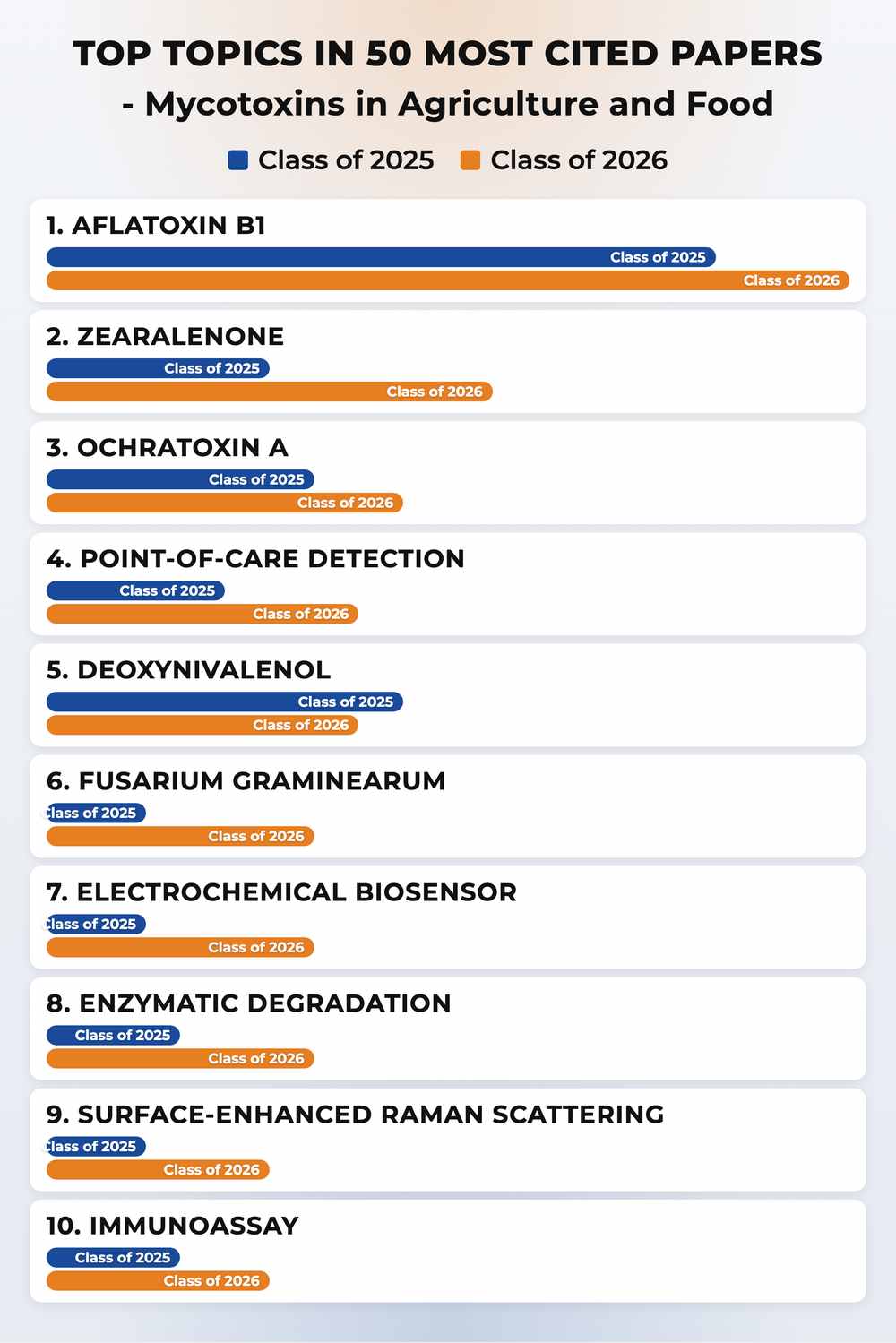
The 2026 cohort in Mycotoxins in Agriculture and Food is defined by major agricultural fungal toxins and advanced detection and remediation technologies. Aflatoxin B1 dominates the research landscape, appearing in 36% of analyzed papers as the leading toxicological threat in food and feed commodities. Other critical fungal toxins, including zearalenone (20%), ochratoxin A (16%), and deoxynivalenol (14%), form a prominent cluster of contamination challenges addressed across agricultural supply chains. To combat these hazards, research has heavily gravitated toward rapid, on-site analytical platforms and biological mitigation strategies. Point-of-care detection (14%) and electrochemical biosensors (12%) lead analytical innovation alongside immunoassays (10%) and surface-enhanced Raman scattering (SERS, 10%). Concurrently, biological control measures are heavily emphasized, centered around enzymatic degradation (12%) and microbial detoxification of mycotoxins in food products. Additionally, studies investigating Fusarium graminearum (12%) highlight ongoing efforts to control fungal pathogenesis at the field level, bridging crop protection with downstream food safety.
How Did Topics Shift from the Class of 2025 to the Class of 2026?
Comparing the Class of 2025 to the Class of 2026 reveals a distinct shift toward high-sensitivity biosensing, molecular recognition, and targeted biocatalytic detoxification. The most dramatic surges occurred in electrochemical biosensing platforms and Fusarium graminearum pathogen research, both expanding 6.0-fold in normalized frequency. Aptamer-based recognition and mycotoxin co-occurrence studies also surged 4.0-fold, reflecting growing awareness of synergistic toxicity from multi-toxin exposure in grain commodities. Furthermore, zearalenone research doubled (2.0-fold), driven by its prevalence in corn and cereal crops. Novel 2024 entries highlight the rise of optical sensing and enzymatic solutions, spearheaded by surface-enhanced Raman scattering (SERS, 10% frequency), specific SERS aptasensors, and specialized toxin-degrading enzymes. In contrast, traditional chemical assay topics and broader cellular stress markers saw relative declines; patulin research fell to 0.4-fold of its previous frequency, while studies focused purely on reactive oxygen species decreased to 0.6-fold. Overall, the field is transitioning from general toxicity profiling toward rapid, multi-target diagnostics and precise, green enzymatic degradation.
Methodology
PRI identifies high-impact research using a transparent, topic-agnostic framework applied consistently across scientific domains. Bibliographic records are drawn from OpenAlex, including publication dates, citation relationships, and document types.
This ranking covers the Class of 2026 cohort: journal articles published in 2024. Reviews and other non-article document types are excluded to ensure comparability.
Research impact is quantified with an 18-month post-publication citation window—the number of citing works published within 18 months of each paper's publication date. This metric captures early impact while controlling for publication age.
An LLM-based relevance classifier then reviews each candidate's title and abstract to confirm substantive alignment with the target domain. Only papers classified as relevant appear in the final ranking.
Zheng Su, Tinsley Li, Thematic Shifts in Early-High-Impact Cancer Genomics and Diagnostics Research: A Bibliometric and Semantic Analysis. bioRxiv 2026.07.04.736459; doi: https://doi.org/10.64898/2026.07.04.736459
Cite this ranking
Pepkio Research Index (PRI). Topics and Trends in Most Cited Mycotoxins in Agriculture and Food Papers, Class of 2026. https://pri.pepkio.com/top-papers/mycotoxins-in-agriculture-and-food/2026. Accessed 2026-09-13.

Methodology
Zheng Su, Tinsley Li, Thematic Shifts in Early-High-Impact Cancer Genomics and Diagnostics Research: A Bibliometric and Semantic Analysis. bioRxiv 2026.07.04.736459; doi: https://doi.org/10.64898/2026.07.04.736459