
What topics and trends defined most-cited Microbial Metabolic Engineering and Bioproduction research in the Class of 2026?
Most-cited 2024 microbial metabolic engineering research is dominated by genome-scale metabolic modeling, enzyme function prediction, and engineered model chassis including Saccharomyces cerevisiae and Escherichia coli. Trend shifts highlight rapid growth in artificial intelligence for enzyme design, machine learning models, and microbial consortia, alongside declining focus on legacy bioenergy processes like carbon dioxide fixation.
At a glance
- Field
- Microbial Metabolic Engineering and Bioproduction
- Cohort label
- Class of 2026 (2024 publications)
- Papers analyzed
- 5,979
- Papers ranked
- 20
- Top topics in ranked papers
- Genome-scale metabolic modeling, Enzyme function prediction, Saccharomyces cerevisiae, Microbial consortia, Heterologous expression
- Publication window
- Jan 1, 2024 – Dec 31, 2024
- Eligibility
- Research articles; reviews excluded
- Citation window
- 18 months post-publication
- 18m citation range
- 37–120
- Data source
- OpenAlex · Retrieved Jul 2026
- License
- CC BY 4.0
Rankings
20 papers ranked by 18-month citation count
Engineering natural microbiomes toward enhanced bioremediation by microbiome modeling
Nature Communications202410.1038/s41467-024-49098-z
Expanding chemistry through in vitro and in vivo biocatalysis
Nature202410.1038/s41586-024-07506-w
Engineered enzymes for the synthesis of pharmaceuticals and other high-value products
Nature Synthesis202410.1038/s44160-023-00417-0
Complete biosynthesis of QS-21 in engineered yeast
Nature202410.1038/s41586-024-07345-9
Combined transcriptomic and metabolomic analyses of temperature response of microalgae using waste activated sludge extracts for promising biodiesel production
Water Research202410.1016/j.watres.2024.121120
Accurately predicting enzyme functions through geometric graph learning on ESMFold-predicted structures
Nature Communications202410.1038/s41467-024-52533-w
A synthetic methylotrophic Escherichia coli as a chassis for bioproduction from methanol
Nature Catalysis202410.1038/s41929-024-01137-0
Automated in vivo enzyme engineering accelerates biocatalyst optimization
Nature Communications202410.1038/s41467-024-46574-4
H2 production from coal by enriching sugar fermentation and alkane oxidation with hyperthermophilic resistance microbes in municipal wastewater
Chemical Engineering Journal202410.1016/j.cej.2024.151487
Reconstruction, simulation and analysis of enzyme-constrained metabolic models using GECKO Toolbox 3.0
Nature Protocols202410.1038/s41596-023-00931-7
Unlocking the potential of enzyme engineering via rational computational design strategies
Biotechnology Advances202410.1016/j.biotechadv.2024.108376
Computational scoring and experimental evaluation of enzymes generated by neural networks
Nature Biotechnology202410.1038/s41587-024-02214-2
Strategies to enhance production of metabolites in microbial co-culture systems
Bioresource Technology202410.1016/j.biortech.2024.131049
mVOC 4.0: a database of microbial volatiles
Nucleic Acids Research202410.1093/nar/gkae961
TRYing to evaluate production costs in microbial biotechnology
Trends in biotechnology202410.1016/j.tibtech.2024.04.007
Efficient synthesis of squalene by cytoplasmic-peroxisomal engineering and regulating lipid metabolism in Yarrowia lipolytica
Bioresource Technology202410.1016/j.biortech.2024.130379
MPEK: a multitask deep learning framework based on pretrained language models for enzymatic reaction kinetic parameters prediction
Briefings in Bioinformatics202410.1093/bib/bbae387
Yeast metabolism adaptation for efficient terpenoids synthesis via isopentenol utilization
Nature Communications202410.1038/s41467-024-54298-8
Unveiling the deterministic dynamics of microbial meta-metabolism: a multi-omics investigation of anaerobic biodegradation
Microbiome202410.1186/s40168-024-01890-1
Engineering a xylose fermenting yeast for lignocellulosic ethanol production
Nature Chemical Biology202410.1038/s41589-024-01771-6
Topic trends
Dominant research themes and year-over-year shifts in Microbial Metabolic Engineering and Bioproduction
What Topics Define the Class of 2026?
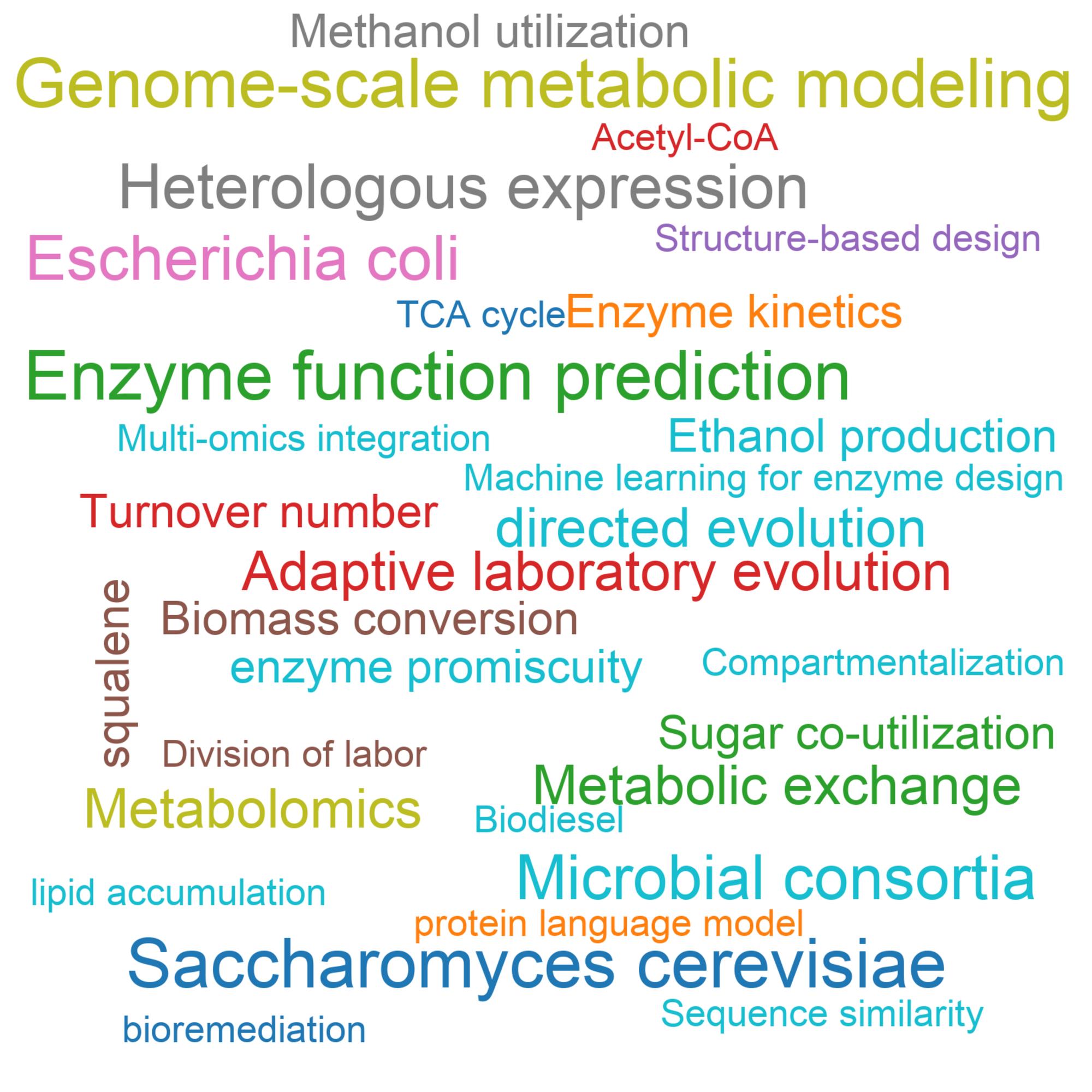
The Class of 2026 in microbial metabolic engineering and bioproduction is strongly anchored by computational modeling, predictive biochemistry, and robust cellular chassis development. At the core of the field, genome-scale metabolic modeling and enzyme function prediction lead in publication density, reflecting a field-wide emphasis on in silico strain design prior to wet-lab implementation. Workhorse microbial hosts remain central to experimental validation, with Saccharomyces cerevisiae and Escherichia coli appearing across numerous top-ranked studies for high-yield bioproduction and pathway optimization. Complementing single-organism strain design is a major focus on synthetic microbial consortia and heterologous expression systems. Researchers are increasingly constructing multi-species communities and division-of-labor networks to distribute complex metabolic pathways and relieve cellular metabolic burdens. Additionally, directed evolution, metabolomics, and adaptive laboratory evolution are widely deployed to refine enzyme kinetics, overcome pathway bottlenecks, and increase tolerance toward industrial stress. Together, these topics showcase a highly integrated paradigm that fuses computational flux modeling, machine-learning-assisted enzyme design, and advanced strain engineering to accelerate industrial biomanufacturing.
How Did Topics Shift from the Class of 2025 to the Class of 2026?
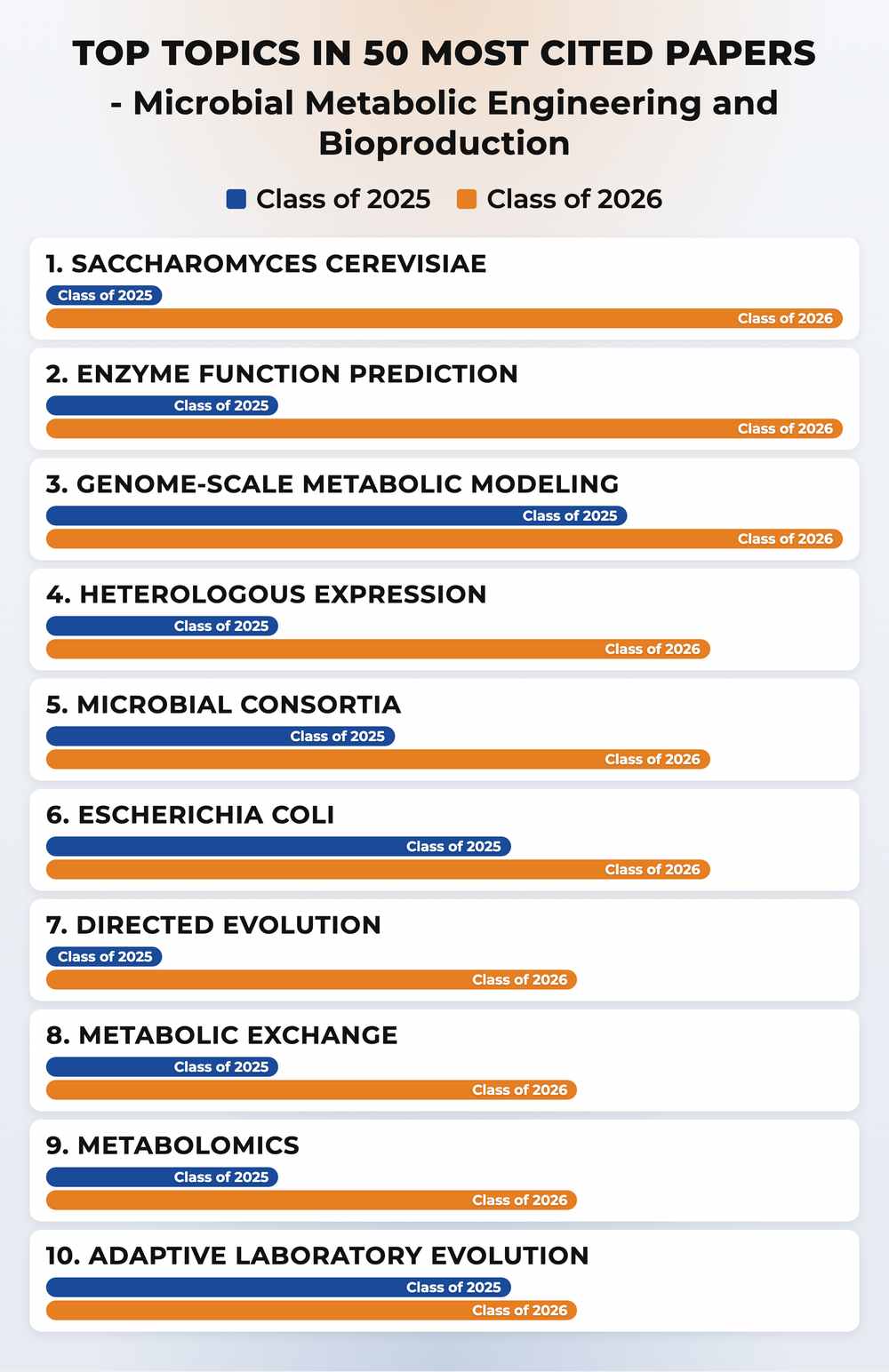
Comparing the Class of 2025 to the Class of 2026 reveals significant momentum toward predictive artificial intelligence and synthetic microbial community engineering. The most prominent surge occurred in Saccharomyces cerevisiae strain engineering, which saw a nearly seven-fold increase in top-paper representation, alongside a more than four-fold rise in directed evolution and computational enzyme prediction. Emerging topics such as protein language models, machine learning for enzyme design, multi-omics integration, and central carbon metabolism optimization entered the top tier of research focus for the first time, reflecting a paradigm shift toward data-driven bioengineering. Conversely, traditional bioenergy and environmental application topics experienced relative declines. Topics including carbon dioxide fixation, techno-economic analysis, biomass conversion, and biodiesel production dropped substantially in representation compared to the previous cohort. This transition indicates a strategic shift across the microbial metabolic engineering community away from legacy bulk biofuel evaluation and toward high-value biochemical synthesis, precision enzyme engineering, and host-consortium co-culture systems.
Methodology
PRI identifies high-impact research using a transparent, topic-agnostic framework applied consistently across scientific domains. Bibliographic records are drawn from OpenAlex, including publication dates, citation relationships, and document types.
This ranking covers the Class of 2026 cohort: journal articles published in 2024. Reviews and other non-article document types are excluded to ensure comparability.
Research impact is quantified with an 18-month post-publication citation window—the number of citing works published within 18 months of each paper's publication date. This metric captures early impact while controlling for publication age.
An LLM-based relevance classifier then reviews each candidate's title and abstract to confirm substantive alignment with the target domain. Only papers classified as relevant appear in the final ranking.
Zheng Su, Tinsley Li, Thematic Shifts in Early-High-Impact Cancer Genomics and Diagnostics Research: A Bibliometric and Semantic Analysis. bioRxiv 2026.07.04.736459; doi: https://doi.org/10.64898/2026.07.04.736459
Cite this ranking
Pepkio Research Index (PRI). Topics and Trends in Most Cited Microbial Metabolic Engineering and Bioproduction Papers, Class of 2026. https://pri.pepkio.com/top-papers/microbial-metabolic-engineering-and-bioproduction/2026. Accessed 2026-10-24.

Methodology
Zheng Su, Tinsley Li, Thematic Shifts in Early-High-Impact Cancer Genomics and Diagnostics Research: A Bibliometric and Semantic Analysis. bioRxiv 2026.07.04.736459; doi: https://doi.org/10.64898/2026.07.04.736459