
What topics and trends defined most-cited Biofuel production and bioconversion research in the Class of 2026?
Lignocellulosic biomass, enzymatic hydrolysis, waste valorization, and biorefinery systems define top-cited biofuel research in the Class of 2026. Hemicellulose degradation, lignin valorization, and xylooligosaccharide recovery expanded rapidly from the Class of 2025, while general enzymatic hydrolysis, biomass recalcitrance, and high-level techno-economic analysis receded among leading publications.
At a glance
- Field
- Biofuel production and bioconversion
- Cohort label
- Class of 2026 (2024 publications)
- Papers analyzed
- 8,229
- Papers ranked
- 20
- Top topics in ranked papers
- Lignocellulosic biomass, Enzymatic hydrolysis, Waste valorization, Biorefinery, Bioethanol
- Publication window
- Jan 1, 2024 – Dec 31, 2024
- Eligibility
- Research articles; reviews excluded
- Citation window
- 18 months post-publication
- 18m citation range
- 44–280
- Data source
- OpenAlex · Retrieved Jul 2026
- License
- CC BY 4.0
Rankings
20 papers ranked by 18-month citation count
Diseño y Construcción de un Biodigestor para la Producción de Biogás a partir de Residuos Orgánicos en Bolivia
Revista horizonte académico202410.70208/3007.8245.v4.n4.14
Selective lignin arylation for biomass fractionation and benign bisphenols
Nature202410.1038/s41586-024-07446-5
The complex polyploid genome architecture of sugarcane
Nature202410.1038/s41586-024-07231-4
Hydrothermal treatment of lignocellulosic biomass towards low-carbon development: Production of high-value-added bioproducts
EnergyChem202410.1016/j.enchem.2024.100133
Release Pattern of Light Aromatic Hydrocarbons during the Biomass Roasting Process
Molecules202410.3390/molecules29061188
Extraction strategies for lignin, cellulose, and hemicellulose to obtain valuable products from biomass
Advanced Composites and Hybrid Materials202410.1007/s42114-024-01009-y
Optimisation of the Ethanol Fermentation Process Using Hydrothermal Pretreatment of Cellulose Waste—Effect of Fermentation Pattern and Strain
Molecules202410.3390/molecules29225266
Engineering thermostability of industrial enzymes for enhanced application performance
International Journal of Biological Macromolecules202410.1016/j.ijbiomac.2024.139067
Engineering strategies to optimize lignocellulosic biorefineries
Nature Reviews Bioengineering202410.1038/s44222-024-00247-5
A synthetic methylotrophic Escherichia coli as a chassis for bioproduction from methanol
Nature Catalysis202410.1038/s41929-024-01137-0
Lignin valorization reshapes sustainable biomass refining
Renewable and Sustainable Energy Reviews202410.1016/j.rser.2024.115296
Comprehensive understanding of co-producing fermentable sugar, furfural, and xylo-oligosaccharides through the pretreatment with CTAB-based deep eutectic solvent containing Brønsted and Lewis acid
Chemical Engineering Journal202410.1016/j.cej.2024.150637
Microbial mechanisms for higher hydrogen production in anaerobic digestion at constant temperature versus gradient heating
Microbiome202410.1186/s40168-024-01908-8
H2 production from coal by enriching sugar fermentation and alkane oxidation with hyperthermophilic resistance microbes in municipal wastewater
Chemical Engineering Journal202410.1016/j.cej.2024.151487
Double in-situ lignin modification in surfactant-assisted glycerol organosolv pretreatment of sugarcane bagasse towards efficient enzymatic hydrolysis
Chemical Engineering Journal202410.1016/j.cej.2024.148713
Life Cycle Assessment (LCA) of Bioplastics Production from Lignocellulosic Waste (Study Case: PLA and PHB)
Polymers202410.3390/polym16233330
Earthworm modifies microbial community and functional genes for lignocellulosic waste valorization: Isolating plant-growth-promoting bacteria via next generation sequencing
International Biodeterioration & Biodegradation202410.1016/j.ibiod.2024.105854
Reconstruction, simulation and analysis of enzyme-constrained metabolic models using GECKO Toolbox 3.0
Nature Protocols202410.1038/s41596-023-00931-7
A chromosomal-scale genome assembly of modern cultivated hybrid sugarcane provides insights into origination and evolution
Nature Communications202410.1038/s41467-024-47390-6
Furfural production from lignocellulosic biomass: one-step and two-step strategies and techno-economic evaluation
Green Chemistry202410.1039/d4gc00883a
Topic trends
Dominant research themes and year-over-year shifts in Biofuel production and bioconversion
What Topics Define the Class of 2026?
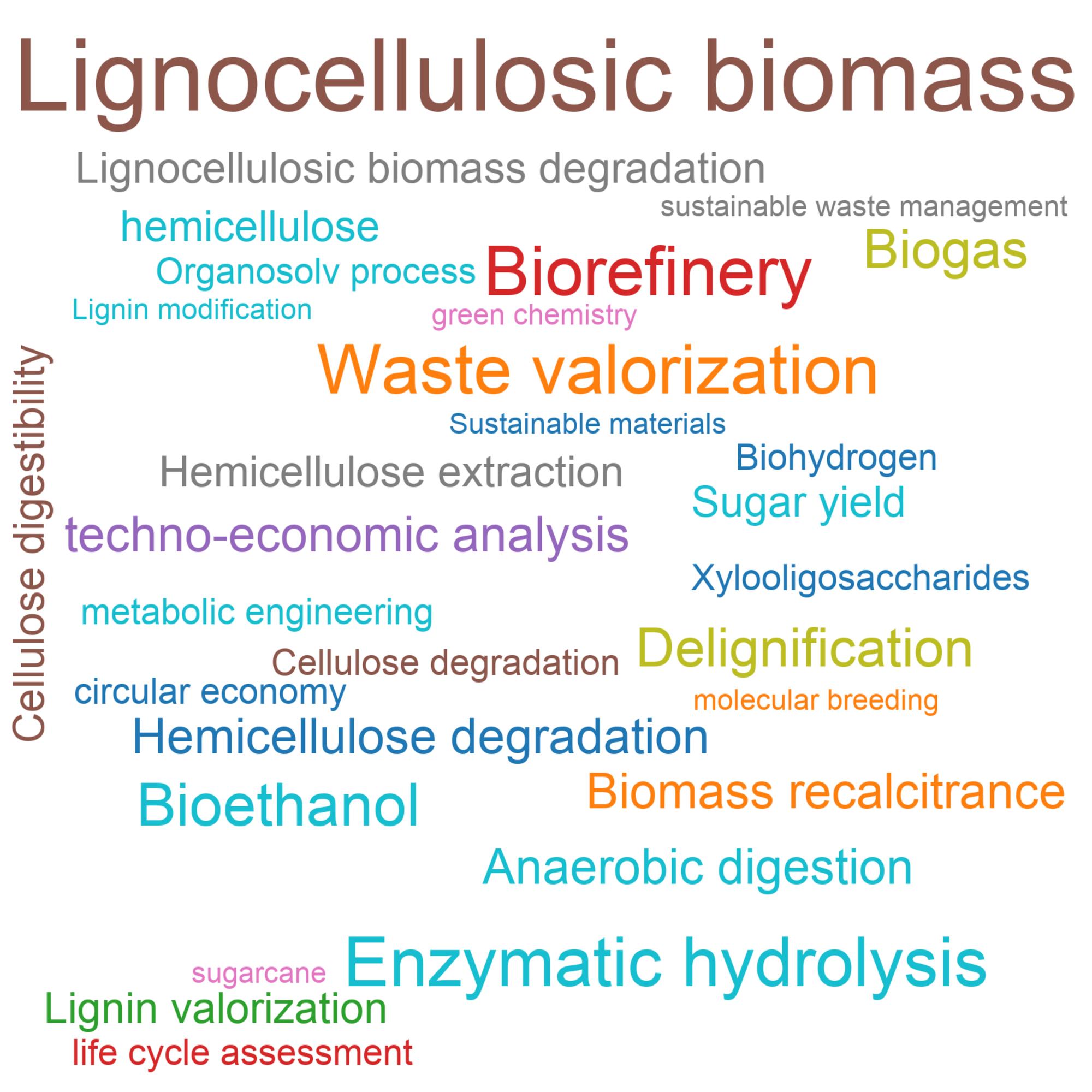
Lignocellulosic biomass dominates early-high-impact research in the Class of 2026, appearing in 19 of 50 top-cited papers (normalized frequency 0.38). This foundational feedstocks focus is anchored by three secondary thematic pillars—enzymatic hydrolysis, waste valorization, and biorefinery integration—each represented in 9 papers (0.18). Downstream biofuel outputs and processing routes maintain steady visibility through bioethanol (7 papers, 0.14), delignification (6 papers, 0.12), and biogas (6 papers, 0.12). Mid-tier topics highlight specific mechanistic and evaluation parameters, including hemicellulose degradation (5 papers, 0.10), biomass recalcitrance (5 papers, 0.10), techno-economic analysis (5 papers, 0.10), and anaerobic digestion (5 papers, 0.10). Advanced bioprocessing themes such as lignin valorization, hemicellulose extraction, cellulose digestibility, and sugar yield appear in 4 papers each (0.08), while metabolic engineering and life cycle assessment anchor 3 papers each (0.06). Overall, the informative topic landscape demonstrates that high-impact biofuel literature is heavily centered on optimizing pretreatment strategies, overcoming cell wall recalcitrance, and scaling circular biorefinery models to convert agricultural waste into renewable bioenergy and value-added biochemicals.
How Did Topics Shift from the Class of 2025 to the Class of 2026?
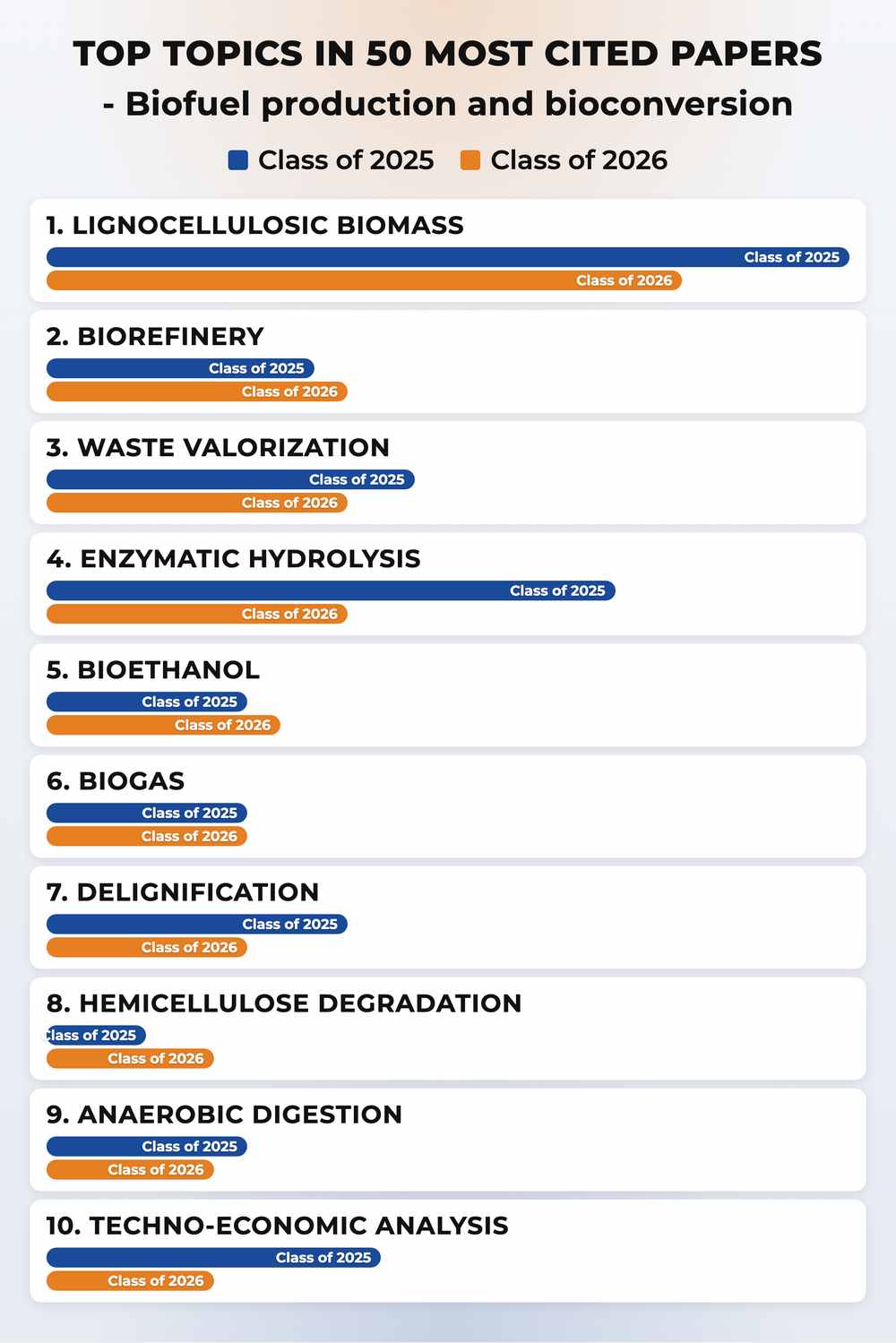
Comparing normalized concept frequencies between the Class of 2025 (2023 publications) and Class of 2026 (2024 publications) reveals a clear shift from generalized biomass characterization toward targeted component degradation and high-value co-product valorization. Hemicellulose degradation led all rising topics, gaining +0.08 in normalized frequency (1 to 5 papers). Lignin valorization increased by +0.06 (1 to 4 papers), while specialized products like xylooligosaccharides (+0.06; 0 to 3 papers) and cellulose degradation (+0.06; 0 to 3 papers) emerged strongly in 2024. Biorefinery (+0.02; 8 to 9 papers) and bioethanol (+0.02; 6 to 7 papers) also gained modest ground. Conversely, broad process terms experienced notable contractions: enzymatic hydrolysis dropped by −0.16 (17 to 9 papers), while biomass recalcitrance (−0.10; 10 to 5 papers), techno-economic analysis (−0.10; 10 to 5 papers), cellulose digestibility (−0.10; 9 to 4 papers), and general lignocellulosic biomass (−0.10; 24 to 19 papers) all receded. Systems-level modeling like life cycle assessment (−0.08; 7 to 3 papers) and biodiesel (−0.08; 6 to 2 papers) also declined among top-cited works. Together, these trends indicate that leading researchers are concentrating on precise biochemical fractionations and value-added lignin/hemicellulose co-products rather than general recalcitrance metrics.
Methodology
PRI identifies high-impact research using a transparent, topic-agnostic framework applied consistently across scientific domains. Bibliographic records are drawn from OpenAlex, including publication dates, citation relationships, and document types.
This ranking covers the Class of 2026 cohort: journal articles published in 2024. Reviews and other non-article document types are excluded to ensure comparability.
Research impact is quantified with an 18-month post-publication citation window—the number of citing works published within 18 months of each paper's publication date. This metric captures early impact while controlling for publication age.
An LLM-based relevance classifier then reviews each candidate's title and abstract to confirm substantive alignment with the target domain. Only papers classified as relevant appear in the final ranking.
Zheng Su, Tinsley Li, Thematic Shifts in Early-High-Impact Cancer Genomics and Diagnostics Research: A Bibliometric and Semantic Analysis. bioRxiv 2026.07.04.736459; doi: https://doi.org/10.64898/2026.07.04.736459
Cite this ranking
Pepkio Research Index (PRI). Topics and Trends in Most Cited Biofuel production and bioconversion Papers, Class of 2026. https://pri.pepkio.com/top-papers/biofuel-production-and-bioconversion/2026. Accessed 2026-10-16.

Methodology
Zheng Su, Tinsley Li, Thematic Shifts in Early-High-Impact Cancer Genomics and Diagnostics Research: A Bibliometric and Semantic Analysis. bioRxiv 2026.07.04.736459; doi: https://doi.org/10.64898/2026.07.04.736459