
What topics and trends defined most-cited Computational Drug Discovery Methods research in the Class of 2026?
Computational drug discovery is rapidly transitioning from static screening to multi-objective generative AI. De novo molecular design surged fivefold to lead the cohort, supported by graph neural networks and 3D diffusion models. Concurrently, physics-informed molecular dynamics and automated ADMET profiling expanded significantly, while traditional standalone drug-target prediction declined.
At a glance
- Field
- Computational Drug Discovery Methods
- Cohort label
- Class of 2026 (2024 publications)
- Papers analyzed
- 13,632
- Papers ranked
- 20
- Top topics in ranked papers
- De novo molecular design, virtual screening, binding affinity prediction, graph neural networks
- Publication window
- Jan 1, 2024 – Dec 31, 2024
- Eligibility
- Research articles; reviews excluded
- Citation window
- 18 months post-publication
- 18m citation range
- 86–583
- Data source
- OpenAlex · Retrieved July 2026
- License
- CC BY 4.0
Rankings
20 papers ranked by 18-month citation count
ProTox 3.0: a webserver for the prediction of toxicity of chemicals
Nucleic Acids Research202410.1093/nar/gkae303
Practical guide to <scp>SHAP</scp> analysis: Explaining supervised machine learning model predictions in drug development
Clinical and Translational Science202410.1111/cts.70056
ADMETlab 3.0: an updated comprehensive online ADMET prediction platform enhanced with broader coverage, improved performance, API functionality and decision support
Nucleic Acids Research202410.1093/nar/gkae236
SwissDock 2024: major enhancements for small-molecule docking with Attracting Cavities and AutoDock Vina
Nucleic Acids Research202410.1093/nar/gkae300
Leveraging large language models for predictive chemistry
Nature Machine Intelligence202410.1038/s42256-023-00788-1
Structure-based drug design with equivariant diffusion models
Nature Computational Science202410.1038/s43588-024-00737-x
Open Targets Platform: facilitating therapeutic hypotheses building in drug discovery
Nucleic Acids Research202410.1093/nar/gkae1128
An artificial intelligence accelerated virtual screening platform for drug discovery
Nature Communications202410.1038/s41467-024-52061-7
VFDB 2025: an integrated resource for exploring anti-virulence compounds
Nucleic Acids Research202410.1093/nar/gkae968
ADMET-AI: a machine learning ADMET platform for evaluation of large-scale chemical libraries
Bioinformatics202410.1093/bioinformatics/btae416
Artificial intelligence alphafold model for molecular biology and drug discovery: a machine-learning-driven informatics investigation
Molecular Cancer202410.1186/s12943-024-02140-6
A foundation model for clinician-centered drug repurposing
Nature Medicine202410.1038/s41591-024-03233-x
Deep-PK: deep learning for small molecule pharmacokinetic and toxicity prediction
Nucleic Acids Research202410.1093/nar/gkae254
AlphaFold predictions of fold-switched conformations are driven by structure memorization
Nature Communications202410.1038/s41467-024-51801-z
Reinvent 4: Modern AI–driven generative molecule design
Journal of Cheminformatics202410.1186/s13321-024-00812-5
Machine learning-aided generative molecular design
Nature Machine Intelligence202410.1038/s42256-024-00843-5
Equivariant 3D-conditional diffusion model for molecular linker design
Nature Machine Intelligence202410.1038/s42256-024-00815-9
DynamicBind: predicting ligand-specific protein-ligand complex structure with a deep equivariant generative model
Nature Communications202410.1038/s41467-024-45461-2
Generative AI for designing and validating easily synthesizable and structurally novel antibiotics
Nature Machine Intelligence202410.1038/s42256-024-00809-7
AlphaFold2 structures guide prospective ligand discovery
Science202410.1126/science.adn6354
Topic trends
Dominant research themes and year-over-year shifts in Computational Drug Discovery Methods
What Topics Define the Class of 2026?
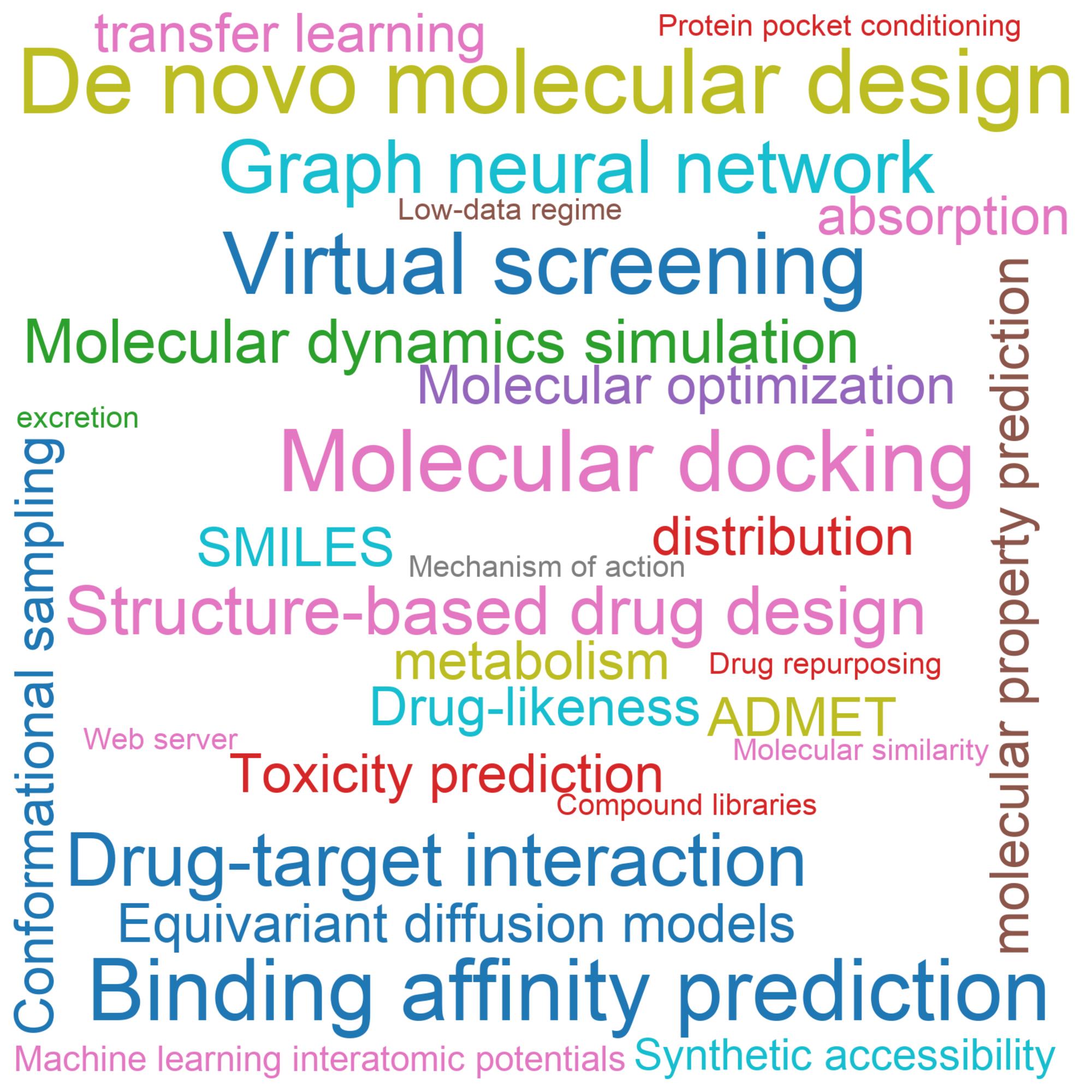
The Class of 2026 in computational drug discovery reflects a major pivot toward generative molecular design and AI-driven predictive screening. De novo molecular design emerges as the single most dominant theme, present in 20% of high-impact papers (10 out of 50). Classical structure-based methodologies—including molecular docking, virtual screening, and binding affinity prediction—remain fundamental pillars, each featured in 18% of ranked studies. However, these traditional approaches are increasingly augmented by deep learning frameworks such as graph neural networks (14%) and 3D equivariant diffusion models (8%). A key hallmark of this cohort is the holistic integration of property optimization early in the generative pipeline. Rather than treating candidate selection as a post-hoc filtering step, top-ranked studies embed ADMET predictions—spanning absorption, distribution, metabolism, and toxicity—directly into molecular generation workflows. Additionally, machine learning interatomic potentials (8%) and high-throughput molecular dynamics simulations (10%) are expanding the accuracy of conformational sampling and free energy landscapes. Together, these trends demonstrate that computational drug discovery has evolved from static virtual screening toward dynamic, multi-objective generative frameworks capable of designing synthetically accessible, drug-like candidates.
How Did Topics Shift from the Class of 2025 to the Class of 2026?
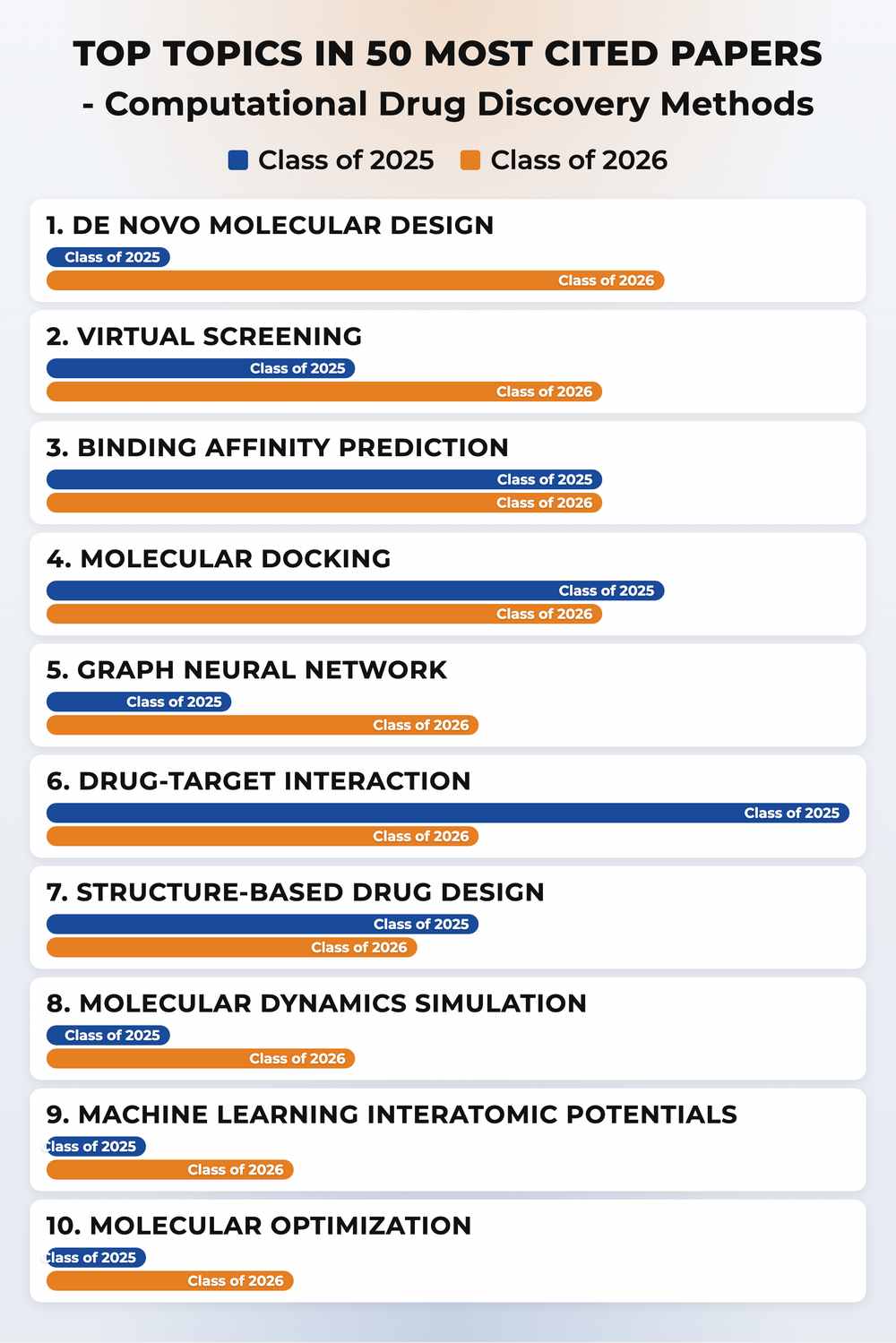
Comparing the Class of 2025 to the Class of 2026 reveals a decisive structural shift from single-target hit identification toward end-to-end generative design. The most dramatic surge occurred in de novo molecular design, which expanded fivefold from 4% of papers in 2023 to 20% in 2024. Next-generation deep learning architectures experienced rapid adoption: graph neural networks grew 2.33-fold (6% to 14%), while 3D equivariant diffusion models and machine learning interatomic potentials emerged as new frontline methodologies, appearing in 8% of ranked publications. Predictive biophysics and safety profiling also recorded significant gains. Molecular dynamics simulations grew 2.5-fold (4% to 10%), while comprehensive ADMET evaluations and conformational sampling quadrupled (2% to 8%). In contrast, legacy methodologies such as standalone drug-target interaction modeling dropped from 26% to 14%, and basic hit identification declined from 10% to 4%. This shift indicates that the field is moving away from isolated binding predictions toward unified AI architectures that simultaneously optimize target binding affinity, synthetic accessibility, and pharmacokinetic profiles in a single computational workflow.
Methodology
PRI identifies high-impact research using a transparent, topic-agnostic framework applied consistently across scientific domains. Bibliographic records are drawn from OpenAlex, including publication dates, citation relationships, and document types.
This ranking covers the Class of 2026 cohort: journal articles published in 2024. Reviews and other non-article document types are excluded to ensure comparability.
Research impact is quantified with an 18-month post-publication citation window—the number of citing works published within 18 months of each paper's publication date. This metric captures early impact while controlling for publication age.
An LLM-based relevance classifier then reviews each candidate's title and abstract to confirm substantive alignment with the target domain. Only papers classified as relevant appear in the final ranking.
Zheng Su, Tinsley Li, Thematic Shifts in Early-High-Impact Cancer Genomics and Diagnostics Research: A Bibliometric and Semantic Analysis. bioRxiv 2026.07.04.736459; doi: https://doi.org/10.64898/2026.07.04.736459
Cite this ranking
Pepkio Research Index (PRI). Topics and Trends in Most Cited Computational Drug Discovery Methods Papers, Class of 2026. https://pri.pepkio.com/top-papers/computational-drug-discovery-methods/2026. Accessed 2026-10-16.

Methodology
Zheng Su, Tinsley Li, Thematic Shifts in Early-High-Impact Cancer Genomics and Diagnostics Research: A Bibliometric and Semantic Analysis. bioRxiv 2026.07.04.736459; doi: https://doi.org/10.64898/2026.07.04.736459
Source data
The full ranking corpus and analysis files are openly available on an external repository. Please cite the dataset below when reusing this data.
View source dataset →Pepkio Research Index (2026). Computational Drug Discovery Methods — Top Papers (Class of 2026) [Data set]. Figshare.