
What topics and trends defined most-cited Enzyme Production and Characterization research in the Class of 2026?
Lignocellulosic biomass, agricultural residues, and rational enzyme design define the Class of 2026 enzyme production cohort. Cellulase discovery, cellulose-degrading bacteria, and alkaline pretreatment rose sharply from the Class of 2025, reflecting accelerated research into sustainable biocatalysis, computational protein engineering, and lignocellulosic biorefining.
At a glance
- Field
- Enzyme Production and Characterization
- Cohort label
- Class of 2026 (2024 publications)
- Papers analyzed
- 4,359
- Papers ranked
- 20
- Top topics in ranked papers
- Lignocellulosic biomass, Agricultural residues, Cellulase, Biorefinery, Rational design
- Publication window
- Jan 1, 2024 – Dec 31, 2024
- Eligibility
- Research articles; reviews excluded
- Citation window
- 18 months post-publication
- 18m citation range
- 21–128
- Data source
- OpenAlex · Retrieved Jul 2026
- License
- CC BY 4.0
Rankings
20 papers ranked by 18-month citation count
Global marine microbial diversity and its potential in bioprospecting
Nature202410.1038/s41586-024-07891-2
Engineering thermostability of industrial enzymes for enhanced application performance
International Journal of Biological Macromolecules202410.1016/j.ijbiomac.2024.139067
A bifunctional endolytic alginate lyase with two different lyase catalytic domains from Vibrio sp. H204
Frontiers in Microbiology202410.3389/fmicb.2024.1509599
Inhibition of α-amylase digestion by a Lonicera caerulea berry polyphenol starch complex revealed via multi-spectroscopic and molecular dynamics analyses
International Journal of Biological Macromolecules202410.1016/j.ijbiomac.2024.129573
Evolution-guided engineering of <i>trans</i> -acyltransferase polyketide synthases
Science202410.1126/science.adj7621
Comparative genomic analysis of Planctomycetota potential for polysaccharide degradation identifies biotechnologically relevant microbes
BMC Genomics202410.1186/s12864-024-10413-z
Genome-wide analysis of wheat xyloglucan endotransglucosylase/hydrolase (XTH) gene family revealed TaXTH17 involved in abiotic stress responses
BMC Plant Biology202410.1186/s12870-024-05370-4
Green immobilization: Enhancing enzyme stability and reusability on eco-friendly support
Food Chemistry202410.1016/j.foodchem.2024.138978
Coupling protein scaffold and biosilicification: A sustainable and recyclable approach for d-mannitol production via one-step purification and immobilization of multienzymes
International Journal of Biological Macromolecules202410.1016/j.ijbiomac.2024.132196
Physiochemical characterization and ameliorative effect of rice resistant starch modified by heat-stable α-amylase and glucoamylase on the gut microbial community in T2DM mice
Food & Function202410.1039/d3fo05456j
De novo 2′-fucosyllactose biosynthesis using glucose as the sole carbon source by multiple engineered Bacillus subtilis
Metabolic Engineering202410.1016/j.ymben.2024.12.004
Cellulase production under solid-state fermentation by Aspergillus sp. IN5: Parameter optimization and application
Heliyon202410.1016/j.heliyon.2024.e26601
Optimizing the Conditions of Pretreatment and Enzymatic Hydrolysis of Sugarcane Bagasse for Bioethanol Production
ACS Omega202410.1021/acsomega.4c02485
Unravelling the potential of sugarcane bagasse: An eco-friendly and inexpensive agro-industrial waste for the production of valuable products using pretreatment processes for sustainable bio-economy
Journal of environmental chemical engineering202410.1016/j.jece.2024.114461
Fabrication of mung bean protein-sugar beet pectin hydrogels by duo-induction of heating and laccase: Gelling properties and delivery of riboflavin
Food Hydrocolloids202410.1016/j.foodhyd.2024.110690
In-depth recognition of mixed surfactants maintaining the enzymatic activity of cellulases through stabilization of their spatial structures
Bioresource Technology202410.1016/j.biortech.2024.131756
Structural insights into the catalytic selectivity of glycosyltransferase SgUGT94-289-3 towards mogrosides
Nature Communications202410.1038/s41467-024-50662-w
Thermophilic biocatalysts for one-step conversion of citrus waste into lactic acid
Applied Microbiology and Biotechnology202410.1007/s00253-023-12904-7
Comparative genomic analysis of thermophilic fungi reveals convergent evolutionary adaptations and gene losses
Communications Biology202410.1038/s42003-024-06681-w
New insights into adlay seed bran polysaccharides: Effects of enzyme-assisted Aspergillus niger solid-state fermentation on its structural features, simulated gastrointestinal digestion, and prebiotic activity
International Journal of Biological Macromolecules202410.1016/j.ijbiomac.2024.138101
Topic trends
Dominant research themes and year-over-year shifts in Enzyme Production and Characterization
What Topics Define the Class of 2026?
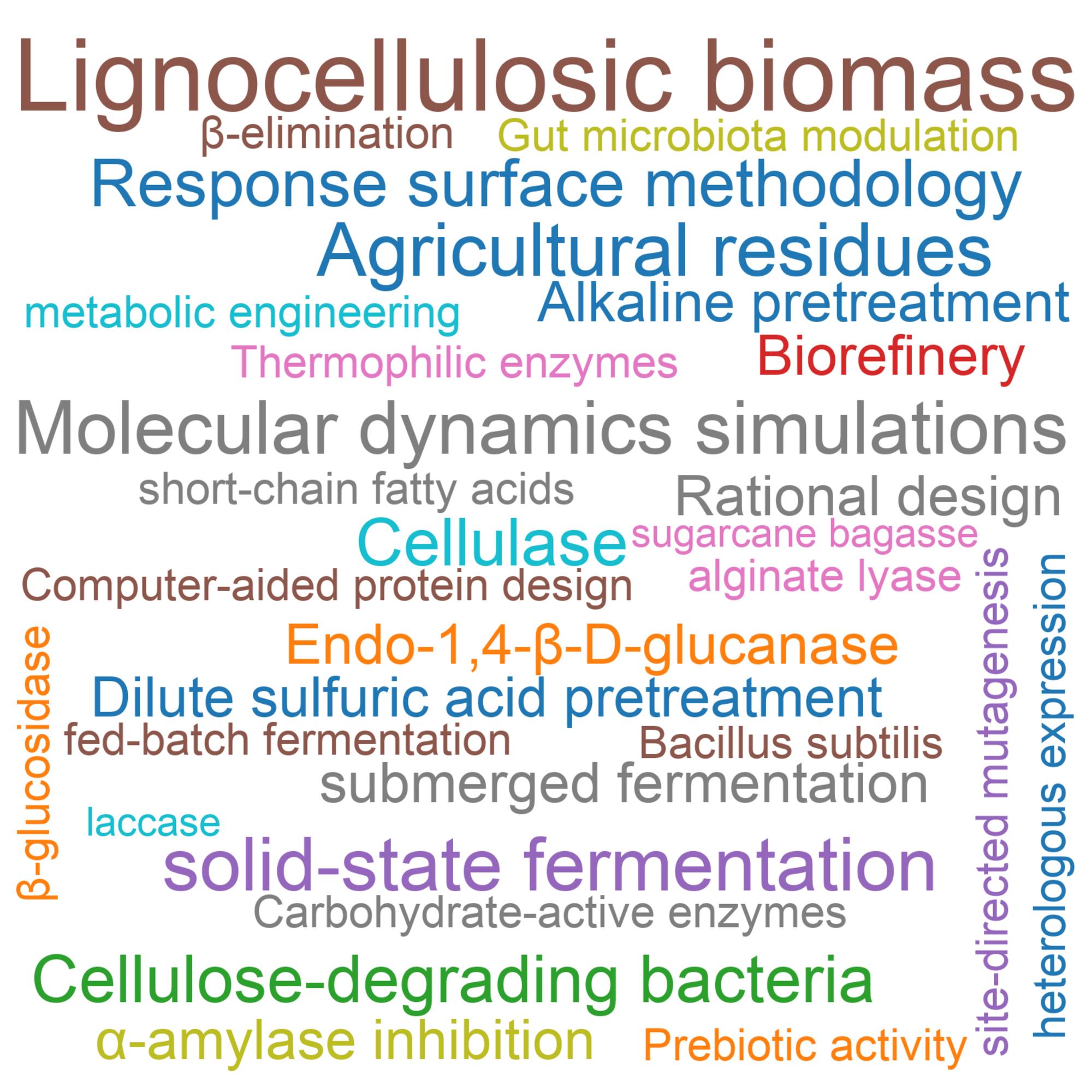
The informative word cloud across the top-cited enzyme production and characterization papers reveals a research landscape centered on biomass valorization, computational protein design, and bioprocess optimization. Lignocellulosic biomass leads at 6 of 50 top papers (normalized frequency 0.12), closely followed by agricultural residues (5 papers, 0.10), illustrating a strong field-wide focus on converting renewable plant waste into valuable biochemicals. Computational and structural approaches are prominent, with molecular dynamics simulations appearing in 5 papers (0.10) and rational design in 3 papers (0.06) to enhance enzyme thermostability and catalytic efficiency. Bioprocess engineering is heavily represented through solid-state fermentation (5 papers, 0.10) and submerged fermentation (3 papers, 0.06), frequently paired with response surface methodology (4 papers, 0.08) for yield optimization. Specific enzymatic systems anchor the corpus, including cellulases (4 papers, 0.08), cellulose-degrading bacteria (4 papers, 0.08), and endo-1,4-β-D-glucanase (3 papers, 0.06). In addition, chemical pretreatments such as alkaline pretreatment (3 papers, 0.06) and dilute sulfuric acid pretreatment (3 papers, 0.06) highlight integrated biorefinery pipelines aimed at overcoming biomass recalcitrance for industrial enzyme applications.
How Did Topics Shift from the Class of 2025 to the Class of 2026?
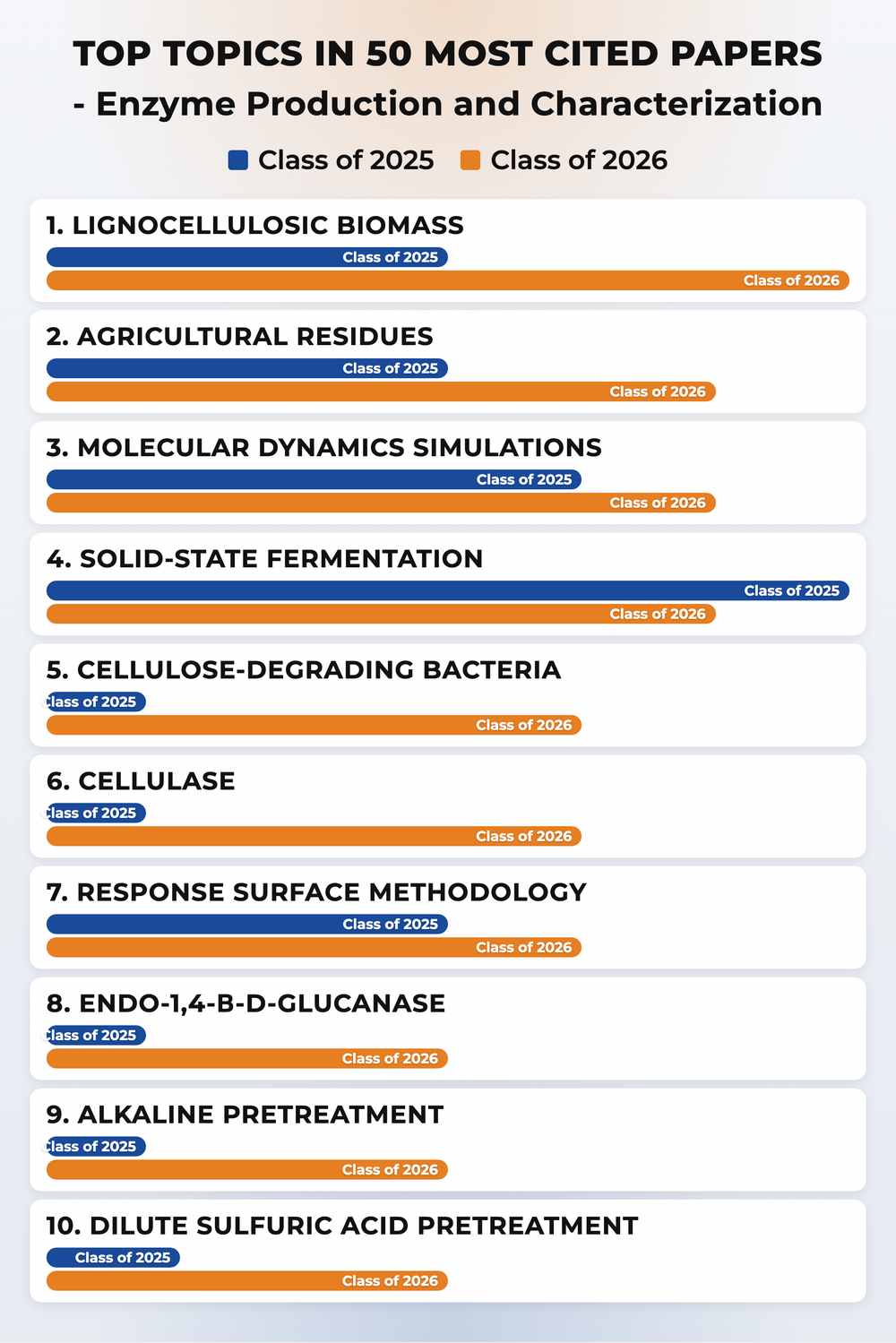
Comparing normalized concept frequencies between the Class of 2025 (2023 publications) and Class of 2026 (2024 publications) reveals significant thematic shifts toward enzymatic biomass conversion and computer-aided enzyme engineering. Cellulase exhibited the largest gain (+0.08 normalized frequency; 0 versus 4 papers), tied with cellulose-degrading bacteria (+0.08; 0 versus 4 papers), underscoring a rapid expansion in functional cellulolytic microbial screening. Lignocellulosic biomass saw substantial growth (+0.06; 3 versus 6 papers), alongside chemical pretreatment strategies including alkaline pretreatment (+0.06; 0 versus 3 papers) and dilute sulfuric acid pretreatment (+0.04; 1 versus 3 papers). Specific catalytic enzymes also gained traction, led by endo-1,4-β-D-glucanase (+0.06; 0 versus 3 papers). Emerging methodologies including computer-aided protein design (+0.04), Bacillus subtilis host expression (+0.04), and gut microbiota modulation (+0.04) entered the top-cited tier. Conversely, solid-state fermentation experienced a slight relative decline (−0.02; 6 versus 5 papers), though it remains a top process method overall. Core analytical baselines such as 16S rRNA gene sequencing and carbohydrate-active enzymes held steady, reflecting an evolving focus from descriptive microbial profiling toward targeted enzymatic engineering.
Methodology
PRI identifies high-impact research using a transparent, topic-agnostic framework applied consistently across scientific domains. Bibliographic records are drawn from OpenAlex, including publication dates, citation relationships, and document types.
This ranking covers the Class of 2026 cohort: journal articles published in 2024. Reviews and other non-article document types are excluded to ensure comparability.
Research impact is quantified with an 18-month post-publication citation window—the number of citing works published within 18 months of each paper's publication date. This metric captures early impact while controlling for publication age.
An LLM-based relevance classifier then reviews each candidate's title and abstract to confirm substantive alignment with the target domain. Only papers classified as relevant appear in the final ranking.
Zheng Su, Tinsley Li, Thematic Shifts in Early-High-Impact Cancer Genomics and Diagnostics Research: A Bibliometric and Semantic Analysis. bioRxiv 2026.07.04.736459; doi: https://doi.org/10.64898/2026.07.04.736459
Cite this ranking
Pepkio Research Index (PRI). Topics and Trends in Most Cited Enzyme Production and Characterization Papers, Class of 2026. https://pri.pepkio.com/top-papers/enzyme-production-and-characterization/2026. Accessed 2026-10-21.

Methodology
Zheng Su, Tinsley Li, Thematic Shifts in Early-High-Impact Cancer Genomics and Diagnostics Research: A Bibliometric and Semantic Analysis. bioRxiv 2026.07.04.736459; doi: https://doi.org/10.64898/2026.07.04.736459