
What topics and trends defined most-cited Advanced biosensing and bioanalysis techniques research in the Class of 2026?
The Class of 2026 in advanced biosensing is driven by point-of-care testing, dual-mode detection, and MXene nanomaterials. Surface plasmon resonance and refractive index sensing surged alongside nanopore sequencing, while traditional gold nanoparticle assays declined as research shifted toward multi-modal diagnostics and clinical biomarker profiling.
At a glance
- Field
- Advanced biosensing and bioanalysis techniques
- Cohort label
- Class of 2026 (2024 publications)
- Papers analyzed
- 19,051
- Papers ranked
- 20
- Top topics in ranked papers
- Point-of-care testing, electrochemical sensors, dual-mode detection, SPR sensing, MXene
- Publication window
- Jan 1, 2024 – Dec 31, 2024
- Eligibility
- Research articles; reviews excluded
- Citation window
- 18 months post-publication
- 18m citation range
- 77–160
- Data source
- OpenAlex · Retrieved Jul 2026
- License
- CC BY 4.0
Rankings
20 papers ranked by 18-month citation count
Bimetallic Single-Atom Nanozyme-Based Electrochemical-Photothermal Dual-Function Portable Immunoassay with Smartphone Imaging
Analytical Chemistry202410.1021/acs.analchem.4c02606
Design of Surface Plasmon Resonance (SPR) Sensors for Highly Sensitive Biomolecular Detection in Cancer Diagnostics
Plasmonics202410.1007/s11468-024-02343-z
Pt/Zn-TCPP Nanozyme-Based Flexible Immunoassay for Dual-Mode Pressure–Temperature Monitoring of Low-Abundance Proteins
Analytical Chemistry202410.1021/acs.analchem.4c01059
Peptide-Functionalized Lipid Nanoparticles for Targeted Systemic mRNA Delivery to the Brain
Nano Letters202410.1021/acs.nanolett.4c05186
Multi-pass, single-molecule nanopore reading of long protein strands
Nature202410.1038/s41586-024-07935-7
A self‐powered photoelectrochemical aptasensor using 3D‐carbon nitride and carbon‐based metal‐organic frameworks for high‐sensitivity detection of tetracycline in milk and water
Journal of Food Science202410.1111/1750-3841.17398
Self-designed portable dual-mode fluorescence device with custom python-based analysis software for rapid detection via dual-color FRET aptasensor with IoT capabilities
Food Chemistry202410.1016/j.foodchem.2024.140190
Ultrasensitive DNA Origami Plasmon Sensor for Accurate Detection in Circulating Tumor DNAs
Laser & Photonics Review202410.1002/lpor.202400035
Lamellar Ti3C2 MXene composite decorated with platinum-doped MoS2 nanosheets as electrochemical sensing functional platform for highly sensitive analysis of organophosphorus pesticides
Food Chemistry202410.1016/j.foodchem.2024.140379
Tuning sensitivity of bimetallic, MXene and graphene-based SPR biosensors for rapid malaria detection: a numerical approach
Journal of Computational Electronics202410.1007/s10825-024-02191-4
Ti3C2 MXene-based nanozyme as coreaction accelerator for enhancing electrochemiluminescence of glucose biosensing
Biosensors and Bioelectronics202410.1016/j.bios.2024.116078
Zr‐MOF Carrier‐Enhanced Dual‐Mode Biosensing Platforms for Rapid and Sensitive Diagnosis of Mpox
Advanced Science202410.1002/advs.202405848
A bioswitchable delivery system for microRNA therapeutics based on a tetrahedral DNA nanostructure
Nature Protocols202410.1038/s41596-024-01050-7
Regulating Reactive Oxygen Species over M–N–C Single-Atom Catalysts for Potential-Resolved Electrochemiluminescence
Journal of the American Chemical Society202410.1021/jacs.4c02986
A Mo2C/CoO@N/CNFs electrochemiluminescence sensor was prepared based on the electrospinning method for rapid detection of azithromycin
Microchemical Journal202410.1016/j.microc.2024.111241
Multifunctional methyl orange-delaminated Ti3C2 MXene for non-enzymatic/metal-free electrochemical detection of hydrogen peroxide and hydrazine
Microchemical Journal202410.1016/j.microc.2024.111382
Plasmonic trimers designed as SERS-active chemical traps for subtyping of lung tumors
Nature Communications202410.1038/s41467-024-50321-0
Gold nanoparticles in microelectronics advancements and biomedical applications
Materials Science and Engineering B202410.1016/j.mseb.2024.117191
Preparation of dual recognition adsorbents based on molecularly imprinted polymers and aptamer for highly sensitive recognition and enrichment of ochratoxin A
Journal of Hazardous Materials202410.1016/j.jhazmat.2024.135112
Hybrid Plasmonic Biosensors with Deep Learning for Colorectal Cancer Detection
Plasmonics202410.1007/s11468-024-02568-y
Topic trends
Dominant research themes and year-over-year shifts in Advanced biosensing and bioanalysis techniques
What Topics Define the Class of 2026?
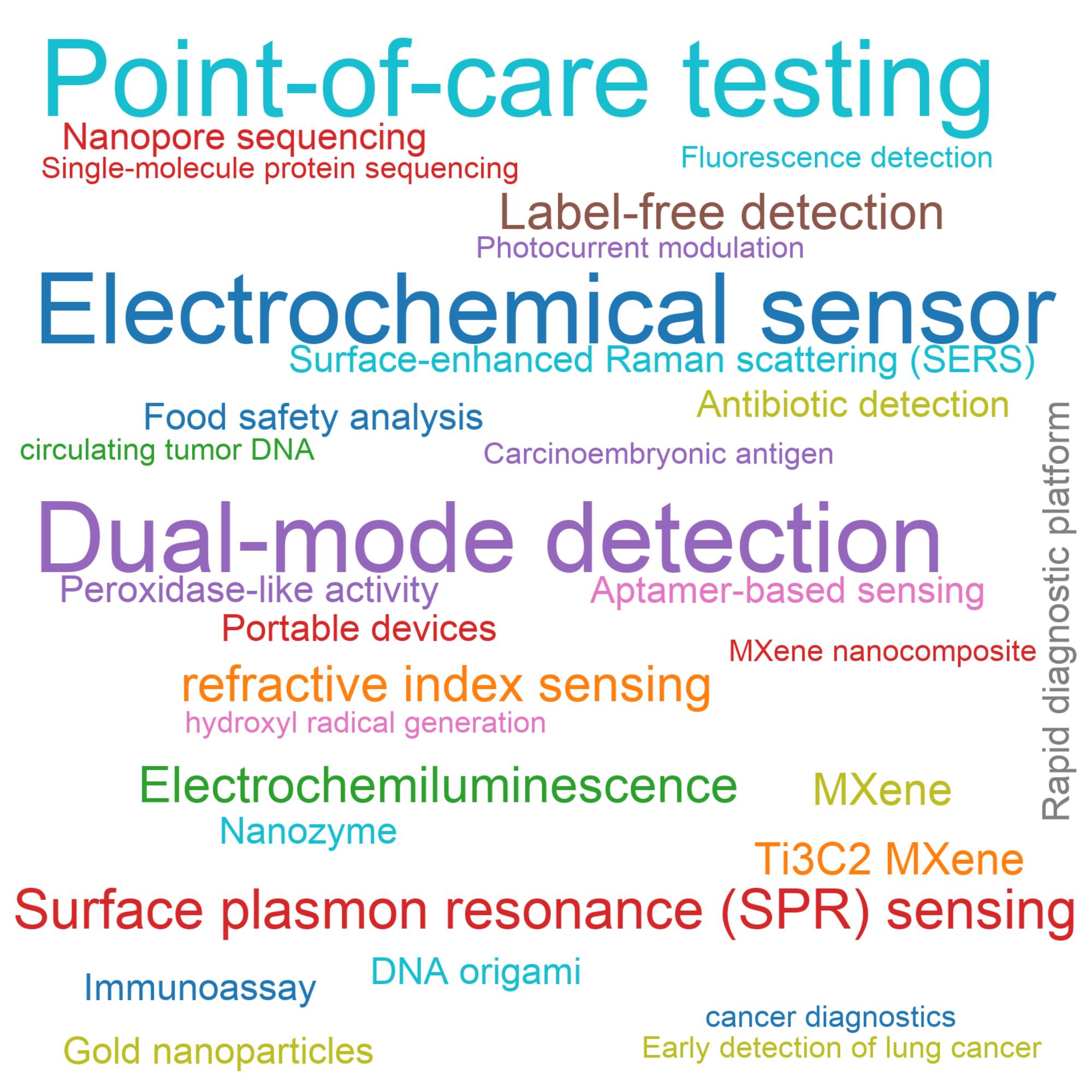
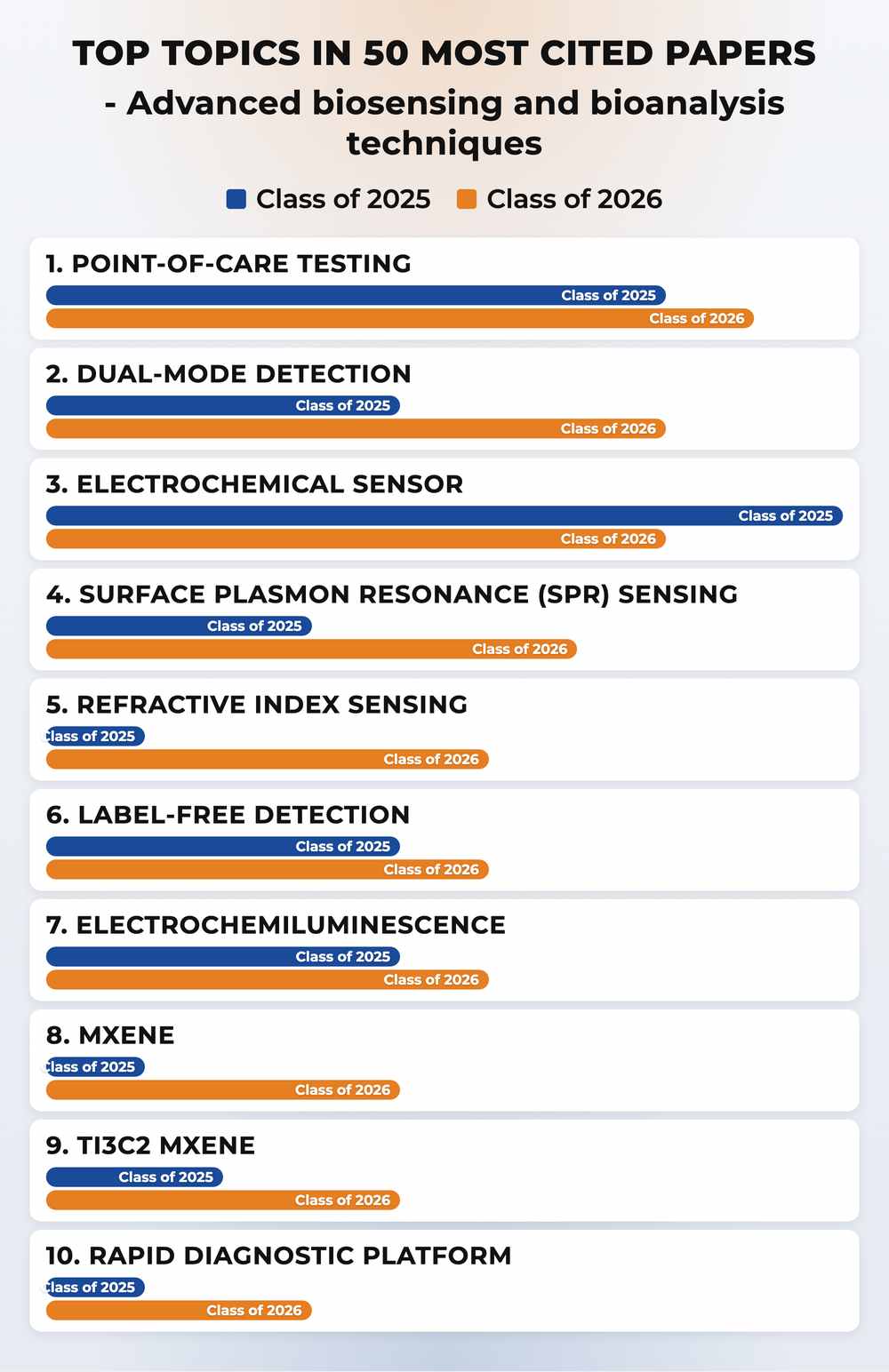
The Class of 2026 in advanced biosensing and bioanalysis is anchored by clinical translation, optical-electrochemical synergy, and nanomaterial innovation. Point-of-care testing leads the cohort, appearing in 16.0% of top-ranked publications as researchers prioritize decentralized, rapid diagnostic platforms for immediate clinical and field applications. Electrochemical sensors (14.0%) and surface plasmon resonance (SPR) sensing (12.0%) serve as primary transduction modalities, providing ultra-sensitive, label-free quantitative monitoring of target analytes. A key hallmark of this cohort is the rapid adoption of dual-mode detection platforms (14.0%), which integrate complementary signal channels—such as electrochemical-photothermal or optical-fluorescent readouts—to cross-verify diagnostic signals and drastically reduce false positives. Furthermore, advanced 2D nanomaterials, particularly Ti3C2 MXene and MXene nanocomposites (8.0%), have emerged as essential electrode modifiers due to their superior metallic conductivity, hydrophilic surfaces, and high catalytic active sites. Coupled with electrochemiluminescence and nanopore sequencing platforms (6.0%), these bioanalysis techniques collectively emphasize portable, highly specific, and multi-analyte biosensors capable of robust performance in complex biological matrices.
How Did Topics Shift from the Class of 2025 to the Class of 2026?
The transition from the Class of 2025 to the Class of 2026 reveals a significant evolution from traditional single-modality assays toward multi-modal transduction and next-generation nanomaterials. Emerging optical and physical detection techniques experienced the sharpest surge: refractive index sensing and nanopore sequencing entered the top tier from near-zero baseline mentions in 2023, reflecting growing interest in single-molecule resolution and real-time physical bio-interfacing. Surface plasmon resonance (SPR) sensing doubled its presence (fold change 2.0x), while dual-mode detection rose by 75%, reflecting a field-wide movement toward orthogonal validation mechanisms. Material choices also underwent a decisive shift: Ti3C2 MXene and MXene derivatives expanded 4-fold as functional electrocatalytic scaffolds. Conversely, classic signal amplifiers saw reduced dominance; gold nanoparticles experienced a sharp contraction from 10 mentions (20.0%) down to 3 mentions (6.0%), as researchers transitioned toward enzyme-mimicking nanozymes and engineered 2D nanocomposites. Furthermore, target applications shifted away from routine food safety analysis (dropping 40%) toward high-value clinical biomarker profiling and rapid point-of-care diagnostic platforms.
Methodology
PRI identifies high-impact research using a transparent, topic-agnostic framework applied consistently across scientific domains. Bibliographic records are drawn from OpenAlex, including publication dates, citation relationships, and document types.
This ranking covers the Class of 2026 cohort: journal articles published in 2024. Reviews and other non-article document types are excluded to ensure comparability.
Research impact is quantified with an 18-month post-publication citation window—the number of citing works published within 18 months of each paper's publication date. This metric captures early impact while controlling for publication age.
An LLM-based relevance classifier then reviews each candidate's title and abstract to confirm substantive alignment with the target domain. Only papers classified as relevant appear in the final ranking.
Zheng Su, Tinsley Li, Thematic Shifts in Early-High-Impact Cancer Genomics and Diagnostics Research: A Bibliometric and Semantic Analysis. bioRxiv 2026.07.04.736459; doi: https://doi.org/10.64898/2026.07.04.736459
Cite this ranking
Pepkio Research Index (PRI). Topics and Trends in Most Cited Advanced biosensing and bioanalysis techniques Papers, Class of 2026. https://pri.pepkio.com/top-papers/advanced-biosensing-and-bioanalysis-techniques/2026. Accessed 2026-10-16.

Methodology
Zheng Su, Tinsley Li, Thematic Shifts in Early-High-Impact Cancer Genomics and Diagnostics Research: A Bibliometric and Semantic Analysis. bioRxiv 2026.07.04.736459; doi: https://doi.org/10.64898/2026.07.04.736459