
What topics and trends defined most-cited Marine animal studies overview research in the Class of 2026?
Marine animal research in 2024 was heavily defined by the rapid surge of Highly Pathogenic Avian Influenza H5N1 outbreaks in marine mammals, ocean warming events in the Great Barrier Reef, and mass mortality incidents, alongside expanding use of passive acoustic monitoring and species distribution modeling for marine mammal conservation.
At a glance
- Field
- Marine animal studies overview
- Cohort label
- Class of 2026 (2024 publications)
- Papers analyzed
- 4,254
- Papers ranked
- 20
- Top topics in ranked papers
- Avian Influenza H5N1, sea surface temperature, passive acoustic monitoring, Great Barrier Reef, mass mortality events
- Publication window
- Jan 1, 2024 – Dec 31, 2024
- Eligibility
- Research articles; reviews excluded
- Citation window
- 18 months post-publication
- 18m citation range
- 19–112
- Data source
- OpenAlex · Retrieved Jul 2026
- License
- CC BY 4.0
Rankings
20 papers ranked by 18-month citation count
Epidemiological data of an influenza A/H5N1 outbreak in elephant seals in Argentina indicates mammal-to-mammal transmission
Nature Communications202410.1038/s41467-024-53766-5
Highest ocean heat in four centuries places Great Barrier Reef in danger
Nature202410.1038/s41586-024-07672-x
Pacific and Atlantic sea lion mortality caused by highly pathogenic Avian Influenza A(H5N1) in South America
Travel Medicine and Infectious Disease202410.1016/j.tmaid.2024.102712
Ship collision risk threatens whales across the world’s oceans
Science202410.1126/science.adp1950
Contextual and combinatorial structure in sperm whale vocalisations
Nature Communications202410.1038/s41467-024-47221-8
Evolutionary novelties underlie sound production in baleen whales
Nature202410.1038/s41586-024-07080-1
Catastrophic and persistent loss of common murres after a marine heatwave
Science202410.1126/science.adq4330
Bellwethers of change: population modelling of North Pacific humpback whales from 2002 through 2021 reveals shift from recovery to climate response
Royal Society Open Science202410.1098/rsos.231462
Revised taxonomy of eastern North Pacific killer whales ( <i>Orcinus orca</i> ): Bigg’s and resident ecotypes deserve species status
Royal Society Open Science202410.1098/rsos.231368
Seasonal dynamics and diversity of Antarctic marine viruses reveal a novel viral seascape
Nature Communications202410.1038/s41467-024-53317-y
The evolution of menopause in toothed whales
Nature202410.1038/s41586-024-07159-9
Changing dynamics of Great Barrier Reef hard coral cover in the Anthropocene
Coral Reefs202410.1007/s00338-024-02498-5
Heat tolerance varies considerably within a reef-building coral species on the Great Barrier Reef
Communications Earth & Environment202410.1038/s43247-024-01649-4
Genomic and fitness consequences of a near-extinction event in the northern elephant seal
Nature Ecology & Evolution202410.1038/s41559-024-02533-2
The Acoustic Index User's Guide: A practical manual for defining, generating and understanding current and future acoustic indices
Methods in Ecology and Evolution202410.1111/2041-210x.14357
Seabird bycatch in European waters
Animal Conservation202410.1111/acv.12948
Polar bear energetic and behavioral strategies on land with implications for surviving the ice-free period
Nature Communications202410.1038/s41467-023-44682-1
Collective sensing in electric fish
Nature202410.1038/s41586-024-07157-x
Mortality in sea lions is associated with the introduction of the H5N1 clade 2.3.4.4b virus in Brazil October 2023: whole genome sequencing and phylogenetic analysis
BMC Veterinary Research202410.1186/s12917-024-04137-1
Advances in remote sensing of emperor penguins: first multi-year time series documenting trends in the global population
Proceedings of the Royal Society B Biological Sciences202410.1098/rspb.2023.2067
Topic trends
Dominant research themes and year-over-year shifts in Marine animal studies overview
What Topics Define the Class of 2026?
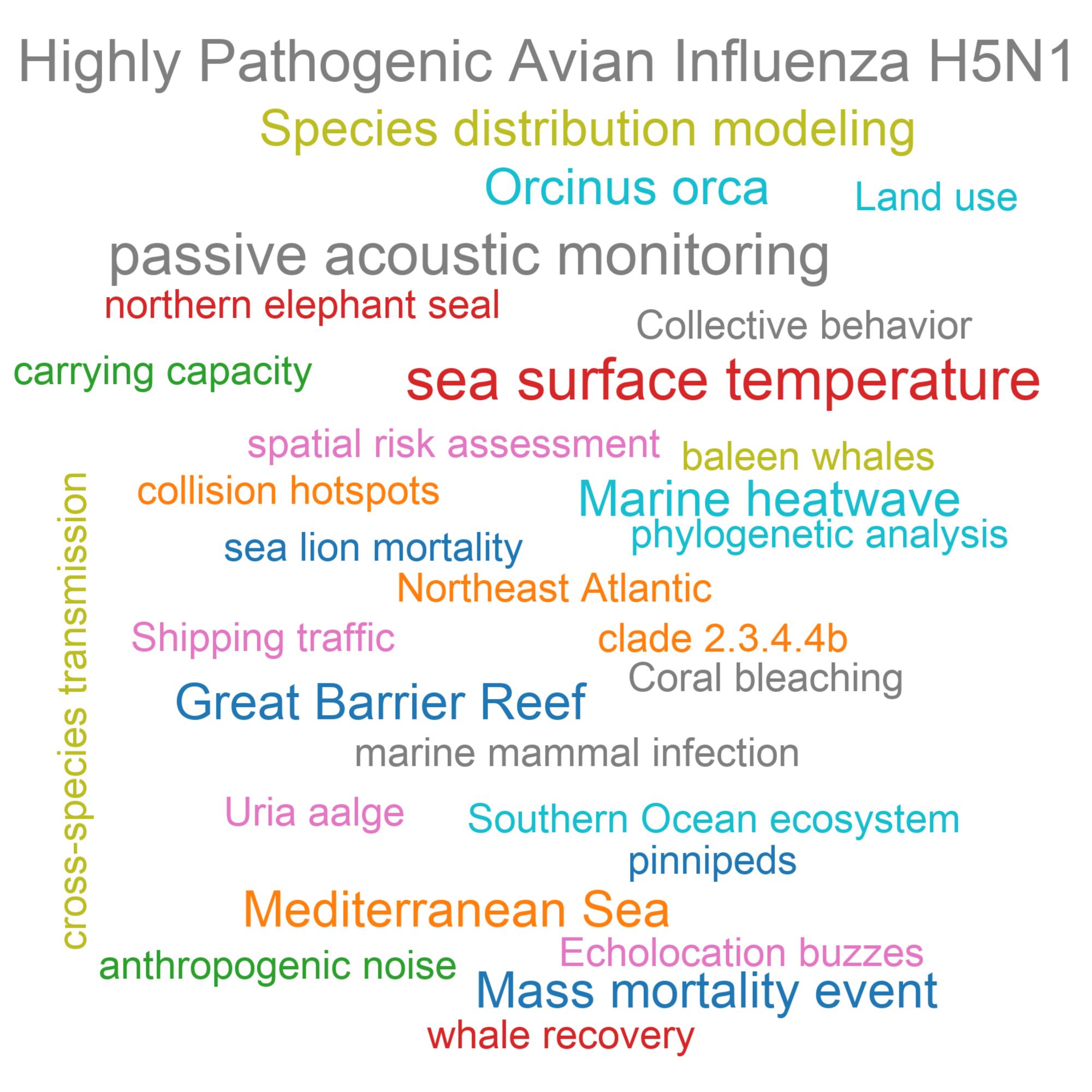
The Class of 2026 in marine animal studies is anchored by urgent wildlife epidemiology, ocean climate extremes, and high-resolution ecological monitoring. Leading the cohort are studies investigating Highly Pathogenic Avian Influenza H5N1 (8% normalized frequency), driven by unprecedented multi-species outbreaks and cross-species transmission into marine mammal populations such as southern elephant seals and South American sea lions. Concurrently, environmental stressors dominate research focus, with sea surface temperature anomalies (8%), marine heatwaves (6%), and thermal impacts on the Great Barrier Reef (6%) associated with catastrophic ecological disturbances and mass mortality events (6%). To track these rapid population shifts and habitat degradation, researchers have increasingly deployed non-invasive monitoring technologies. Passive acoustic monitoring (8%) and species distribution modeling (6%) feature prominently alongside UAS photogrammetry, bioenergetic models, and line-transect sampling. Furthermore, conservation biology studies focus on anthropogenic noise, ship collision hotspots, and taxonomic re-evaluations of key marine mammal populations including Orcinus orca and North Atlantic right whales.
How Did Topics Shift from the Class of 2025 to the Class of 2026?
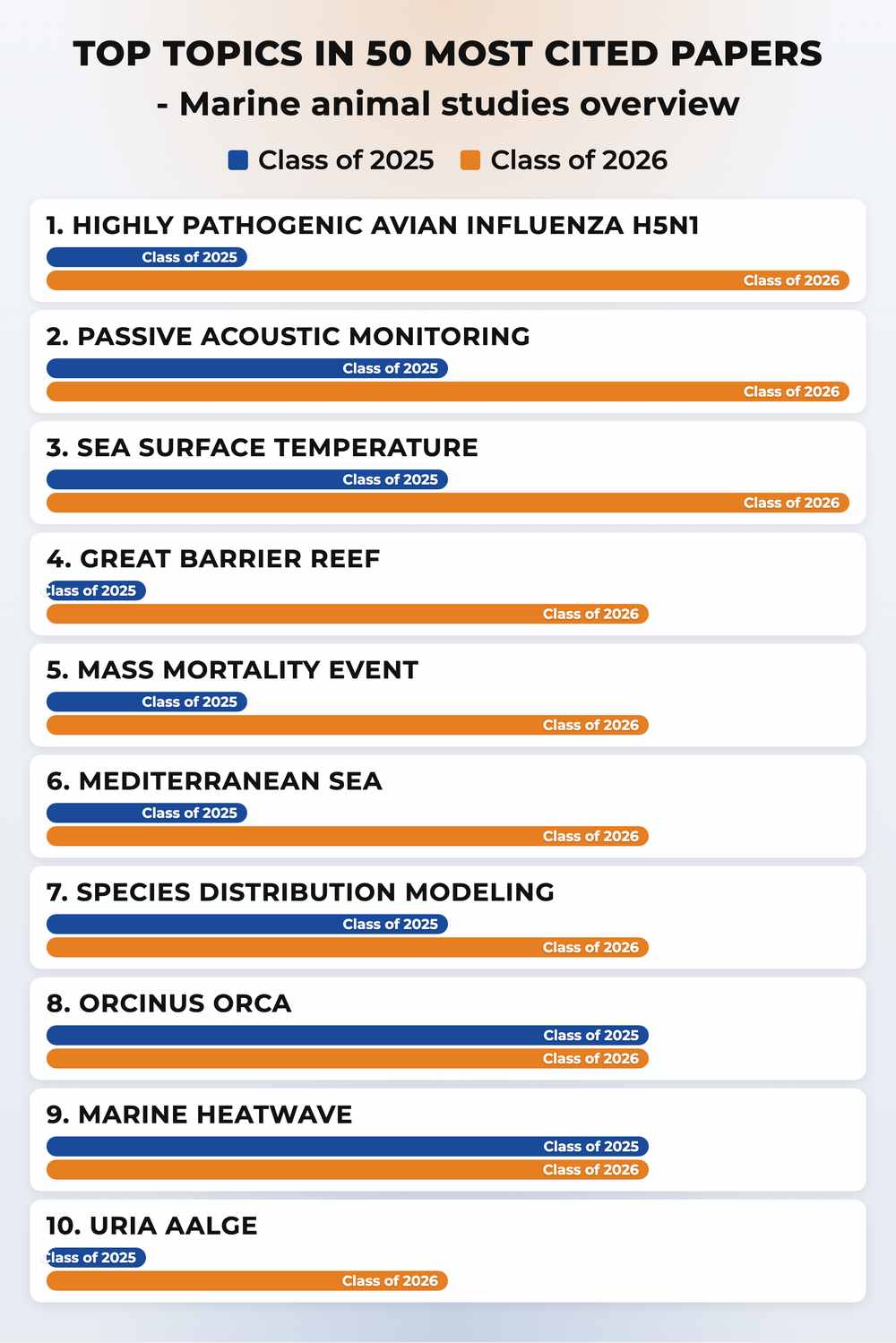
Topic trajectory analysis from the Class of 2025 to the Class of 2026 highlights a dramatic surge in viral disease dynamics and extreme ocean warming impacts. Highly Pathogenic Avian Influenza H5N1 underwent a four-fold expansion (rising from 2% in 2023 to 8% in 2024), driven by high-impact reports of mammal-to-mammal transmission and sea lion mass mortality across South America. Emerging focus areas with marked increases include the Great Barrier Reef (jumping to 6%), mass mortality events (increasing three-fold to 6%), and cross-species virus transmission. Technical methodologies also saw heightened adoption, with passive acoustic monitoring doubling to 8% and line-transect sampling, anthropogenic noise assessment, and bioenergetic modeling expanding significantly. In contrast, foundational marine ecology topics such as general marine heatwave characterization and Orcinus orca studies remained stable at 6%, while broad baleen whale surveys declined from 6% to 4% as research shifted toward targeted crisis response and disease surveillance.
Methodology
PRI identifies high-impact research using a transparent, topic-agnostic framework applied consistently across scientific domains. Bibliographic records are drawn from OpenAlex, including publication dates, citation relationships, and document types.
This ranking covers the Class of 2026 cohort: journal articles published in 2024. Reviews and other non-article document types are excluded to ensure comparability.
Research impact is quantified with an 18-month post-publication citation window—the number of citing works published within 18 months of each paper's publication date. This metric captures early impact while controlling for publication age.
An LLM-based relevance classifier then reviews each candidate's title and abstract to confirm substantive alignment with the target domain. Only papers classified as relevant appear in the final ranking.
Zheng Su, Tinsley Li, Thematic Shifts in Early-High-Impact Cancer Genomics and Diagnostics Research: A Bibliometric and Semantic Analysis. bioRxiv 2026.07.04.736459; doi: https://doi.org/10.64898/2026.07.04.736459
Cite this ranking
Pepkio Research Index (PRI). Topics and Trends in Most Cited Marine animal studies overview Papers, Class of 2026. https://pri.pepkio.com/top-papers/marine-animal-studies-overview/2026. Accessed 2026-10-24.

Methodology
Zheng Su, Tinsley Li, Thematic Shifts in Early-High-Impact Cancer Genomics and Diagnostics Research: A Bibliometric and Semantic Analysis. bioRxiv 2026.07.04.736459; doi: https://doi.org/10.64898/2026.07.04.736459