
What topics and trends defined most-cited Amphibian and Reptile Biology research in the Class of 2026?
Amphibian and reptile biology in the Class of 2026 is anchored by conservation planning, IUCN Red List assessments, and mitochondrial DNA studies. Research shifted significantly toward fungal pathogen dynamics, particularly Batrachochytrium dendrobatidis and invasive species threats, while traditional species distribution modelling experienced a sharp decline compared to the previous cohort.
At a glance
- Field
- Amphibian and Reptile Biology
- Cohort label
- Class of 2026 (2024 publications)
- Papers analyzed
- 3,901
- Papers ranked
- 20
- Top topics in ranked papers
- Conservation planning, mitochondrial DNA, IUCN Red List, fungal pathogens, divergence time estimation
- Publication window
- Jan 1, 2024 – Dec 31, 2024
- Eligibility
- Research articles; reviews excluded
- Citation window
- 18 months post-publication
- 18m citation range
- 14–57
- Data source
- OpenAlex · Retrieved Jul 2026
- License
- CC BY 4.0
Rankings
20 papers ranked by 18-month citation count
The macroevolutionary singularity of snakes
Science202410.1126/science.adh2449
<scp>SquamBase</scp>—A database of squamate (Reptilia: Squamata) traits
Global Ecology and Biogeography202410.1111/geb.13812
Hotspot shelters stimulate frog resistance to chytridiomycosis
Nature202410.1038/s41586-024-07582-y
A phylogeny-informed characterisation of global tetrapod traits addresses data gaps and biases
PLoS Biology202410.1371/journal.pbio.3002658
A time-calibrated salamander phylogeny including 765 species and 503 genes
Molecular Phylogenetics and Evolution202410.1016/j.ympev.2024.108272
Hidden hotspots of amphibian biodiversity in China
Proceedings of the National Academy of Sciences202410.1073/pnas.2320674121
Phylogenomic insights into the diversity and evolution of Palearctic vipers
Molecular Phylogenetics and Evolution202410.1016/j.ympev.2024.108095
Piecing the barcoding puzzle of Palearctic water frogs (<i>Pelophylax</i>) sheds light on amphibian biogeography and global invasions
Global Change Biology202410.1111/gcb.17180
The genetic regulatory architecture and epigenomic basis for age-related changes in rattlesnake venom
Proceedings of the National Academy of Sciences202410.1073/pnas.2313440121
A pulse check for trends in sea turtle numbers across the globe
iScience202410.1016/j.isci.2024.109071
Building pondscapes for amphibian metapopulations
Conservation Biology202410.1111/cobi.14281
Climate change-related distributional range shifts of venomous snakes: a predictive modelling study of effects on public health and biodiversity
The Lancet Planetary Health202410.1016/s2542-5196(24)00005-6
Global conservation status of the jawed vertebrate Tree of Life
Nature Communications202410.1038/s41467-024-45119-z
Phenological mismatches mitigate the ecological impact of a biological invader on amphibian communities
Ecological Applications202410.1002/eap.3017
Diversity and Evolution of Frog Visual Opsins: Spectral Tuning and Adaptation to Distinct Light Environments
Molecular Biology and Evolution202410.1093/molbev/msae049
Convergent evolution toward a slow pace of life predisposes insular endotherms to anthropogenic extinctions
Science Advances202410.1126/sciadv.adm8240
Unnecessary splitting of genus-level clades reduces taxonomic stability in amphibians
Vertebrate Zoology202410.3897/vz.74.e114285
Evolutionary bursts drive morphological novelty in the world’s largest skinks
Current Biology202410.1016/j.cub.2024.07.039
An integrative taxonomic revision of the Trimeresurus popeiorum group of pitvipers (Reptilia: Serpentes: Viperidae) with descriptions of two new species from the Indo-Burma Biodiversity Hotspot
Vertebrate Zoology202410.3897/vz.74.e113347
Amphibians Exhibit Extremely High Hydric Costs of Respiration
Integrative and Comparative Biology202410.1093/icb/icae053
Topic trends
Dominant research themes and year-over-year shifts in Amphibian and Reptile Biology
What Topics Define the Class of 2026?
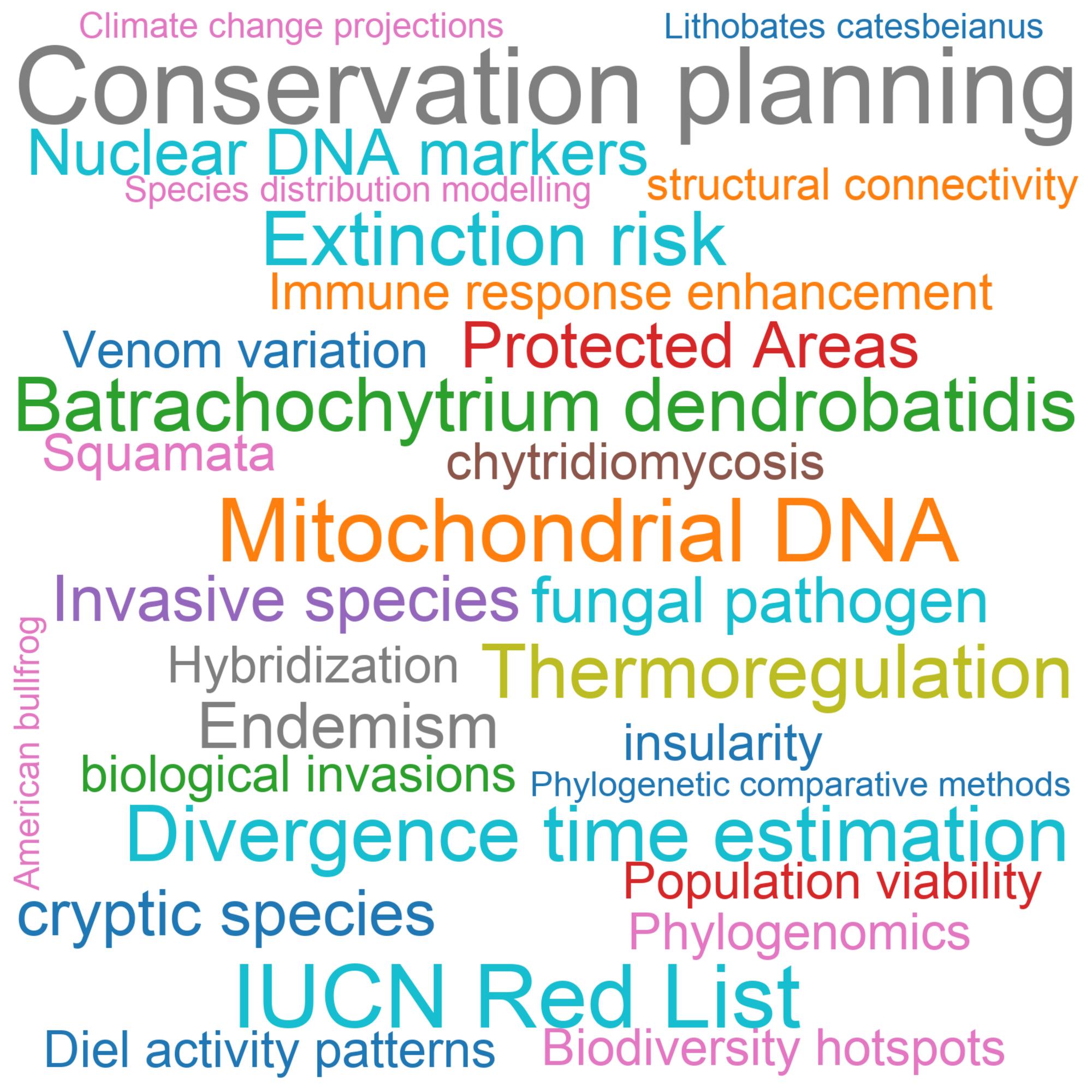
The Class of 2026 in amphibian and reptile biology reflects a field heavily concentrated on biodiversity preservation, molecular phylogenetics, and physiological adaptability. Conservation planning remains the single most prominent thematic anchor, featuring in 14% of highly cited publications, closely paired with formal IUCN Red List risk assessments (10%) and protected area design (6%). Molecular approaches continue to underpin herpetological taxonomy and evolutionary studies, with mitochondrial DNA markers appearing in 10% of top papers alongside nuclear DNA markers and divergence time estimation (8%). A major driver of recent high-impact literature is the ecology and mitigation of infectious diseases. The chytrid fungal pathogen Batrachochytrium dendrobatidis (Bd) and associated chytridiomycosis account for 8% of top studies, highlighting ongoing global efforts to monitor amphibian declines and bolster host immune responses. Meanwhile, organismal biology and eco-physiology retain significant attention, focused on thermoregulation (8%), thermal sensitivity, and diel activity patterns in response to environmental microclimates. Together, these clusters underscore an integrative research paradigm where molecular tools, disease monitoring, and physiological assessments directly inform habitat conservation and extinction risk management across global reptile and amphibian populations.
How Did Topics Shift from the Class of 2025 to the Class of 2026?
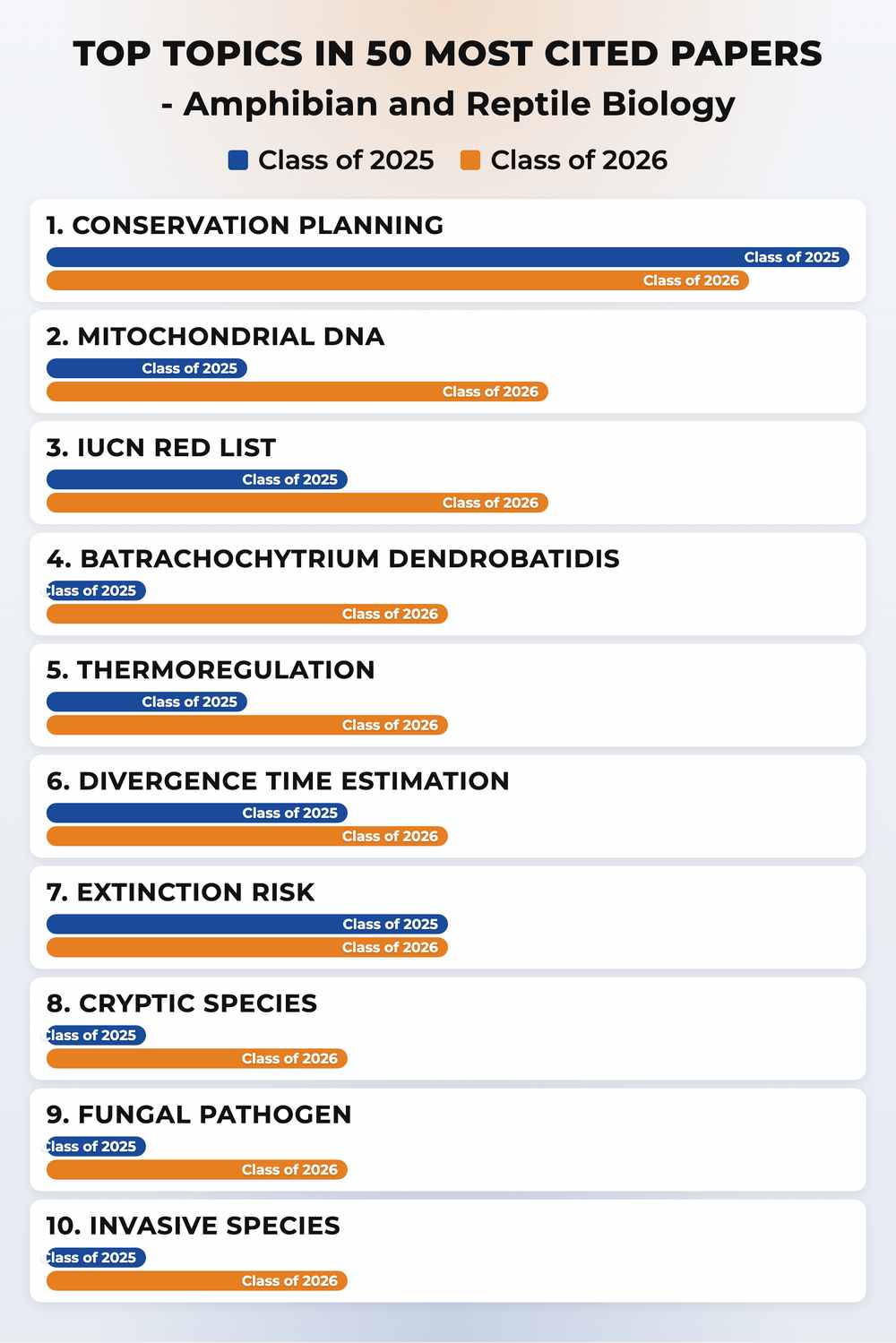
Comparing the Class of 2025 and Class of 2026 cohorts reveals clear shifts in herpetological research priorities. The most dramatic rise occurs in disease ecology and biological invasions. Batrachochytrium dendrobatidis (Bd) surged from unranked status in 2023 to 8% of top papers in 2024, accompanied by increased attention to host-microbiome interactions and invasive species like the American bullfrog (Lithobates catesbeianus). Similarly, mitochondrial DNA markers expanded 2.5-fold (from 4% to 10%), reflecting a resurgence in barcode-assisted species discovery and cryptic diversity mapping across vulnerable ecosystems. Conversely, standalone species distribution modelling suffered the sharpest contraction, dropping from 12% of top-cited publications in the 2025 cohort to just 4% in 2026. This decline suggests a transition away from macroecological habitat mapping toward mechanistic disease modeling, integrative taxonomy, and empirical thermal physiology. Broad phylogenomic surveys and climate change projections also experienced modest pullbacks as researchers shifted focus toward actionable conservation planning, protected area connectivity, and targeted threat intensity evaluations.
Methodology
PRI identifies high-impact research using a transparent, topic-agnostic framework applied consistently across scientific domains. Bibliographic records are drawn from OpenAlex, including publication dates, citation relationships, and document types.
This ranking covers the Class of 2026 cohort: journal articles published in 2024. Reviews and other non-article document types are excluded to ensure comparability.
Research impact is quantified with an 18-month post-publication citation window—the number of citing works published within 18 months of each paper's publication date. This metric captures early impact while controlling for publication age.
An LLM-based relevance classifier then reviews each candidate's title and abstract to confirm substantive alignment with the target domain. Only papers classified as relevant appear in the final ranking.
Zheng Su, Tinsley Li, Thematic Shifts in Early-High-Impact Cancer Genomics and Diagnostics Research: A Bibliometric and Semantic Analysis. bioRxiv 2026.07.04.736459; doi: https://doi.org/10.64898/2026.07.04.736459
Cite this ranking
Pepkio Research Index (PRI). Topics and Trends in Most Cited Amphibian and Reptile Biology Papers, Class of 2026. https://pri.pepkio.com/top-papers/amphibian-and-reptile-biology/2026. Accessed 2026-10-16.

Methodology
Zheng Su, Tinsley Li, Thematic Shifts in Early-High-Impact Cancer Genomics and Diagnostics Research: A Bibliometric and Semantic Analysis. bioRxiv 2026.07.04.736459; doi: https://doi.org/10.64898/2026.07.04.736459