
What topics and trends defined most-cited Genetic and phenotypic traits in livestock research in the Class of 2026?
The Class of 2026 is defined by a surge in high-resolution multi-omics and single-cell RNA sequencing, moving beyond traditional genomic selection. Research increasingly targets specific breeds like Hu and Tibetan sheep, emphasizing high-altitude adaptation and microbiome interactions to unravel complex phenotypic traits.
At a glance
- Field
- Genetic and phenotypic traits in livestock
- Cohort label
- Class of 2026 (2024 publications)
- Papers analyzed
- 7,294
- Papers ranked
- 20
- Top topics in ranked papers
- Whole-genome sequencing, GWAS, and multi-omics integration
- Publication window
- Jan 1, 2024 – Dec 31, 2024
- Eligibility
- Research articles; reviews excluded
- Citation window
- 18 months post-publication
- 18m citation range
- 18–118
- Data source
- OpenAlex · Retrieved July 2026
- License
- CC BY 4.0
Rankings
20 papers ranked by 18-month citation count
A compendium of genetic regulatory effects across pig tissues
Nature Genetics202410.1038/s41588-023-01585-7
Characterization of heterozygosity-rich regions in Italian and worldwide goat breeds
Scientific Reports202410.1038/s41598-023-49125-x
Integrated multi-omics reveals the relationship between growth performance, rumen microbes and metabolic status of Hu sheep with different residual feed intakes
Animal nutrition202410.1016/j.aninu.2024.04.021
Genomic structural variation contributes to evolved changes in gene expression in high-altitude Tibetan sheep
Proceedings of the National Academy of Sciences202410.1073/pnas.2322291121
Genomic prediction using machine learning: a comparison of the performance of regularized regression, ensemble, instance-based and deep learning methods on synthetic and empirical data
BMC Genomics202410.1186/s12864-023-09933-x
Structural variant landscapes reveal convergent signatures of evolution in sheep and goats
Genome biology202410.1186/s13059-024-03288-6
Genome-wide variation study and inter-tissue communication analysis unveil regulatory mechanisms of egg-laying performance in chickens
Nature Communications202410.1038/s41467-024-50809-9
The Population History of Domestic Sheep Revealed by Paleogenomes
Molecular Biology and Evolution202410.1093/molbev/msae158
Insights into left-right asymmetric development of chicken ovary at the single-cell level
Journal of genetics and genomics/Journal of Genetics and Genomics202410.1016/j.jgg.2024.08.002
Transcriptome and Metabolome Insights into Key Genes Regulating Fat Deposition and Meat Quality in Pig Breeds
Animals202410.3390/ani14243560
Analysis of 206 whole‐genome resequencing reveals selection signatures associated with breed‐specific traits in Hu sheep
Evolutionary Applications202410.1111/eva.13697
Comparative whole-genome resequencing to uncover selection signatures linked to litter size in Hu Sheep and five other breeds
BMC Genomics202410.1186/s12864-024-10396-x
Integrating genome‐ and transcriptome‐wide association studies to uncover the host–microbiome interactions in bovine rumen methanogenesis
iMeta202410.1002/imt2.234
Comprehensive Analysis of Transcriptome and Metabolome Reveals Regulatory Mechanism of Intramuscular Fat Content in Beef Cattle
Journal of Agricultural and Food Chemistry202410.1021/acs.jafc.3c07844
Decoding cow behavior patterns from accelerometer data using deep learning
Journal of Veterinary Behavior202410.1016/j.jveb.2024.06.005
Integrative 3D genomics with multi-omics analysis and functional validation of genetic regulatory mechanisms of abdominal fat deposition in chickens
Nature Communications202410.1038/s41467-024-53692-6
Single-cell transcriptomic and cross-species comparison analyses reveal distinct molecular changes of porcine testes during puberty
Communications Biology202410.1038/s42003-024-07163-9
Pangenome-genotyped structural variation improves molecular phenotype mapping in cattle
Genome Research202410.1101/gr.278267.123
Multiomics Analyses Provide New Insight into Genetic Variation of Reproductive Adaptability in Tibetan Sheep
Molecular Biology and Evolution202410.1093/molbev/msae058
Whole-genome resequencing of Chinese indigenous sheep provides insight into the genetic basis underlying climate adaptation
Genetics Selection Evolution202410.1186/s12711-024-00880-z
Topic trends
Dominant research themes and year-over-year shifts in Genetic and phenotypic traits in livestock
What Topics Define the Class of 2026?
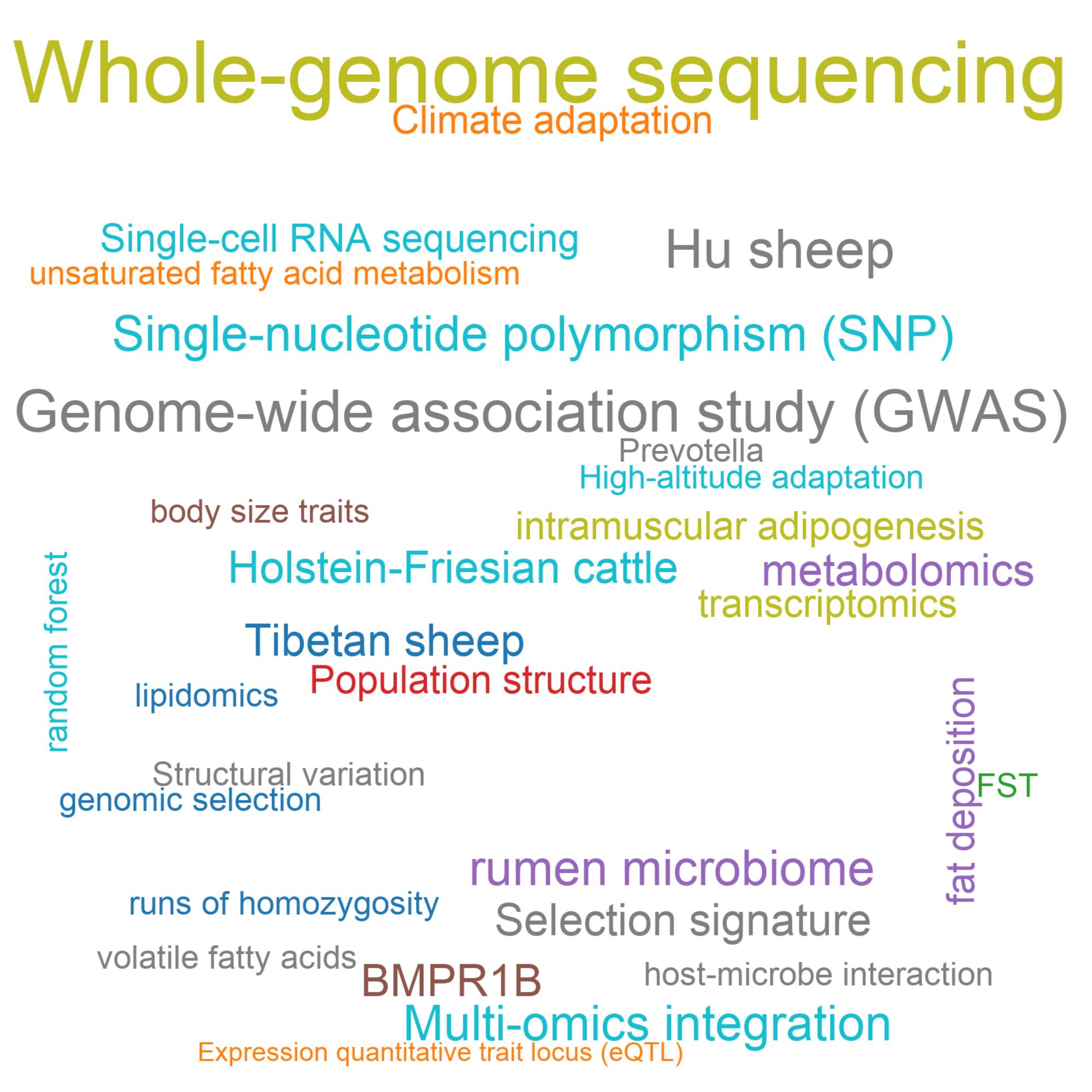
The Class of 2026 for genetic and phenotypic traits in livestock is heavily anchored in the application of high-resolution genomics. Whole-genome sequencing and Genome-Wide Association Studies (GWAS) remain the dominant, foundational tools for uncovering novel trait-associated variants across populations. Crucially, however, the field is rapidly advancing into systems biology through a substantial and growing emphasis on multi-omics integration. Researchers are increasingly combining transcriptomic, metabolomic, and genomic datasets to map the complex molecular architecture underlying phenotypic traits. Alongside these technological shifts, targeted studies on specialized and indigenous breeds are remarkably prevalent. Research focusing extensively on Hu sheep, Tibetan sheep, and Holstein-Friesian cattle forms a core component of this cohort's landscape. These breed-specific analyses are frequently coupled with targeted investigations into high-value functional attributes, such as fat deposition, body size traits, and unique adaptation mechanisms. Mechanistically, there is also an expanded focus on the rumen microbiome and its diverse metabolic outputs—such as volatile fatty acids—as critical drivers of host phenotype. This illustrates a broader paradigm shift toward understanding host-microbe interactions as an integral factor in modern livestock genetics.
How Did Topics Shift from the Class of 2025 to the Class of 2026?
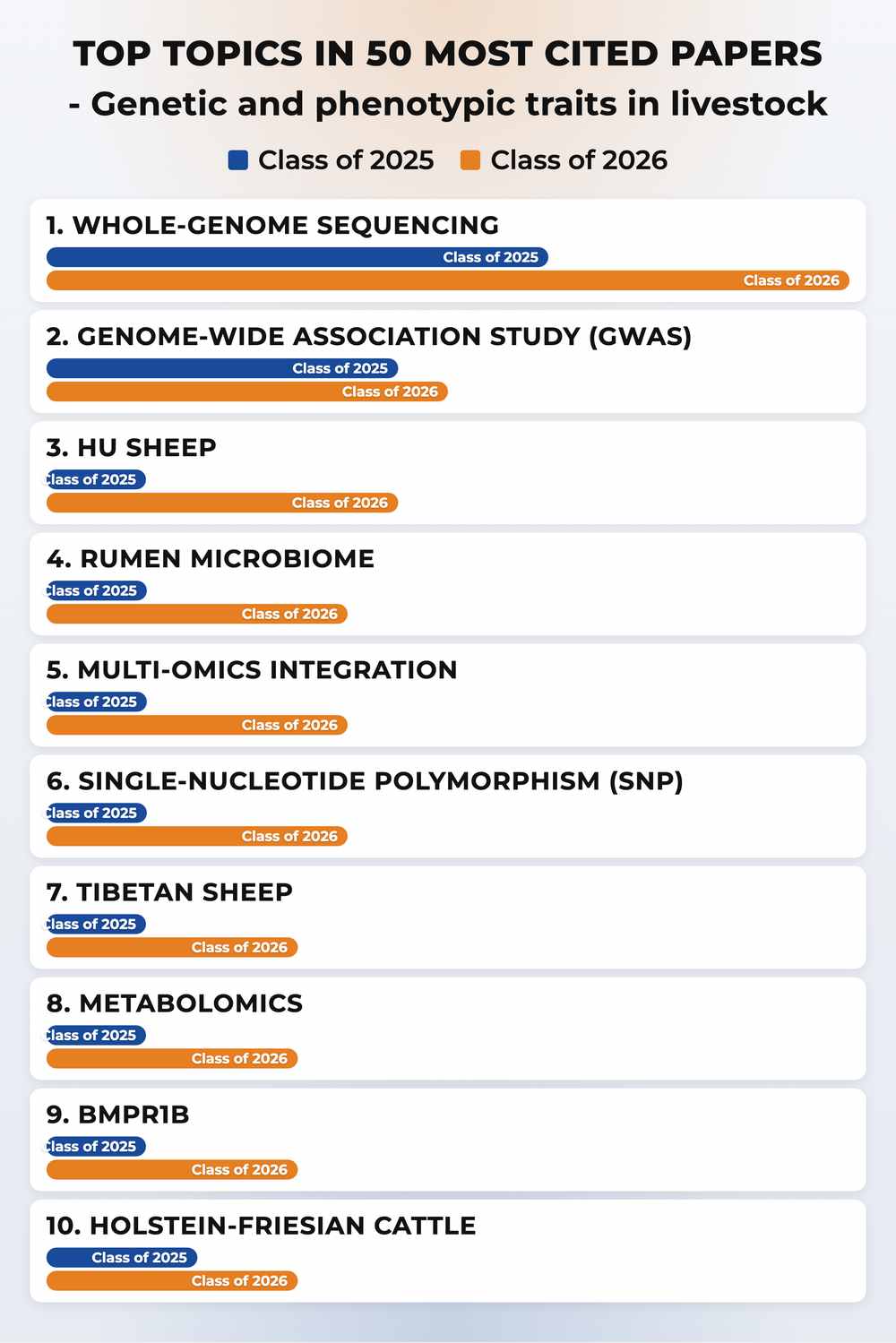
A striking evolution in the Class of 2026 is the rapid ascent of single-cell RNA sequencing and targeted multi-omics approaches, which are actively displacing more conventional genetic mapping strategies. Traditional mainstays of the field, such as the analysis of selection signatures and the application of genomic selection, experienced nearly a 50% decline in relative frequency. This notable drop suggests that researchers are steadily moving past basic locus identification toward high-resolution functional validation and the exploration of complex molecular interactions. Simultaneously, there is a pronounced and fascinating pivot toward the genetics of extreme adaptation and specialized breed traits. Research on Tibetan sheep and the associated EPAS1 gene emerged entirely in this cohort, driven by efforts to investigate the mechanisms of high-altitude adaptation. Similarly, studies centering on Hu sheep surged seven-fold, often intersecting with metabolic profiling (metabolomics) and the mapping of expression quantitative trait loci (eQTLs). The exponential rise of supporting topics like volatile fatty acids and body size traits further underscores this broader paradigm shift: modern livestock genetics is increasingly prioritizing systems-level mechanistic pathways—such as those mediated by the rumen microbiome—over isolated genomic breeding values.
Methodology
PRI identifies high-impact research using a transparent, topic-agnostic framework applied consistently across scientific domains. Bibliographic records are drawn from OpenAlex, including publication dates, citation relationships, and document types.
This ranking covers the Class of 2026 cohort: journal articles published in 2024. Reviews and other non-article document types are excluded to ensure comparability.
Research impact is quantified with an 18-month post-publication citation window—the number of citing works published within 18 months of each paper's publication date. This metric captures early impact while controlling for publication age.
An LLM-based relevance classifier then reviews each candidate's title and abstract to confirm substantive alignment with the target domain. Only papers classified as relevant appear in the final ranking.
Zheng Su, Tinsley Li, Thematic Shifts in Early-High-Impact Cancer Genomics and Diagnostics Research: A Bibliometric and Semantic Analysis. bioRxiv 2026.07.04.736459; doi: https://doi.org/10.64898/2026.07.04.736459
Cite this ranking
Pepkio Research Index (PRI). Topics and Trends in Most Cited Genetic and phenotypic traits in livestock Papers, Class of 2026. https://pri.pepkio.com/top-papers/genetic-and-phenotypic-traits-in-livestock/2026. Accessed 2026-10-14.

Methodology
Zheng Su, Tinsley Li, Thematic Shifts in Early-High-Impact Cancer Genomics and Diagnostics Research: A Bibliometric and Semantic Analysis. bioRxiv 2026.07.04.736459; doi: https://doi.org/10.64898/2026.07.04.736459