
What topics and trends defined most-cited Animal Genetics and Reproduction research in the Class of 2026?
Research in animal genetics and reproduction is led by genomic selection and single-cell transcriptomics alongside targeted CRISPR modifications. Cohort trends show rapid growth in genomic breeding tools, reproductive maternal factors, and multi-gene xenotransplantation models, while generalized gene-editing tool validations have given way to applied trait modification.
At a glance
- Field
- Animal Genetics and Reproduction
- Cohort label
- Class of 2026 (2024 publications)
- Papers analyzed
- 2,658
- Papers ranked
- 20
- Top topics in ranked papers
- Genomic selection, CRISPR-Cas9, single-cell RNA sequencing, xenotransplantation, reproductive factors
- Publication window
- Jan 1, 2024 – Dec 31, 2024
- Eligibility
- Research articles; reviews excluded
- Citation window
- 18 months post-publication
- 18m citation range
- 17–118
- Data source
- OpenAlex · Retrieved Jul 2026
- License
- CC BY 4.0
Rankings
20 papers ranked by 18-month citation count
A compendium of genetic regulatory effects across pig tissues
Nature Genetics202410.1038/s41588-023-01585-7
Hagfish genome elucidates vertebrate whole-genome duplication events and their evolutionary consequences
Nature Ecology & Evolution202410.1038/s41559-023-02299-z
A conserved fertilization complex bridges sperm and egg in vertebrates
Cell202410.1016/j.cell.2024.09.035
Pig-to-human kidney xenotransplants using genetically modified minipigs
Cell Reports Medicine202410.1016/j.xcrm.2024.101744
Genome engineering with Cas9 and AAV repair templates generates frequent concatemeric insertions of viral vectors
Nature Biotechnology202410.1038/s41587-024-02171-w
A spontaneously immortalized muscle stem cell line (EfMS) from brown-marbled grouper for cell-cultured fish meat production
Communications Biology202410.1038/s42003-024-07400-1
Genome-wide variation study and inter-tissue communication analysis unveil regulatory mechanisms of egg-laying performance in chickens
Nature Communications202410.1038/s41467-024-50809-9
Telomere-to-telomere assemblies of cattle and sheep Y-chromosomes uncover divergent structure and gene content
Nature Communications202410.1038/s41467-024-52384-5
Genomics‐informed captive breeding can reduce inbreeding depression and the genetic load in zoo populations
Molecular Ecology Resources202410.1111/1755-0998.13967
Insights into left-right asymmetric development of chicken ovary at the single-cell level
Journal of genetics and genomics/Journal of Genetics and Genomics202410.1016/j.jgg.2024.08.002
Advancing fish breeding in aquaculture through genome functional annotation
Aquaculture202410.1016/j.aquaculture.2024.740589
Genetic etiological spectrum of sperm morphological abnormalities
Journal of Assisted Reproduction and Genetics202410.1007/s10815-024-03274-8
Development and validation of animal variant classification guidelines to objectively evaluate genetic variant pathogenicity in domestic animals
Frontiers in Veterinary Science202410.3389/fvets.2024.1497817
Integrative 3D genomics with multi-omics analysis and functional validation of genetic regulatory mechanisms of abdominal fat deposition in chickens
Nature Communications202410.1038/s41467-024-53692-6
<i>Nr5a2</i> is dispensable for zygotic genome activation but essential for morula development
Science202410.1126/science.adg7325
Pretransplant Screening for Prevention of Hyperacute Graft Loss in Pig-to-primate Kidney Xenotransplantation
Transplantation202410.1097/tp.0000000000004958
Decoding the fish genome opens a new era in important trait research and molecular breeding in China
Science China Life Sciences202410.1007/s11427-023-2670-5
Development of a novel Japanese eel myoblast cell line for application in cultured meat production
Biochemical and Biophysical Research Communications202410.1016/j.bbrc.2024.150784
Protein profiling of zebrafish embryos unmasks regulatory layers during early embryogenesis
Cell Reports202410.1016/j.celrep.2024.114769
Stable germline transgenesis using the <i>Minos</i> Tc1/ <i>mariner</i> element in the sea urchin <i>Lytechinus pictus</i>
Development202410.1242/dev.202991
Topic trends
Dominant research themes and year-over-year shifts in Animal Genetics and Reproduction
What Topics Define the Class of 2026?
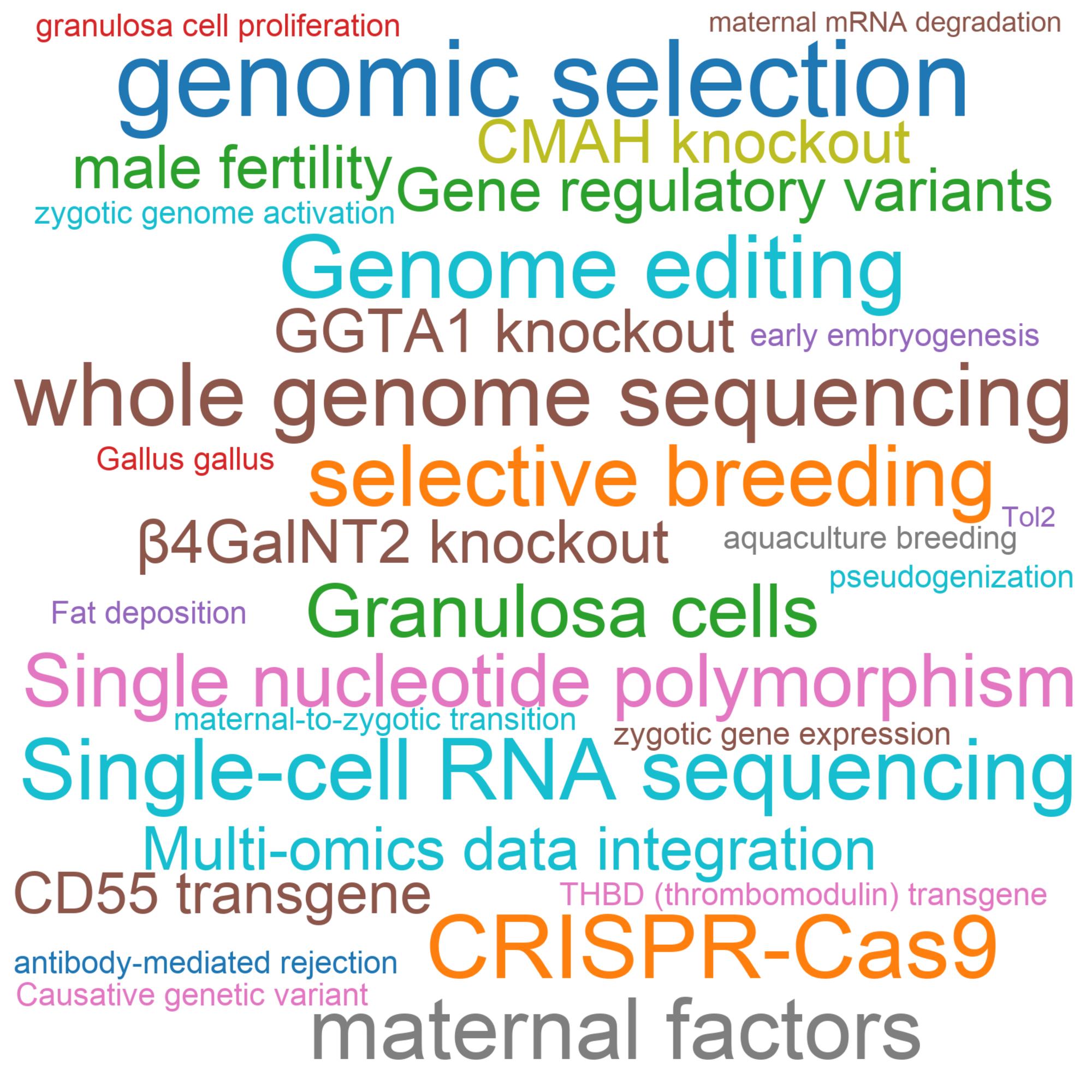
The Class of 2026 in Animal Genetics and Reproduction reflects a decisive shift toward high-resolution genomic tools and targeted gene-editing technologies aimed at improving livestock breeding, reproductive efficiency, and biomedical applications. Leading the cohort, genomic selection and whole-genome sequencing serve as foundational methodologies, enabling precise genotype-to-phenotype associations for economically important traits such as growth performance, disease resistance, and reproductive longevity. Simultaneously, single-cell RNA sequencing and single-nucleotide polymorphism (SNP) profiling provide granular insights into cellular heterogeneity within reproductive tissues, particularly focusing on granulosa cell proliferation, follicle selection, and theca cell signaling. In parallel, gene-editing paradigms centered around CRISPR-Cas9 systems form a dominant thematic pillar. Beyond traditional agricultural enhancement, research extensively explores genetically modified animal models for xenotransplantation, featuring targeted knockouts—such as GGTA1, CMAH, and β4GalNT2—and human transgene integration (CD55, THBD) to minimize hyperacute rejection. Reproductive biology also features prominently, with studies decoding maternal factors, maternal-to-zygotic transition mechanisms, and zygotic genome activation during early embryogenesis. Together, these thematic clusters highlight an integrative research ecosystem bridging agricultural biotechnology, developmental reproductive biology, and translational medicine.
How Did Topics Shift from the Class of 2025 to the Class of 2026?
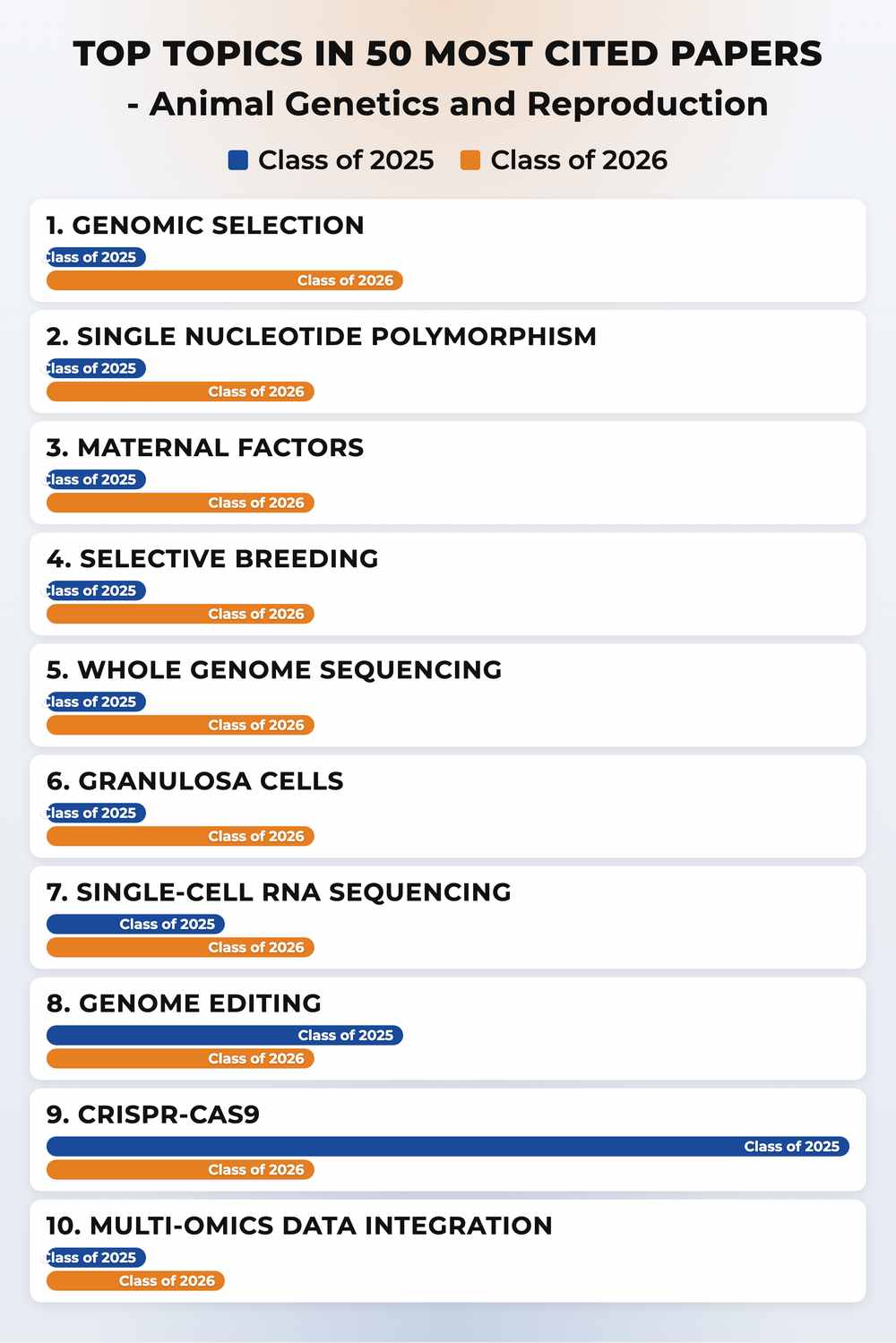
Comparing topic distributions between the Class of 2025 and the Class of 2026 reveals significant evolutionary shifts in animal genetics and reproductive research. The most prominent rise is seen in genomic selection, which jumped from zero mentions in the previous cohort's top tier to become the leading concept in 2024 (+0.08 normalized frequency difference). Similarly, single nucleotide polymorphism (SNP) mapping and maternal factors exhibited notable expansion (+0.06 frequency gain), reflecting an increased focus on fine-mapping functional variants and understanding early developmental programming in livestock and model species. Conversely, foundational method-level terms such as broad CRISPR-Cas9 evaluation experienced a relative frequency decline (-0.12 frequency difference, dropping from 9 top-tier publications to 3). Rather than indicating waning interest, this shift signifies a maturation of gene-editing technologies: basic tool validation has given way to highly specific downstream applications. This maturation is evidenced by the surge in specialized xenotransplantation knockout constructs—including GGTA1, CMAH, and β4GalNT2 knockouts alongside CD55 and THBD transgene integration—and targeted reproductive studies examining maternal-to-zygotic transitions and zygotic genome activation. Ultimately, the field has transitioned from broad methodology development toward targeted genomic breeding and complex multi-gene editing applications.
Methodology
PRI identifies high-impact research using a transparent, topic-agnostic framework applied consistently across scientific domains. Bibliographic records are drawn from OpenAlex, including publication dates, citation relationships, and document types.
This ranking covers the Class of 2026 cohort: journal articles published in 2024. Reviews and other non-article document types are excluded to ensure comparability.
Research impact is quantified with an 18-month post-publication citation window—the number of citing works published within 18 months of each paper's publication date. This metric captures early impact while controlling for publication age.
An LLM-based relevance classifier then reviews each candidate's title and abstract to confirm substantive alignment with the target domain. Only papers classified as relevant appear in the final ranking.
Zheng Su, Tinsley Li, Thematic Shifts in Early-High-Impact Cancer Genomics and Diagnostics Research: A Bibliometric and Semantic Analysis. bioRxiv 2026.07.04.736459; doi: https://doi.org/10.64898/2026.07.04.736459
Cite this ranking
Pepkio Research Index (PRI). Topics and Trends in Most Cited Animal Genetics and Reproduction Papers, Class of 2026. https://pri.pepkio.com/top-papers/animal-genetics-and-reproduction/2026. Accessed 2026-10-16.

Methodology
Zheng Su, Tinsley Li, Thematic Shifts in Early-High-Impact Cancer Genomics and Diagnostics Research: A Bibliometric and Semantic Analysis. bioRxiv 2026.07.04.736459; doi: https://doi.org/10.64898/2026.07.04.736459