
What topics and trends defined most-cited Animal Nutrition and Physiology research in the Class of 2026?
Broiler chickens, gut microbiota, and feed conversion ratio anchor the Class of 2026 animal nutrition cohort, alongside cecal microbiota, glutathione peroxidase, and Lactobacillus. From Class of 2025 to 2026, villus height, Lactobacillus, and Lactiplantibacillus plantarum rose while broiler chickens, intestinal barrier integrity, and feed conversion ratio receded among top-cited work.
At a glance
- Field
- Animal Nutrition and Physiology
- Cohort label
- Class of 2026 (2024 publications)
- Papers analyzed
- 8,939
- Papers ranked
- 20
- Top topics in ranked papers
- Broiler chickens, gut microbiota, feed conversion ratio, cecal microbiota, glutathione peroxidase
- Publication window
- Jan 1, 2024 – Dec 31, 2024
- Eligibility
- Research articles; reviews excluded
- Citation window
- 18 months post-publication
- 18m citation range
- 23–733
- Data source
- OpenAlex · Retrieved Jul 2026
- License
- CC BY 4.0
Rankings
20 papers ranked by 18-month citation count
Utilization of Differently Processed Sesame Seed Meal as a Source of Methionine in Guinea Fowls Diets
International Journal of Innovative Science and Research Technology (IJISRT)202410.38124/ijisrt/ijisrt24jul207
Response of Broiler Chickens to Three Different Energy Source Feedstuffs
International Journal of Innovative Science and Research Technology (IJISRT)202410.38124/ijisrt/ijisrt24jul049
Hydrolyzed protein formula improves the nutritional tolerance by increasing intestinal development and altering cecal microbiota in low-birth-weight piglets
Frontiers in Nutrition202410.3389/fnut.2024.1439110
Flavor profile analysis of grilled lamb seasoned with classic salt, chili pepper, and cumin (Cuminum cyminum) through HS-SPME-GC-MS, HS-GC-IMS, E-nose techniques, and sensory evaluation on Sonit sheep
Food Chemistry202410.1016/j.foodchem.2024.139514
<i>Clostridium butyricum</i> and carbohydrate active enzymes contribute to the reduced fat deposition in pigs
iMeta202410.1002/imt2.160
Effects of Heat Stress on the Laying Performance, Egg Quality, and Physiological Response of Laying Hens
Animals202410.3390/ani14071076
Pea protein soften surimi gels and improve in vitro digestibility: Potential high protein foods for elderly
Food Hydrocolloids202410.1016/j.foodhyd.2024.110664
Driving gut microbiota enterotypes through host genetics
Microbiome202410.1186/s40168-024-01827-8
Enhancing iron and zinc bioavailability in maize (Zea mays) through phytate reduction: the impact of fermentation alone and in combination with soaking and germination
Frontiers in Nutrition202410.3389/fnut.2024.1478155
The comparative effects of probiotics on growth, antioxidant indices and intestinal histomorphology of broilers under heat stress condition
Scientific Reports202410.1038/s41598-024-66301-9
Curcumin Mitigates Oxidative Damage in Broiler Liver and Ileum Caused by Aflatoxin B1-Contaminated Feed through Nrf2 Signaling Pathway
Animals202410.3390/ani14030409
Genome-wide variation study and inter-tissue communication analysis unveil regulatory mechanisms of egg-laying performance in chickens
Nature Communications202410.1038/s41467-024-50809-9
Supplementation of curcumin promotes the intestinal structure, immune barrier function and cecal microbiota composition of laying hens in early laying period
Poultry Science202410.1016/j.psj.2024.104355
Influence of using synbiotics by various routes on Mandarah male chicks: intestinal bacterial counts, gut morphology and histological status
Poultry Science202410.1016/j.psj.2024.103601
Monitoring activity index and behaviors of cage-free hens with advanced deep learning technologies
Poultry Science202410.1016/j.psj.2024.104193
Effects of duo-strain probiotics on growth, digestion, and gut health in broiler chickens
Veterinary and Animal Science202410.1016/j.vas.2024.100343
Decreased eggshell strength caused by impairment of uterine calcium transport coincide with higher bone minerals and quality in aged laying hens
Journal of Animal Science and Biotechnology/Journal of animal science and biotechnology202410.1186/s40104-023-00986-2
Tannic acid extracted from gallnut improves intestinal health with regulation of redox homeostasis and gut microbiota of weaned piglets
Animal Research and One Health202410.1002/aro2.51
Precooked state based on protein denaturation kinetics impacts moisture status, protein oxidation and texture of prepared chicken breast
Food Chemistry202410.1016/j.foodchem.2024.140994
Effects of organic acid blends on the growth performance, intestinal morphology, microbiota, and serum lipid parameters of broiler chickens
Poultry Science202410.1016/j.psj.2024.104546
Topic trends
Dominant research themes and year-over-year shifts in Animal Nutrition and Physiology
What Topics Define the Class of 2026?
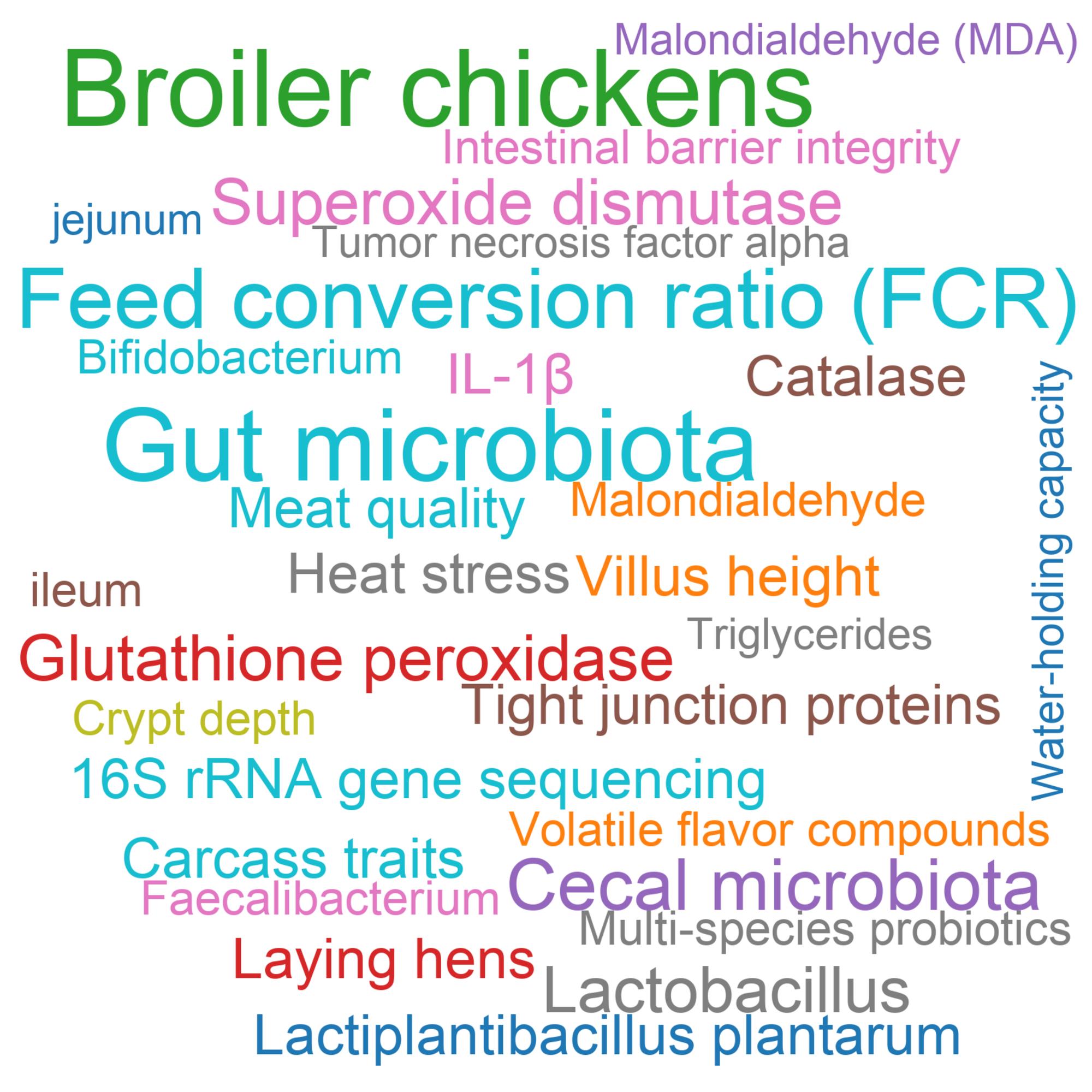
The informative word cloud across the 50 highest 18-month-cited animal nutrition and physiology papers reveals a field organized around poultry production performance, gut microbiology, and oxidative-stress physiology rather than generic livestock labels. Broiler chickens is the most frequently mentioned informative topic, appearing in 11 of 50 papers (normalized frequency 0.22), followed by gut microbiota (10 papers, 0.20) and feed conversion ratio (8 papers, 0.16). A second tier clusters cecal microbiota (6 papers, 0.12) with antioxidant and probiotic markers—glutathione peroxidase, Lactobacillus, and superoxide dismutase each appear in 5 papers (0.10). Larger type further highlights 16S rRNA gene sequencing, carcass traits, meat quality, heat stress, villus height, tight junction proteins, IL-1β, and Lactiplantibacillus plantarum (4 papers each, 0.08), signaling that influential 2024 publications increasingly pair broiler and laying-hen trials with cecal sequencing, intestinal morphology readouts, and multi-species probiotic interventions. Laying hens, malondialdehyde, tumor necrosis factor alpha, and volatile flavor compounds appear at moderate prominence, suggesting that high-impact work spans production economics, gut-barrier integrity, meat and egg quality, and flavor chemistry across monogastric species.
How Did Topics Shift from the Class of 2025 to the Class of 2026?
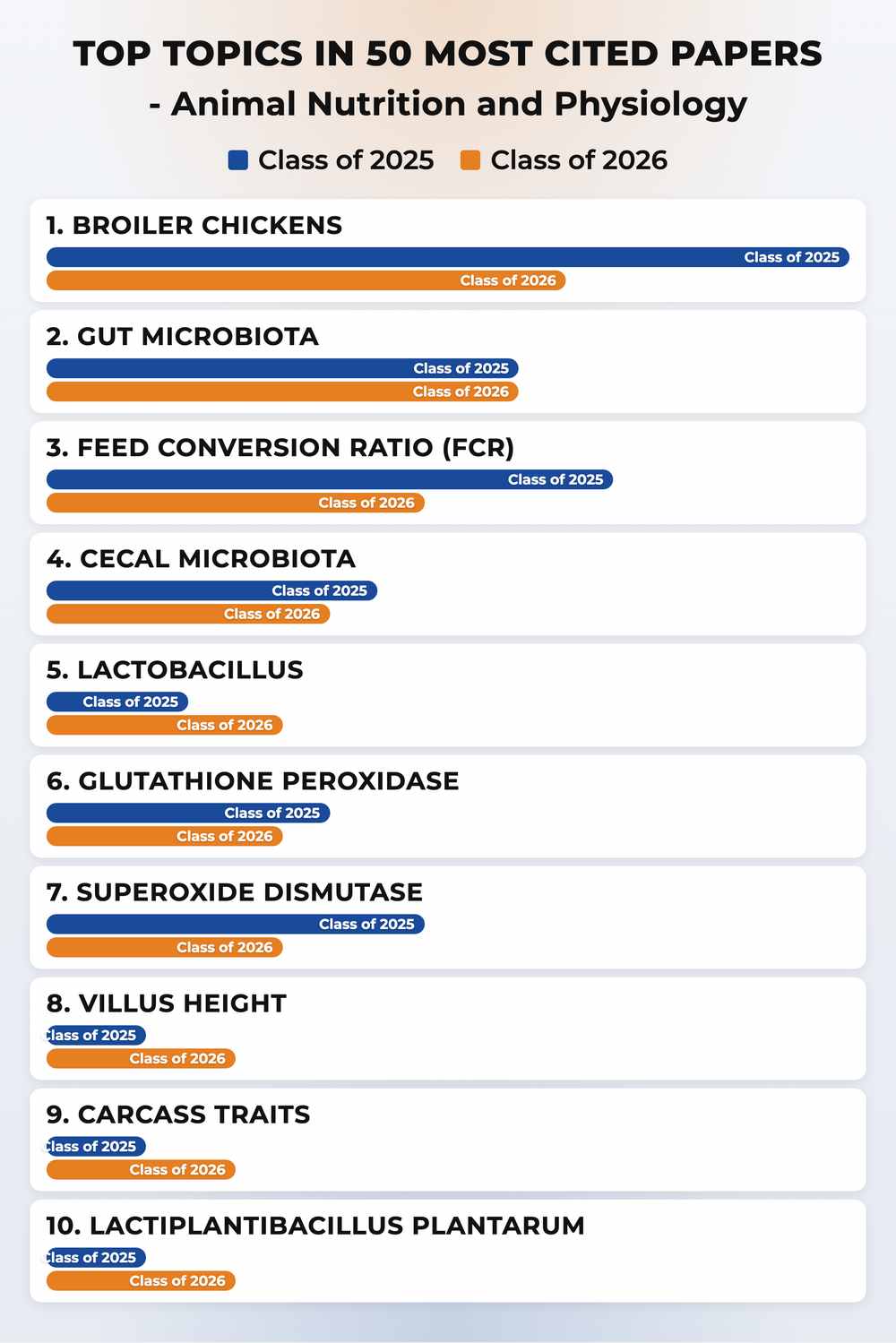
Comparing normalized concept frequencies between the Class of 2025 (2023 publications) and Class of 2026 (2024 publications) cohorts shows a rebalancing of early-high-impact animal nutrition priorities toward gut morphology, named probiotics, and product-quality endpoints, while broad broiler and barrier-integrity framing recedes. Intestinal barrier integrity exhibited the largest decline among leading themes (−0.14 normalized frequency; 10 versus 3 papers), followed by broiler chickens (−0.12; 0.34 to 0.22) and feed conversion ratio (−0.08; 0.24 to 0.16). Bacteroidota and superoxide dismutase each fell −0.08 and −0.06 respectively. The topic evolution card underscores complementary gains: villus height climbed +0.08 (0 to 4 papers), Lactobacillus rose +0.04 (0.06 to 0.10), and Lactiplantibacillus plantarum, carcass traits, meat quality, and tight junction proteins each strengthened +0.04 to 0.08. Faecalibacterium, jejunum, and ileum emerged at 0.06 in 2026 after minimal 2025 presence, aligning with more histomorphology- and segment-specific gut studies. Gut microbiota held steady at 0.20, indicating persistent centrality even as cecal microbiota dipped modestly (−0.02). Together, these shifts suggest that the most-cited 2024 papers emphasize named probiotic taxa, villus and crypt metrics, and carcass or meat-quality outcomes over generalized broiler-production and barrier-integrity narratives that dominated the prior cohort.
Methodology
PRI identifies high-impact research using a transparent, topic-agnostic framework applied consistently across scientific domains. Bibliographic records are drawn from OpenAlex, including publication dates, citation relationships, and document types.
This ranking covers the Class of 2026 cohort: journal articles published in 2024. Reviews and other non-article document types are excluded to ensure comparability.
Research impact is quantified with an 18-month post-publication citation window—the number of citing works published within 18 months of each paper's publication date. This metric captures early impact while controlling for publication age.
An LLM-based relevance classifier then reviews each candidate's title and abstract to confirm substantive alignment with the target domain. Only papers classified as relevant appear in the final ranking.
Zheng Su, Tinsley Li, Thematic Shifts in Early-High-Impact Cancer Genomics and Diagnostics Research: A Bibliometric and Semantic Analysis. bioRxiv 2026.07.04.736459; doi: https://doi.org/10.64898/2026.07.04.736459
Cite this ranking
Pepkio Research Index (PRI). Topics and Trends in Most Cited Animal Nutrition and Physiology Papers, Class of 2026. https://pri.pepkio.com/top-papers/animal-nutrition-and-physiology/2026. Accessed 2026-10-14.

Methodology
Zheng Su, Tinsley Li, Thematic Shifts in Early-High-Impact Cancer Genomics and Diagnostics Research: A Bibliometric and Semantic Analysis. bioRxiv 2026.07.04.736459; doi: https://doi.org/10.64898/2026.07.04.736459