
What topics and trends defined most-cited Ruminant Nutrition and Digestive Physiology research in the Class of 2026?
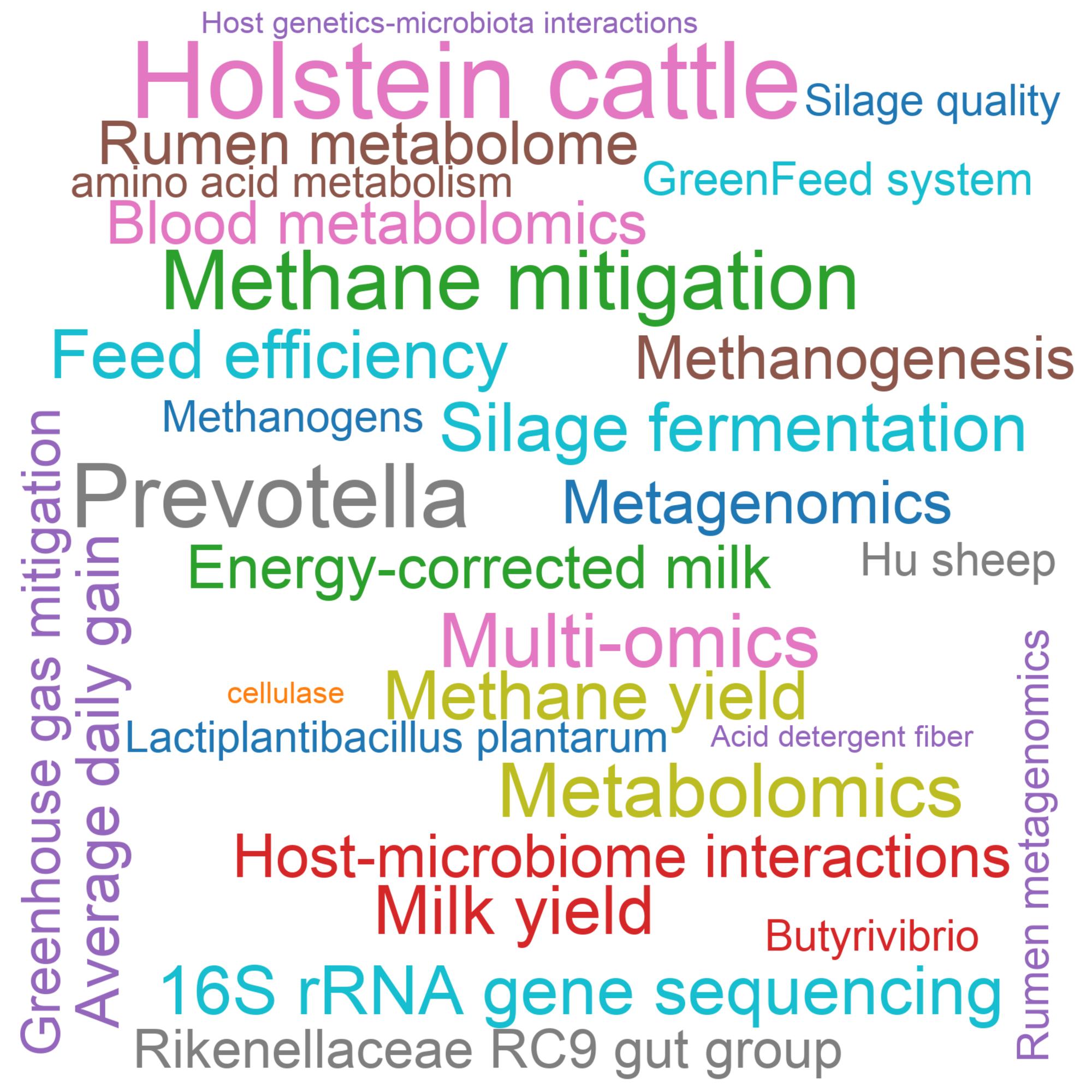
The Class of 2026 in ruminant nutrition shifts from basic taxonomic profiling to functional, systems-level analysis. High-impact research increasingly relies on multi-omics and metabolomics to link specific rumen microbes, like Prevotella, to environmental goals such as methane mitigation and enhanced feed efficiency.
At a glance
- Field
- Ruminant Nutrition and Digestive Physiology
- Cohort label
- Class of 2026 (2024 publications)
- Papers analyzed
- 4,240
- Papers ranked
- 20
- Top topics in ranked papers
- Holstein cattle, Prevotella, methane mitigation, metabolomics
- Publication window
- Jan 1, 2024 – Dec 31, 2024
- Eligibility
- Research articles; reviews excluded
- Citation window
- 18 months post-publication
- 18m citation range
- 19–48
- Data source
- OpenAlex · Retrieved July 2026
- License
- CC BY 4.0
Rankings
20 papers ranked by 18-month citation count
Single-cell transcriptomics across 2,534 microbial species reveals functional heterogeneity in the rumen microbiome
Nature Microbiology202410.1038/s41564-024-01723-9
Integrated multi-omics reveals the relationship between growth performance, rumen microbes and metabolic status of Hu sheep with different residual feed intakes
Animal nutrition202410.1016/j.aninu.2024.04.021
Long-term effects of 3-nitrooxypropanol on methane emission and milk production characteristics in Holstein-Friesian dairy cows
Journal of Dairy Science202410.3168/jds.2023-24198
Volatile metabolomics and metagenomics reveal the effects of lactic acid bacteria on alfalfa silage quality, microbial communities, and volatile organic compounds
Communications Biology202410.1038/s42003-024-07083-8
Phenotypic variation of dairy cows’ hematic metabolites and feasibility of non-invasive monitoring of the metabolic status in the transition period
Frontiers in Veterinary Science202410.3389/fvets.2024.1437352
An integrated microbiome- and metabolome-genome-wide association study reveals the role of heritable ruminal microbial carbohydrate metabolism in lactation performance in Holstein dairy cows
Microbiome202410.1186/s40168-024-01937-3
Growth performance, carcass characteristics, fatty acid profile, and meat quality of male goat kids supplemented by alternative feed resources: bitter vetch and sorghum grains
Archives animal breeding/Archiv für Tierzucht202410.5194/aab-67-481-2024
Feed additives for methane mitigation: Modeling the impact of feed additives on enteric methane emission of ruminants—Approaches and recommendations
Journal of Dairy Science202410.3168/jds.2024-25049
Rumen and hindgut microbiome regulate average daily gain of preweaning Holstein heifer calves in different ways
Microbiome202410.1186/s40168-024-01844-7
Feed additives for methane mitigation: Assessment of feed additives as a strategy to mitigate enteric methane from ruminants—Accounting; How to quantify the mitigating potential of using antimethanogenic feed additives
Journal of Dairy Science202410.3168/jds.2024-25044
Multi-omics analysis reveals the core microbiome and biomarker for nutrition degradation in alfalfa silage fermentation
mSystems202410.1128/msystems.00682-24
Succession of rumen microbiota and metabolites across different reproductive periods in different sheep breeds and their impact on the growth and development of offspring lambs
Microbiome202410.1186/s40168-024-01892-z
Deciphering functional groups of rumen microbiome and their underlying potentially causal relationships in shaping host traits
iMeta202410.1002/imt2.225
Mitigating methane emissions in grazing beef cattle with a seaweed-based feed additive: Implications for climate-smart agriculture
Proceedings of the National Academy of Sciences202410.1073/pnas.2410863121
Fermentation profile and bioactive component retention in honeysuckle residue silages inoculated with lactic acid bacteria: A promising feed additive for sustainable agriculture
Industrial Crops and Products202410.1016/j.indcrop.2024.120315
Integrating genome‐ and transcriptome‐wide association studies to uncover the host–microbiome interactions in bovine rumen methanogenesis
iMeta202410.1002/imt2.234
A metagenomic catalogue of the ruminant gut archaeome
Nature Communications202410.1038/s41467-024-54025-3
Seasonal stability of the rumen microbiome contributes to the adaptation patterns to extreme environmental conditions in grazing yak and cattle
BMC Biology202410.1186/s12915-024-02035-4
Multi-omics reveal mechanisms of high enteral starch diet mediated colonic dysbiosis via microbiome-host interactions in young ruminant
Microbiome202410.1186/s40168-024-01760-w
Effects of a range of effective inclusion levels of Asparagopsis armata steeped in oil on enteric methane emissions of dairy cows
Animal Feed Science and Technology202410.1016/j.anifeedsci.2024.115932
Topic trends
Dominant research themes and year-over-year shifts in Ruminant Nutrition and Digestive Physiology
What Topics Define the Class of 2026?
The Class of 2026 for ruminant nutrition and digestive physiology is defined by an intensified focus on precision interventions and advanced analytical techniques. While Holstein cattle remains the primary model system driving a significant portion of the literature, there is a pronounced emphasis on specific microbial players and environmental impact. Concepts such as 'Prevotella' and 'methane mitigation' have emerged as leading subjects of investigation. This signals a definitive shift from merely characterizing broad microbial communities to targeting specific keystone taxa and elucidating their functional roles in greenhouse gas emissions. Methodologically, the field is advancing beyond single-assay approaches. 'Metabolomics' and 'multi-omics' have become central to the most highly cited studies, reflecting a strong push toward systems-level understanding of rumen function. Researchers are increasingly linking these comprehensive omics profiles to practical agricultural outcomes like 'feed efficiency', 'methane yield', and 'milk yield'. Furthermore, studies exploring 'silage fermentation' remain critical, underscoring the foundational role of feed quality in shaping the rumen microbiome and determining overall animal performance.
How Did Topics Shift from the Class of 2025 to the Class of 2026?
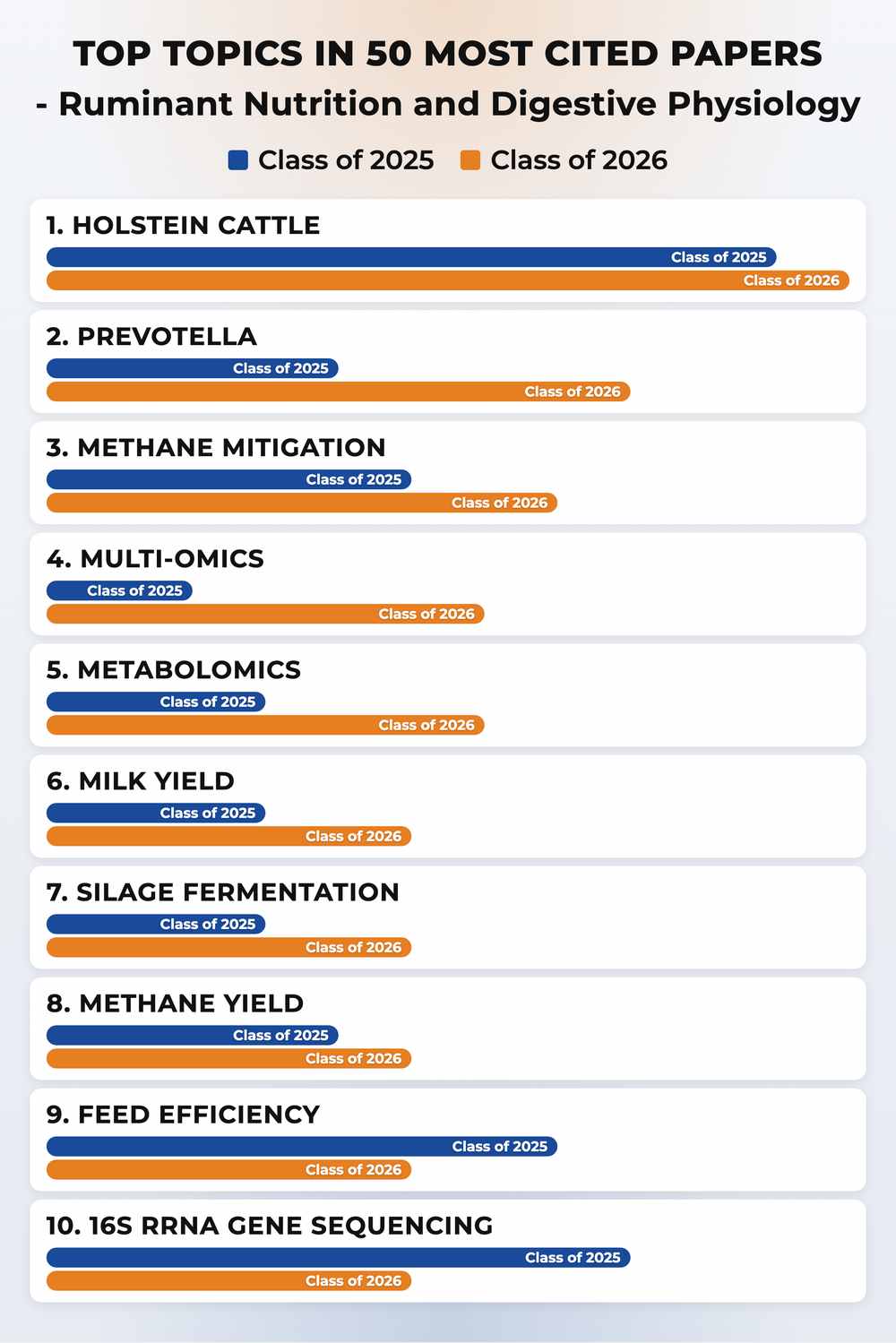
Comparing the Class of 2025 to the Class of 2026 reveals a distinct transition in both analytical resolution and targeted interventions within ruminant nutrition. The most striking increases are observed in high-resolution analytical approaches. 'Multi-omics' and 'blood metabolomics' surged to prominence, demonstrating a profound expansion in methodological sophistication. This aligns with a relative decline in foundational '16S rRNA gene sequencing', suggesting the field has moved past basic taxonomic cataloging toward functional and systemic metabolic profiling. Concurrently, there is a sharp rise in research focusing on specific microbial modulators and taxa, such as 'Lactiplantibacillus plantarum', 'Butyrivibrio', and 'Prevotella'. This indicates a growing interest in targeted probiotic applications and microbial interventions rather than relying solely on broad dietary shifts. Research into 'greenhouse gas mitigation' also saw significant growth, further emphasizing the environmental imperative driving current ruminant research. Conversely, classical fermentation parameters like 'acetate-to-propionate ratio' experienced relative declines, not because they are unimportant, but because the vanguard of the field is increasingly exploring the underlying molecular and microbial mechanisms that govern these outcomes.
Methodology
PRI identifies high-impact research using a transparent, topic-agnostic framework applied consistently across scientific domains. Bibliographic records are drawn from OpenAlex, including publication dates, citation relationships, and document types.
This ranking covers the Class of 2026 cohort: journal articles published in 2024. Reviews and other non-article document types are excluded to ensure comparability.
Research impact is quantified with an 18-month post-publication citation window—the number of citing works published within 18 months of each paper's publication date. This metric captures early impact while controlling for publication age.
An LLM-based relevance classifier then reviews each candidate's title and abstract to confirm substantive alignment with the target domain. Only papers classified as relevant appear in the final ranking.
Zheng Su, Tinsley Li, Thematic Shifts in Early-High-Impact Cancer Genomics and Diagnostics Research: A Bibliometric and Semantic Analysis. bioRxiv 2026.07.04.736459; doi: https://doi.org/10.64898/2026.07.04.736459
Cite this ranking
Pepkio Research Index (PRI). Topics and Trends in Most Cited Ruminant Nutrition and Digestive Physiology Papers, Class of 2026. https://pri.pepkio.com/top-papers/ruminant-nutrition-and-digestive-physiology/2026. Accessed 2026-10-16.

Methodology
Zheng Su, Tinsley Li, Thematic Shifts in Early-High-Impact Cancer Genomics and Diagnostics Research: A Bibliometric and Semantic Analysis. bioRxiv 2026.07.04.736459; doi: https://doi.org/10.64898/2026.07.04.736459