
What topics and trends defined most-cited Aquaculture disease management and microbiota research in the Class of 2026?
The 2024 aquaculture disease management and microbiota cohort demonstrates a clear shift toward biofloc technology, metagenomics, and multi-omics host-microbiome profiling. While Nile tilapia and Aeromonas hydrophila remain focal models, research increasingly prioritizes functional antioxidant immunity, relative percent survival, and antibiotic resistance gene mitigation over traditional 16S rRNA surveys.
At a glance
- Field
- Aquaculture disease management and microbiota
- Cohort label
- Class of 2026 (2024 publications)
- Papers analyzed
- 6,987
- Papers ranked
- 20
- Top topics in ranked papers
- Nile tilapia, Biofloc technology, Antibiotic resistance genes (ARGs), Aeromonas hydrophila, Antioxidant response
- Publication window
- Jan 1, 2024 – Dec 31, 2024
- Eligibility
- Research articles; reviews excluded
- Citation window
- 18 months post-publication
- 18m citation range
- 20–69
- Data source
- OpenAlex · Retrieved Jun 2026
- License
- CC BY 4.0
Rankings
20 papers ranked by 18-month citation count
Combined exposure of emamectin benzoate and microplastics induces tight junction disorder, immune disorder and inflammation in carp midgut via lysosome/ROS/ferroptosis pathway
Water Research202410.1016/j.watres.2024.121660
Probiotics reshape the coral microbiome in situ without detectable off-target effects in the surrounding environment
Communications Biology202410.1038/s42003-024-06135-3
Tissue Accumulation and Biotransformation of 6PPD-Quinone in Adult Zebrafish and Its Effects on the Intestinal Microbial Community
Environmental Science & Technology202410.1021/acs.est.4c01409
Effects of chronic cold stress and thermal stress on growth performance, hepatic apoptosis, oxidative stress, immune response and gut microbiota of juvenile hybrid sturgeon (Acipenser baerii ♀ × A. schrenkii ♂)
Fish & Shellfish Immunology202410.1016/j.fsi.2024.110078
Deciphering the gut microbiome of grass carp through multi-omics approach
Microbiome202410.1186/s40168-023-01715-7
TLRs signaling pathway regulation, antibacterial and apoptotic activity of largemouth bass ECSIT during Edwardsiella piscicida infection
Aquaculture202410.1016/j.aquaculture.2024.741615
Transcriptome profiling of triploid Crassostrea gigas gills indicates the host immune mechanism against bacterial infection
Comparative Biochemistry and Physiology Part D Genomics and Proteomics202410.1016/j.cbd.2024.101392
The major role of glucocorticoid receptor (GR) in astaxanthin alleviates immune stress in Channa argus lymphocyte
Aquaculture202410.1016/j.aquaculture.2024.740637
The intestinal microbiome and Cetobacterium somerae inhibit viral infection through TLR2-type I IFN signaling axis in zebrafish
Microbiome202410.1186/s40168-024-01958-y
Efficacy of nutritional selenium nanoparticles on growth performance, immune response, antioxidant capacity, expression of growth and immune-related genes, and post-stress recovery in juvenile Sobaity seabream (Sparidentex hasta)
Fish & Shellfish Immunology202410.1016/j.fsi.2024.109452
Effects of ammonia nitrogen stress on the physiological, biochemical, and metabolic levels of the gill tissue of juvenile four-finger threadfin (Eleutheronema tetradactylum)
Aquatic Toxicology202410.1016/j.aquatox.2024.107049
Metagenomic approach revealed the mobility and co-occurrence of antibiotic resistomes between non-intensive aquaculture environment and human
Microbiome202410.1186/s40168-024-01824-x
Advancing fish breeding in aquaculture through genome functional annotation
Aquaculture202410.1016/j.aquaculture.2024.740589
Effects of Lactobacillus plantarum and Bacillus subtilis on growth, immunity and intestinal flora of largemouth bass(Micropterus salmoides)
Aquaculture202410.1016/j.aquaculture.2024.740581
The coral pathogen Vibrio coralliilyticus uses a T6SS to secrete a group of novel anti-eukaryotic effectors that contribute to virulence
PLoS Biology202410.1371/journal.pbio.3002734
Biological control of a parasite: The efficacy of cleaner fish in salmon farming
Ecological Economics202410.1016/j.ecolecon.2024.108359
Control of Vibrio vulnificus proliferation in the Baltic Sea through eutrophication and algal bloom management
Communications Earth & Environment202410.1038/s43247-024-01410-x
Effect of non-antibiotic factors on conjugative transfer of antibiotic resistance genes in aquaculture water
Journal of Hazardous Materials202410.1016/j.jhazmat.2024.136701
Effects of Nitrite Stress on the Antioxidant, Immunity, Energy Metabolism, and Microbial Community Status in the Intestine of Litopenaeus vannamei
Antioxidants202410.3390/antiox13111318
Guava and Star gooseberry leaf extracts improve growth performance, innate immunity, intestinal microbial community, and disease resistance in Nile tilapia (Oreochromis niloticus) against Aeromonas hydrophila
Aquaculture Reports202410.1016/j.aqrep.2024.101947
Topic trends
Dominant research themes and year-over-year shifts in Aquaculture disease management and microbiota
What Topics Define the Class of 2026?
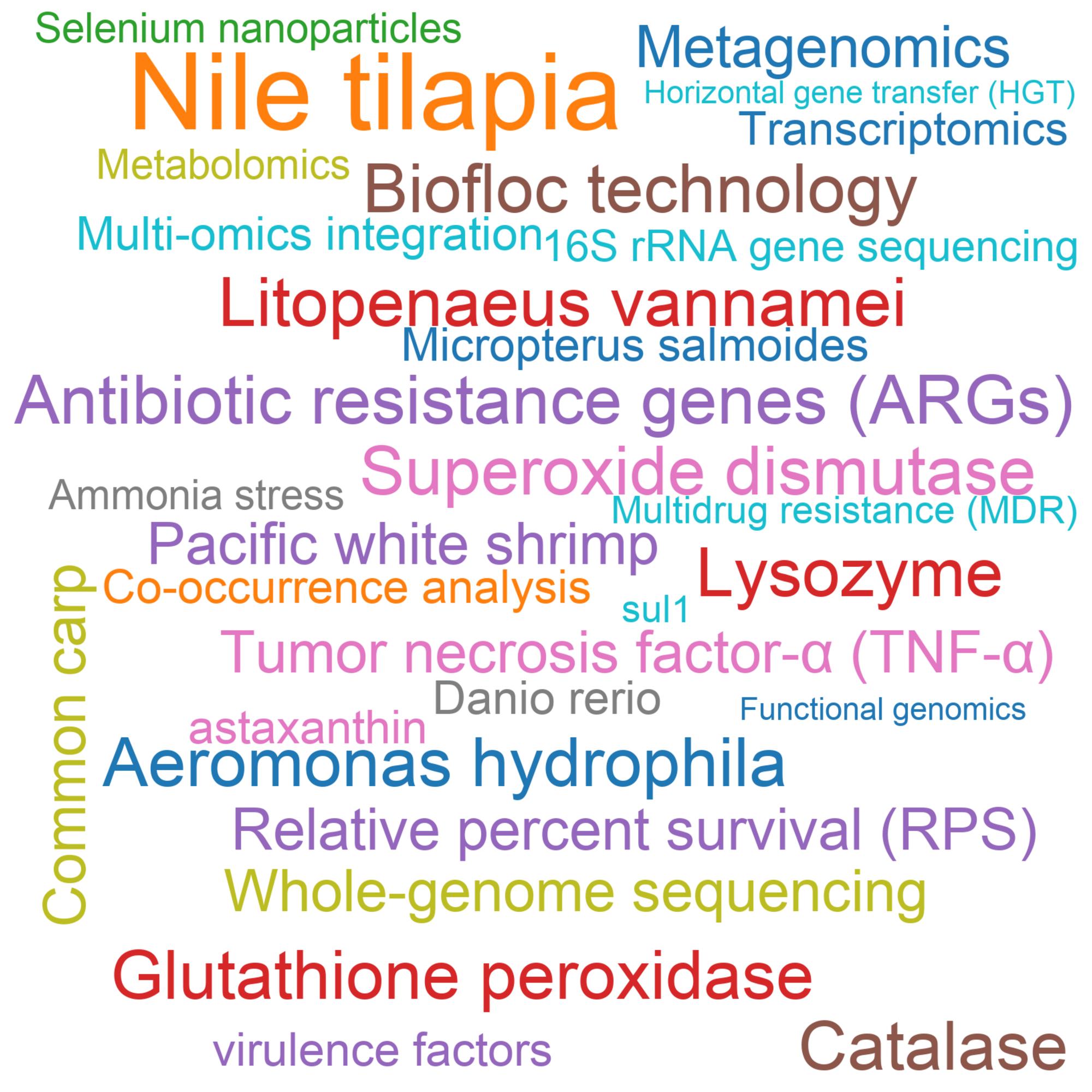
The 2024 aquaculture disease management and microbiota research landscape is centered on disease prevention, mucosal immunity, and sustainable microbial interventions in key commercial species. Major farmed aquatic species drive research activity, led by Nile tilapia (Oreochromis niloticus) and Pacific white shrimp (Litopenaeus vannamei), alongside common carp and largemouth bass (Micropterus salmoides). Host health assessments heavily rely on key antioxidant and immune biomarkers, including superoxide dismutase, glutathione peroxidase, catalase, lysozyme, alkaline phosphatase, and inflammatory cytokines like TNF-α and IL-1β. A central focus of high-impact studies is combating bacterial pathogens—most notably Aeromonas hydrophila—and mitigating antibiotic resistance genes (ARGs) in aquatic environments. To address these disease challenges without relying on conventional antibiotics, researchers are actively investigating biofloc technology, dietary probiotic strains such as Bacillus subtilis, and mucosal immune modulation. Furthermore, advanced analytical methodologies including 16S rRNA gene sequencing, whole-genome sequencing, metagenomics, metabolomics, and co-occurrence network analysis have become essential tools for resolving host-microbe interactions and hepatopancreas morphological responses under environmental stressors like ammonia toxicity.
How Did Topics Shift from the Class of 2025 to the Class of 2026?
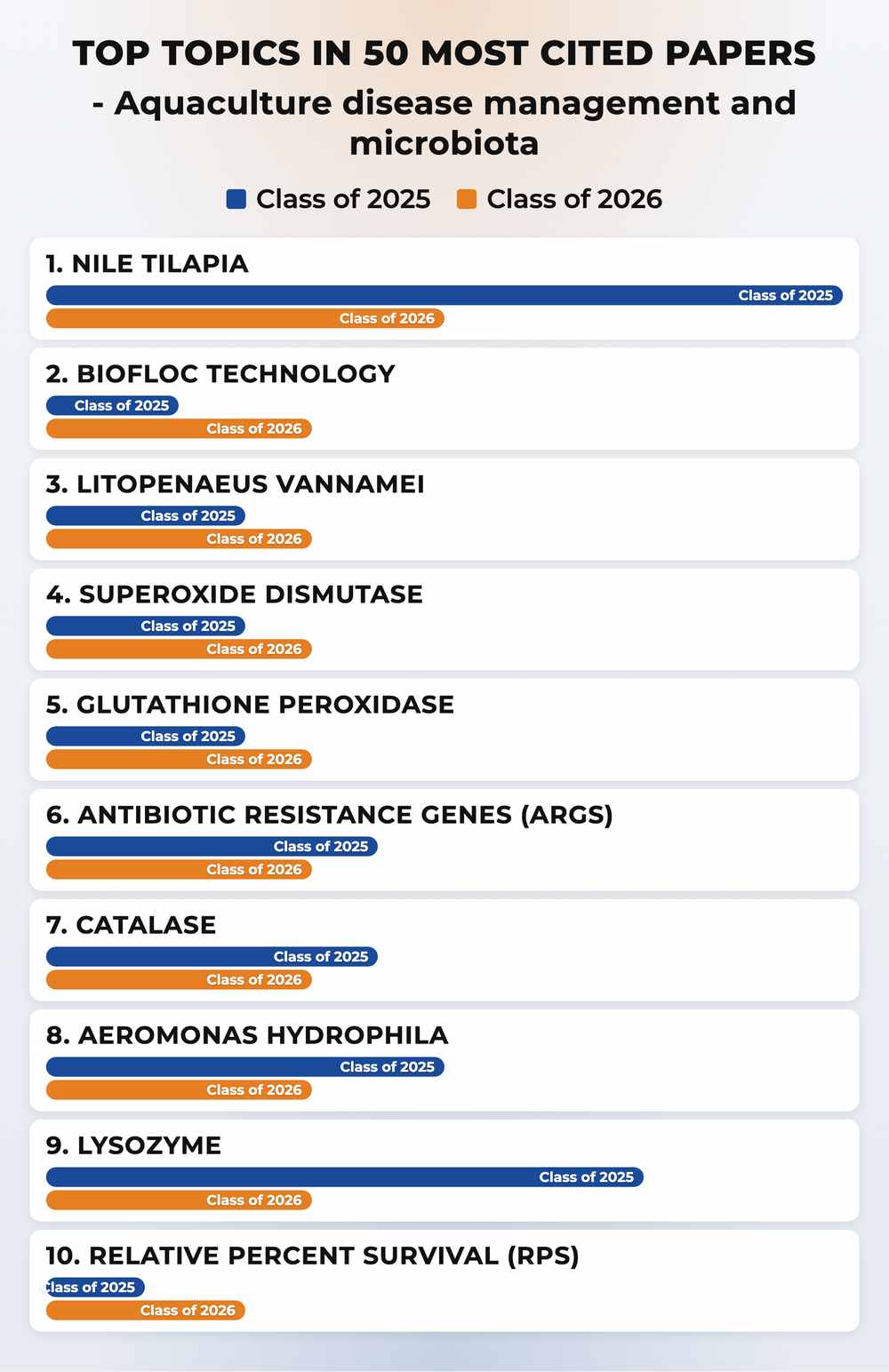
Comparing the 2023 and 2024 publication cohorts reveals a distinct methodological evolution from basic microbial profiling toward functional multi-omics and ecological disease mitigation strategies. Sustainable aquaculture interventions experienced notable gains: biofloc technology expanded two-fold (from 2 to 4 papers), while quantitative disease challenge metrics like relative percent survival (RPS) emerged strongly with 3 high-impact publications. High-throughput sequencing technologies transitioned toward deeper resolution, with metagenomics and whole-genome sequencing increasing three-fold (from 1 to 3 papers each), supported by rising adoption of multi-omics integration, metabolomics, and microbial co-occurrence network analysis. Functional host health markers such as glutathione peroxidase, superoxide dismutase, and hepatopancreas morphological evaluation also demonstrated increased attention. Conversely, single-marker descriptive studies experienced relative declines: standard 16S rRNA gene sequencing fell (from 3 to 2 papers, 0.67x fold-change), as did traditional lysozyme assays (from 9 to 4 papers, 0.44x fold-change). Primary disease model studies focusing exclusively on Nile tilapia (from 12 to 6 papers, 0.50x) and Aeromonas hydrophila challenge models (from 6 to 4 papers, 0.67x) yielded share to broader host-microbiome and ARG dynamics across diverse aquaculture systems.
Methodology
PRI identifies high-impact research using a transparent, topic-agnostic framework applied consistently across scientific domains. Bibliographic records are drawn from OpenAlex, including publication dates, citation relationships, and document types.
This ranking covers the Class of 2026 cohort: journal articles published in 2024. Reviews and other non-article document types are excluded to ensure comparability.
Research impact is quantified with an 18-month post-publication citation window—the number of citing works published within 18 months of each paper's publication date. This metric captures early impact while controlling for publication age.
An LLM-based relevance classifier then reviews each candidate's title and abstract to confirm substantive alignment with the target domain. Only papers classified as relevant appear in the final ranking.
Zheng Su, Tinsley Li, Thematic Shifts in Early-High-Impact Cancer Genomics and Diagnostics Research: A Bibliometric and Semantic Analysis. bioRxiv 2026.07.04.736459; doi: https://doi.org/10.64898/2026.07.04.736459
Cite this ranking
Pepkio Research Index (PRI). Topics and Trends in Most Cited Aquaculture disease management and microbiota Papers, Class of 2026. https://pri.pepkio.com/top-papers/aquaculture-disease-management-and-microbiota/2026. Accessed 2026-10-21.

Methodology
Zheng Su, Tinsley Li, Thematic Shifts in Early-High-Impact Cancer Genomics and Diagnostics Research: A Bibliometric and Semantic Analysis. bioRxiv 2026.07.04.736459; doi: https://doi.org/10.64898/2026.07.04.736459