
What topics and trends defined most-cited Marine and coastal plant biology research in the Class of 2026?
Marine and coastal plant biology in the Class of 2026 is anchored by blue carbon ecosystems and algal bioprospecting. Comparative genomics, invasive macroalgae dynamics, and standardized antioxidant extraction methods showed significant growth, while research on static carbon stocks and acute marine heatwaves declined markedly.
At a glance
- Field
- Marine and coastal plant biology
- Cohort label
- Class of 2026 (2024 publications)
- Papers analyzed
- 4,390
- Papers ranked
- 20
- Top topics in ranked papers
- Blue carbon, seagrass meadows, fucoidan, antioxidant capacity, kelp forests
- Publication window
- Jan 1, 2024 – Dec 31, 2024
- Eligibility
- Research articles; reviews excluded
- Citation window
- 18 months post-publication
- 18m citation range
- 20–68
- Data source
- OpenAlex · Retrieved Jul 2026
- License
- CC BY 4.0
Rankings
20 papers ranked by 18-month citation count
Evolutionary genomics of the emergence of brown algae as key components of coastal ecosystems
Cell202410.1016/j.cell.2024.10.049
Carbon export from seaweed forests to deep ocean sinks
Nature Geoscience202410.1038/s41561-024-01449-7
Global impacts of marine heatwaves on coastal foundation species
Nature Communications202410.1038/s41467-024-49307-9
It's time to broaden what we consider a ‘blue carbon ecosystem’
Global Change Biology202410.1111/gcb.17261
Photosynthetic light requirement near the theoretical minimum detected in Arctic microalgae
Nature Communications202410.1038/s41467-024-51636-8
Advanced Extraction Techniques and Physicochemical Properties of Carrageenan from a Novel Kappaphycus alvarezii Cultivar
Marine Drugs202410.3390/md22110491
Projected loss of brown macroalgae and seagrasses with global environmental change
Nature Communications202410.1038/s41467-024-48273-6
Seagrass genomes reveal ancient polyploidy and adaptations to the marine environment
Nature Plants202410.1038/s41477-023-01608-5
Ultrasound-Assisted Multi-Enzyme Extraction for Highly Efficient Extraction of Polysaccharides from Ulva lactuca
Foods202410.3390/foods13060891
Long-term sediment organic carbon remineralization in different seagrass and macroalgae habitats: implication for blue carbon storage
Frontiers in Marine Science202410.3389/fmars.2024.1370768
Cryogenian Origins of Multicellularity in Archaeplastida
Genome Biology and Evolution202410.1093/gbe/evae026
“Pink power”—the importance of coralline algal beds in the oceanic carbon cycle
Nature Communications202410.1038/s41467-024-52697-5
Optimizing the fucoidan extraction using Box-Behnken Design and its potential bioactivity
International Journal of Biological Macromolecules202410.1016/j.ijbiomac.2024.134490
Mechanisms of recalcitrant fucoidan breakdown in marine Planctomycetota
Nature Communications202410.1038/s41467-024-55268-w
Consequences of kelp forest ecosystem shifts and predictors of persistence through multiple stressors
Proceedings of the Royal Society B Biological Sciences202410.1098/rspb.2023.2749
Marine Protected Areas That Preserve Trophic Cascades Promote Resilience of Kelp Forests to Marine Heatwaves
Global Change Biology202410.1111/gcb.17620
Metagenomic insights into the dynamic degradation of brown algal polysaccharides by kelp-associated microbiota
Applied and Environmental Microbiology202410.1128/aem.02025-23
Optimizing extraction methods by a comprehensive experimental approach and characterizing polyphenol compositions of Ecklonia radiata
Food Chemistry202410.1016/j.foodchem.2024.139926
Reduced and smaller phytoplankton during marine heatwaves in eastern boundary upwelling systems
Communications Earth & Environment202410.1038/s43247-024-01805-w
Invasive Seaweed Rugulopteryx okamurae: A Potential Source of Bioactive Compounds with Antioxidant Activity
Antioxidants202410.3390/antiox13111298
Topic trends
Dominant research themes and year-over-year shifts in Marine and coastal plant biology
What Topics Define the Class of 2026?
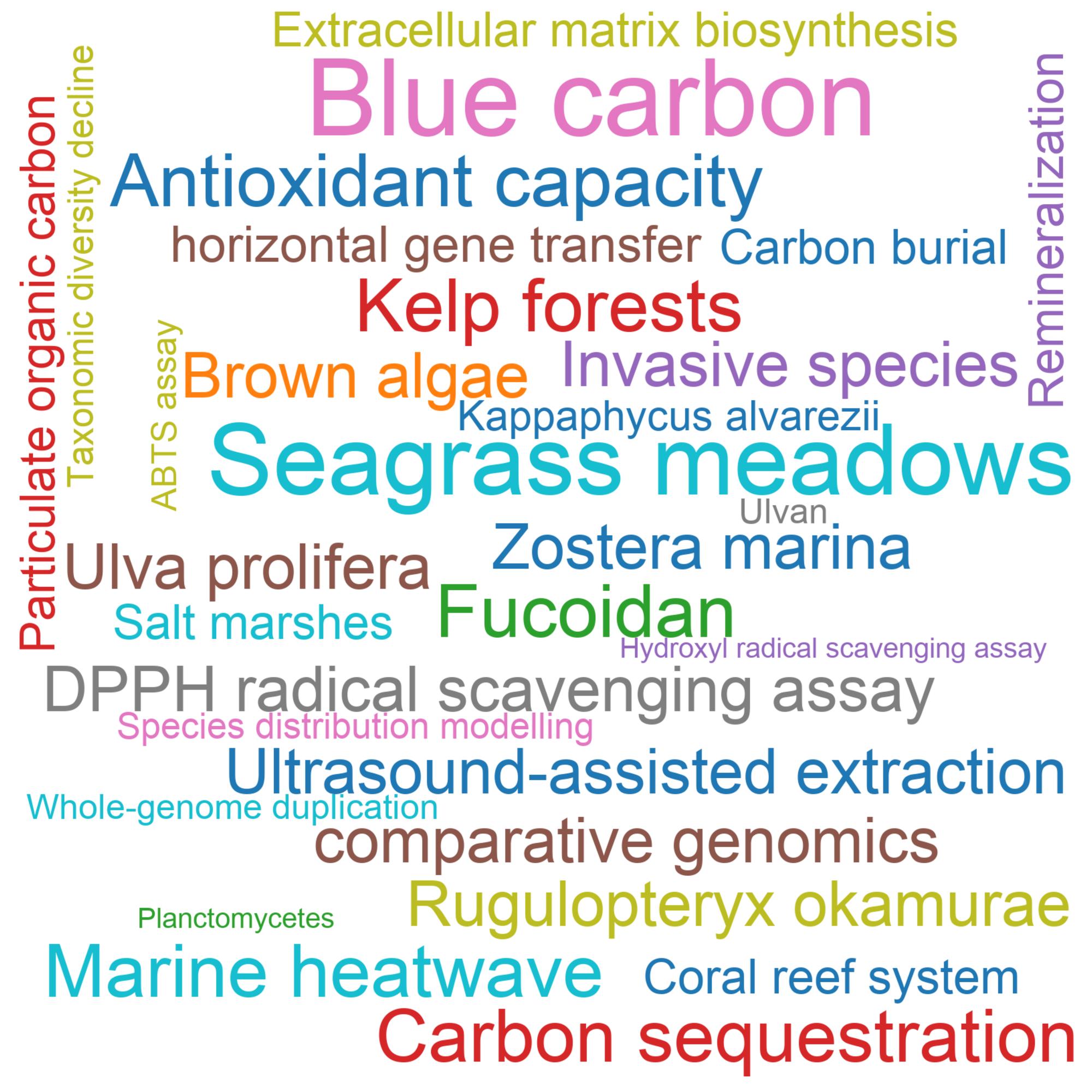
The Class of 2026 in marine and coastal plant biology is strongly defined by blue carbon ecosystems and high-value marine biochemicals. Coastal vegetated habitats represent the primary ecological foundation, led by blue carbon (16% normalized frequency) and seagrass meadows (14%), alongside kelp forests (8%) and carbon sequestration dynamics (8%). Researchers are actively quantifying coastal carbon budgets and examining how vegetated habitats mitigate environmental change. Concurrently, a major biochemical cluster centers on seaweed bioactive compounds and extraction technologies. High-value marine polysaccharides, particularly fucoidan (8%) and ulvan (4%), are prominent alongside functional assays measuring antioxidant capacity (8%), DPPH radical scavenging (6%), and ABTS radical reduction (4%). Advanced bioprocessing techniques like ultrasound-assisted extraction (6%) are increasingly integrated to refine green extraction workflows for algae. Additional key themes encompass species distribution modeling, salt marsh ecology, brown algae physiological traits, and macroalgal blooms across regional coastal waters such as the Yellow Sea. Together, these dominant themes demonstrate a dual focus within marine plant biology: expanding ecological understanding of coastal carbon sinks while advancing high-value pharmaceutical and industrial applications from marine flora.
How Did Topics Shift from the Class of 2025 to the Class of 2026?
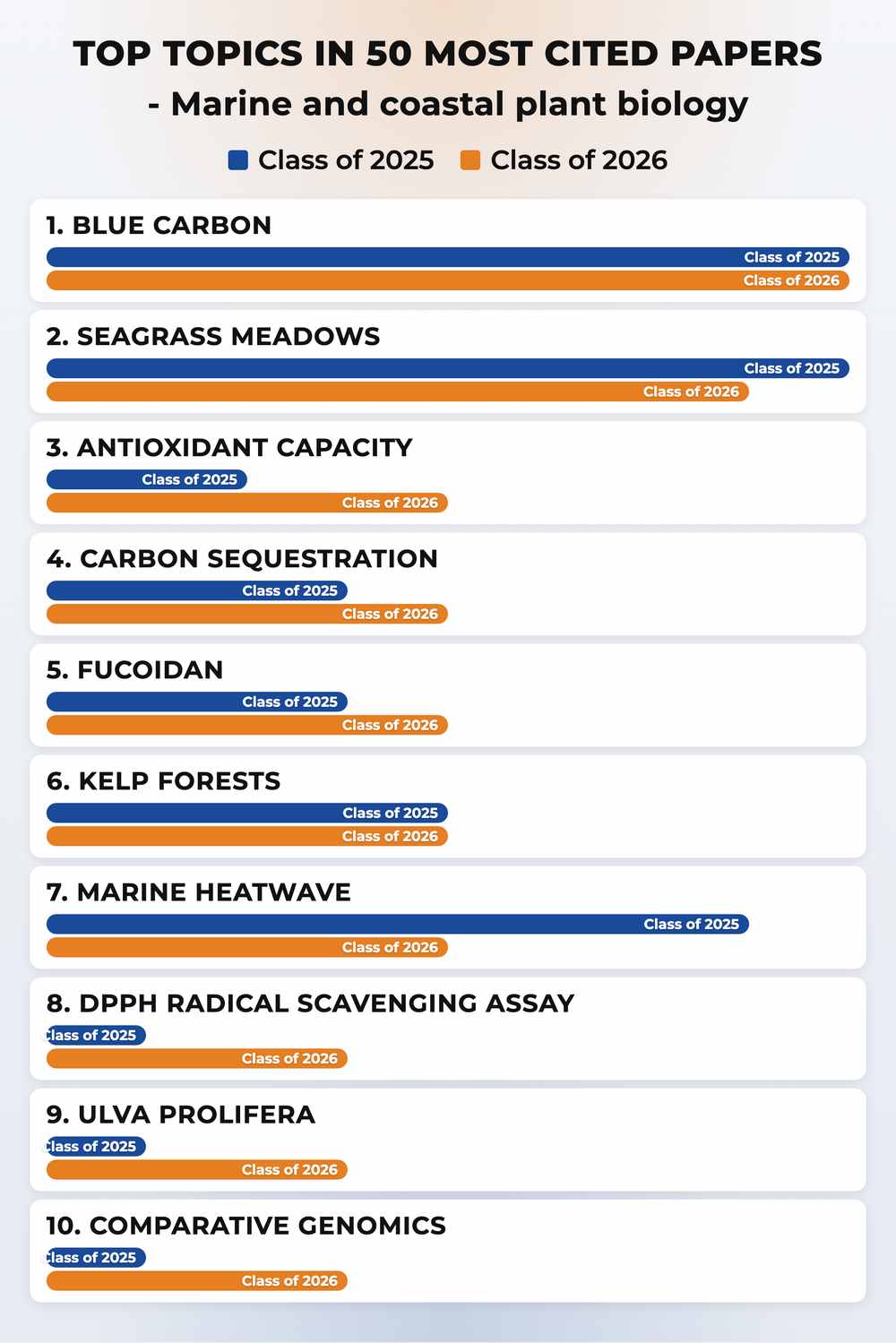
Comparing the Class of 2025 to the Class of 2026 reveals a clear strategic pivot toward molecular genomics, invasive ecology, and high-precision bioprocessing. The most notable growth was driven by comparative genomics, which entered the top cohort at 6% normalized frequency, accompanied by genomic insights into whole-genome duplication (4%) and horizontal gene transfer (4%). Invasive macroalgal species and green tides also saw rapid escalation; Rugulopteryx okamurae and Ulva prolifera surged from zero representation in 2023 to 6% each in 2024, alongside Spartina alterniflora invasions (4%). In contrast, broader observational and climate anomaly themes experienced significant relative declines: carbon stocks studies dropped sharply from 14% to 4%, while marine heatwave research fell from 14% to 8%. Furthermore, methodological focus shifted toward standardized biochemical evaluation, with DPPH radical scavenging assays (6%) and ultrasound-assisted extraction (6%) gaining substantial momentum. This shift highlights an evolving discipline moving beyond static baseline carbon counting toward genomic adaptation, invasion dynamics, and refined marine bioprospecting.
Methodology
PRI identifies high-impact research using a transparent, topic-agnostic framework applied consistently across scientific domains. Bibliographic records are drawn from OpenAlex, including publication dates, citation relationships, and document types.
This ranking covers the Class of 2026 cohort: journal articles published in 2024. Reviews and other non-article document types are excluded to ensure comparability.
Research impact is quantified with an 18-month post-publication citation window—the number of citing works published within 18 months of each paper's publication date. This metric captures early impact while controlling for publication age.
An LLM-based relevance classifier then reviews each candidate's title and abstract to confirm substantive alignment with the target domain. Only papers classified as relevant appear in the final ranking.
Zheng Su, Tinsley Li, Thematic Shifts in Early-High-Impact Cancer Genomics and Diagnostics Research: A Bibliometric and Semantic Analysis. bioRxiv 2026.07.04.736459; doi: https://doi.org/10.64898/2026.07.04.736459
Cite this ranking
Pepkio Research Index (PRI). Topics and Trends in Most Cited Marine and coastal plant biology Papers, Class of 2026. https://pri.pepkio.com/top-papers/marine-and-coastal-plant-biology/2026. Accessed 2026-10-21.

Methodology
Zheng Su, Tinsley Li, Thematic Shifts in Early-High-Impact Cancer Genomics and Diagnostics Research: A Bibliometric and Semantic Analysis. bioRxiv 2026.07.04.736459; doi: https://doi.org/10.64898/2026.07.04.736459