
What topics and trends defined most-cited Marine and coastal ecosystems research in the Class of 2026?
Marine and coastal ecosystems research in the Class of 2026 is anchored by primary production, coastal eutrophication, and dissolved organic matter dynamics. Major expansions feature surges in oxygen tolerance, phytoplankton community modeling, and land-ocean continuum transport, while broad sea surface temperature monitoring and general satellite remote sensing experienced relative declines.
At a glance
- Field
- Marine and coastal ecosystems
- Cohort label
- Class of 2026 (2024 publications)
- Papers analyzed
- 6,137
- Papers ranked
- 20
- Top topics in ranked papers
- Chlorophyll a, primary production, eutrophication, dissolved organic matter (DOM)
- Publication window
- Jan 1, 2024 – Dec 31, 2024
- Eligibility
- Research articles; reviews excluded
- Citation window
- 18 months post-publication
- 18m citation range
- 30–137
- Data source
- OpenAlex · Retrieved Jul 2026
- License
- CC BY 4.0
Rankings
20 papers ranked by 18-month citation count
Nitrogen-fixing organelle in a marine alga
Science202410.1126/science.adk1075
The microbial carbon pump and climate change
Nature Reviews Microbiology202410.1038/s41579-024-01018-0
Biochar-enhanced bioremediation of eutrophic waters impacted by algal blooms
Journal of Environmental Management202410.1016/j.jenvman.2024.122044
New Record Ocean Temperatures and Related Climate Indicators in 2023
Advances in Atmospheric Sciences202410.1007/s00376-024-3378-5
<scp>Bio‐ORACLE</scp> v3.0. Pushing marine data layers to the <scp>CMIP6</scp> Earth System Models of climate change research
Global Ecology and Biogeography202410.1111/geb.13813
Global riverine land-to-ocean carbon export constrained by observations and multi-model assessment
Nature Geoscience202410.1038/s41561-024-01524-z
Evidence of dark oxygen production at the abyssal seafloor
Nature Geoscience202410.1038/s41561-024-01480-8
A Synthesis of Global Coastal Ocean Greenhouse Gas Fluxes
Global Biogeochemical Cycles202410.1029/2023gb007803
Nitrifying niche in estuaries is expanded by the plastisphere
Nature Communications202410.1038/s41467-024-50200-8
Enhanced CO2 uptake of the coastal ocean is dominated by biological carbon fixation
Nature Climate Change202410.1038/s41558-024-01956-w
Microbiology of wetlands and the carbon cycle in coastal wetland mediated by microorganisms
The Science of The Total Environment202410.1016/j.scitotenv.2024.175734
The application of magical microalgae in carbon sequestration and emission reduction: Removal mechanisms and potential analysis
Renewable and Sustainable Energy Reviews202410.1016/j.rser.2024.114417
Particle-attached bacteria act as gatekeepers in the decomposition of complex phytoplankton polysaccharides
Microbiome202410.1186/s40168-024-01757-5
Phytoplankton composition from sPACE: Requirements, opportunities, and challenges
Remote Sensing of Environment202410.1016/j.rse.2023.113964
Growth of sulfate-reducing Desulfobacterota and Bacillota at periodic oxygen stress of 50% air-O2 saturation
Microbiome202410.1186/s40168-024-01909-7
Photosynthetic light requirement near the theoretical minimum detected in Arctic microalgae
Nature Communications202410.1038/s41467-024-51636-8
Astaxanthin Alleviates Hepatic Lipid Metabolic Dysregulation Induced by Microcystin-LR
Toxins202410.3390/toxins16090401
Global subterranean estuaries modify groundwater nutrient loading to the ocean
Limnology and Oceanography Letters202410.1002/lol2.10390
Molecular forecasting of domoic acid during a pervasive toxic diatom bloom
Proceedings of the National Academy of Sciences202410.1073/pnas.2319177121
Robust remote sensing retrieval of key eutrophication indicators in coastal waters based on explainable machine learning
ISPRS Journal of Photogrammetry and Remote Sensing202410.1016/j.isprsjprs.2024.04.007
Topic trends
Dominant research themes and year-over-year shifts in Marine and coastal ecosystems
What Topics Define the Class of 2026?
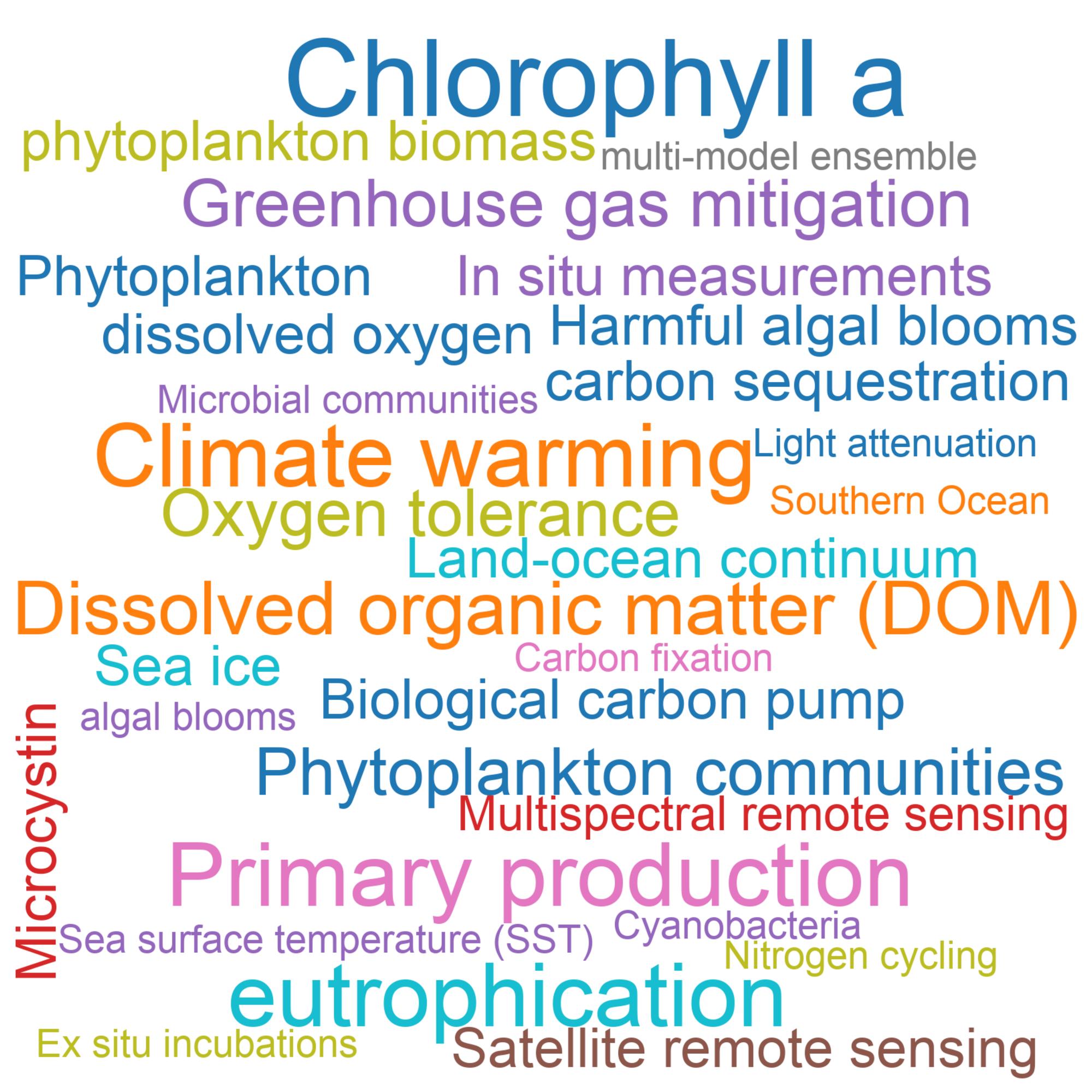
The Class of 2026 in marine and coastal ecosystems research is dominated by studies investigating biogeochemical fluxes, primary productivity, and coastal environmental stressors. Leading the cohort, Chlorophyll a remote sensing and monitoring stands out as the most prominent indicator, present in 14% of top-ranked publications. Primary production and eutrophication dynamics represent major twin pillars, each appearing in 10% of high-impact studies, alongside dissolved organic matter (DOM) characterization (10%). Researchers are placing significant emphasis on coastal water quality degradation and microbial community shifts, highlighted by oxygen tolerance mechanisms (8%) and phytoplankton community dynamics (8%). Additionally, core marine processes such as the biological carbon pump, carbon sequestration, dissolved oxygen depleted zones, sea ice dynamics, and harmful algal blooms (including microcystin toxin analysis) each account for 6% of top paper mentions. Multi-spectral remote sensing techniques and land-ocean continuum modeling are increasingly leveraged to track land-based nutrient runoff and estuarine transport. Together, these dominant themes reflect a strong scientific consensus around quantifying coastal carbon transformation, monitoring anthropogenic eutrophication, and predicting marine ecological responses to changing environmental gradients.
How Did Topics Shift from the Class of 2025 to the Class of 2026?
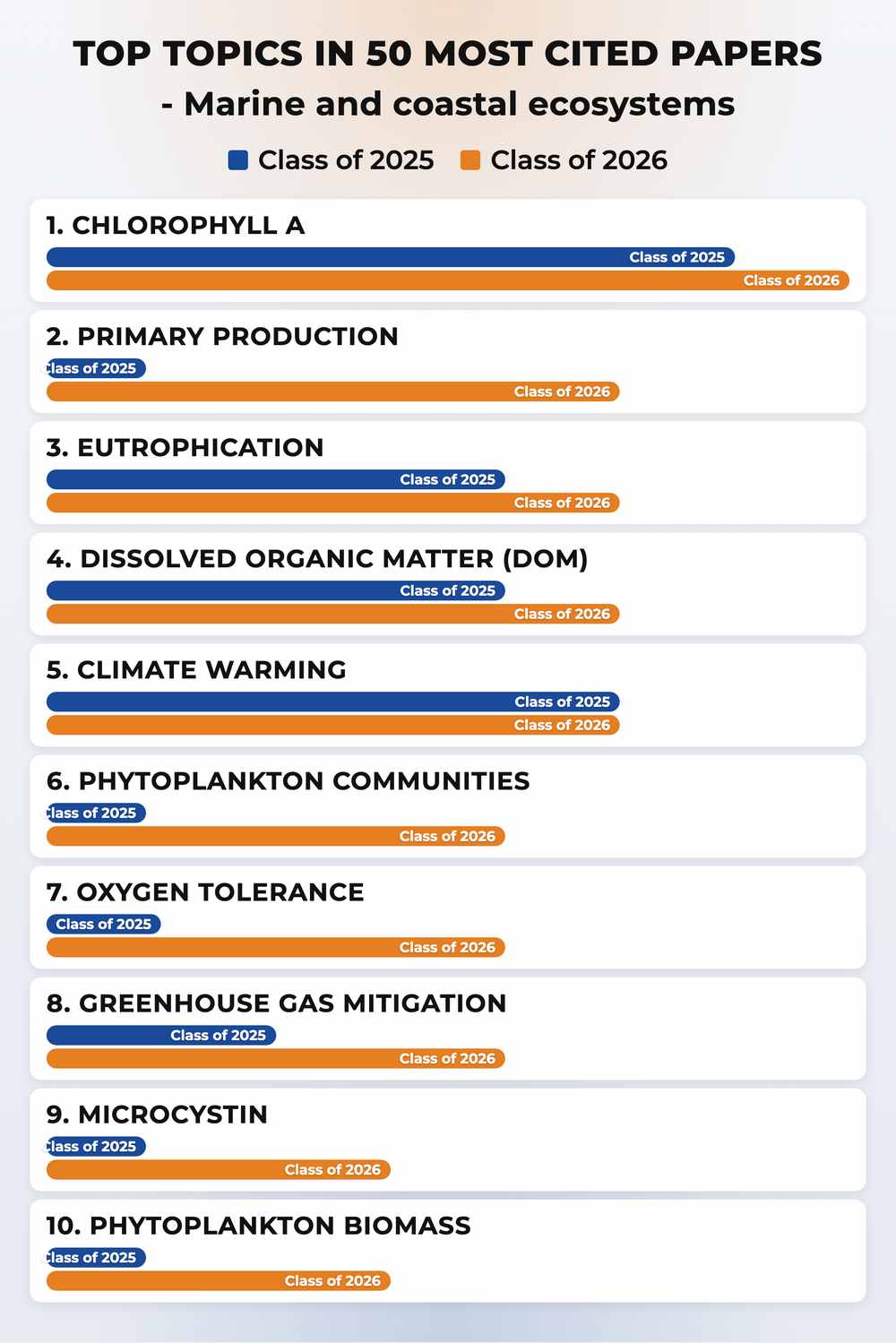
Comparing the Class of 2025 to the Class of 2026 highlights a strategic transition toward process-oriented coastal biogeochemistry and localized ecosystem health monitoring. The most pronounced expansion occurred in primary production research, which surged from zero representation in 2023 to 10% of top-ranked literature in 2024. Similarly, studies targeting phytoplankton community structure and oxygen tolerance saw dramatic gains, rising to 8% of publications each. Emerging growth topics also included multispectral remote sensing, land-ocean continuum interactions, phytoplankton biomass quantification, and cyanobacterial microcystin toxicity, all entering top ranks at 6% frequency. Sea ice biogeochemistry also quadrupled in representation from 2% to 6%. Conversely, broad physical oceanography indicators experienced relative declines: sea surface temperature (SST) tracking dropped from 10% in 2023 to 4% in 2024, and general satellite remote sensing decreased from 10% to 6%. Studies centered on Southern Ocean regional dynamics and iron limitation also showed modest declines from 6% to 4%. This reallocation underscores a field-wide movement from macro-scale thermal monitoring toward high-resolution ecological modeling of coastal nutrient loading, hypoxia resilience, and organic carbon processing.
Methodology
PRI identifies high-impact research using a transparent, topic-agnostic framework applied consistently across scientific domains. Bibliographic records are drawn from OpenAlex, including publication dates, citation relationships, and document types.
This ranking covers the Class of 2026 cohort: journal articles published in 2024. Reviews and other non-article document types are excluded to ensure comparability.
Research impact is quantified with an 18-month post-publication citation window—the number of citing works published within 18 months of each paper's publication date. This metric captures early impact while controlling for publication age.
An LLM-based relevance classifier then reviews each candidate's title and abstract to confirm substantive alignment with the target domain. Only papers classified as relevant appear in the final ranking.
Zheng Su, Tinsley Li, Thematic Shifts in Early-High-Impact Cancer Genomics and Diagnostics Research: A Bibliometric and Semantic Analysis. bioRxiv 2026.07.04.736459; doi: https://doi.org/10.64898/2026.07.04.736459
Cite this ranking
Pepkio Research Index (PRI). Topics and Trends in Most Cited Marine and coastal ecosystems Papers, Class of 2026. https://pri.pepkio.com/top-papers/marine-and-coastal-ecosystems/2026. Accessed 2026-10-24.

Methodology
Zheng Su, Tinsley Li, Thematic Shifts in Early-High-Impact Cancer Genomics and Diagnostics Research: A Bibliometric and Semantic Analysis. bioRxiv 2026.07.04.736459; doi: https://doi.org/10.64898/2026.07.04.736459