
What topics and trends defined most-cited Invertebrate Taxonomy and Ecology research in the Class of 2026?
Research in invertebrate taxonomy and ecology shifted toward functional soil ecology, with earthworms (+14% freq.) and bioturbation (+8%) driving major growth. Soil microbial interactions, livestock-integrated agriculture, and integrative taxonomy expanded rapidly, while standalone species distribution modeling and purely morphological surveys saw relative declines.
At a glance
- Field
- Invertebrate Taxonomy and Ecology
- Cohort label
- Class of 2026 (2024 publications)
- Papers analyzed
- 1,230
- Papers ranked
- 20
- Top topics in ranked papers
- Earthworms, Clitellata, bioturbation, conventional farming, soil microbial communities
- Publication window
- Jan 1, 2024 – Dec 31, 2024
- Eligibility
- Research articles; reviews excluded
- Citation window
- 18 months post-publication
- 18m citation range
- 9–32
- Data source
- OpenAlex · Retrieved Jul 2026
- License
- CC BY 4.0
Rankings
20 papers ranked by 18-month citation count
Linking effect traits of soil fauna to processes of organic matter transformation
Functional Ecology202410.1111/1365-2435.14720
Identification crisis: a fauna-wide estimate of biodiversity expertise shows massive decline in a Central European country
Biodiversity and Conservation202410.1007/s10531-024-02934-6
Earthworms in an enhanced weathering mesocosm experiment: Effects on soil carbon sequestration, base cation exchange and soil CO2 efflux
Soil Biology and Biochemistry202410.1016/j.soilbio.2024.109596
The effects of earthworm species on organic matter transformations and soil microbial communities are only partially related to their bioturbation activity
Soil Biology and Biochemistry202410.1016/j.soilbio.2024.109606
Ephemeroptera, Plecoptera and Trichoptera (EPT) trait-based biomonitoring of rivers within the northwestern Rif of Morocco: implications for determining riverine ecosystems ecological health in Africa
Aquatic Sciences202410.1007/s00027-024-01070-1
Predicting Current and Future Habitat Suitability of an Endemic Species Using Data-Fusion Approach: Responses to Climate Change
Rangeland Ecology & Management202410.1016/j.rama.2024.03.002
Earthworms regulate soil microbial and plant residues through decomposition
Geoderma202410.1016/j.geoderma.2024.117040
Conventional agricultural management negatively affects soil fauna abundance, soil physicochemical quality and multifunctionality
Pedobiologia202410.1016/j.pedobi.2024.150961
Edaphobase 2.0: Advanced international data warehouse for collating and using soil biodiversity datasets
Applied Soil Ecology202410.1016/j.apsoil.2024.105710
Catálogo Taxonômico da Fauna do Brasil: Setting the baseline knowledge on the animal diversity in Brazil
Zoologia (Curitiba)202410.1590/s1984-4689.v41.e24005
Earthworms as Catalysts for Climate-Resilient Agriculture: Enhancing Food Security and Water Management in the Face of Climate Change
Water Air & Soil Pollution202410.1007/s11270-024-07576-6
Make it a standard? The creation and variability assessment of a consensus standard protocol for Tenebrio molitor larvae feeding trials
Journal of Insects as Food and Feed202410.1163/23524588-00001347
Are earthworms the victim, facilitator or antidote of antibiotics and antibiotic resistance at the soil-animal-human interface? A One-Health perspective
The Science of The Total Environment202410.1016/j.scitotenv.2024.173882
Litter quality modulates changes in bacterial and fungal communities during the gut transit of earthworm species of different ecological groups
ISME Communications202410.1093/ismeco/ycae171
Influence of earthworms on the mobility and bioavailability of metals, metalloids and radionuclides in historically contaminated soil
Applied Soil Ecology202410.1016/j.apsoil.2024.105665
Multiple invasion routes have led to the pervasive introduction of earthworms in North America
Nature Ecology & Evolution202410.1038/s41559-023-02310-7
Machine learning approaches delimit cryptic taxa in a previously intractable species complex
Molecular Phylogenetics and Evolution202410.1016/j.ympev.2024.108061
The burrowing and casting dynamics of earthworms are influenced by litter presence as evidenced by repeated scans and a new marker of bioturbation
Applied Soil Ecology202410.1016/j.apsoil.2024.105569
Towards an integrative revision of Haplotaxidae (Annelida: Clitellata)
Zoological Journal of the Linnean Society202410.1093/zoolinnean/zlae141
Phylogenetics of Lepidonotopodini (Macellicephalinae, Polynoidae, Annelida) and Comparative Mitogenomics of Shallow-Water vs. Deep-Sea Scaleworms (Aphroditiformia)
Biology202410.3390/biology13120979
Topic trends
Dominant research themes and year-over-year shifts in Invertebrate Taxonomy and Ecology
What Topics Define the Class of 2026?
The Class of 2026 in Invertebrate Taxonomy and Ecology is strongly anchored by soil biodiversity and functional ecosystem engineering. Earthworms (norm. freq. 0.22) and the class Clitellata (0.14) dominate the research landscape, reflecting intense investigation into their role as ecosystem engineers. A major thematic pillar centers on bioturbation (0.12), where researchers link invertebrate functional traits directly to soil organic matter transformation, carbon sequestration, and soil structure maintenance. Agricultural management impacts form another major focal cluster. Studies heavily evaluate how conventional farming practices (0.08), no-tillage systems (0.06), and livestock-integrated agriculture (0.06) alter soil fauna communities, soil respiration, and remediation processes. Concurrently, interest in subterranean biological interactions has expanded to include soil microbial communities (0.08) and earthworm gut microbiota, highlighting the functional cross-talk between macro-invertebrates and soil microbiomes. Methodologically, the field balances classical biodiversity assessment with modern analytical tools. Integrative taxonomy (0.06), multi-gene phylogeny (0.06), and COI gene barcoding remain essential for resolving complex lineages such as Moniligastridae and terrestrial gastropods. In freshwater ecosystems, aquatic macroinvertebrates—specifically Trichoptera, Ephemeroptera, and Plecoptera (EPT assemblages)—serve as vital bioindicators for water quality and environmental monitoring. Together, these topics reflect a dynamic discipline connecting taxonomic discovery with functional soil and aquatic ecology.
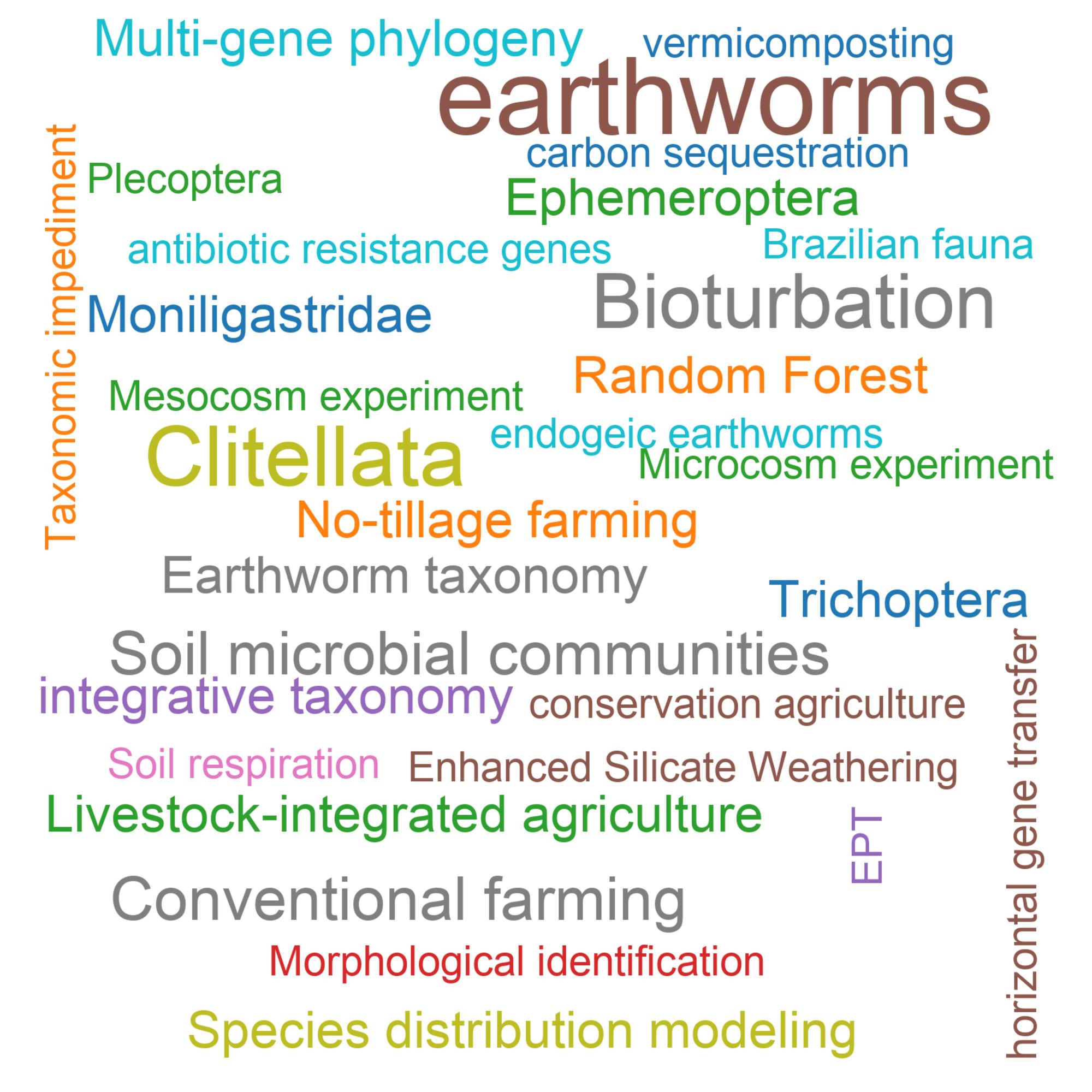
How Did Topics Shift from the Class of 2025 to the Class of 2026?
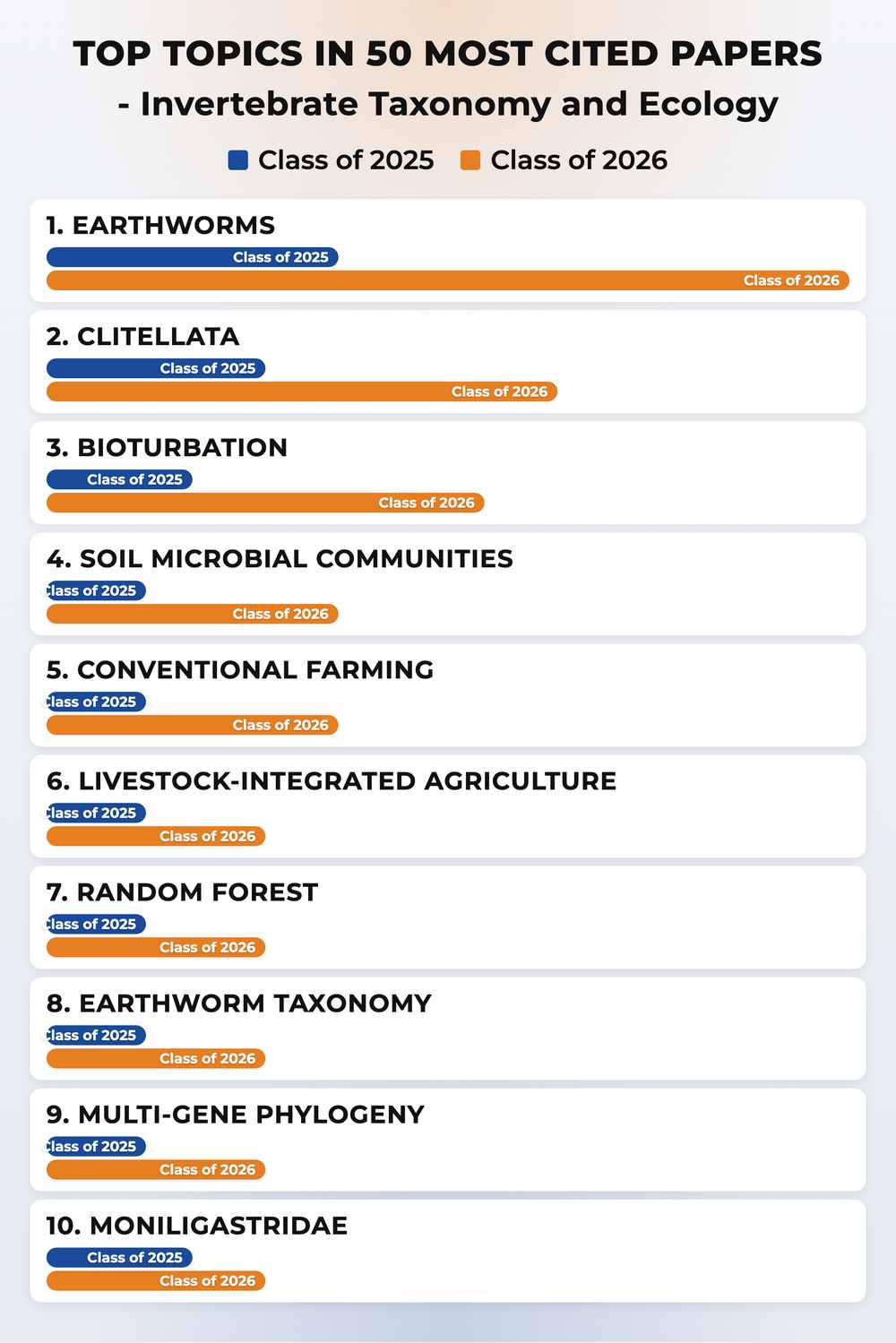
Comparing publication cohorts reveals a distinct shift toward functional soil ecology and microbiome-integrated agricultural studies. The most prominent upward trajectory is led by earthworms, which expanded from a normalized frequency of 0.08 in the Class of 2025 to 0.22 in the Class of 2026 (a 2.75-fold increase). Associated functional processes saw matching growth, with bioturbation rising from 0.04 to 0.12 (3.0-fold increase) and Clitellata expanding from 0.06 to 0.14. Emergent themes in the 2026 cohort highlight sustainable land management and microbial ecology. Soil microbial communities, livestock-integrated agriculture, and Random Forest ecological modeling emerged as new high-impact topics (growing from 0.00 to 0.06–0.08 norm. freq.). Similarly, topics such as conventional farming impacts (4.0-fold increase), biochar, enhanced silicate weathering, and antibiotic resistance genes gained traction as researchers explore invertebrate roles in soil health and climate mitigation. Conversely, broad macro-ecological modeling and standalone morphological surveys experienced relative declines. Species distribution modeling dropped from 0.10 to 0.06 norm. freq., while standalone morphological identification and standalone DNA barcoding saw slight proportional decreases (0.06 to 0.04). Rather than disappearing, these classical approaches are increasingly subsumed into integrative taxonomy frameworks, where multi-gene phylogenetics and morphological traits are deployed jointly to address taxonomic impediments in high-biodiversity regions.
Methodology
PRI identifies high-impact research using a transparent, topic-agnostic framework applied consistently across scientific domains. Bibliographic records are drawn from OpenAlex, including publication dates, citation relationships, and document types.
This ranking covers the Class of 2026 cohort: journal articles published in 2024. Reviews and other non-article document types are excluded to ensure comparability.
Research impact is quantified with an 18-month post-publication citation window—the number of citing works published within 18 months of each paper's publication date. This metric captures early impact while controlling for publication age.
An LLM-based relevance classifier then reviews each candidate's title and abstract to confirm substantive alignment with the target domain. Only papers classified as relevant appear in the final ranking.
Zheng Su, Tinsley Li, Thematic Shifts in Early-High-Impact Cancer Genomics and Diagnostics Research: A Bibliometric and Semantic Analysis. bioRxiv 2026.07.04.736459; doi: https://doi.org/10.64898/2026.07.04.736459
Cite this ranking
Pepkio Research Index (PRI). Topics and Trends in Most Cited Invertebrate Taxonomy and Ecology Papers, Class of 2026. https://pri.pepkio.com/top-papers/invertebrate-taxonomy-and-ecology/2026. Accessed 2026-09-13.

Methodology
Zheng Su, Tinsley Li, Thematic Shifts in Early-High-Impact Cancer Genomics and Diagnostics Research: A Bibliometric and Semantic Analysis. bioRxiv 2026.07.04.736459; doi: https://doi.org/10.64898/2026.07.04.736459