
What topics and trends defined most-cited Geology and Paleoclimatology Research research in the Class of 2026?
Paleoclimate proxy records, ice sheet dynamics, and Earth system evolution dominated the field. High-resolution tree-ring records, precipitation isotopes, and the Mid-Pleistocene Transition led thematic interest. The most significant shift was the rapid emergence of lunar geology from the Chang'e-6 mission, alongside expanded interest in Proterozoic and Archean atmospheric evolution.
At a glance
- Field
- Geology and Paleoclimatology Research
- Cohort label
- Class of 2026 (2024 publications)
- Papers analyzed
- 9,689
- Papers ranked
- 20
- Top topics in ranked papers
- Mid-Pleistocene Transition, Tibetan Plateau, Proterozoic Eon, Tree-ring records, Chang'e-6 mission
- Publication window
- Jan 1, 2024 – Dec 31, 2024
- Eligibility
- Research articles; reviews excluded
- Citation window
- 18 months post-publication
- 18m citation range
- 40–177
- Data source
- OpenAlex · Retrieved June 2026
- License
- CC BY 4.0
Rankings
20 papers ranked by 18-month citation count
A 485-million-year history of Earth’s surface temperature
Science202410.1126/science.adk3705
A sample of the Moon’s far side retrieved by Chang’e-6 contains 2.83-billion-year-old basalt
Science202410.1126/science.adt1093
2023 summer warmth unparalleled over the past 2,000 years
Nature202410.1038/s41586-024-07512-y
300 years of sclerosponge thermometry shows global warming has exceeded 1.5 °C
Nature Climate Change202410.1038/s41558-023-01919-7
Regional differences in the effects of atmospheric moisture residence time on precipitation isotopes over Eurasia
Atmospheric Research202410.1016/j.atmosres.2024.107813
Dataset of stable isotopes of precipitation in the Eurasian continent
Earth system science data202410.5194/essd-16-1543-2024
Co‐evolution of early Earth environments and microbial life
Nature Reviews Microbiology202410.1038/s41579-024-01044-y
The restoration of karst rocky desertification has enhanced the carbon sequestration capacity of the ecosystem in southern China
Global and Planetary Change202410.1016/j.gloplacha.2024.104602
Global and regional temperature change over the past 4.5 million years
Science202410.1126/science.adi1908
Influence of mountain orientation on precipitation isotopes in the westerly belt of Eurasia
Global and Planetary Change202410.1016/j.gloplacha.2024.104543
The 4.2 ka event is not remarkable in the context of Holocene climate variability
Nature Communications202410.1038/s41467-024-50886-w
The impacts of climate change on coastal groundwater
Nature Reviews Earth & Environment202410.1038/s43017-023-00500-2
Environmental drivers of increased ecosystem respiration in a warming tundra
Nature202410.1038/s41586-024-07274-7
Exploring the effects of weighting against homoplasy in genealogies of palaeontological phylogenetic matrices
Cladistics202410.1111/cla.12581
Soil carbon in the world’s tidal marshes
Nature Communications202410.1038/s41467-024-54572-9
The history of Earth’s sulfur cycle
Nature Reviews Earth & Environment202410.1038/s43017-024-00615-0
Mid-Pleistocene climate transition triggered by Antarctic Ice Sheet growth
Science202410.1126/science.abn4861
Returned samples indicate volcanism on the Moon 120 million years ago
Science202410.1126/science.adk6635
Storage, form, and influencing factors of karst inorganic carbon in a carbonate area in China
Science China Earth Sciences202410.1007/s11430-023-1249-9
Middle and Late Pleistocene Denisovan subsistence at Baishiya Karst Cave
Nature202410.1038/s41586-024-07612-9
Topic trends
Dominant research themes and year-over-year shifts in Geology and Paleoclimatology Research
What Topics Define the Class of 2026?
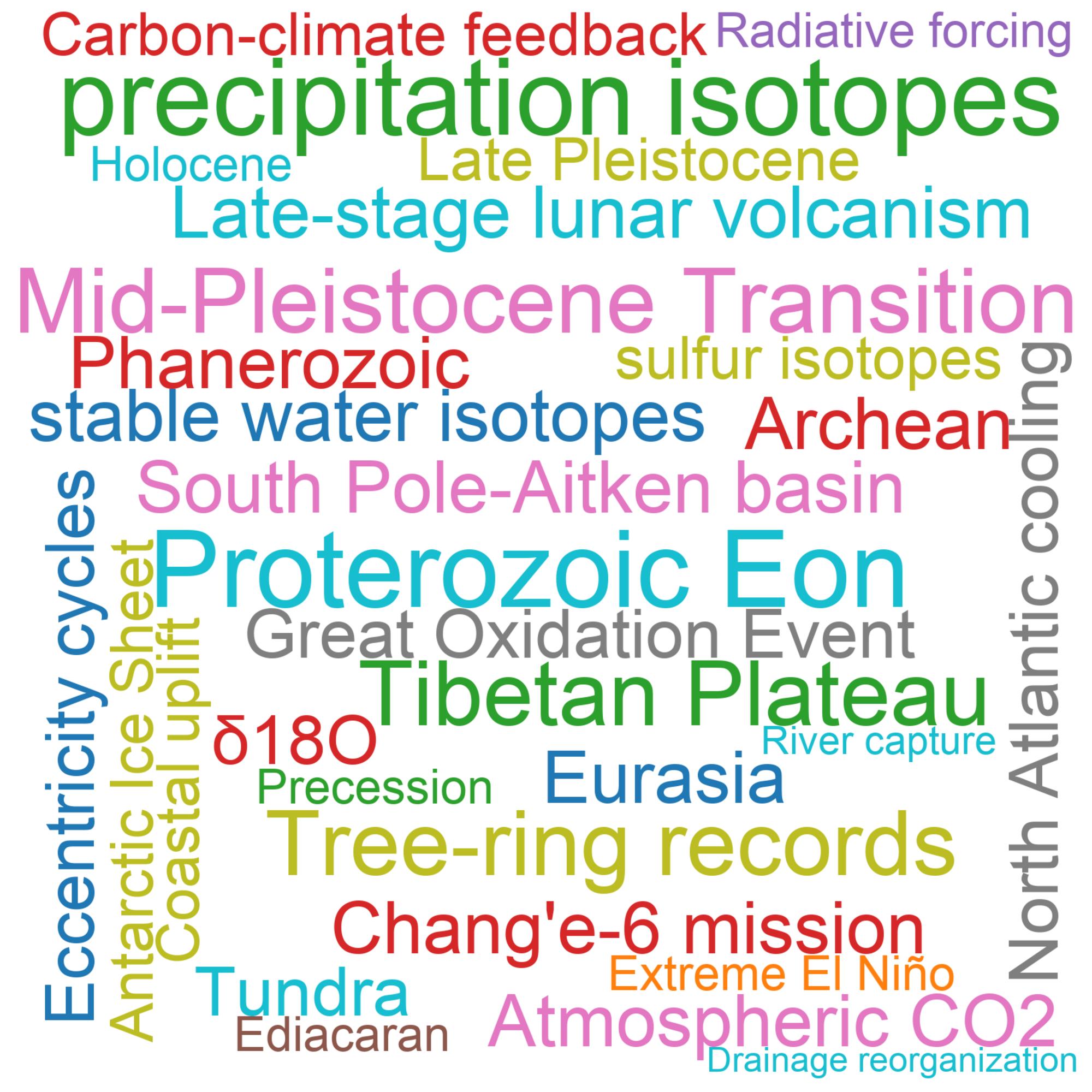
The Class of 2026 in Geology and Paleoclimatology Research is defined by high-resolution paleoclimate reconstructions, Quaternary ice age dynamics, and deep-time Earth and planetary evolution. Paleoclimate proxies were central to the cohort, led by precipitation isotopes, stable water isotopes, and tree-ring records featured in up to 6% of top papers. In Quaternary climate dynamics, the Mid-Pleistocene Transition emerged as a key focal point for understanding orbital forcing, eccentricity cycles, and ice sheet sensitivity, with major contributions analyzing Antarctic Ice Sheet behavior and North Atlantic cooling. In regional geomorphology and climate interactions, the Tibetan Plateau was prominent, driving studies on tectonic uplift, drainage reorganization, and Asian monsoon evolution. Deep-time Earth history maintained strong representation across the Proterozoic Eon, Archean, Great Oxidation Event, and Ediacaran, highlighting carbon-climate feedbacks and atmospheric CO2 controls. Crucially, planetary geology made a major impact on this cohort, highlighted by lunar sample returns from China's Chang'e-6 mission to the South Pole-Aitken basin, providing critical constraint on late-stage lunar volcanism and crater chronology.
How Did Topics Shift from the Class of 2025 to the Class of 2026?
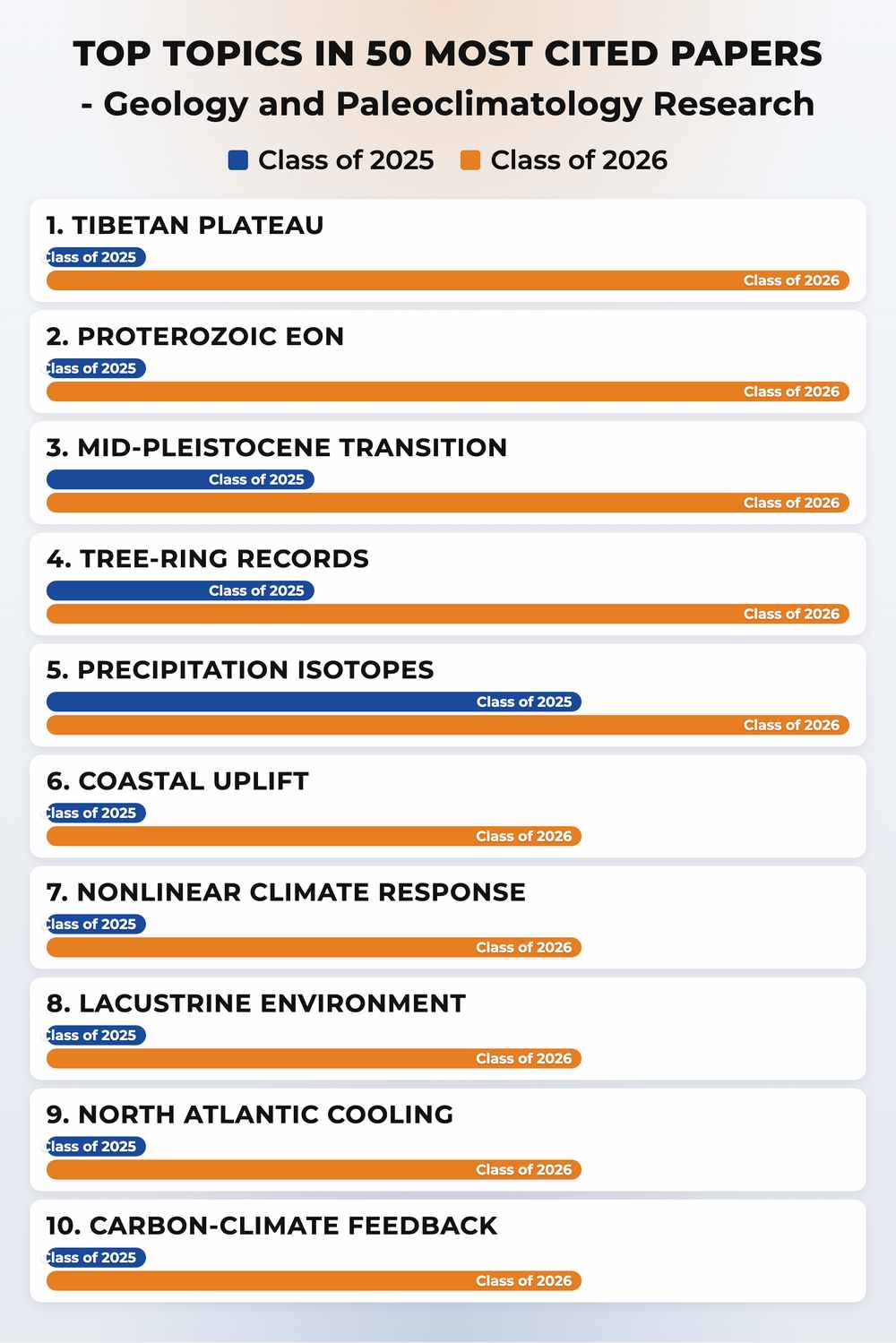
Comparing the Class of 2025 to the Class of 2026 reveals significant thematic expansion toward planetary sample analysis, orbital paleoclimatology, and tectonic-hydrologic coupling. The most prominent surge was driven by lunar geology, where research on the Chang'e-6 mission, the South Pole-Aitken basin, and late-stage lunar volcanism rose from absence in the prior year to 4% of top papers following sample returns. In terrestrial paleoclimatology, studies of the Mid-Pleistocene Transition and tree-ring records tripled in frequency (from 2% to 6%), signaling an intensified focus on high-precision climate benchmarks and nonlinear climate responses. Research on the Tibetan Plateau and Proterozoic Eon also experienced steep gains, expanding from zero presence to 6% representation. Similarly, investigations into extreme El Niño events, carbon-climate feedbacks, and stable water isotope dynamics doubled or newly emerged. Conversely, generic regional surveys saw reduced relative emphasis as the field pivoted toward mechanistic integration of paleoclimate proxy data, orbital cycles, and planetary evolution.
Methodology
PRI identifies high-impact research using a transparent, topic-agnostic framework applied consistently across scientific domains. Bibliographic records are drawn from OpenAlex, including publication dates, citation relationships, and document types.
This ranking covers the Class of 2026 cohort: journal articles published in 2024. Reviews and other non-article document types are excluded to ensure comparability.
Research impact is quantified with an 18-month post-publication citation window—the number of citing works published within 18 months of each paper's publication date. This metric captures early impact while controlling for publication age.
An LLM-based relevance classifier then reviews each candidate's title and abstract to confirm substantive alignment with the target domain. Only papers classified as relevant appear in the final ranking.
Zheng Su, Tinsley Li, Thematic Shifts in Early-High-Impact Cancer Genomics and Diagnostics Research: A Bibliometric and Semantic Analysis. bioRxiv 2026.07.04.736459; doi: https://doi.org/10.64898/2026.07.04.736459
Cite this ranking
Pepkio Research Index (PRI). Topics and Trends in Most Cited Geology and Paleoclimatology Research Papers, Class of 2026. https://pri.pepkio.com/top-papers/geology-and-paleoclimatology-research/2026. Accessed 2026-09-13.

Methodology
Zheng Su, Tinsley Li, Thematic Shifts in Early-High-Impact Cancer Genomics and Diagnostics Research: A Bibliometric and Semantic Analysis. bioRxiv 2026.07.04.736459; doi: https://doi.org/10.64898/2026.07.04.736459