
What topics and trends defined most-cited Forest Insect Ecology and Management research in the Class of 2026?
Forest insect ecology in the Class of 2026 is driven by predictive species distribution modeling and climate scenario forecasting for major pests like Bursaphelenchus xylophilus and Ips typographus. MaxEnt modeling and range expansion analysis saw the largest growth, while empirical canopy monitoring methods like UAV imagery and green attack detection experienced relative declines.
At a glance
- Field
- Forest Insect Ecology and Management
- Cohort label
- Class of 2026 (2024 publications)
- Papers analyzed
- 3,722
- Papers ranked
- 20
- Top topics in ranked papers
- Species distribution modeling, MaxEnt, future climate scenarios, Ips typographus, Bursaphelenchus xylophilus
- Publication window
- Jan 1, 2024 – Dec 31, 2024
- Eligibility
- Research articles; reviews excluded
- Citation window
- 18 months post-publication
- 18m citation range
- 14–30
- Data source
- OpenAlex · Retrieved Jul 2026
- License
- CC BY 4.0
Rankings
20 papers ranked by 18-month citation count
Drought increases Norway spruce susceptibility to the Eurasian spruce bark beetle and its associated fungi
New Phytologist202410.1111/nph.19635
Can ecological niche models be used to accurately predict the distribution of invasive insects? A case study of <i>Hyphantria cunea</i> in China
Ecology and Evolution202410.1002/ece3.11159
The Value of Forests to Pollinating Insects Varies with Forest Structure, Composition, and Age
Current Forestry Reports202410.1007/s40725-024-00224-6
YOLOv8-RD: High-Robust Pine Wilt Disease Detection Method Based on Residual Fuzzy YOLOv8
IEEE Journal of Selected Topics in Applied Earth Observations and Remote Sensing202410.1109/jstars.2024.3494838
Spatial Distribution Pattern of <i>Aromia bungii</i> Within China and Its Potential Distribution Under Climate Change and Human Activity
Ecology and Evolution202410.1002/ece3.70520
Predicting the global potential distribution of Bursaphelenchus xylophilus using an ecological niche model: expansion trend and the main driving factors
BMC Ecology and Evolution202410.1186/s12862-024-02234-1
Drought initialised bark beetle outbreak in Central Europe: Meteorological factors and infestation dynamic
Forest Ecology and Management202410.1016/j.foreco.2023.121666
Patterns of early post-disturbance reorganization in Central European forests
Proceedings of the Royal Society B Biological Sciences202410.1098/rspb.2024.0625
Occurrence and potential diffusion of pine wilt disease mediated by insect vectors in China under climate change
Pest Management Science202410.1002/ps.8335
In Situ Antimicrobial Properties of Sabinene Hydrate, a Secondary Plant Metabolite
Molecules202410.3390/molecules29174252
Vulnerability of Global Pine Forestry's Carbon Sink to an Invasive Pathogen–Vector System
Global Change Biology202410.1111/gcb.17614
Evaluating the Impact of Climate Change and Human Activities on the Potential Distribution of Pine Wood Nematode (Bursaphelenchus xylophilus) in China
Forests202410.3390/f15071253
Ecosystem heterogeneity is key to limiting the increasing climate-driven risks to European forests
One Earth202410.1016/j.oneear.2024.10.005
Detection of green attack and bark beetle susceptibility in Norway Spruce: Utilizing PlanetScope Multispectral Imagery for Tri-Stage spectral separability analysis
Forest Ecology and Management202410.1016/j.foreco.2024.121838
Modeling the distribution of pine wilt disease in China using the ensemble models <scp>MaxEnt</scp> and <scp>CLIMEX</scp>
Ecology and Evolution202410.1002/ece3.70277
A general DDE framework to describe insect populations: Why delays are so important?
Ecological Modelling202410.1016/j.ecolmodel.2024.110937
Higher tree species richness and diversity in urban areas than in forests: Implications for host availability for invasive tree pests and pathogens
Landscape and Urban Planning202410.1016/j.landurbplan.2024.105144
Bark beetle pre-emergence detection using multi-temporal hyperspectral drone images: Green shoulder indices can indicate subtle tree vitality decline
ISPRS Journal of Photogrammetry and Remote Sensing202410.1016/j.isprsjprs.2024.07.027
Why so many Hemiptera invasions?
Diversity and Distributions202410.1111/ddi.13911
Catching invasives with curiosity: the importance of passive biosecurity surveillance systems for invasive forest pest detection
Environmental Entomology202410.1093/ee/nvae082
Topic trends
Dominant research themes and year-over-year shifts in Forest Insect Ecology and Management
What Topics Define the Class of 2026?
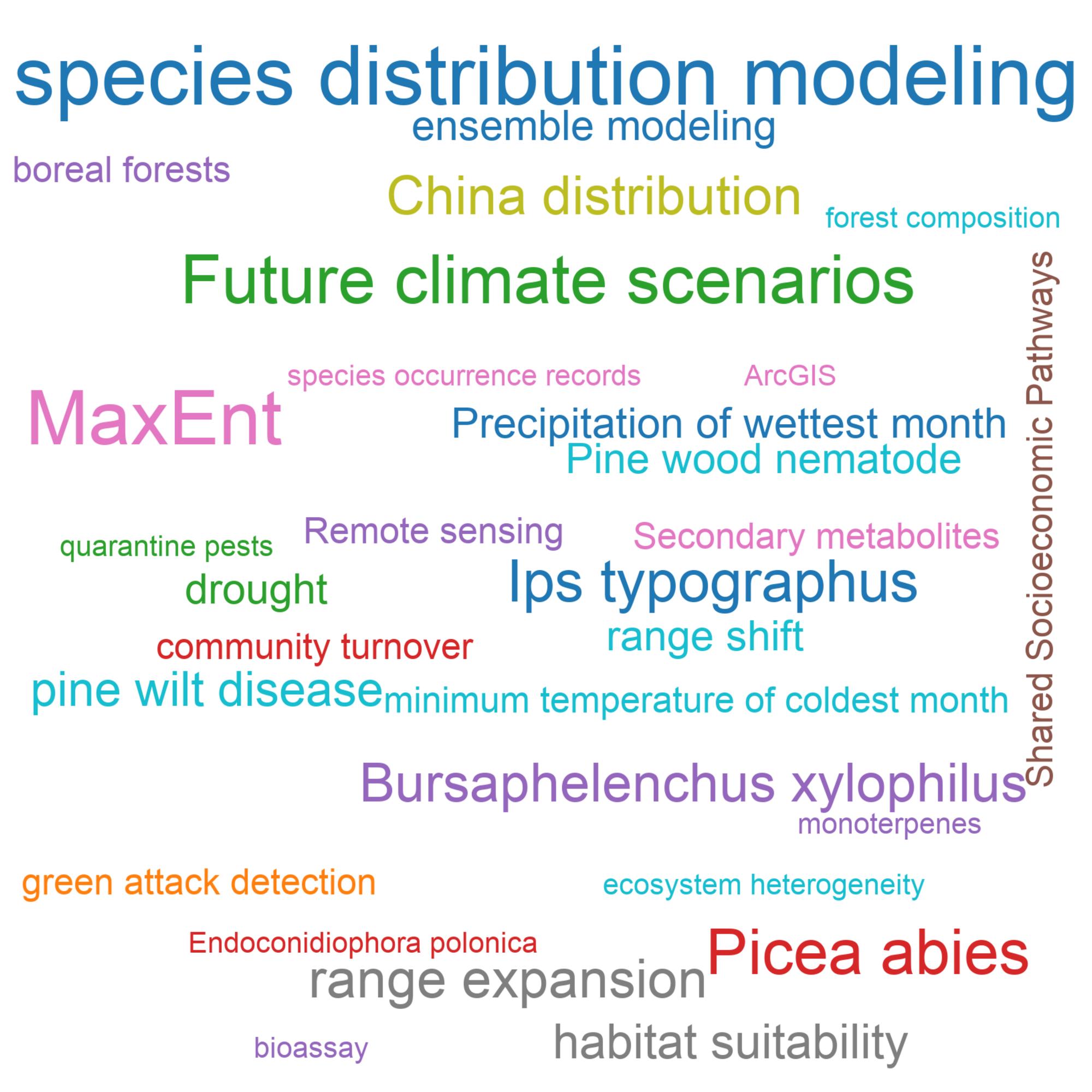
In the Class of 2026, research in forest insect ecology and management is strongly centered on species distribution modeling and climate impact forecasting. The most prominent analytical frameworks include Maximum Entropy (MaxEnt) modeling and ensemble modeling, widely applied to project habitat suitability under future climate scenarios. Research heavily targets major forest pests and vectors, notably the European spruce bark beetle (Ips typographus) attacking Norway spruce (Picea abies), as well as the pine wood nematode (Bursaphelenchus xylophilus) causing pine wilt disease. Geographic distribution studies, particularly focusing on range expansion and potential distribution across vulnerable forest ecosystems in China and Europe, represent a core thematic cluster. Environmental stressors such as drought and changing precipitation patterns are increasingly integrated into niche models to anticipate pest outbreaks and range shifts. Together, these patterns reflect a discipline-wide shift toward predictive, macro-ecological modeling tools designed to inform proactive forest protection and biosecurity management under accelerating global climate change.
How Did Topics Shift from the Class of 2025 to the Class of 2026?
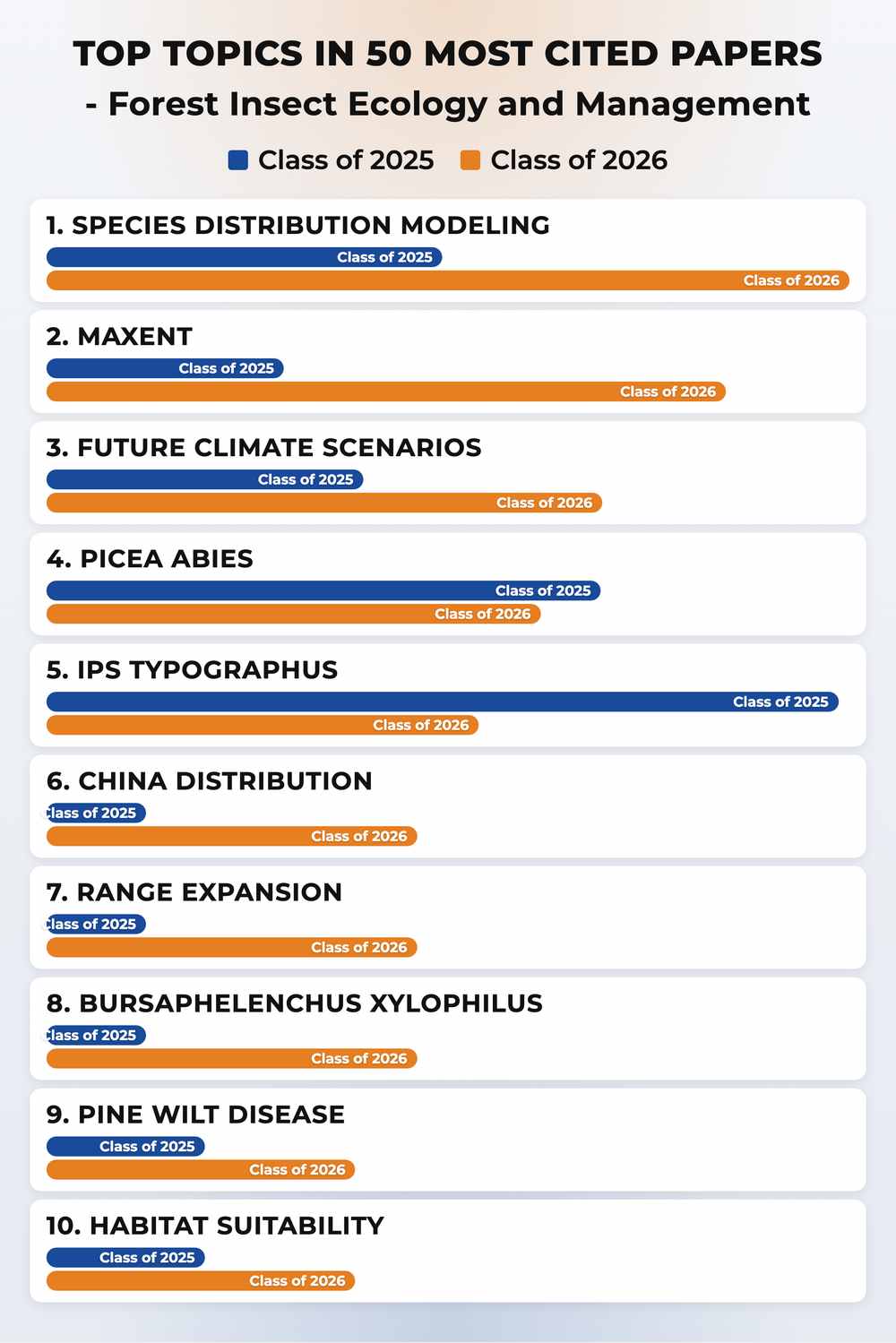
Comparing the Class of 2025 to the Class of 2026 reveals a distinct transition from localized, remote sensing-based canopy monitoring toward high-resolution predictive species distribution modeling. Methodologies such as MaxEnt and species distribution modeling experienced the sharpest growth, propelled by expanding research into range expansion and climate suitability for invasive pests like Bursaphelenchus xylophilus. Regional biogeographic studies focusing on distribution shifts in China and ensemble climate modeling also recorded marked increases. Conversely, empirical monitoring topics such as green attack detection and unmanned aerial vehicle (UAV) imagery saw noticeable declines in relative frequency. While Ips typographus remains a core focal insect, its relative representation moderated compared to the previous cohort as attention expanded to emerging pine wilt vectors and broader invasive species risks. Overall, the field is evolving from reactive airborne surveillance of active forest damage toward proactive, model-driven forecasting of climate-driven insect range expansions.
Methodology
PRI identifies high-impact research using a transparent, topic-agnostic framework applied consistently across scientific domains. Bibliographic records are drawn from OpenAlex, including publication dates, citation relationships, and document types.
This ranking covers the Class of 2026 cohort: journal articles published in 2024. Reviews and other non-article document types are excluded to ensure comparability.
Research impact is quantified with an 18-month post-publication citation window—the number of citing works published within 18 months of each paper's publication date. This metric captures early impact while controlling for publication age.
An LLM-based relevance classifier then reviews each candidate's title and abstract to confirm substantive alignment with the target domain. Only papers classified as relevant appear in the final ranking.
Zheng Su, Tinsley Li, Thematic Shifts in Early-High-Impact Cancer Genomics and Diagnostics Research: A Bibliometric and Semantic Analysis. bioRxiv 2026.07.04.736459; doi: https://doi.org/10.64898/2026.07.04.736459
Cite this ranking
Pepkio Research Index (PRI). Topics and Trends in Most Cited Forest Insect Ecology and Management Papers, Class of 2026. https://pri.pepkio.com/top-papers/forest-insect-ecology-and-management/2026. Accessed 2026-09-13.

Methodology
Zheng Su, Tinsley Li, Thematic Shifts in Early-High-Impact Cancer Genomics and Diagnostics Research: A Bibliometric and Semantic Analysis. bioRxiv 2026.07.04.736459; doi: https://doi.org/10.64898/2026.07.04.736459