
What topics and trends defined most-cited Animal Virus Infections Studies research in the Class of 2026?
The Class of 2026 in Animal Virus Infections Studies is heavily focused on SARS-CoV-2 evolution, particularly immune evasion by Omicron subvariants like XBB.1.5 and JN.1. A major shift from 2023 to 2024 shows rising focus on reactogenicity, antibody durability, and newer variants like EG.5.1 and JN.1, alongside a relative decline in broader SARS-CoV-2 research.
At a glance
- Field
- Animal Virus Infections Studies
- Cohort label
- Class of 2026 (2024 publications)
- Papers analyzed
- 5014
- Papers ranked
- 20
- Top topics in ranked papers
- Immune evasion, Omicron XBB.1.5, SARS-CoV-2, Spike protein
- Publication window
- Jan 1, 2024 – Dec 31, 2024
- Eligibility
- Research articles; reviews excluded
- Citation window
- 18 months post-publication
- 18m citation range
- 45–145
- Data source
- OpenAlex · Retrieved September 2026
- License
- CC BY 4.0
Rankings
20 papers ranked by 18-month citation count
H5N1 clade 2.3.4.4b dynamics in experimentally infected calves and cows
Nature202410.1038/s41586-024-08063-y
XBB.1.5 monovalent mRNA vaccine booster elicits robust neutralizing antibodies against XBB subvariants and JN.1
Cell Host & Microbe202410.1016/j.chom.2024.01.014
Efficacy and Safety of Respiratory Syncytial Virus (RSV) Prefusion F Protein Vaccine (RSVPreF3 OA) in Older Adults Over 2 RSV Seasons
Clinical Infectious Diseases202410.1093/cid/ciae010
Virological characteristics of the SARS-CoV-2 BA.2.86 variant
Cell Host & Microbe202410.1016/j.chom.2024.01.001
SARS-CoV-2-infection- and vaccine-induced antibody responses are long lasting with an initial waning phase followed by a stabilization phase
Immunity202410.1016/j.immuni.2024.01.017
Sialic Acid Receptor Specificity in Mammary Gland of Dairy Cattle Infected with Highly Pathogenic Avian Influenza A(H5N1) Virus
Emerging infectious diseases202410.3201/eid3007.240689
SARS-CoV-2-specific plasma cells are not durably established in the bone marrow long-lived compartment after mRNA vaccination
Nature Medicine202410.1038/s41591-024-03278-y
Virological characteristics of the SARS-CoV-2 KP.3.1.1 variant
The Lancet Infectious Diseases202410.1016/s1473-3099(24)00505-x
Transmission of a human isolate of clade 2.3.4.4b A(H5N1) virus in ferrets
Nature202410.1038/s41586-024-08246-7
Development of a nucleoside-modified mRNA vaccine against clade 2.3.4.4b H5 highly pathogenic avian influenza virus
Nature Communications202410.1038/s41467-024-48555-z
Virological characteristics of the SARS-CoV-2 Omicron XBB.1.5 variant
Nature Communications202410.1038/s41467-024-45274-3
Highly pathogenic avian influenza A(H5N1) virus of clade 2.3.4.4b isolated from a human case in Chile causes fatal disease and transmits between co-housed ferrets
Emerging Microbes & Infections202410.1080/22221751.2024.2332667
A potent pan-sarbecovirus neutralizing antibody resilient to epitope diversification
Cell202410.1016/j.cell.2024.09.026
A single mutation in dairy cow-associated H5N1 viruses increases receptor binding breadth
Nature Communications202410.1038/s41467-024-54934-3
Interim Report of the Reactogenicity and Immunogenicity of Severe Acute Respiratory Syndrome Coronavirus 2 XBB–Containing Vaccines
The Journal of Infectious Diseases202410.1093/infdis/jiae067
An Omicron-specific, self-amplifying mRNA booster vaccine for COVID-19: a phase 2/3 randomized trial
Nature Medicine202410.1038/s41591-024-02955-2
Recurrent SARS-CoV-2 spike mutations confer growth advantages to select JN.1 sublineages
Emerging Microbes & Infections202410.1080/22221751.2024.2402880
The evolution and diversity of porcine reproductive and respiratory syndrome virus in China
Veterinary Microbiology202410.1016/j.vetmic.2024.110252
PEDV-spike-protein-expressing mRNA vaccine protects piglets against PEDV challenge
mBio202410.1128/mbio.02958-23
Long-Term Prognosis of Patients With Myocarditis Attributed to COVID-19 mRNA Vaccination, SARS-CoV-2 Infection, or Conventional Etiologies
JAMA202410.1001/jama.2024.16380
Topic trends
Dominant research themes and year-over-year shifts in Animal Virus Infections Studies
What Topics Define the Class of 2026?
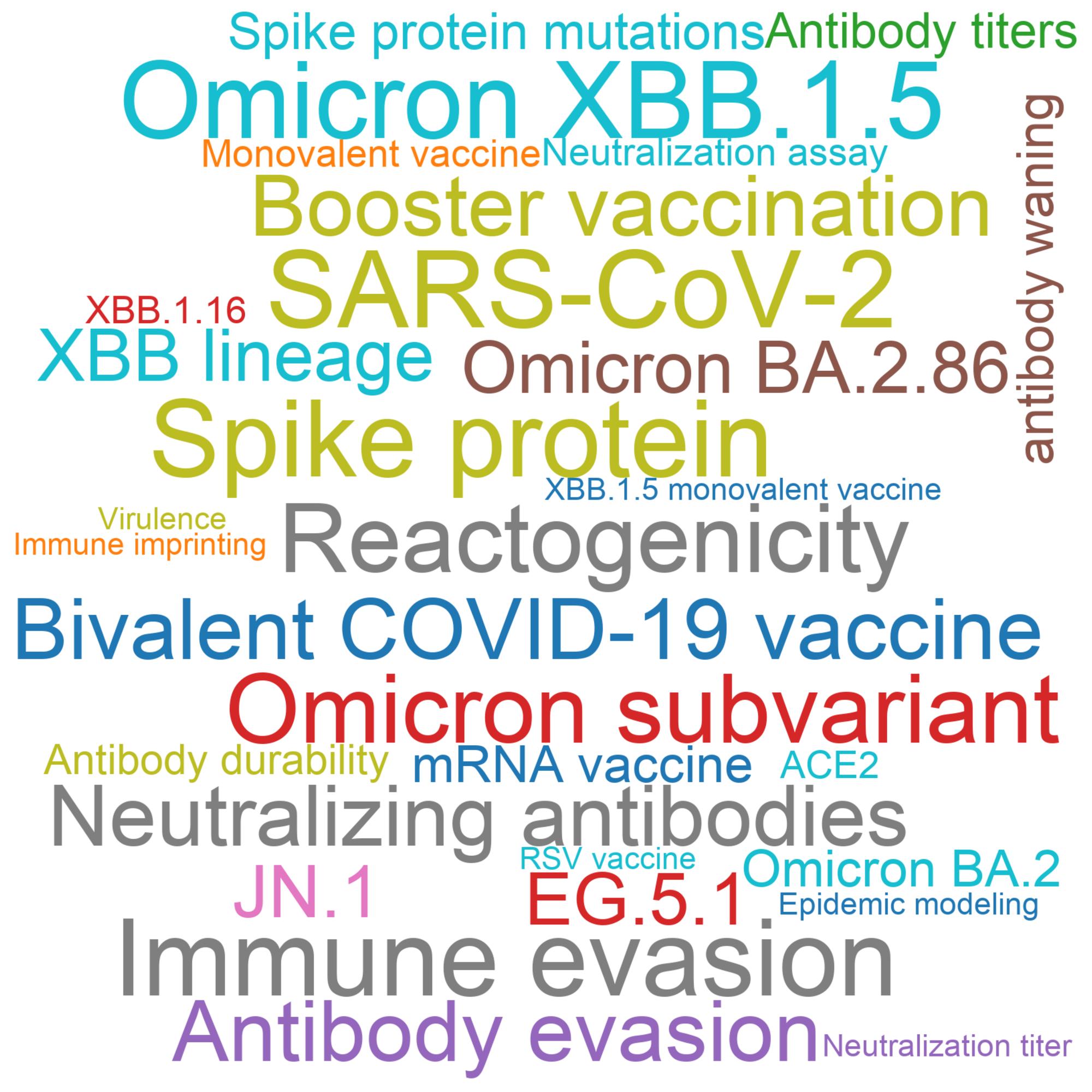
The Animal Virus Infections Studies field for the Class of 2026 is overwhelmingly driven by research into SARS-CoV-2 and its continued evolution. Dominant themes include immune evasion strategies, the Spike protein, and specific Omicron subvariants, particularly XBB.1.5. This clustering suggests that the primary focus of highly cited research has shifted from acute pandemic response to understanding the persistent challenges of viral mutation and vaccine efficacy. The prominence of terms like 'reactogenicity' and 'antibody evasion' alongside 'bivalent COVID-19 vaccine' highlights a sustained effort to evaluate and optimize vaccination strategies in the face of an evolving virus.
How Did Topics Shift from the Class of 2025 to the Class of 2026?
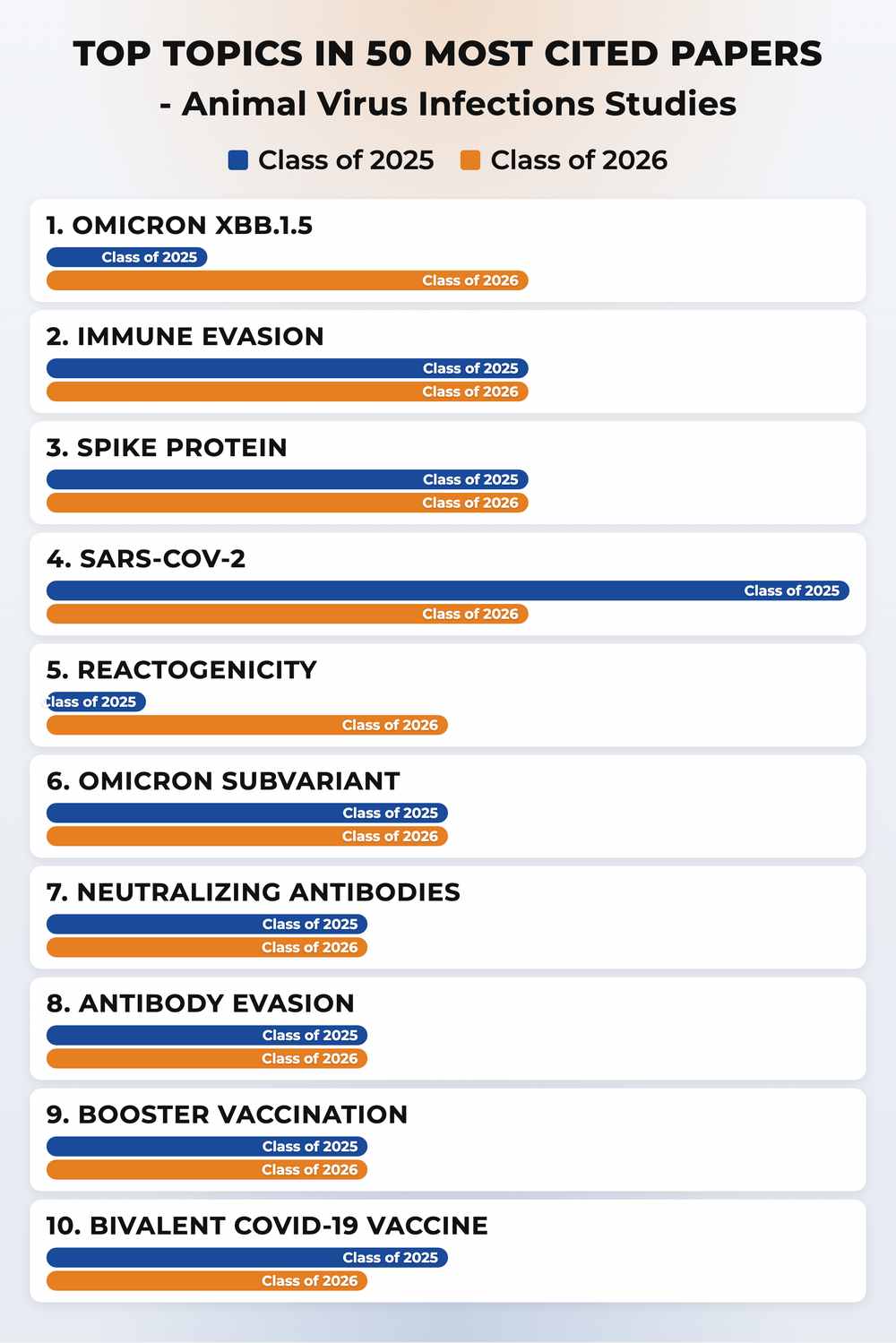
Between the Class of 2025 and 2026, the landscape of Animal Virus Infections Studies shifted markedly toward understanding the long-term dynamics of COVID-19 immunity and newer viral lineages. The most significant risers include specific emergent variants such as JN.1, EG.5.1, and XBB.1.16, alongside functional concerns like 'antibody durability' and 'reactogenicity.' Conversely, broader topics like general SARS-CoV-2 research and older subvariants like Omicron BA.2 saw relative declines. This pattern indicates a maturation in the field, moving away from characterizing the pandemic broadly toward precise tracking of viral escape mechanisms and the waning of vaccine-induced immunity.
Methodology
PRI identifies high-impact research using a transparent, topic-agnostic framework applied consistently across scientific domains. Bibliographic records are drawn from OpenAlex, including publication dates, citation relationships, and document types.
This ranking covers the Class of 2026 cohort: journal articles published in 2024. Reviews and other non-article document types are excluded to ensure comparability.
Research impact is quantified with an 18-month post-publication citation window—the number of citing works published within 18 months of each paper's publication date. This metric captures early impact while controlling for publication age.
An LLM-based relevance classifier then reviews each candidate's title and abstract to confirm substantive alignment with the target domain. Only papers classified as relevant appear in the final ranking.
Zheng Su, Tinsley Li, Thematic Shifts in Early-High-Impact Cancer Genomics and Diagnostics Research: A Bibliometric and Semantic Analysis. bioRxiv 2026.07.04.736459; doi: https://doi.org/10.64898/2026.07.04.736459
Cite this ranking
Pepkio Research Index (PRI). Topics and Trends in Most Cited Animal Virus Infections Studies Papers, Class of 2026. https://pri.pepkio.com/top-papers/animal-virus-infections-studies/2026. Accessed 2026-10-24.

Methodology
Zheng Su, Tinsley Li, Thematic Shifts in Early-High-Impact Cancer Genomics and Diagnostics Research: A Bibliometric and Semantic Analysis. bioRxiv 2026.07.04.736459; doi: https://doi.org/10.64898/2026.07.04.736459