
What topics and trends defined most-cited Rice Cultivation and Yield Improvement research in the Class of 2026?
Nitrogen use efficiency and nitrogen uptake dominated top rice cultivation research, accompanied by sustainable irrigation practices. The most significant shifts were the emergence of source-sink relationships and synthetic aperture radar, alongside a major increase in photosynthetic rate optimization and organic fertilizer studies.
At a glance
- Field
- Rice Cultivation and Yield Improvement
- Cohort label
- Class of 2026 (2024 publications)
- Papers analyzed
- 6,314
- Papers ranked
- 20
- Top topics in ranked papers
- Nitrogen use efficiency, Nitrogen uptake, Alternate wetting and drying (AWD), Organic fertilizers, Source-sink relationships
- Publication window
- Jan 1, 2024 – Dec 31, 2024
- Eligibility
- Research articles; reviews excluded
- Citation window
- 18 months post-publication
- 18m citation range
- 27–122
- Data source
- OpenAlex · Retrieved June 2026
- License
- CC BY 4.0
Rankings
20 papers ranked by 18-month citation count
Engineering source-sink relations by prime editing confers heat-stress resilience in tomato and rice
Cell202410.1016/j.cell.2024.11.005
Crop traits and production under drought
Nature Reviews Earth & Environment202410.1038/s43017-023-00514-w
Effects of Alternate Wetting and Drying Irrigation on Methane and Nitrous Oxide Emissions From Rice Fields: A Meta‐Analysis
Global Change Biology202410.1111/gcb.17581
Improved alternate wetting and drying irrigation increases global water productivity
Nature Food202410.1038/s43016-024-01081-z
Enhancing rice panicle branching and grain yield through tissue-specific brassinosteroid inhibition
Science202410.1126/science.adk8838
<scp>CRISPR</scp>/Cas knockout of the <scp>NADPH</scp> oxidase gene <scp><i>OsRbohB</i></scp> reduces <scp>ROS</scp> overaccumulation and enhances heat stress tolerance in rice
Plant Biotechnology Journal202410.1111/pbi.14500
Strategies for crop straw management in China's major grain regions: Yield-driven conditions and factors influencing the effectiveness of straw return
Resources Conservation and Recycling202410.1016/j.resconrec.2024.107941
Sugar transporter modulates nitrogen-determined tillering and yield formation in rice
Nature Communications202410.1038/s41467-024-53651-1
The OsNAC41-RoLe1-OsAGAP module promotes root development and drought resistance in upland rice
Molecular Plant202410.1016/j.molp.2024.09.002
ABA-mediated regulation of rice grain quality and seed dormancy via the NF-YB1-SLRL2-bHLH144 Module
Nature Communications202410.1038/s41467-024-48760-w
Effect of Soil Texture on Soil Nutrient Status and Rice Nutrient Absorption in Paddy Soils
Agronomy202410.3390/agronomy14061339
The miR172a–SNB module orchestrates both induced and adult-plant resistance to multiple diseases via MYB30-mediated lignin accumulation in rice
Molecular Plant202410.1016/j.molp.2024.11.015
The elite haplotype OsGATA8-H coordinates nitrogen uptake and productive tiller formation in rice
Nature Genetics202410.1038/s41588-024-01795-7
Effects of Salt Stress on Physiological and Agronomic Traits of Rice Genotypes with Contrasting Salt Tolerance
Plants202410.3390/plants13081157
The measurement of agricultural disaster vulnerability in China and implications for land-supported agricultural resilience building
Land Use Policy202410.1016/j.landusepol.2024.107400
Ensuring China's food security in a geographical shift of its grain production: Driving factors, threats, and solutions
Resources Conservation and Recycling202410.1016/j.resconrec.2024.107845
Pathways to identify and reduce uncertainties in agricultural climate impact assessments
Nature Food202410.1038/s43016-024-01014-w
Subfield-level crop yield mapping without ground truth data: A scale transfer framework
Remote Sensing of Environment202410.1016/j.rse.2024.114427
Impact of irrigation, fertilizer, and pesticide management practices on groundwater and soil health in the rice–wheat cropping system—a comparison of conventional, resource conservation technologies and conservation agriculture
Environmental Science and Pollution Research202410.1007/s11356-024-35661-0
Intensifying rice production to reduce imports and land conversion in Africa
Nature Communications202410.1038/s41467-024-44950-8
Topic trends
Dominant research themes and year-over-year shifts in Rice Cultivation and Yield Improvement
What Topics Define the Class of 2026?
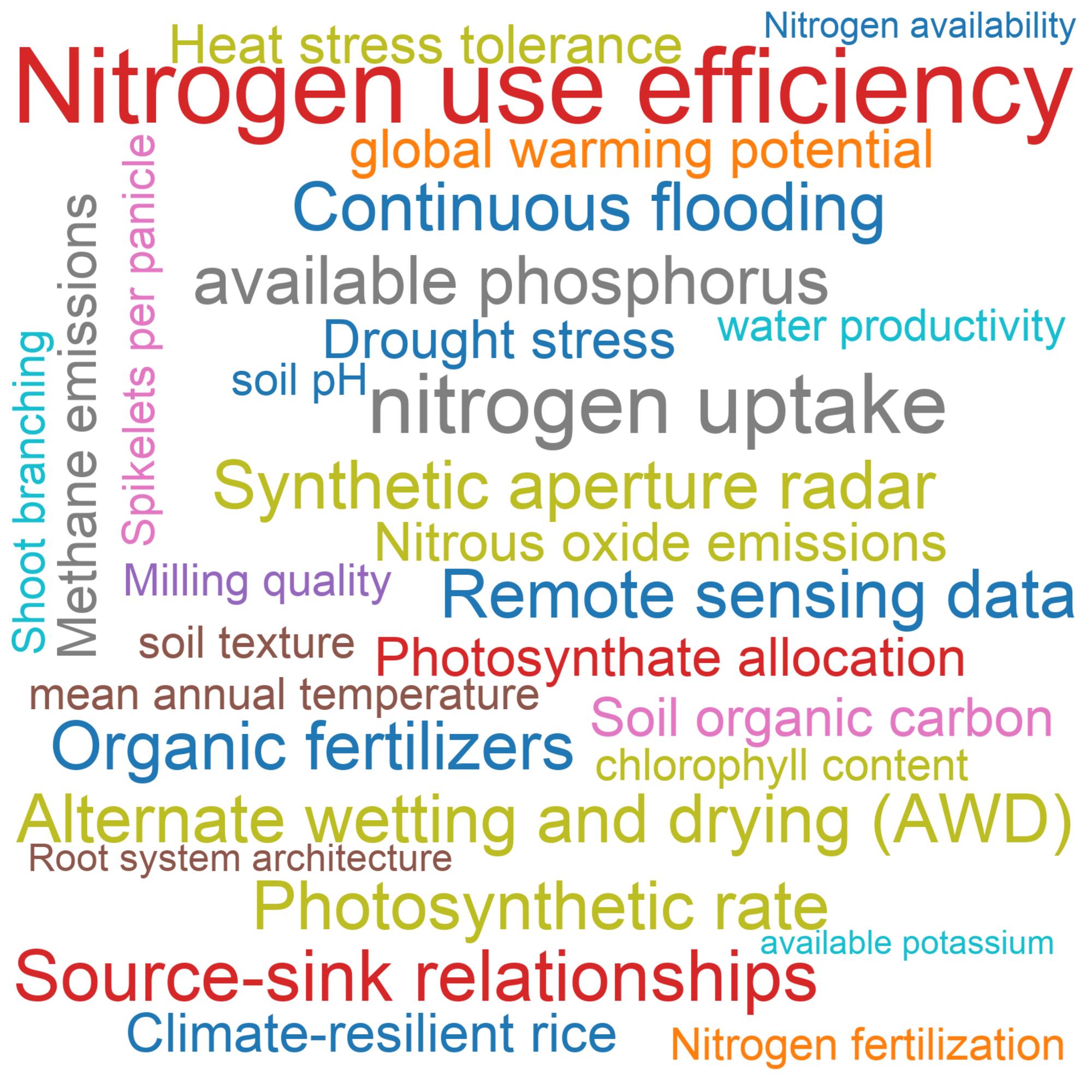
The Class of 2026 in Rice Cultivation and Yield Improvement is heavily characterized by precision nutrient management, physiological optimization, and sustainable water practices. Nitrogen use efficiency stands out as the most predominant focus area, appearing in 12% of top-ranked research papers, closely paired with nitrogen uptake studies (8%) to maximize yield while minimizing environmental leaching. Water management techniques, particularly alternate wetting and drying (AWD) and continuous flooding, remain central to production strategies (each representing 6% of top papers), addressing the dual challenges of water scarcity and greenhouse gas mitigation. Furthermore, physiological mechanisms such as source-sink relationships (6%), photosynthetic rate optimization (6%), and organic fertilizer incorporation (6%) represent key avenues for boosting yield potential. Remote sensing technologies, including synthetic aperture radar (6%), also play an increasingly vital role in crop monitoring and yield prediction. Together, these topics reflect a paradigm shift toward integrated agronomy combining molecular/physiological precision with climate-resilient field management.
How Did Topics Shift from the Class of 2025 to the Class of 2026?
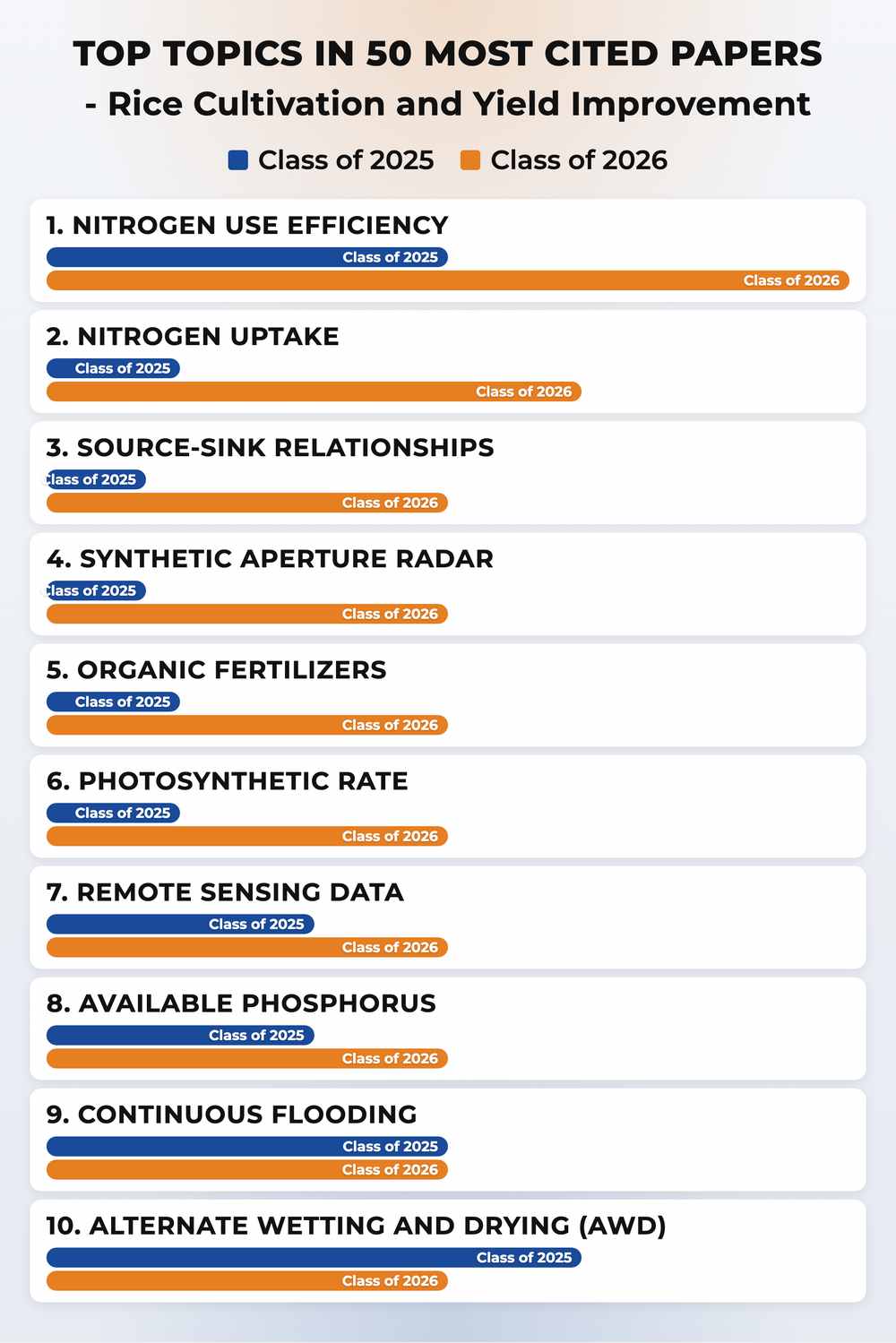
Comparing the Class of 2025 to the Class of 2026 reveals a distinct reorientation toward physiological source-sink dynamics and advanced monitoring technologies. Most notably, research on source-sink relationships and synthetic aperture radar emerged rapidly from near absence to being featured in 6% of top papers. Nitrogen uptake studies underwent a four-fold surge, increasing from 2% to 8% representation, alongside a three-fold rise in studies evaluating organic fertilizers and photosynthetic rates (climbing from 2% to 6% each). Nitrogen use efficiency also doubled its footprint from 6% to 12%. Conversely, traditional soil-focused baselines experienced noticeable declines: soil organic carbon representation dropped from 12% to 4%, while methane emissions and nitrous oxide emissions fell by 50% and 33% respectively. These shifts highlight how high-impact rice research is transitioning from passive observation of environmental emissions and baseline soil carbon toward active genetic, physiological, and technological interventions designed to drive yield resilience.
Methodology
PRI identifies high-impact research using a transparent, topic-agnostic framework applied consistently across scientific domains. Bibliographic records are drawn from OpenAlex, including publication dates, citation relationships, and document types.
This ranking covers the Class of 2026 cohort: journal articles published in 2024. Reviews and other non-article document types are excluded to ensure comparability.
Research impact is quantified with an 18-month post-publication citation window—the number of citing works published within 18 months of each paper's publication date. This metric captures early impact while controlling for publication age.
An LLM-based relevance classifier then reviews each candidate's title and abstract to confirm substantive alignment with the target domain. Only papers classified as relevant appear in the final ranking.
Zheng Su, Tinsley Li, Thematic Shifts in Early-High-Impact Cancer Genomics and Diagnostics Research: A Bibliometric and Semantic Analysis. bioRxiv 2026.07.04.736459; doi: https://doi.org/10.64898/2026.07.04.736459
Cite this ranking
Pepkio Research Index (PRI). Topics and Trends in Most Cited Rice Cultivation and Yield Improvement Papers, Class of 2026. https://pri.pepkio.com/top-papers/rice-cultivation-and-yield-improvement/2026. Accessed 2026-10-21.

Methodology
Zheng Su, Tinsley Li, Thematic Shifts in Early-High-Impact Cancer Genomics and Diagnostics Research: A Bibliometric and Semantic Analysis. bioRxiv 2026.07.04.736459; doi: https://doi.org/10.64898/2026.07.04.736459