
What topics and trends defined most-cited Retinal Diseases and Treatments research in the Class of 2026?
Diabetic retinopathy, clinical endpoints, and neovascular AMD define the Class of 2026 retinal cohort, with next-generation anti-VEGF therapies maintaining prominence. Diabetic retinopathy grading and diabetic macular edema rose from the Class of 2025, alongside new interest in genetic studies. Conversely, foundational CNN models and broad fundus-imaging studies sharply receded among top-cited papers.
At a glance
- Field
- Retinal Diseases and Treatments
- Cohort label
- Class of 2026 (2024 publications)
- Papers analyzed
- 7,793
- Papers ranked
- 20
- Top topics in ranked papers
- Diabetic retinopathy, Best-corrected visual acuity, Fundus imaging, Neovascular AMD, Faricimab
- Publication window
- Jan 1, 2024 – Dec 31, 2024
- Eligibility
- Research articles; reviews excluded
- Citation window
- 18 months post-publication
- 18m citation range
- 41–153
- Data source
- OpenAlex · Retrieved Jul 2026
- License
- CC BY 4.0
Rankings
20 papers ranked by 18-month citation count
Integrated image-based deep learning and language models for primary diabetes care
Nature Medicine202410.1038/s41591-024-03139-8
A deep learning system for predicting time to progression of diabetic retinopathy
Nature Medicine202410.1038/s41591-023-02702-z
Gene Editing for <i>CEP290</i> -Associated Retinal Degeneration
New England Journal of Medicine202410.1056/nejmoa2309915
Intravitreal aflibercept 8 mg in neovascular age-related macular degeneration (PULSAR): 48-week results from a randomised, double-masked, non-inferiority, phase 3 trial
The Lancet202410.1016/s0140-6736(24)00063-1
Improved Support Vector Machine based on CNN-SVD for vision-threatening diabetic retinopathy detection and classification
PLoS ONE202410.1371/journal.pone.0295951
OCTA-500: A retinal dataset for optical coherence tomography angiography study
Medical Image Analysis202410.1016/j.media.2024.103092
TENAYA and LUCERNE
Ophthalmology202410.1016/j.ophtha.2024.02.014
OCTDL: Optical Coherence Tomography Dataset for Image-Based Deep Learning Methods
Scientific Data202410.1038/s41597-024-03182-7
Global burden of low vision and blindness due to age-related macular degeneration from 1990 to 2021 and projections for 2050
BMC Public Health202410.1186/s12889-024-21047-x
Phenotyping and genotyping inherited retinal diseases: Molecular genetics, clinical and imaging features, and therapeutics of macular dystrophies, cone and cone-rod dystrophies, rod-cone dystrophies, Leber congenital amaurosis, and cone dysfunction syndromes
Progress in Retinal and Eye Research202410.1016/j.preteyeres.2024.101244
Oral Antioxidant and Lutein/Zeaxanthin Supplements Slow Geographic Atrophy Progression to the Fovea in Age-Related Macular Degeneration
Ophthalmology202410.1016/j.ophtha.2024.07.014
Gene therapy for neovascular age-related macular degeneration by subretinal delivery of RGX-314: a phase 1/2a dose-escalation study
The Lancet202410.1016/s0140-6736(24)00310-6
Therapeutic targeting of cellular senescence in diabetic macular edema: preclinical and phase 1 trial results
Nature Medicine202410.1038/s41591-024-02802-4
Effect of Fenofibrate on Progression of Diabetic Retinopathy
NEJM Evidence202410.1056/evidoa2400179
DRAC 2022: A public benchmark for diabetic retinopathy analysis on ultra-wide optical coherence tomography angiography images
Patterns202410.1016/j.patter.2024.100929
Autonomous artificial intelligence increases screening and follow-up for diabetic retinopathy in youth: the ACCESS randomized control trial
Nature Communications202410.1038/s41467-023-44676-z
Intravitreal aflibercept 8 mg in diabetic macular oedema (PHOTON): 48-week results from a randomised, double-masked, non-inferiority, phase 2/3 trial
The Lancet202410.1016/s0140-6736(23)02577-1
Severe Intraocular Inflammation Following Intravitreal Faricimab
JAMA Ophthalmology202410.1001/jamaophthalmol.2024.0530
Glaucoma diagnosis from fundus images using modified Gauss-Kuzmin-distribution-based Gabor features in 2D-FAWT
Computers & Electrical Engineering202410.1016/j.compeleceng.2024.109538
Boost diagnostic performance in retinal disease classification utilizing deep ensemble classifiers based on OCT
Multimedia Tools and Applications202410.1007/s11042-024-19922-1
Topic trends
Dominant research themes and year-over-year shifts in Retinal Diseases and Treatments
What Topics Define the Class of 2026?
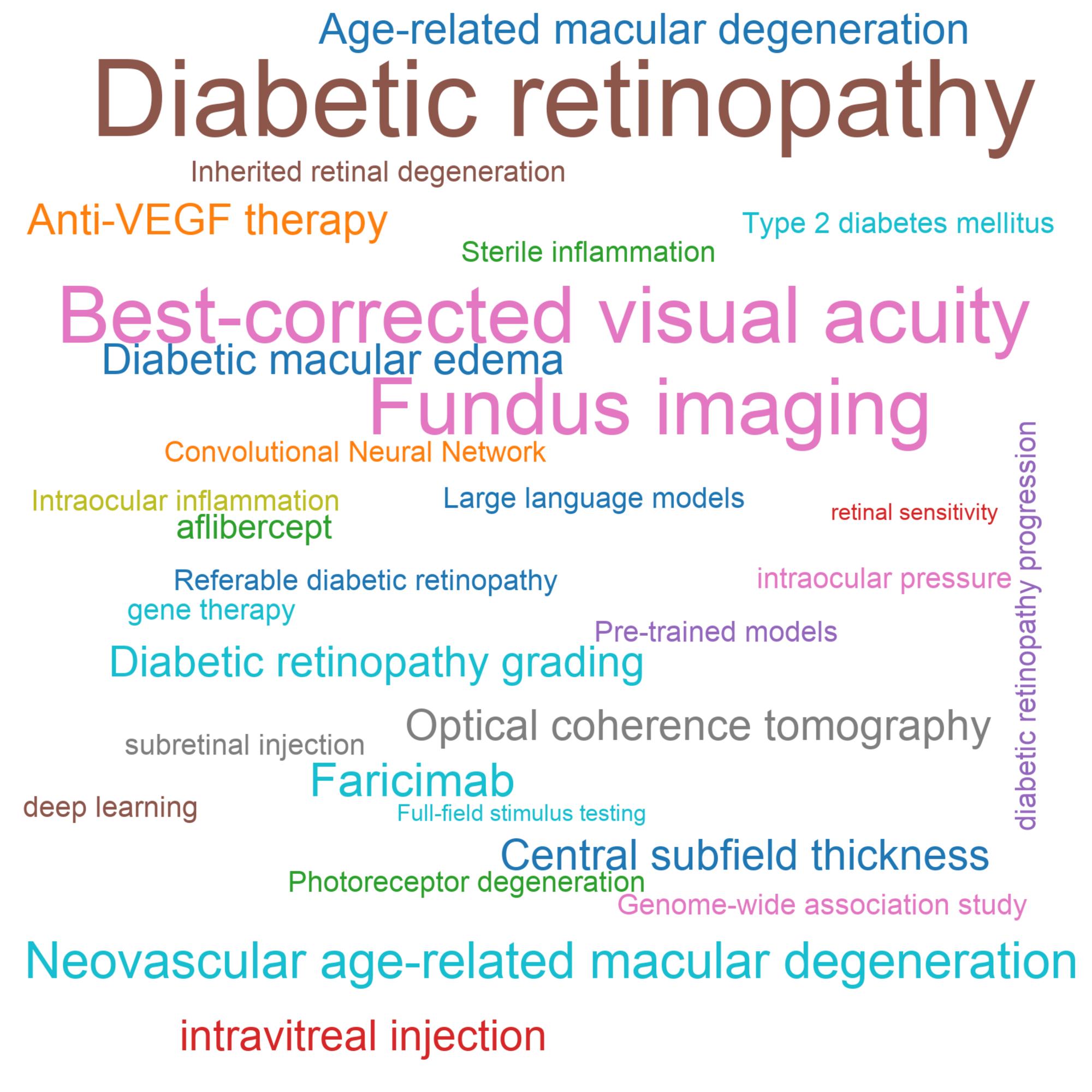
The informative word cloud across the 50 highest 18-month-cited retinal diseases and treatments papers reveals a field anchored in treatable retinal diseases, next-generation anti-VEGF therapies, and clinical trial endpoints. Diabetic retinopathy leads at 14 of 50 papers (normalized frequency 0.28), followed by best-corrected visual acuity, fundus imaging, and neovascular age-related macular degeneration (8 papers each, 0.16). Faricimab (7 papers, 0.14) and anti-VEGF therapy (6 papers, 0.12) underscore the sustained focus on emerging vascular treatments. Mid-sized terms cluster around trial metrics and imaging modalities—central subfield thickness, optical coherence tomography, diabetic macular edema, and intravitreal injection (6 papers each, 0.12). Standalone deep-learning classification remains present but less dominant, with diabetic retinopathy grading appearing in 6 papers (0.12) while convolutional neural network applications feature in just 3 papers (0.06). Smaller visible terms—including genome-wide association study, inherited retinal degeneration, and photoreceptor degeneration—signal a growing footprint for genetic analysis and inherited disease research alongside traditional therapy trials.
How Did Topics Shift from the Class of 2025 to the Class of 2026?
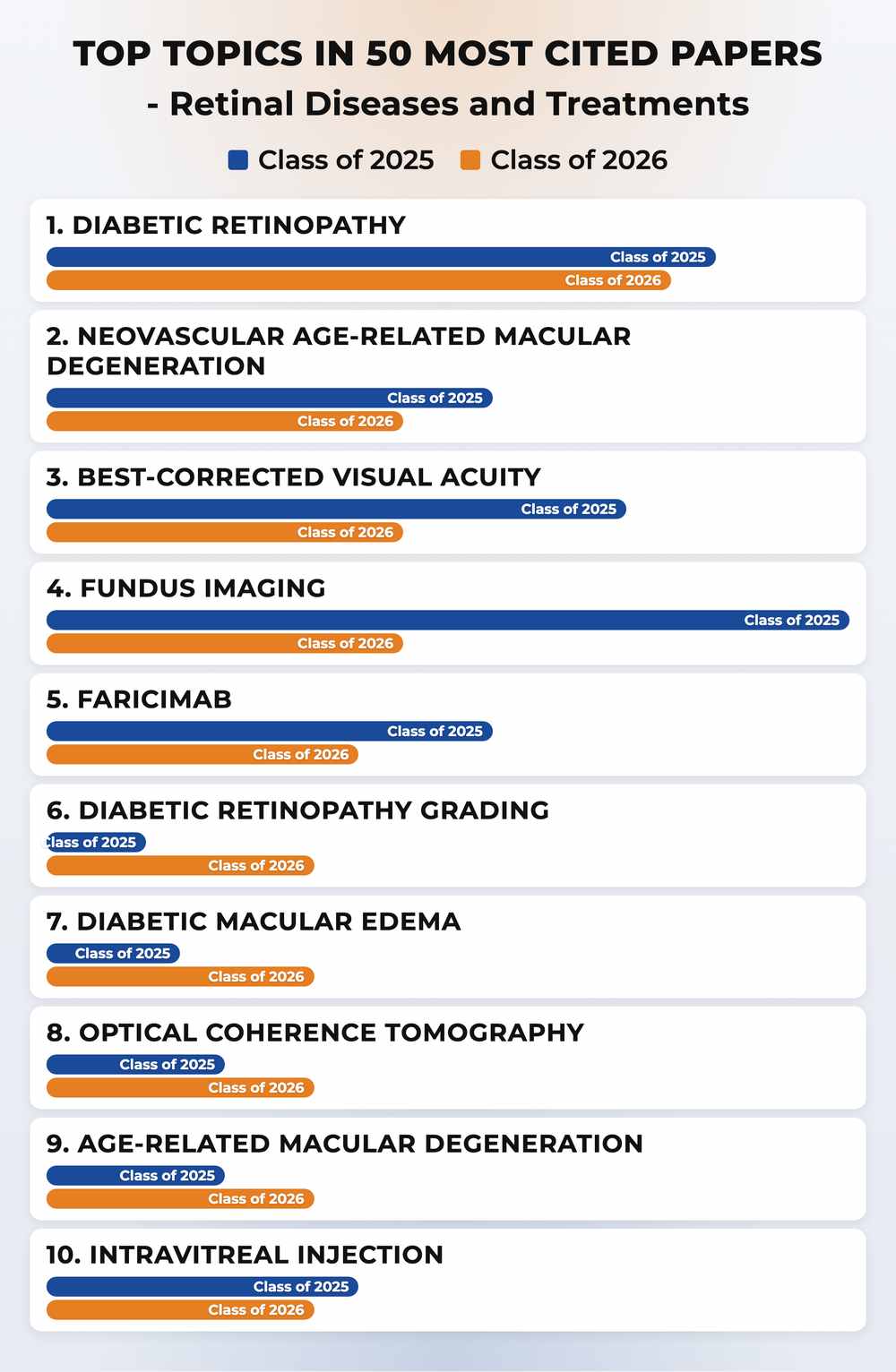
Comparing normalized concept frequencies between the Class of 2025 (2023 publications) and Class of 2026 (2024 publications) cohorts shows a reorientation of early-high-impact research priorities within retinal medicine. Diabetic retinopathy grading exhibited the largest gain (+0.10 normalized frequency; 1 versus 6 papers), followed by diabetic macular edema (+0.06; 3 versus 6). New thematic entries that gained traction include genome-wide association study, photoreceptor degeneration, and sterile inflammation (each +0.06; 0 to 3). The topic evolution card underscores that Class of 2026 bars extend furthest for diabetic retinopathy, best-corrected visual acuity, fundus imaging, and neovascular AMD. Conversely, convolutional neural network applications showed the steepest decline (−0.22; 14 versus 3 papers), followed closely by broad fundus imaging (−0.20; 18 versus 8). Best-corrected visual acuity and angiopoietin-2 inhibition also saw notable reductions. Together, these shifts suggest a transition away from foundational deep learning imaging models and toward specific disease manifestations, refined grading applications, and genetic insights within the most-cited retinal research.
Methodology
PRI identifies high-impact research using a transparent, topic-agnostic framework applied consistently across scientific domains. Bibliographic records are drawn from OpenAlex, including publication dates, citation relationships, and document types.
This ranking covers the Class of 2026 cohort: journal articles published in 2024. Reviews and other non-article document types are excluded to ensure comparability.
Research impact is quantified with an 18-month post-publication citation window—the number of citing works published within 18 months of each paper's publication date. This metric captures early impact while controlling for publication age.
An LLM-based relevance classifier then reviews each candidate's title and abstract to confirm substantive alignment with the target domain. Only papers classified as relevant appear in the final ranking.
Zheng Su, Tinsley Li, Thematic Shifts in Early-High-Impact Cancer Genomics and Diagnostics Research: A Bibliometric and Semantic Analysis. bioRxiv 2026.07.04.736459; doi: https://doi.org/10.64898/2026.07.04.736459
Cite this ranking
Pepkio Research Index (PRI). Topics and Trends in Most Cited Retinal Diseases and Treatments Papers, Class of 2026. https://pri.pepkio.com/top-papers/retinal-diseases-and-treatments/2026. Accessed 2026-10-14.

Methodology
Zheng Su, Tinsley Li, Thematic Shifts in Early-High-Impact Cancer Genomics and Diagnostics Research: A Bibliometric and Semantic Analysis. bioRxiv 2026.07.04.736459; doi: https://doi.org/10.64898/2026.07.04.736459
Source data
The full ranking corpus and analysis files are openly available on an external repository. Please cite the dataset below when reusing this data.
View source dataset →PRI Team (2026). PRI results: Retinal Diseases and Treatments (T10170) — Class of 2025 and Class of 2026 cohorts [Data set]. Figshare. https://doi.org/10.6084/m9.figshare.32902781